
The Late Night Pour | Still Looking for the Switch

|
Four Fingers News
The News, Neat.
|
| SATURDAY, OCTOBER 24, 2026 · DAY 239 |
| The Late Night Pour |
Still Looking for the Switch
Still Looking for the Switch, read aloud · 6 minutes.
Last week I asked who holds the switch on Ukraine’s satellite links. On Saturday Ukraine’s defense ministry said Starlink and Starshield speeds are back to where they were before Oct 14, when hardware moving faster than about 160 km/h started losing its connection. That cap knocked out the interceptor drones Ukraine uses against Russia’s jet-powered drones for more than a week. I’ve spent the days since trying to work out who imposed it, and I still can’t tell you.
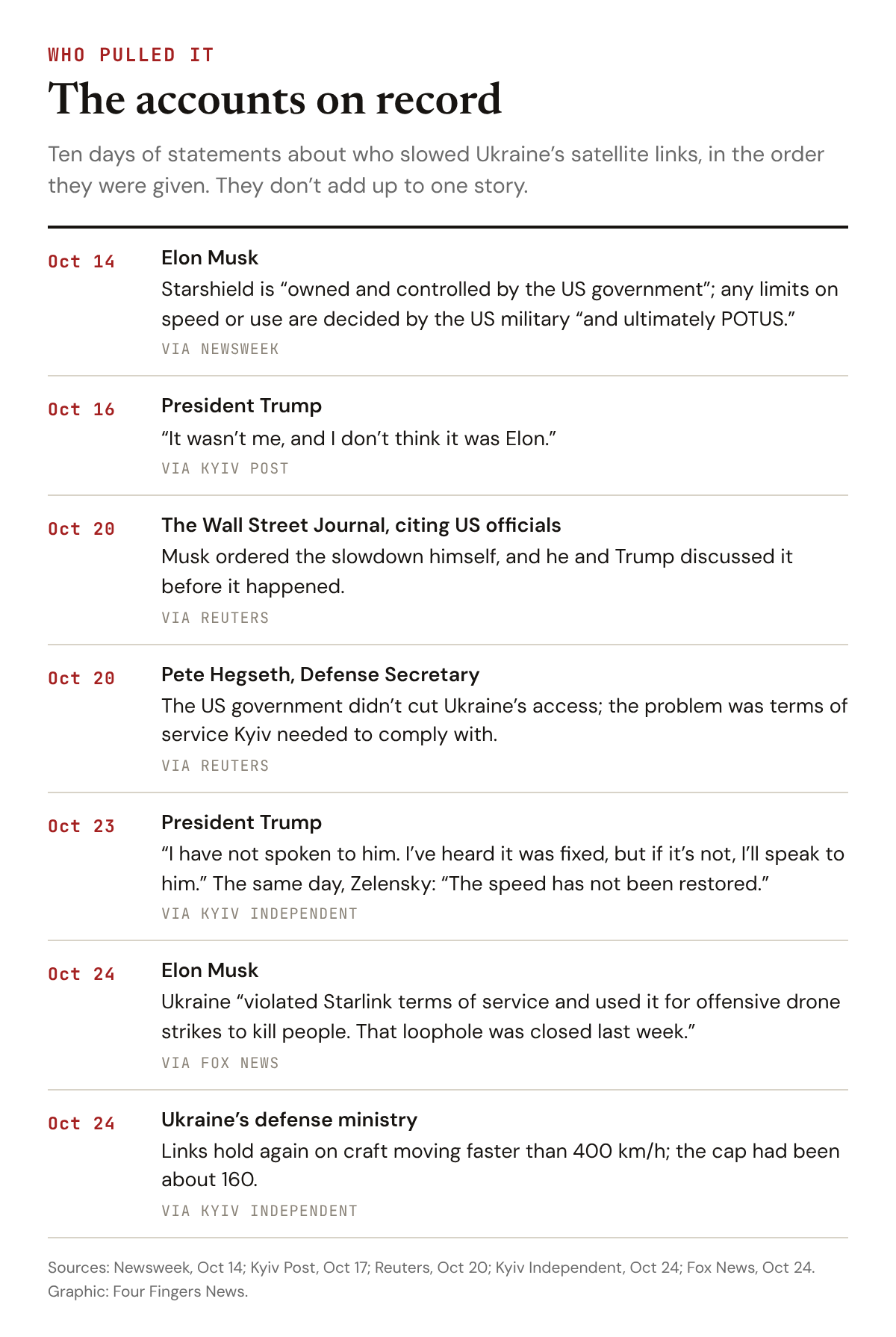
The accounts I’ve found don’t fit together. On Oct 14 Elon Musk said speed limits on Starshield are set by the US military and ultimately the president, because the US government owns and controls that network. Trump said two days later that “it wasn’t me, and I don’t think it was Elon,” and the Defense Secretary, Pete Hegseth, said the US government hadn’t cut Ukraine’s access and that the problem was terms of service Kyiv needed to comply with. On Tuesday The Wall Street Journal, citing US officials, reported that Musk ordered the slowdown himself and that he and Trump had discussed it before it happened. On Friday Trump said he hadn’t spoken to Musk and had “heard it was fixed,” hours after Zelensky said the speeds hadn’t been restored. Then on Saturday, with the service back, Musk said Ukraine had “violated Starlink terms of service and used it for offensive drone strikes to kill people,” and that “that loophole was closed last week,” which is a terms-of-service argument about a network he’d said ten days earlier wasn’t his to manage. Maybe those accounts can be reconciled, maybe the cap touched the commercial network and the military one in different ways, or maybe someone isn’t being straight. I don’t know which, and eight senators, four from each party, have asked the Pentagon’s inspector general to find out.
The timing is hard to ignore, since the US government had been pressing Ukraine to stop its drone strikes on Russian refineries because they were pushing fuel prices up. On Oct 11 it announced an energy ceasefire that neither Kyiv nor Moscow had been told about, and that same weekend, according to CNN, it warned Ukrainian and European officials that intelligence sharing and European purchases of American weapons for Ukraine could stop if the strikes went on. In the same stretch it made the deal for Russian diesel and waived the new Russia sanctions two days before they took effect. Ukraine says it went several days without warning of incoming Russian ballistic missiles; the US government says it never stopped sharing. The satellite cap landed in the middle of all that.
One reading is that this was money all the way down, though I’m less sure now whose money. Fuel prices are the administration’s worry, and Musk has his own. SpaceX has been a public company since June, when it raised more money than any company ever has in a listing, and the weekend before the cap he posted that Zelensky had “gone too far,” right after Trump said he’d told Zelensky to stop hitting Russian refineries. On Oct 20, with the cap still on, SpaceX reported a $4.4B quarterly profit after a string of losses, and Musk said SpaceX and Tesla had each set up a committee of independent directors to explore a merger that would make a company worth more than $3 trillion, if a majority of all Tesla shares vote for it. SpaceX’s stock rose more than 7% after hours. By one reading of its IPO filing, about a fifth of SpaceX’s revenue last year came from US federal agencies, and in May the Space Force gave it a $4.16B contract to build satellites that track aircraft and other airborne threats from space. For someone trying to put together the largest merger in history, staying on good terms with the government that signs those contracts probably matters a lot more than how the war in Ukraine goes, and that’s the reading I lean toward, though I can’t show it. The cap hit the interceptor drones and the frontline links; whether it also touched the long-range strikes the pressure was supposedly about depends on whose account you take, and nothing on the record ties the throttle to the merger.
The other two governments are easier to read. Russia wants the refinery strikes stopped because they take refining capacity offline, and this month it got sanctions relief on its fuel exports. Ukraine wants to keep the one form of pressure it can apply deep inside Russia, with three-way talks now penciled in for after Nov 10. It paused the refinery strikes for three days, resumed them Oct 15 with a strike on a refinery in Ryazan, and overnight Friday its General Staff says it hit a plant in Tolyatti that makes synthetic rubber for solid rocket fuel, all while its interceptor drones were degraded.
A capability this important to a war was dialed down for more than a week, and the people with the authority to explain it haven’t done so in a way that holds together, which bothers me more than any single answer would. It could be a private company making a call that belongs to a government, a government using a private company to avoid owning a decision, or something I haven’t thought of. I’d like to know, and right now I can’t tell you.
Sources (18), on the site.
Trump Weighs a Strike “Maybe Tomorrow” as Iran Vows to Keep US Warships Out of the Gulf
“We’re thinking about doing it, and maybe tomorrow,” President Trump told reporters Saturday when asked how close he is to hitting Iran again, adding that “maybe they’ll make a deal” and that the other road is a “big, beautiful” agreement; the night before, he’d told a Fort Myers rally the US “may do another little Epic Fury.” Tehran’s line came earlier Saturday: “We will not allow U.S. military ships in the Persian Gulf under any circumstances and at any time,” armed forces chief of staff Ali Abdollahi said on state TV, while IRGC spokesman Hossein Mohebbi called the US threats “largely for media consumption.” The State Department is thinning its embassies in Jordan, Lebanon, Qatar and the UAE after a memo from Director of National Intelligence Jay Clayton, obtained by CBS News, said Iranian plots against Americans had reached “advanced stages,” and Trump’s Oct 8 pledge of no strikes before the Nov 3 midterms now sits beside US Ambassador Tom Barrack’s “Could there be a strike this weekend? Absolutely.” What each side says it wants hasn’t moved: the White House wants a deal Tehran will “hold,” and Tehran’s envoy in Islamabad says Hormuz reopens the day the US lifts its blockade; in between, Brent sits at a six-month high and President Masoud Pezeshkian conceded Saturday that many Iranians can’t afford food.
| War: Day 239, counted from Feb 28 |
| Crude: Brent $116.72 at Friday’s settle, up 3.1% · WTI $103.26 · Brent was under $97 on Oct 1 |
| Timing: Trump said Oct 8 no strikes before the midterms · Saturday: “maybe tomorrow” · Barrack: a strike this weekend is “absolutely” possible |
| Embassies: staff cuts in Amman, Beirut, Doha and Abu Dhabi; all four stay open · nonessential staff ordered out of Saudi Arabia earlier · travel advisories redone for 14 countries |
| Blockade: CENTCOM’s Adm. Brad Cooper said Oct 16 it has kept $25B of Iranian oil off the market · Tehran’s offer, per its Islamabad envoy: Hormuz reopens when the blockade lifts |
| Next: Israel votes Oct 27 · Pezeshkian meets Putin in Moscow next week · Friday in Istanbul, Türkiye, Saudi Arabia, Pakistan and Egypt sat with the UK, France, Germany and Italy; neither the US nor Iran was in the room |
Saudi Defenses Down Missiles at Riyadh, Taif and Yanbu; Debris Falls Near Mecca
The Saudi-led coalition says it intercepted a ballistic missile aimed at Riyadh before dawn Saturday and two more aimed at Taif and the Red Sea oil port of Yanbu; Saudi Civil Defence says debris from two missiles fired toward Mecca and Medina fell in Wadi al-Mughammas, Jeddah, Taif and Rabigh. Ansarallah denies aiming at the holy cities and lists its targets as Riyadh’s airport, Aramco sites at Yanbu and Rabigh and the East-West pipeline. In Yemen, Ansarallah media say Saudi strikes killed 11 people in Sanaa, six of them women, and five of one family in Hodeida; Riyadh hasn’t commented. King Khalid airport reopens Sunday at two terminals.
BC Conservatives Win a Majority; Eby Resigns as NDP Leader
Thirty-two days after David Eby called the snap election, British Columbia handed Lorne Doerkson’s Conservatives a majority: by late evening the party was elected or leading in 64 of 93 ridings to the NDP’s 27 and the Greens’ two, with about 48% of the vote to the NDP’s 37%. Eby, in a tight count in his own Vancouver-Point Grey seat, quit as NDP leader in his concession speech: “It breaks my heart, and I accept full responsibility for that outcome.” Doerkson, interim leader for 34 days, will be premier; Green leader Emily Lowan won Saanich North and the Islands.
Brazil Votes Sunday with Both Final Polls at 51-49 for Flávio Bolsonaro
Datafolha’s last survey, 4,050 interviews Friday and Saturday, has Flávio Bolsonaro at 51% of valid votes to Lula’s 49%; Quaest, 3,702 interviews over the same two days, lands on the same 51-49. Both carry a two-point margin, so both are technical ties, and across 43 polls from 20 firms the average is 51.0 to 49.0. Friday’s Globo debate ended with Flávio apologizing on air for a jab at Lula’s missing finger and asking whether Lula or Google governs Brazil; Lula went after him for “licking up to Trump to get Brazil taxed.” First-round abstention was 21%.
Egypt’s House Votes Monday on Sending Troops to Defend Saudi Arabia
The House of Representatives votes Oct 26, in closed session, on President Abdel Fattah el-Sisi’s request to answer any Saudi call for military help; the constitution requires two-thirds of all members for combat abroad. Sisi: “I’m not talking about confronting or attacking anyone. We’re talking only about defence.” The opposition Social Democrats will abstain, saying nobody has told them the mission’s objectives, duration or cost. Yahya Ali al-Rai, speaker of the Ansarallah-run parliament in Sanaa, warned that intervention would pose “a grave threat to its own national security and internal stability.” Cairo’s other track ran Friday in Istanbul, backing a negotiated settlement with Iran alongside Saudi Arabia, Türkiye and Pakistan.
Ukraine Hits a Rocket-Fuel Rubber Plant in Tolyatti as the Oleshky Truce Nears
Ukraine’s General Staff says drones set off an explosion and fire at Tolyattikauchuk in Samara region overnight Friday, a plant whose synthetic rubber goes into solid fuel for tactical and ballistic missiles, and that it also hit the Proton electronics plant in Oryol and an aircraft at the Yeysk airfield; Tolyatti’s mayor reported damage at several industrial sites and no casualties, and Russia’s defense ministry says it downed 1,297 drones in 24 hours. On the Kherson front, both general staffs have set the Oleshky ceasefire for the early hours of Oct 27 so civilians can leave the occupied town; ombudsman Dmytro Lubinets calls the operation “extremely difficult to implement.”
Wild Rout the Kraken 5-1; Chiefs and Kenneth Walker Come to Lumen Field Sunday Night
Kirill Kaprizov scored 26 seconds in and Minnesota put three past Joey Daccord in the second period at Climate Pledge Arena; Berkly Catton’s power-play goal was Seattle’s only answer, Daccord stopped 31, and the Kraken are 7-4-1 with Toronto in Wednesday. Sunday at 5:20 PM PT the Seahawks (3-3) host the 5-0 Chiefs and Kenneth Walker III, February’s Super Bowl MVP, who leads the NFL in rushing in his first season in Kansas City; Zach Charbonnet, Drake Thomas and Chazz Surratt are out, and Drew Lock, DeMarcus Lawrence, Uchenna Nwosu and Nick Emmanwori are questionable.
| Read the full dispatch |
You’re receiving The Late Night Pour, an edition of Four Fingers News.