
The Late Night Pour | Seven Fronts

|
Four Fingers News
The News, Neat.
|
| TUESDAY, OCTOBER 27, 2026 · DAY 242 |
| The Late Night Pour |
Seven Fronts
Seven Fronts, read aloud · 9 minutes.
Benjamin Netanyahu lost on Tuesday, and I want to walk you through how a man can lose an election and keep the job, because that’s what’s happening. Israel held its first election since the Hamas attack of October 7, 2023, the one Hamas named Al-Aqsa Flood, and it was a vote on Netanyahu and the wars he’s run since. Israel’s parliament, the Knesset, has 120 seats, and whoever can gather 61 of them forms the government. With less than half the ballots counted on Wednesday morning, Netanyahu’s side had 57. The parties behind Gadi Eisenkot, the former head of the army who ran to replace him, had 47. The two parties that represent Israel’s Arab citizens had the other 16. So more seats went to the people who ran to remove him than to his side, 63 to 57, and nobody reached 61. The soldiers’ ballots are counted last, through Friday, and they’re the one thing that could still change the picture.
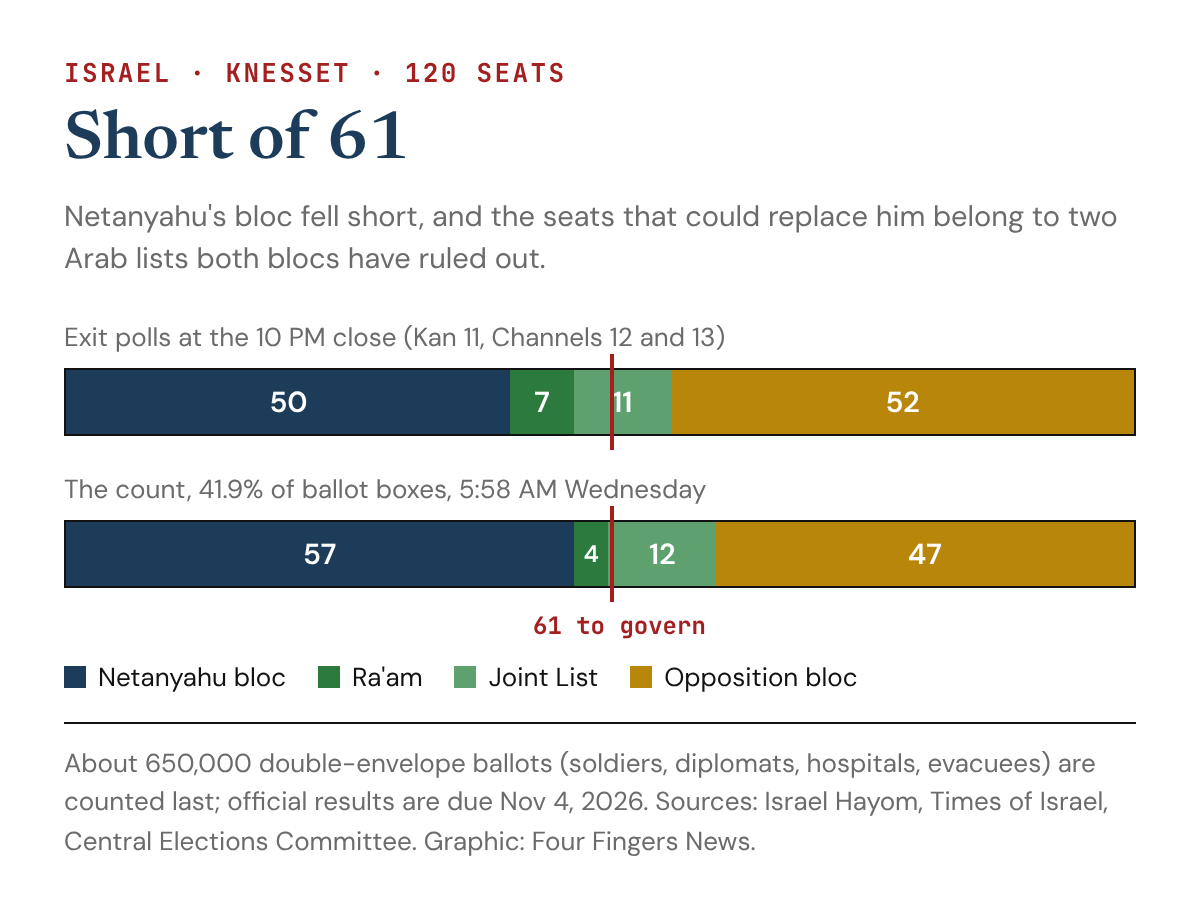
The reason he keeps the job comes in two parts. The first is the law: a government that loses its majority stays in office, with all of its powers, until a new one is sworn in. The second is a rule about those 16 seats. For thirty years Netanyahu has argued that the Arab parties can’t be part of any Israeli government, and his opponents have gone along with it. At 3 AM he called them “anti-Zionist” and said a government resting on them is “forbidden.” A Zionist believes Israel should be a Jewish state, and most of the Arab parties don’t, so that’s the disqualification. In practice, one in five of the people who voted on Tuesday got a seat for their ballot but no say in who governs, and the other 104 seats can’t produce 61 on their own.
A few things about him, for anyone who hasn’t followed closely. Netanyahu is 77 and has been prime minister for most of the last 17 years. He’s been on trial for bribery since 2020, with no verdict yet. Since November 2024 the International Criminal Court, the world’s war-crimes court in The Hague, has had a warrant out for his arrest, for starving civilians as a method of warfare and for murder and persecution in Gaza, where the count of the dead passed 74,500 this month. On Monday, the day before the vote, the United Nations commission that investigates the territories reported that the genocide it first found in September 2025 didn’t stop with last October’s ceasefire.
Why this reaches us in Washington State is Iran. Netanyahu still runs the war, and tonight the Wall Street Journal reported that the United States has told the Gulf states to expect a short, intense offensive against Iran after the November 3 midterms. After 3 AM, at his party’s headquarters in Jerusalem, Netanyahu told the room that Israel has “a historic, once-in-a-lifetime opportunity” with “our wonderful friend President Trump” to “remove the existential threat from Iran once and for all.” Two hours earlier, in Tel Aviv, Eisenkot had said that “Netanyahu is a caretaker prime minister, without a mandate and without the public’s confidence,” and then, to him directly, “do not dare use Israel’s security for your own political ends.” The trouble is that the law doesn’t limit a caretaker much: the decision to start a war belongs to the government and its security cabinet, whether or not that government is on its way out.
His party is Likud, and his partners are two ultra-Orthodox religious parties and two from the far right, Bezalel Smotrich, the finance minister, who told his own crowd tonight that “Jewish settlements will rise in Gaza,” and Itamar Ben Gvir, the national security minister. Eisenkot’s side is his new party, Yashar, plus Naftali Bennett, who was prime minister for a year, and two smaller parties.
I should explain who holds those 16 seats, because from here “Arab” and “Israeli” sound like opposites, and they aren’t. About 2.2 million of Israel’s 10.3 million citizens are Arab, the descendants of Palestinians who stayed inside Israel’s borders when the state was founded in 1948. They’re Israeli citizens who vote, a different group from the Palestinians in Gaza and the West Bank, who don’t. The Joint List, with 12 seats, is three parties running together, one of which, Balad, holds that Israel should be “a state of all its citizens” rather than a Jewish state. The other four seats belong to Ra’am, a religious Muslim party led by Mansour Abbas.
Both sides have said they won’t govern with them. Netanyahu, from the stage: “It is simply forbidden to endanger Israel and form a government that rests on anti-Zionist Arab parties,” parties “that see Hamas as a charitable organization, that call our soldiers war criminals.” Eisenkot sets three conditions for any partner, that they accept Israel as a Jewish and democratic state, accept military or national service for everyone, and support dismantling Hamas, and he’s said no Arab party meets them. The Arab parties, for their part, aren’t the ones saying no. The Joint List’s leaders have said they’d support a government from outside to remove Netanyahu, and Abbas wants in: he says he accepts a Jewish and democratic state and expects offers, and he’s the one Netanyahu accused on election day of “trying to steal the election from us.”
This has been tried before, twice. In 1992 Yitzhak Rabin won without a majority of his own and governed with the Arab parties voting for him from outside the government, and that’s the majority that passed the Oslo accords, the 1993 peace deal with the Palestinians. The right’s answer at the time was that a government without a Jewish majority had no right to give up land. Rabin called that racism. The argument has been made at every election since, and it’s the argument keeping Netanyahu in office tonight. Then in 2021 Abbas took Ra’am into Bennett’s government, the first Arab party ever inside an Israeli coalition, in exchange for money and infrastructure for Arab towns. That government lasted a year.
So what happens now. The count finishes this week, and then Israel’s president, Isaac Herzog, whose office is mostly ceremonial except for this one power, picks who gets the first try at building a majority. Herzog is also the man holding the pardon request Netanyahu filed in November 2025; he turned it down “at this stage” in April 2026 and has pushed for a plea deal instead. The last time the numbers looked like this, Israel voted four times in two years and went 508 days without a full government. I don’t know how the count ends or whose name Herzog calls first. What I can tell you is what’s on the table: either a prime minister under an international arrest warrant for the last war gets a full term to start the next one, or he gets a few more months of it by default, while the two sides that could end it argue over whether the 16 seats in the middle count.
I want the best for the Israeli people, and the genocide has to stop. I can’t judge a man’s soul and I don’t need to. I’ve watched Benjamin Netanyahu through three years of this war and I’m convinced he’s been a force for war and death in the world, and that the holy war his partners wrap it in, settlements rising in Gaza, a once-in-a-lifetime chance in Iran, is the oldest move in politics: a war to keep a man out of a courtroom. He told the UN in September 2024 that Israel is fighting on seven fronts, Gaza, Lebanon, Syria, the West Bank, Iraq, Yemen and Iran, and he said it as a boast. That’s delusions of grandeur, and ordinary Israelis pay for them: nearly 30,000 soldiers have come home wounded since October 7, two in three of them in the mind. Eisenkot is a general whose own son died in Gaza. He knows. These stories are never good against evil. They’re people. Victims and victims. I think Netanyahu is done, and I think the project he calls Greater Israel, which he told Israeli television last year is his “historic and spiritual mission,” ends with him. A country can’t belong to one religion and still be a democracy for everyone who lives in it, and the 2018 law that wrote “unique to the Jewish people” into Israel’s constitution is the same rule that says one in five of its citizens can vote but can’t count. America proved you don’t have to choose. I hope whoever Herzog calls is the one who fixes it.
If you want to know what I mean by genocide, visit ArchiveGenocide.org, or don’t. If you do, you’ll never be the same.
Sources (40), on the site.
Qatar’s Emir and Iran’s President Meet in Moscow as Doha Says “the Ball Is Now in Iran’s Court”
Sheikh Tamim bin Hamad Al Thani and Masoud Pezeshkian met Tuesday on the sidelines of the gas exporters’ summit Vladimir Putin hosted in Moscow, and the Emir’s office said they discussed the war and the blockaded Strait of Hormuz; Pezeshkian saw Putin later in the day. In Doha, foreign ministry spokesman Ibrahim Al Hashmi said Iran must “stop threatening countries of the region” and “reopen the Strait of Hormuz,” and that “the ball is now in Iran’s court to commit to these principles and demonstrate good faith.” The same day Iran’s army said an oil tanker that had switched off its tracking and entered a prohibited zone east of the strait hit its naval mines and caught fire.
| War: Day 242, counted from Feb 28 · Hormuz crude flows about 60% of normal (ANZ) |
| Crude: Brent $113.88 · WTI $99.90 at Tuesday’s settle |
| Qatar’s gas: About a fifth of the world’s LNG capacity · September exports under a quarter of pre-war (Kpler) |
| Talks: Qatar and Pakistan mediating · Saudi, Pakistani and Turkish chiefs in Tehran Monday |
| Next: The Fed decides Wednesday at 11 AM PT · US midterms Nov 3 |
Mojtaba Khamenei, Unseen Since March, Meets His Security Chief on “Maintaining Control” of the Strait
State media said the Supreme Leader, who hasn’t appeared in public since succeeding his father in March 2026, met Security Council chief Mohsen Rezaei and discussed “maintaining control over the Strait of Hormuz.” Tehran called Monday’s talks with Saudi Defense Minister Khalid bin Salman, Pakistan’s Asim Munir and Türkiye’s Ibrahim Kalin “very good”; its terms for ending the war start with lifting the US blockade of its ports. The Wall Street Journal reported Tuesday that Washington DC has told Gulf states to expect a short, intense offensive after the midterms.
Ballistic Missiles Hit Kyiv the Night the Oleshky Truce Took Effect
Russia sent 280 drones and a salvo of ballistic missiles from Bryansk overnight; Ukraine’s Air Force says it downed 255 drones and two of the missiles. A 46-year-old woman was killed, at least 15 people were hurt, and the metro’s green line stopped at the Southern Bridge. The local ceasefire at Oleshky, across the river from Kherson, began at 3 AM for evacuations, and a UN commission reported the same day that Russia’s attacks on civilians and the power grid amount to war crimes and crimes against humanity.
Flávio Drops His Challenge; the Court Takes His Passport
Luiz Inácio Lula da Silva beat Flávio Bolsonaro 51.79% to 48.21% in Sunday’s runoff, about 4.4 million votes. Flávio sought annulment over a two-hour voting extension, then by Monday evening his Liberal Party said, “We recognize the presidential election results,” and on Tuesday he said the Supreme Court had ordered police to seize his passport. Trump called it “another rigged election,” offering no evidence; Mexico’s Claudia Sheinbaum called it “a breath of fresh air.”
Chips Rally into the Fed’s Decision; Brent Slips to $113.88
The S&P 500 closed at 7,722.60, up 0.6%, the Nasdaq rose 1.2% and the Philadelphia semiconductor index 3.6% on the day after Anthropic’s filing for a Nasdaq listing; the Dow was flat. Brent settled at $113.88 and WTI at $99.90, both down under 2%, and gold closed at $4,073.10. The Fed decides Wednesday at 11 AM PT with a hold priced at about 93% and the odds of a December hike above 70%; Microsoft and Alphabet report after the close.
Ebola Passes 10,000 Cases, and a Nurse Is Killed Checking on One
The health ministry counted 10,060 confirmed cases and 4,887 deaths Tuesday, the second-largest Ebola outbreak on record after West Africa’s in 2014 to 2016. It’s the Bundibugyo strain, with no approved vaccine; the first trial dose went into an arm in Ituri on Friday. On Saturday attackers in Tshopo province killed a nurse and seriously hurt a colleague who’d gone to check a suspected case, and about 80% of new cases are turning up outside known chains of transmission. Kenya has nine cases, Uganda 20.
Espada and Kanzler Come to Seattle for the Mariners’ Final Round
Former Astros manager Joe Espada, 51, and Jason Kanzler, 36, the Cubs’ player-development director who’s never managed, meet ownership, the front office and the coaching staff this week; the club wants a hire by month’s end. The Kraken host Toronto Wednesday at 7 PM, and the Seahawks, 4-3 after holding Kansas City to a field goal, host the Bears Monday, Nov 2.
| Read the full dispatch |
You’re receiving The Late Night Pour, an edition of Four Fingers News.