
The Late Night Pour | In-Q-Tel

|
Four Fingers News
The News, Neat.
|
| MONDAY, OCTOBER 26, 2026 · DAY 241 |
| The Late Night Pour |
In-Q-Tel
In-Q-Tel, read aloud · 7 minutes.
In 1965, the American composer Alvin Lucier sat in a chair with electrodes taped to his scalp. The faint electrical signal from his brain ran through amplifiers into loudspeakers set against drums, cymbals and gongs around the room, and when he relaxed enough for the slow waves to come, the instruments shook and rattled with no one touching them. He died in 2021 at 90. The year before, knowing exactly what it was for, he let a team in Perth draw his blood. In the spring of 2025, at the Art Gallery of Western Australia, two white blobs grown from those blood cells sat on a plinth under a magnifying lens, firing pulses at 20 brass plates hung on the walls like paintings, while microphones in the room fed the sound back into the tissue. The team calls it Revivification, and whether that’s Lucier in some thin sense or just cells in a dish is a question nobody can answer, so I won’t pretend I can. What’s easier to answer is who’s paying for the hardware this kind of work now runs on, and one of the names on that list is a venture fund the CIA set up in 1999. That’s why I’m writing tonight.

Revivification at the Art Gallery of Western Australia, 2025: Lucier’s cells on the plinth, and the plates on the walls. Video: Guy Ben-Ary.
Start with what exists, because it’s more than I’d assumed. Cortical Labs in Melbourne sells a box called the CL1 for $35,000. Inside are roughly 200,000 living human neurons, grown from donated blood cells onto a silicon chip and kept alive by pumps, gas and filters for up to six months. In March 2026 the company posted video of the cells learning to play Doom. In August 2026 a rack of 20 of them went live at the National University of Singapore with a data center operator called DayOne as the partner, and if you’d rather not buy a unit you can rent one over the internet for about $300 a week. In Vevey, Switzerland, FinalSpark does the same thing with 16 brain organoids about half a millimeter across; universities pay by the month, and the organoids die after roughly 100 days and get swapped out. Stanford researchers have put human brain organoids into rat brains and watched them wire themselves in. None of it is secret; it’s in journals, press releases and price lists.

Cortical Labs’ own footage of the CL1’s neurons playing Doom, posted in March 2026. Video: Cortical Labs.
It’s also worth saying what it isn’t yet. The cells play Doom badly and die constantly, and FinalSpark says each of its organoids holds about one bit of information. No independent benchmark has confirmed the companies’ energy claims, and the organoids stay tiny because there’s no blood supply to feed anything bigger. None of it is close to replacing a graphics card.
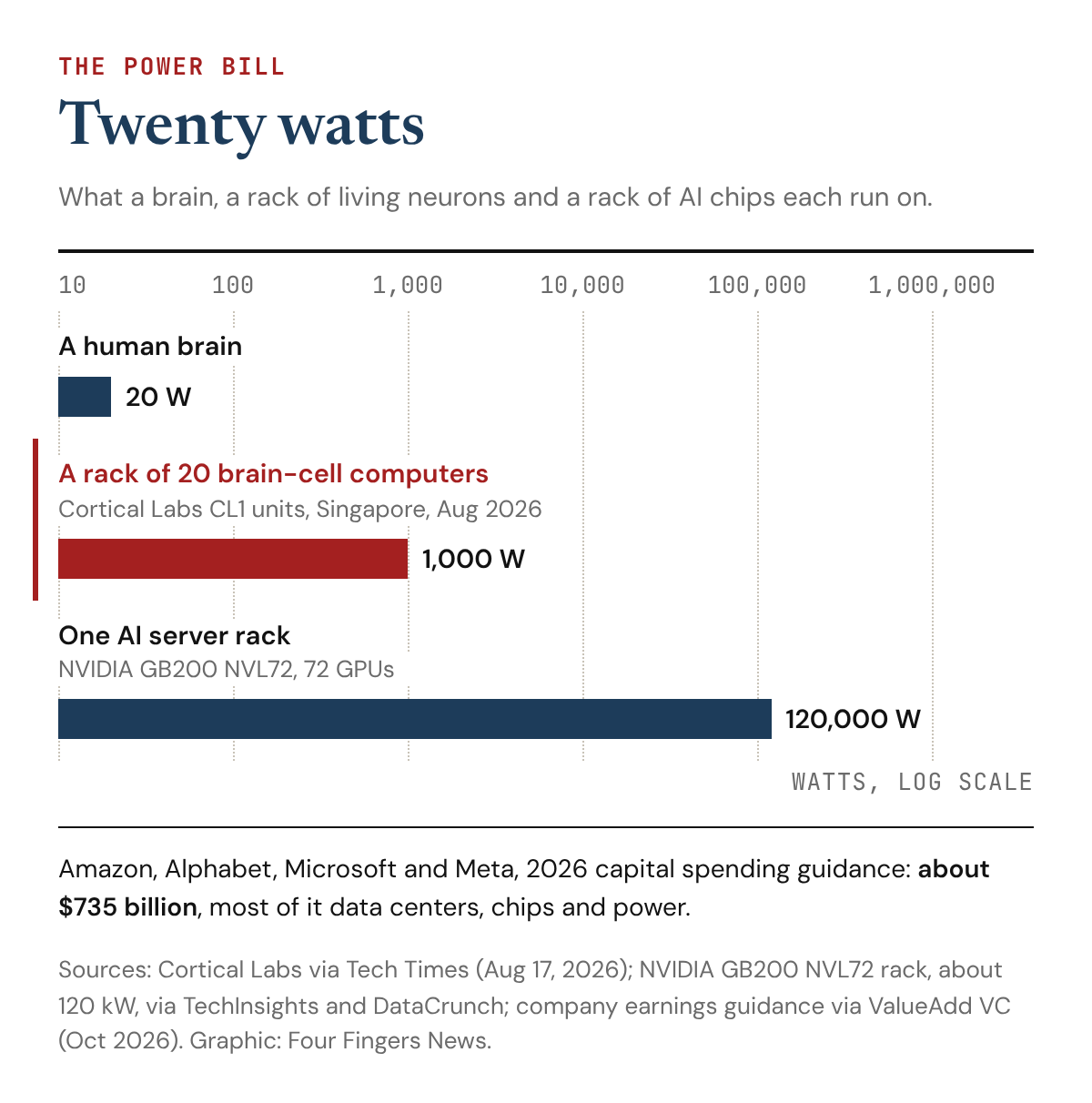
The money is moving because electricity is the constraint on the thing the money’s already in. Amazon, Alphabet, Microsoft and Meta have guided to roughly $735 billion of capital spending for 2026, up about 79% from around $410 billion in 2025, almost all of it data centers, chips and the power to run them, and if you own an index fund you own a piece of that bet. A human brain runs on about 20 watts, less than most light bulbs. That Singapore rack of 20 brain-cell units draws about 1,000 watts in total, and one modern AI server rack draws more than a hundred times that. When the limit on your business is the power grid, a technology that runs on a fraction of the electricity gets a hearing it wouldn’t otherwise get, even this early.
In April 2023, Cortical Labs raised $10 million. The round was led by Horizons Ventures, the private fund of Li Ka-shing, Hong Kong’s richest man, and one of the other names in it was In-Q-Tel. The Q is borrowed from the gadget man in the Bond films. In my family he’s a running joke: every Christmas since the GoldenEye years on the N64, my dad has given my brother and me one piece of technology “from Q,” and the Bond theme comes out of the player piano while we open it. The Tel is intelligence, as in the Central Intelligence Agency. The CIA set it up in 1999 as a nonprofit venture fund in Arlington, Virginia, so the agency could buy into startups the way Silicon Valley does. It takes about $100 million a year in taxpayer money, employs close to 200 people, and writes checks from a few hundred thousand dollars to a few million. Its early money went into Keyhole, which Google bought and turned into Google Earth, and into Palantir and Anduril. By its own account, every dollar it puts in draws about $40 more from commercial investors. And Cortical isn’t its only brain bet. In November 2025 it joined a $200 million round for Synchron, which places a brain implant through the jugular vein instead of through the skull, alongside Jeff Bezos’s fund and the Australian government’s own investment vehicle.
The caveat is real, and it cuts against me. In-Q-Tel has done around 28 deals this year alone and more than 500 since it started, so a slice of a $10 million round is a small bet, not a program. What the money buys is what In-Q-Tel exists to buy: a seat at the table and an early look at the data. I don’t know what the agency intends to do with living neurons on a chip, and I haven’t found anyone outside it who does.
The record, at least, is public. From 1953 to 1973 the CIA ran MKUltra, at least 149 subprojects across more than 80 universities, hospitals and prisons, to find out how a human mind could be bent. In January 1973 the outgoing director, Richard Helms, ordered the files destroyed. Seven boxes of financial records survived because they’d been misfiled, a public records request turned them up in 1977, and most of what’s known about the program was rebuilt from the bookkeeping. On Jun 30, 2026 a House Oversight task force held a hearing on all of it, and its chair said the CIA is now declassifying boxes it only recently found. That same agency’s venture arm is on the cap table of a company growing human brain cells on a chip.
Sources (15), on the site.
Mecca Pact Envoys Leave Tehran with a Promise of More Talks as Ansarallah Fires Through the Night
The three signatories of the Mecca pact sent their heaviest hitters to Tehran Monday: Saudi Defense Minister Prince Khalid bin Salman, Pakistan’s Field Marshal Asim Munir and Turkish intelligence chief Ibrahim Kalin met Mohsen Rezaei, secretary of Iran’s Supreme National Security Council, Foreign Minister Abbas Araghchi and President Masoud Pezeshkian. The joint statement late Monday said the four “agreed to continue the dialogue to strengthen cooperation amongst the four regional countries,” and no more. A senior Pakistani security official told Reuters the agenda ran from a regional non-aggression network to the US-Iran talks, the Strait of Hormuz and the US blockade of Iranian ports, that Munir put a proposal on the table, and that the pact states plus Qatar could stand as guarantors if Tehran accepts it. Riyadh said the aim was to “prevent the return of military escalation”; Rezaei said the visit showed “American threats have little impact on countries around the world.” Overnight, Ansarallah claimed strikes on Riyadh’s airport and on crude pumping stations in the kingdom’s east and west; the coalition said it intercepted them, downed three drones over Riyadh and the south Monday evening, and early Tuesday stopped three ballistic missiles aimed at the Eastern Province and four more drones, with no casualties reported.
| War: Day 241, counted from Feb 28 |
| Crude: Brent $115.81 and WTI $101.76 at Monday’s settle · both lower on the day, off Friday’s six-month high |
| The pact: Signed Aug 7 by Riyadh, Islamabad and Ankara · collective defense activated Oct 5 after Ansarallah attacks on Saudi Arabia |
| Yemen: The coalition says it destroyed five missile storage tunnels, four launchers and a depot in Ansarallah-held territory |
| Hormuz: CENTCOM counts 3,000-plus transits with US support in six months · Iran’s envoy in Islamabad says the strait reopens when the blockade of Iranian ports lifts |
| Next: Israel votes Tuesday · the Fed decides Wednesday · US midterms Nov 3 |
Israel Votes Tuesday with Neither Bloc at 61 in the Final Polls
About 7.3 million Israelis can choose among 36 parties Tuesday; main polls close at 10 PM, 1 PM PT, when exit polls land, and official results are due by Nov 4. Friday’s last polls on three channels put Gadi Eisenkot’s Yashar at 22 or 23 seats, Likud at 19 to 21 and Netanyahu’s bloc at 50. Defense Minister Israel Katz said Israel has no intention of attacking Iran before the vote; Tehran’s Baghaei said the result makes “no difference” to Iran.
Anthropic Files for a November IPO with $430 Billion of Computing on the Books
Anthropic filed publicly Monday to list on the Nasdaq as ANT, with the offering targeted for mid-November. The filing shows $16.3 billion of revenue in the first half of 2026 against $4.6 billion for all of 2025, an $80.7 billion net loss mostly from accounting charges, $9 billion spent on infrastructure in six months, and more than $430 billion of locked-in cloud contracts with Amazon, Google and others. Brent and WTI gave back about $2 from Friday’s six-month highs to settle at $115.81 and $101.76; the Fed decides Wednesday and is expected to hold.
Drones Killed 306 Sudanese in Three Weeks, the UN Counts
UN rights chief Volker Türk says strikes by both the Sudanese Armed Forces and the Rapid Support Forces killed at least 306 people in October’s first three weeks, hitting markets, hospitals and displacement sites; a “double tap” on a truck at Dibab, West Kordofan, killed 139. A day later a strike on Amiet market in Abyei, the disputed strip on the South Sudan border, killed more than 80. The Security Council condemned it without naming who flew the drone; local civil society blames the army, and Juba summoned Khartoum’s ambassador.
Oleshky’s Truce Takes Hold at 3 AM, and Kyiv Is Hit Minutes Later
The local ceasefire brokered by First Lady Melania Trump took effect at 3 AM Kyiv time Tuesday, 6 PM Pacific Monday, around Oleshky, the Russian-held town across the Dnipro from Kherson where the White House says 1,700 to 2,000 of 24,000 prewar residents remain. Ukraine’s ombudsman Dmytro Lubinets said Kyiv is honoring the terms agreed with Russian negotiator Yana Lantratova; Russia’s Defense Ministry said its forces had stopped firing for the aid mission. AP reports the pause runs until at least Saturday. Within minutes of the start, Russian ballistic missiles were launched at Kyiv.
Hanford’s Sick Workers Keep Winning, and the Energy Department Keeps Appealing
A 2018 state law presumes certain cancers and neurological and respiratory diseases among Hanford workers came from the job, yet since 2023 the Department of Energy has recommended approving none of 102 new claims. The state approved 75% anyway, and DOE appealed all but seven. It’s filed more than 500 appeals since 2018 and loses nearly nine in 10; about 152 approved claims are still contested, and half those workers have died. Rep. Gerry Pollet: “This was supposed to have ended a decade ago.”
Seahawks Smother Mahomes, 20-3; Baldelli Pulls Out of the Mariners’ Search
Seattle went 11 for 16 on third downs to Kansas City’s three of 11 Sunday night, handing the Chiefs their first loss; Sam Darnold found Jaxson Smith-Njigba for a 28-yard touchdown. The Seahawks are 4-3 and host the Bears Monday, Nov 2. Rocco Baldelli withdrew from the Mariners’ manager search citing family; Seattle is reportedly at an advanced stage, with Joe Espada and the Cubs’ Jason Kanzler still named.
| Read the full dispatch |
You’re receiving The Late Night Pour, an edition of Four Fingers News.