
The Late Night Pour | Finite Fleet

|
Four Fingers News
The News, Neat.
|
| MONDAY, NOVEMBER 9, 2026 · DAY 255 |
| The Late Night Pour |
Finite Fleet
Finite Fleet, read aloud · 9 minutes.
Day 255. When you see a clip of an oil tanker burning in the Persian Gulf, you’re watching something that can’t be replaced for years. A ship that size ordered today won’t leave the shipyard until 2029 or 2030, and a damaged one has to be repaired, inspected and insured again before it sails, so every tanker that burns means less oil gets moved for a long time. Many more ships drop out without a scratch, because their owners, crews and insurers decide that a trip through the Strait of Hormuz, the only way out of the Persian Gulf by sea, isn’t worth the danger. The ships still willing to go can name their price: a supertanker carrying oil from the Persian Gulf to China earned about $55,540 a day on Jan 9, 2026, seven weeks before the war began, and on Nov 6, 2026 the same trip paid $1.30 million a day, 23 times as much for the same ship doing the same work.
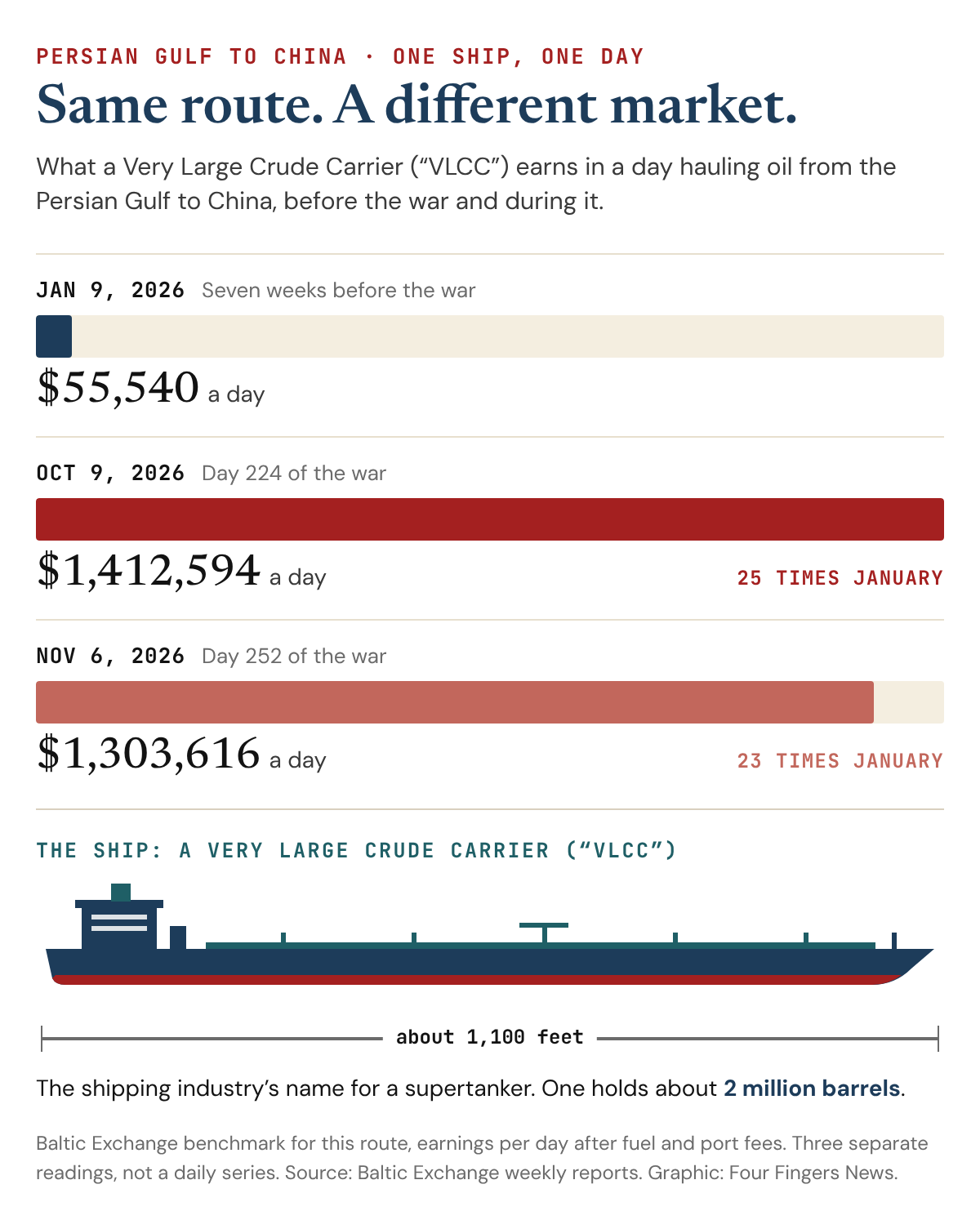
A day is a small slice of the job, because ships move slowly. A loaded supertanker makes about 15 miles an hour, so the trip to China takes about three weeks and the empty run home takes three more, and with time in port one cargo ties up the ship for about 46 days. At November’s rate that single round trip earns the owner about $60 million, which is about $30 for every barrel on board before fuel is counted, against a little over $1 in January 2026. That money is added to the price of the oil, which is why this is bad news for anyone who buys fuel and why it won’t end the day a peace deal is signed.
That supertanker is what the shipping industry calls a Very Large Crude Carrier (“VLCC”), a ship about 1,100 feet long that holds 2 million barrels of oil. What a ship earns per day, after paying for fuel and port fees, is called its time charter equivalent (“TCE”), and the figures here are the benchmark TCE that the Baltic Exchange in London publishes for that route from the rates shipbrokers report. Very little of the increase is the cost of running the ship. Frontline, one of the world’s largest tanker companies, told investors in August 2026 that each of its supertankers needs about $23,800 a day to cover running costs and debt payments, so nearly everything above that is what the market pays an owner to accept the danger, and the buyer of the oil ends up covering it.
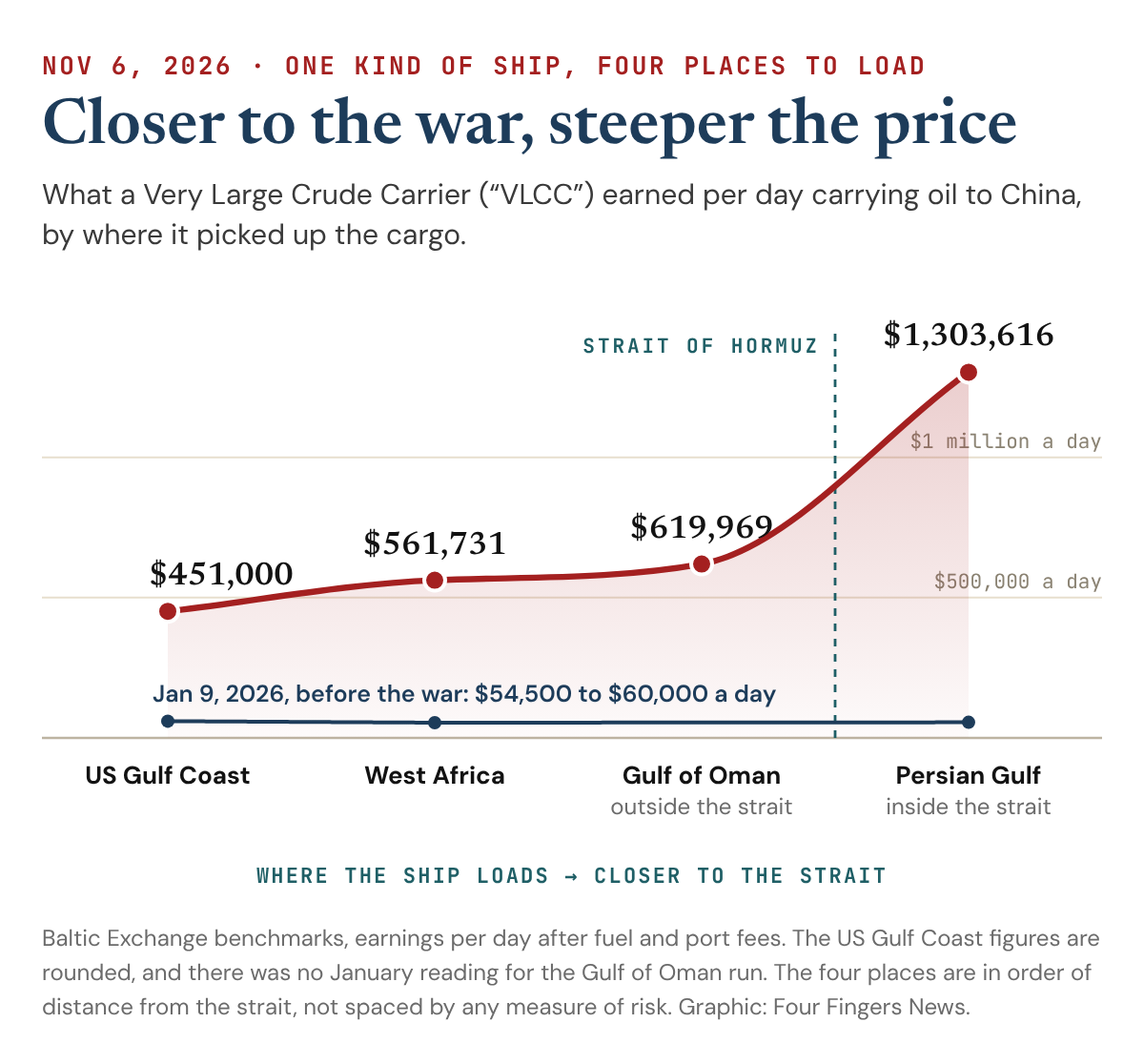
The danger itself has a price, and the same Nov 6, 2026 report shows it. A VLCC that loads in the Gulf of Oman, just outside the strait, earned about $620,000 a day for the trip to China, less than half of what the same kind of ship earned for loading inside the Persian Gulf. The ships are the same and so is the destination, so about half of what an owner earns inside the Gulf is payment for taking a ship through Hormuz and back. The shortage reaches every ocean, because a ship tied up near the Persian Gulf is a ship missing somewhere else: VLCCs loading in West Africa and on the US Gulf Coast earned about eight to ten times what they did in January 2026.
On paper the world has plenty of tankers. The Congressional Research Service, the research office that works for Congress, counted almost 7,500 oil tankers in the global fleet in 2023. But a ship on a list isn’t a ship that a seller in the Persian Gulf can hire tonight. It has to be the right size and close enough to arrive on time, with tanks clean enough for the cargo, inspection papers in order, a crew that’ll go, an owner that’ll send it and an insurer that’ll cover the trip. A tanker anchored on the far side of the Atlantic still counts in the fleet, and it does nothing for a cargo waiting at a Saudi terminal.
The war has shown how far apart the list and the working fleet can get. As of Oct 16, 2026, United Kingdom Maritime Trade Operations (“UKMTO”), the British naval office that takes incident reports from merchant ships, had logged 114 reports of damage to commercial ships of all kinds in and around the Persian Gulf since the start of the year, and six ships confirmed as total losses, meaning sunk or damaged beyond repair. Most ships that get hit don’t sink: of the 12 attacked in one week that October, six kept sailing or reached port and one was lost. But a ship doesn’t have to sink to come off the route, and every strike is studied by the owners, crews and insurers of the ships that weren’t hit.
There was a small rehearsal for this in 2019. Between May 12 and June 13, 2019, six tankers were attacked in the waters just outside the Strait of Hormuz, and none of them sank. The extra insurance an owner buys for each trip into a danger zone is called a war-risk premium, and for a supertanker headed into the Persian Gulf it went to $50,000 after the first attacks and to at least $185,000 after the second. Owners and the companies that hire their ships stopped booking for a time while they worked out the danger. The world had as many tankers after those 32 days as it had before, but fewer of them were on offer in the Persian Gulf.
This year’s numbers are of another size. War-risk cover for a single trip through Hormuz has been reported at 3% to 10% of the value of the ship, up from a fraction of 1% before the war. A nine-year-old supertanker is worth about $135 million, going by two that Frontline agreed to sell in July 2026, so the insurance on one voyage can run from about $4 million to $13.5 million, against about $185,000 in 2019. An owner with a perfectly good ship can look at that bill and decide the trip isn’t worth it, a company hiring the ship can find a willing owner and then watch the insurance wreck the economics of the cargo, and a crew can read the latest attack report and turn down the contract. None of those decisions takes a ship off anyone’s list, and every one of them takes a ship out of the market.
The fleet does grow, but slowly, because the yards that can build a ship this size, most of them in South Korea, China and Japan, are booked through 2028. Two VLCCs ordered from a South Korean yard on Oct 29, 2026, at about $133.5 million apiece, are due in the second half of 2030, and ten that China’s COSCO Shipping Energy ordered on Nov 9, 2026 are due between August 2029 and November 2030. A ship that burns this month can’t be replaced before 2029, a damaged one comes back only after repairs, inspections and an insurer’s sign-off, and even an undamaged one can sit idle while its owner waits to see whether the next trip looks worse than the last.
That’s why an announcement of peace and a working oil trade are two separate events. A ceasefire changes expectations at once, and oil futures, the contracts traders use to bet on where prices are headed, can fall on the hope of one. The physical trade waits for proof: insurers want to see ships get through safely before they cut their prices, owners want to believe their ships will come home, crews have to agree to go, and ships that were damaged or sent elsewhere have to be repaired, brought back and matched with cargoes again.
The White House has been describing a war that’s nearly over while keeping its blockade of Iran’s ports in place. Both can be true as negotiating positions, but to a tanker owner they add up to a risk that still has to be priced, and the freight market isn’t judging who won so much as estimating the odds that the next loaded ship gets out. Nov 9, 2026 was a new moon, the darkest night of the month and the kind long favored for a surprise attack, and it passed without the large strike many had feared, which is a relief and still isn’t something an insurer can count as peace.
A ceasefire can be signed in an afternoon, but the ships come back one repair, one crew and one insurance policy at a time, and until they do, the price of a ride out of the Persian Gulf will say more about whether this war is over than any announcement will.
Sources (11), on the site.
Trump Says the War “militarily is effectively over” and Keeps the Blockade in Place
After meeting Qatar’s prime minister at the White House on Monday, President Trump told reporters the war “militarily is effectively over” and that “we’re just keeping it the status quo,” with US forces “locked and loaded” and the blockade of Iran’s ports still in force. Sheikh Mohammed bin Abdulrahman Al Thani, who also saw Vice President JD Vance, said he was “grateful for the positive discussions on reaching a deal.” In Ankara, Türkiye’s intelligence chief, Ibrahim Kalin, said Qatar would host Vance and Mohsen Rezaei, the secretary of Iran’s Supreme National Security Council, next week. Tehran denied it: a senior security official told the Tasnim news agency no meeting is planned until the US acts on Iran’s seven conditions, and Rezaei said it’s “time to surrender” to them.
| War: Day 255 |
| Monday: Qatar’s prime minister with Trump and Vance at the White House |
| Trump: “militarily is effectively over” · “we’re just keeping it the status quo” |
| Tehran: Rezaei says it’s “time to surrender to the seven conditions” · no meeting planned, Tasnim reports |
| Next week: Kalin says Qatar will host Vance and Rezaei · Tehran denies it |
| Crude: Brent settled Monday at $92.57, down $5.75 · WTI $86.85, down $3.98 |
Stocks Jump 2% as Crude Falls Nearly 6%
The S&P 500 rose 2.3% to 7,549.94, the Dow gained 1,104 points to 52,389.75 and the Nasdaq added 2.7% Monday as oil prices fell. Brent settled at $92.57, down $5.75, and WTI at $86.85, down $3.98. OPIS had the national gas average at $3.999 a gallon early Monday, which would end a 113-day run above $4; analyst Tom Kloza sees “much less relief in sight for diesel.” The consumer price index lands Tuesday, producer prices Friday.
Twelve Ukrainian Regions Lose Power and Kirishi Burns, Ahead of Abu Dhabi
Deputy Energy Minister Artem Nekrasov says Russian strikes cut electricity in 12 regions, worst in Kyiv and Dnipropetrovsk, where more than 600,000 people went dark. Ukrainian drones set fire to the Kirishi refinery near St. Petersburg, some 800 km from the border and good for about 400,000 barrels a day; the regional governor says it’s under control. Moscow says it’ll keep hitting energy sites it says serve Ukraine’s army. US-brokered talks open in Abu Dhabi Tuesday.
Antalya Opens 90 Minutes Late, with Climate Money Already in Dispute
Negotiators worked into Sunday night over developing countries’ push to put climate finance on the formal agenda, and a senior EU official says there’s “no political will” for new pledges. UN chief António Guterres told delegates to “get serious.” The Trump administration sent no officials; a congressional delegation came instead. Berkeley Earth gives 95% odds that 2026 beats 2024 as the hottest year on record.
Windstorm Darkens Tens of Thousands Around Puget Sound
Seattle City Light had about 30,000 customers without power just before midnight Saturday and worked 143 separate outages at one point; Puget Sound Energy topped 21,600 overnight. By late Sunday morning the two were down to roughly 10,000, with lines down on Dexter Avenue and outages on Capitol Hill and around Burien. KIRO 7 forecasters call for a rainy week.
Bills Hold the Vikings to Two Field Goals, 23-6; Seahawks Head to Las Vegas
Buffalo held Minnesota to 178 yards and 0-for-8 on third down Monday night in Minneapolis. Josh Allen threw for 234 yards and a touchdown to Keleki Latu, James Cook ran for another and Tyler Bass kicked three field goals; Carson Wentz went 8-of-25 with two interceptions. The Seahawks, 5-4 after beating Arizona 17-3, play the Raiders in Las Vegas Sunday at 1:05 PM PT. The Huskies (5-4), beaten 28-25 by Penn State, visit Michigan State Saturday.
| Read the full dispatch |
You’re receiving The Late Night Pour, an edition of Four Fingers News.