2026 Nᵒ14 - Turning dilemmas into art
Exploring the use of pairs in Playback Theatre

👋 Greetings, dear readers.
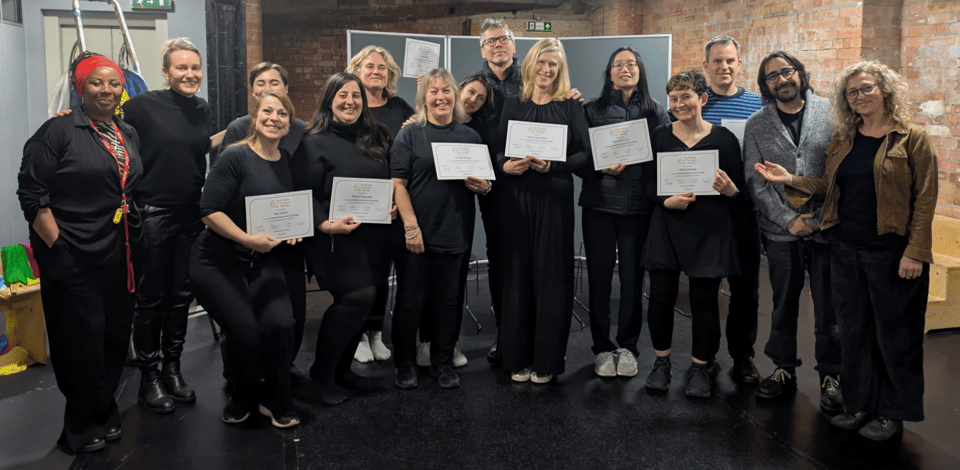
I’m still processing the last Playback Theatre (PT) core training intensive that wrapped up just a few hours ago. Over four days, eleven people got to know, learn, practice, and showcase PT, navigating thick layers of information and juggling different tools and techniques. They were absolutely brilliant.
We happen to have several improvisers in our midst. If you know me, you’re likely familiar with how much I love watching improvisers try playback and seeing them thrive so effortlessly.
This week (and very quickly because we’re about to “go to press”), I want to go back to discuss one of the PT short forms that tends to be tricky.
“Pairs” is part of the original trifecta of Playback Theatre forms, alongside “fluid sculpture” and “story.” This form is used whenever we want to display a dilemma or the struggle of making a choice coming from a teller.
I love this form and the different versions of it people have come up with during the now more than 50 years of the art form.
Of course, as an accredited trainer following the syllabus of the Center for Playback Theatre, I have to teach the original form, hoping the trainees get to experience other ways in the future.
I’d like to share a couple of other ways, but let’s start with…
The vanilla pair
Don’t get me wrong, vanilla is delicious, but I refer to it this way because it’s the first iteration of the form. In this version, two actors stand one behind the other, very closely. When the form starts, both actors share one side of the dilemma with a clear stance, facing the audience. Physicality comes into play as the actor in the back tries to be seen, turning the performance into a game of push and pull while both stances are shared out loud.
Two sides of a coin
The actors stand back-to-back, presenting their profiles to the audience. When cued, they rotate clockwise. The actor who turns to face the audience then presents one of the stances. As they rotate, the audience is exposed to snippets of each stance before the actors come to a stop again to the original profile presenting position.
Rational vs. Emotional
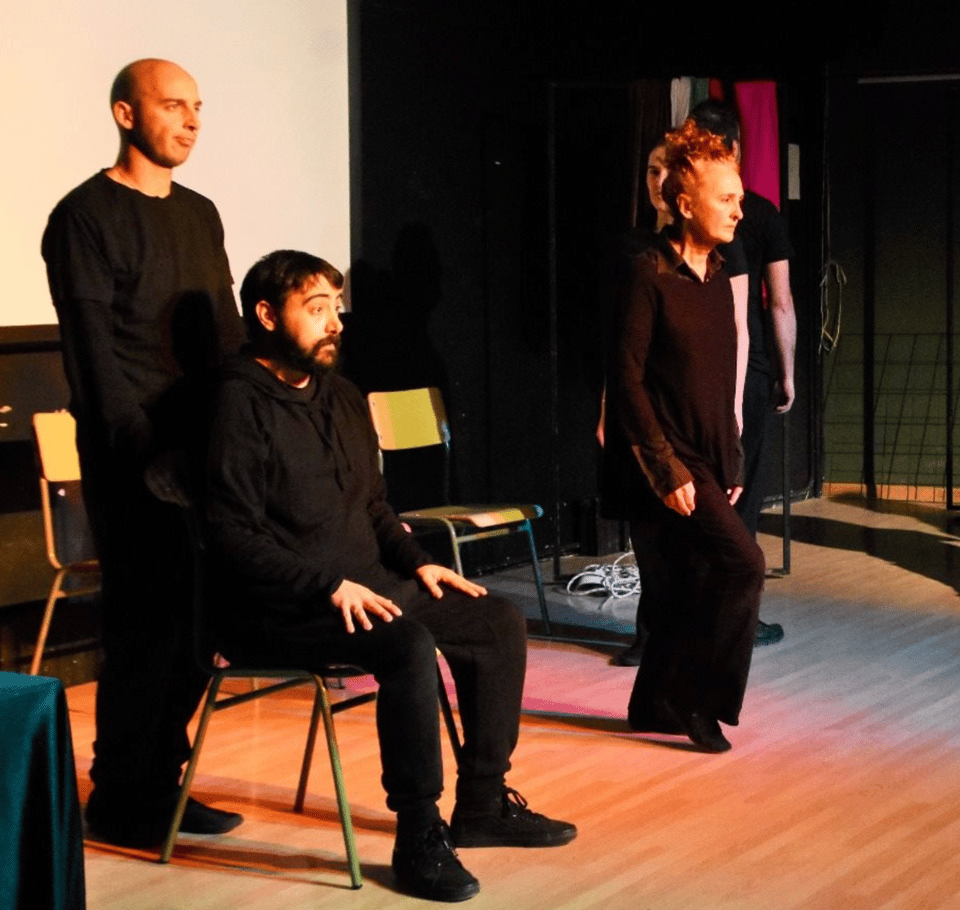
This variation is also known as “Brain vs. Gut”. One actor sits while the other stands behind them. The intent here is for the head of the seated actor to be physically level with the guts of the actor standing behind. At the start, the rational element is introduced by the standing actor, who remains as neutral as possible while exposing objective facts, almost like a news anchor. The seated actor then presents the emotional side of the struggle, performing over the top to achieve a sharper contrast.
The solo one
Although many PT companies opt to leave this variation out, it is particularly useful when working with an uneven number of actors. In this solo version, a single performer carries the dilemma alone. They perform a short routine or present one side of the conflict before dramatically spinning 360 degrees to present the opposing side.
The dilemma lane
OK, I just came up with this name because I don’t actually know who created this variant or what it is called. I stumbled upon this variation recently, first through an Irish playbacker and then again through the Berlin-based company Platforma Linii. If you are reading this and you know this information, let me know. 🙏
Two actors face each other from opposite sides of the stage. On start, they move slowly towards the centre as if they are walking in the same lane. Each actor holds one of the stances, which they gradually exchange when they meet in the middle, before continuing their respective journeys to the other side of the stage. Another way to explain it is: the stances of the dilemma remain in the same side of the stage but we’ll see both actors embracing it.
The counterpoint duet
Hey! I came up with this! This is mine! It was based on my experience at Acaprov (and the always inspiring Lisa Lynn). We tackled it during my Level 2 training in Hamburg and I must admit this one is difficult, but trainable. Actors must be comfortable with singing, coming up with a verse and a chorus on the spot, and retaining them in their heads.
On calling the form, four actors will take their positions. The first pair, the “vanilla” Playback pair, is at the centre of the stage. The actors who form the singing counterpoint duet stay at the sides of the stage facing the audience. Think of a diamond shape.
We first see the vanilla pair interaction, showing the struggle of the dilemma until they freeze. The music then offers a simple tune; it could be a progression of four or even just two chords to make things easier. The actor closer to the musician starts singing a simple verse about one side of the dilemma and sets up an even simpler chorus. The second actor then sings a verse about the other side of the dilemma, followed by the same chorus as the first actor.
Here, things become tricky: both actors then repeat their individual verses at the same time, ending together on the chorus. The actors from the vanilla pair can even join in singing the chorus.
The structure can be AABA or AAAB, or one can sing AABA while the other sings AACA. If this information seems cryptic to you, I’m available to teach! 😀
And there you go! I expected to have a short newsletter this week, but you ended up with a bunch of ways to portray dilemmas in Playback Theatre. What a treat!
🎭 The Theatre bit
After a long hiatus far from home, I finally got back into reading theatre and happened to stumble upon a play by a Polish author I admit I didn’t know: Sławomir Mrożek.
I was pleasantly surprised and entertained while reading, Tango, a reflection in three acts on societal values and family.
The plot revolves around Arthur, a young man with conservative values who struggles to cope with the boundless libertarian views of his family, who live in total chaos and reject all rules and traditions.
The play (which belongs tho the genre of Theatre of the Absurd) had me chuckling out loud on the tube; it really is that funny. Yet, it carries a deep philosophical weight within every conversation Artur has with his peculiar family: a father obsessed with “dramaturgical experiments” who neglects his own appearance, a mother defined by libertine romanticism, and a cousin lost in her own naivety.
From the begining to the hilarious ending a very compelling read. I kind off wat to see it live.
📆 What is coming up
🇬🇧 10th of April - Acaprov at Shoreditch Balls (London, UK). You’d be a fool if you miss April’s new improvised a cappella musical by Acaprov. Hop into the fun.
🇬🇧 15th of April - Not GCSE Drama (London, UK). After a long hiatus, the clueless teenagers are back for another GCSE drama exam and they will do their best to use their creativity to get excellent grades. It will be at The Signal Pub, hosted by 🌲 The Forest 🌳 Improv Comedy.
🇬🇧 1st to 4th of May - Two Islands Playback Theatre Gathering (Buckden, UK). Join playbackers from UK and Ireland on a long weekend of camaraderie, connection, and, of course, Playback theatre. Check the information.
📚 🎮 🎥 📺 The geeky dessert
Driven by curiosity about the upcoming movie adaptation, I used my commute on the way to the Playback Training to finish reading Supergirl: Woman of Tomorrow.

Told through the lens of a girl from an alien planet seeking Supergirl’s help following the murder of her father, this standalone eight-issue limited series offers a peculiar perspective on the Last Daughter of Krypton through a mature story that screams science fiction.
The great story is on par with the exquisite work of Brazilian illustrator Bilquis Evely, her drawing style, by the way, reminds me greatly of the work of Moebius. Definitely I can strongly recommend it, even if you’ve never read a Supergirl comic before (or any whatsoever!).
📨 That’s all for now
Thanks for reading Playing Back an Improvised Life, a newsletter by Ferran Luengo.
If you like it, spread the voice and share with someone who you think might enjoy it.
If you want to keep in touch, feel free to follow me on instagram (@luenkun).
Want to work with me or start a conversation? email me 😀
Want to support me? You can do it through my Ko-fi page
Ferran Luengo AI Disclaimer: Since English is not my first language, I may have used AI tools to proofread the text, limiting their use to grammar only. Everything in this newsletter has been written by me
Add a comment: