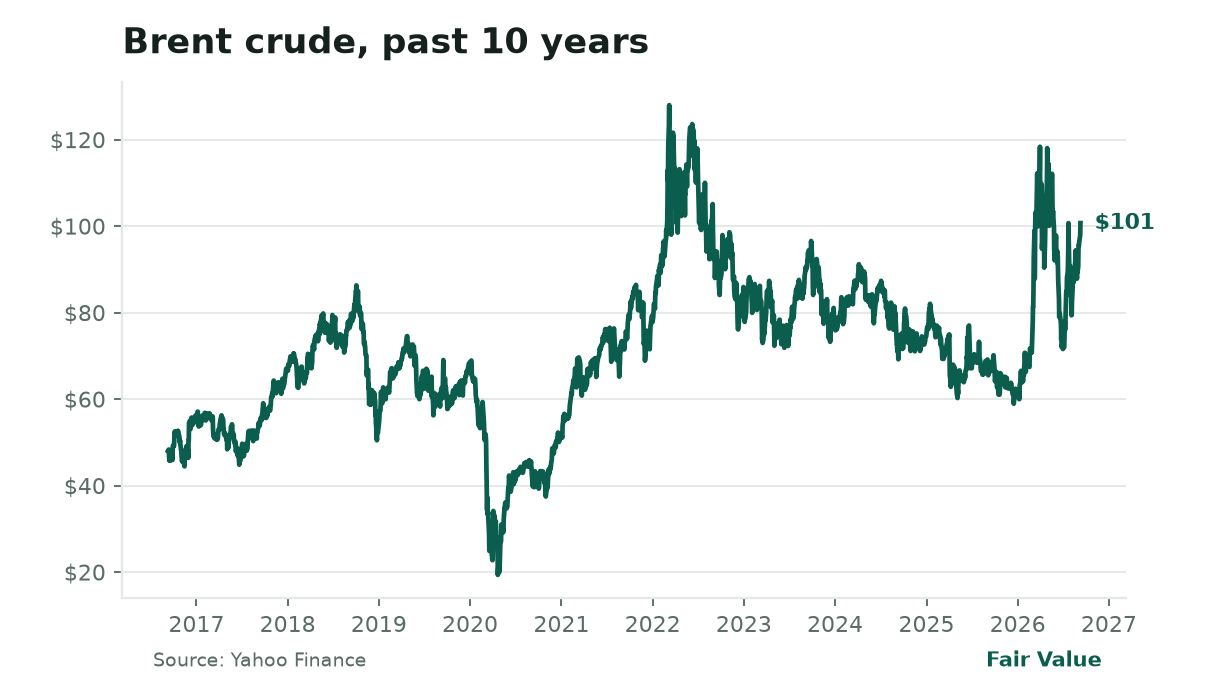
Brent crude breached $100 for the first time since July as U.S. strikes on Iranian tankers and Houthi attacks on Saudi energy facilities create a two-front energy crisis, pump prices and inflation expectations are climbing.
▸
Semiconductors are the only game in town: Intel surged 9%, AMD 6%, ARM 4% while pharma, software, and e-commerce sold off hard, capital is fleeing every other sector into the one asset class with AI demand visibility and pricing power.
▸
The ECB meets tomorrow with a 25bp hike priced in, but economists are split on whether it's the last of this cycle, a divergence from the Fed's "higher for longer" stance could reshape currency markets.
The big story
The semiconductor rally is no longer a growth bet, it is the market's only liquid hedge against a 4.78% 10-year Treasury and $100 oil, and that hedge is now crowded.
In Tuesday's session, the divergence played out in its purest form: Intel +9.1%, AMD +5.9%, ARM +3.7%, Qualcomm +3.2% while Novartis plunged 13.9%, Shopify dropped 7.6%, Adobe fell 3.5%, ServiceNow 5.0%, Salesforce 3.9%. Meanwhile Brent crude crossed $100.56 for the first time since July, and the 10-year yield sat at 4.78% with a razor-thin 41 basis-point spread over the 2-year, a curve shape that historically precedes recession.
Brent sits just above $100, a level unseen since July 2026. The last time Brent breached $100 was in October 2022, when it peaked at $108 before slipping below $90 within three months; the previous $100‑plus rally was in 2008, topping $147 and then retreating to the $80‑90 range over the next year.
The market is not buying chips for earnings. It is buying them as the only liquid asset that can outrun a supply-shock inflation the Fed cannot cut against without breaking growth. Here is the chain: Brent above $100 and WTI at $95.06 (up 15.7% this month) feed directly into headline CPI, keeping it at 3-4% year-over-year.
Persistent above-target prints force the Fed to hold at 5.25-5.50% despite a 4.1% unemployment rate. The 10-year stays pinned at 4.78% with a 41bp 2s10s spread pricing recession risk. A 4.78% risk-free rate makes unprofitable growth and defensive pharma uninvestable, so capital concentrates in the only sector with pricing power and AI-driven demand, semiconductors.
The tell is in the plumbing: the VIX at 16.0 and the Chicago Fed's National Financial Conditions Index at -0.56 mean everyone is comfortable, which means the chip trade is crowded without a cheap volatility hedge. When the unwind comes, and it will when either oil breaks $105 and forces a Fed rethink, or a single chip name misses on AI order flow, the exit will be through a door too narrow for everyone.
Professionals are debating whether this concentration is a rational response to a genuine regime shift (AI capex is the new infrastructure cycle, energy the new constraint) or a late-cycle crowding signal. The second-order effect: if the Fed is forced to hike again to fight oil-driven inflation, the discount rate on chip earnings, priced for 2027-2028 AI revenue, gets repriced simultaneously with energy input costs, squeezing the sector from both sides. The counter-argument: chips are the only sector where demand is so inelastic they can pass through both higher rates and higher energy costs, making them the true inflation hedge.
Watch Brent holding above $100 and the 10-year breaking above 4.85%, if both happen together, the chip trade's discount-rate cushion disappears. Conversely, if the 2s10s spread steepens back above 60bp while oil retreats below $90, the concentration unwinds into a broader rally and chips give back their relative premium.
What's going on today
Markets are waking up to a world where the two biggest stories, energy and semiconductors, are now the same story. Brent crude hit $100.56 overnight, the first print above $100 since July, after U.S. Central Command destroyed five Iranian oil tankers in the Gulf of Oman and near Kharg Island, while Iran-backed Houthi militants struck four Saudi cities including the Jazan Aramco refinery.
The Strait of Hormuz, which carries a fifth of global oil, now has an Iranian-declared "exclusion zone" and a U.S. naval blockade of over 20 warships. Insurance rates for tanker transit are spiking, and the backup Saudi East-West pipeline can only bypass about 2.6 million barrels per day, a fraction of the 20 million that normally flow through Hormuz.
At the same time, Tuesday's equity tape revealed a market that has stopped pretending it's broad-based. The S&P 500 fell 0.6%, the Dow 1.2%, but the PHLX Semiconductor Index rose 1.3%. Only three of eleven S&P sectors closed higher: Energy (+1.0%), Utilities (+0.9%), and Real Estate (barely).
Healthcare cratered 2.6% on Novartis's 13.9% collapse after a clinical trial setback. Software fell 2.5%. E-commerce and fintech joined the selloff. The VIX climbed to 16.0, still low by history but up 5.3% on the week, the market is pricing complacency while the bond market prices recession risk.
The bond market is the quiet narrator. The 10-year Treasury yield at 4.78% and the 2-year at 4.37% leave just 41 basis points of term premium, the curve is screaming that the economy cannot withstand current rates for long. Yet the Fed's own Governor Waller said September 3 he'd support holding rates steady if August inflation data confirms cooling.
That data arrives Friday: CPI forecast at 0.4% month-over-month, core at 0.2%. Thursday brings PPI (forecast 0.4%) and the ECB decision (25bp hike to 2.65% widely expected). The dollar index sits at 98.8, off three-week lows, while the yen strengthens to 153.6 on narrowing rate differentials and safe-haven demand.
S&P 500 futures are down 0.17% this morning, Nasdaq 100 futures down 0.28%. Crypto is quiet: Bitcoin at $79,011 (+0.7% in 24 hours), Ethereum at $2,492 (+0.3%). Gold holds at $4,438. Copper at $6.76 per pound tests record highs on tariff fears and supply constraints. Natural gas slips to $2.88.
The big picture
The 10-year Treasury yield at 4.78% is doing heavy lifting across every asset class. At this level, the risk-free rate exceeds the earnings yield on most growth stocks, the S&P 500 forward earnings yield is roughly 4.5%, making equities expensive on a relative basis. The 2-year at 4.37% means short-term Treasuries now compete with dividend yields.
The 41bp 2s10s spread is the bond market's way of saying it sees a slowdown coming: normally you get paid more to lock money up for ten years than for two. When that premium nearly vanishes, big money is saying it doesn't trust the economy to hold.
The dollar index at 98.8 reflects competing forces. Rising U.S. yields should support the dollar, but the yen's rally to a seven-month high (153.6 per dollar) and the euro's resilience near $1.16 suggest global investors are hedging. The yen's strength is particularly telling: it's driven by both safe-haven flows from Middle East tension and Bank of Japan rate-hike expectations for their September 17-18 meeting. A stronger yen tightens global financial conditions mechanically, Japanese investors repatriate capital, reducing liquidity everywhere.
Oil at $100 changes the inflation math. Every $10 move in crude translates to roughly 25 cents at the pump. With WTI up 15.7% this month alone, that's a de facto tax on consumers arriving just as the savings rate sits near 3.5%, the thinnest cushion in years.
The Fed's preferred inflation gauge, core PCE, was 2.7% through July; August data could push it higher. If the Fed sees energy-driven inflation bleeding into core services, the "higher for longer" narrative hardens.
Equity breadth tells the real story. The S&P 500 is down 1% on the month, but that masks a violent rotation: semiconductors up 7-17% week-to-date, energy up 7.6%, utilities up 2.9%, while healthcare, software, consumer discretionary, and industrials are all down 4-13% on the month. This is not a bull market; it's a lifeboat drill. Capital is fleeing rate-sensitive, margin-sensitive, and China-exposed sectors into the only names with visible demand (AI), pricing power (chips), and enough liquidity to absorb institutional flows (mega-cap semis).
Crypto is a sideshow but not irrelevant. Bitcoin at $79,000 is up 23.5% on the month but flat on the week, trading in a $76,968-$82,300 range. Volume is light, 24-hour volume of 4,950 BTC versus a 7-day average of 13,100, suggesting the rally is running on low conviction.
Ethereum at $2,492 shows similar patterns. The Liquid Network hack ($320 million stolen, partially returned) reminds holders that infrastructure risk remains real. But tokenized asset holders just crossed 3.5 million, up 108% in 30 days, driven by platforms like Robinhood offering tokenized stocks, a structural shift in how financial assets are accessed.
Around the world
The Middle East has moved from simmer to boil. Iran's Supreme National Security Council announced an "exclusion zone" around the Strait of Hormuz on September 6, threatening to sanction any vessel attempting transit. Since then, the IRGC has fired ballistic missiles at a U.S. carrier group twice; the U.S. responded by destroying eight Iranian tankers in four days, calling them a "multibillion-dollar shadow network" funding regional proxies.
Houthi militants, meanwhile, opened a second front: missile and drone strikes on Abha, Khamis Mushait, Jazan, and Najran in Saudi Arabia, hitting the Jazan Aramco refinery and wounding 73 civilians. The Bab el-Mandeb Strait, the Red Sea chokepoint for Saudi exports, is now under declared Houthi blockade. Two active choke points mean no safe route for Persian Gulf oil; the East-West pipeline bypasses only 13% of normal Hormuz flow.
Russia-Ukraine diplomacy took a surprising turn. The Kremlin confirmed Tuesday that Trump told Putin he wants a "swift end" to the war and full restoration of U.S.-Russia ties, the first direct Trump-Putin communication on the conflict. Treasury Secretary Bessent separately stated the U.S. is "stepping in" under Trump: "If you don't talk, you can't stop it." No formal negotiations are scheduled, but the channel is open. Markets have barely reacted, the ruble remains weak above 95 per dollar, suggesting skepticism that talk translates to ceasefire.
Europe faces its own crosscurrents. The ECB meets tomorrow with a 25bp hike to 2.65% fully priced in, but the real question is the press conference: will Lagarde signal "higher for longer" or "wait and see"? Economists at DWS, DekaBank, and ING argue the September hike could be the last, core inflation dipped to 2.4% in August, and hiking further against a supply-side energy shock risks recession.
Markets disagree, pricing more hikes into early 2027. The divergence matters: if the ECB pauses while the Fed holds or hikes, the euro weakens further (EUR/USD at 1.16, EUR/AUD and EUR/NZD testing support). Germany's AfD won a state election in Saxony-Anhalt, forcing mainstream parties to decide whether to maintain the "firewall" against far-right governance. Separately, European nations imposed trade bans on Israel over West Bank settlements; Israel retaliated against the UK first.
China halted rare-earth shipments to the U.S. as of September 8, per multiple sources, a direct response to August sanctions on the Responsible Business Alliance. Rare earths are irreplaceable in semiconductors, defense, and EV motors; no quick substitute exists. This adds a critical-minerals dimension to tech supply chains already strained by U.S. export controls on chip equipment. Canada-U.S. tariffs took effect Tuesday, targeting subsidized manufacturing including Bombardier, escalating a dispute that adds friction to North American supply chains just as copper hits record highs ($6.76/lb) on industrial demand signals.
Companies making news
Intel surges 9% on pricing power and process lead. Intel rose 9.1% to $104.47 in Tuesday's session, extending a 16.7% weekly gain. The catalyst: a third PC CPU price hike of 10% effective October 5, and confirmation that Intel has processed over one million High-NA EUV wafers, the industry's most advanced lithography, signaling a manufacturing yield advantage that could translate to foundry revenue.
AMD adds 6% on Amazon partnership momentum. AMD climbed 5.9% to $505.74, its seventh straight week of gains. The move follows Qualcomm's $60 billion multi-generational deal with AWS for custom AI chips and optical connectivity, a signal that hyperscalers are diversifying beyond Nvidia, and AMD's EPYC processors and MI300 accelerators are the primary alternative.
Novartis collapses 14% on trial failure. Novartis plunged 13.9% to $137.7, down 12.2% on the month, after a Phase 3 trial for its experimental heart-failure drug missed the primary endpoint. The drop erased $28 billion in market cap in a single day, a reminder that pharma's defensive label offers no shelter when the pipeline breaks.
Shopify drops 7.6% as e-commerce sentiment sours. Shopify fell to $134.1, down 13.6% this month. The WSJ reported today that online retailers are imposing surprise return fees, shorter windows, and delayed refunds, a structural margin squeeze as consumer spending power erodes. Shopify's merchant base feels it first.
Adobe, ServiceNow, Salesforce extend software selloff. Adobe -3.5%, ServiceNow -5.0%, Salesforce -3.9%, all double-digit weekly declines. The WSJ noted Tuesday that AI is disrupting software companies "but not as fast as many feared," yet the market is pricing a faster disruption: if AI agents can replace seats, the recurring-revenue model compresses.
Tesla bucks the trend, up 4%. Tesla rose to $368.16, gaining 11.3% on the month. The move coincides with Elon Musk's push into power-turbine components (a potential vertical integration play for energy storage) and continued FSD licensing talks with legacy auto.
Google pledges $15 billion for AI infrastructure in Finland. Alphabet announced its largest single European investment, €13 billion ($15.1 billion) for data centers in Kajaani, Muhos, Vaala, and an expansion in Hamina, targeting 2027-2028 completion. The project expects to contribute €3.6 billion annually to Finland's GDP and support 37,000 construction jobs. This is capex as geopolitics: securing EU compute sovereignty while locking in Nordic renewable energy.
Micron breaks ground on $100 billion New York megapfab. Micron began foundation work in July on a four-fab campus in Clay, N.Y., targeting 2030 production for advanced DRAM. The scale, largest U.S. chipmaking complex, signals memory is the new bottleneck: AI models need bandwidth as much as compute.
Qualcomm-Amazon $60 billion deal includes $4 billion stock warrants. The multi-generational partnership for custom AI data-center chips gives Amazon warrants at $161.26/share, a bet that Qualcomm's data-center revenue hits $15 billion by 2029. Qualcomm rose 3.2% Tuesday.
Meta launches "Muse" consumer AI agent. Available to U.S. adults 18+, Muse handles shopping, scheduling, and goal-planning within a secure virtual machine. It's Meta's first direct-to-consumer AI product, a test of whether its massive AI spend can generate consumer revenue, not just ad targeting.
Blackstone private credit fund caps withdrawals at 5% for second quarter. The $77.2 billion fund limited redemptions again, selling assets including Australian operator Nucleus Network. This is the canary in the coal mine for semi-liquid private credit: when the biggest manager gates, liquidity stress is systemic.
From Washington
The Fed enters its blackout period before the September 15-16 FOMC with mixed signals. Governor Waller's September 3 speech was dovish: he'd support holding rates at 5.25-5.50% if August inflation confirms cooling, noting three-month core inflation fell from 4.76% in February to 3.05% through July. He also flagged that "nonmarket prices" drove over half of recent inflation and a forthcoming Commerce Department adjustment could shave 20 basis points off the index.
But the July FOMC minutes (released August 19) told a different story: "several participants" wanted to hike in July, "many" saw further tightening likely, and upside risks, tariff pass-through, Middle East energy prices, AI infrastructure demand, were a "reoccurring theme." The market prices a 60% chance of a September hike (CME FedWatch); Waller's comments pull that down, but Friday's CPI is the tiebreaker.
Treasury Secretary Bessent debuted new sanctions on Iranian airlines and service providers Tuesday, targeting the "economic D-Day" logistics of Iran's oil shadow fleet. The sanctions extend to foreign entities owned 50%+ by restricted parties, the BIS Affiliates Rule effective September 29, closing a loophole that let foreign-owned semiconductor fabs in China export equipment license-free. This is export control as supply-chain warfare: the U.S. is mapping ownership networks to strangle Iran's revenue and China's chip access simultaneously.
Canada-U.S. tariffs took effect Tuesday after trade talks stalled. Retaliatory duties on subsidized manufacturing (including Bombardier) are now live. The dispute is narrow in dollar terms but wide in signal: North American supply chains are no longer friction-free. For a market already pricing $100 oil and $6.76 copper, any additional logistics cost feeds the inflation narrative the Fed cannot ignore.
Under the hood
The chip rally is no longer a growth bet, it is the market's only liquid hedge against a 4.77% 10-year and a $100 oil shock, and that hedge is now crowded.
WHY NOW: Today's tape shows the divergence in its purest form: Intel +9.1%, AMD +5.9%, ARM +3.7%, QCOM +3.2% while Novartis -13.9%, Shopify -7.6%, Adobe -3.5%, ServiceNow -5.0%, Salesforce -3.9%. Meanwhile Brent crossed $100 for the first time since July on the same day the 10-year sits at 4.77%. The market is not buying chips for earnings, it is buying them as the only liquid asset that can outrun a supply-shock inflation the Fed cannot cut against without breaking growth.
THE CHAIN: commodities-energy → inflation: Brent above $100 and WTI at $93.69 feed directly into headline CPI, keeping it at 3-4% YoY; inflation → rates-fed: persistent above-target prints force the Fed to hold at 5.25-5.50% despite a 4.1% unemployment rate; rates-fed → bonds-credit: the 10-year stays pinned at 4.77% with a 41bp 2s10s spread pricing recession risk; bonds-credit → equities: a 4.77% risk-free rate makes unprofitable growth and defensive pharma uninvestable, so capital concentrates in the only sector with pricing power and AI-driven demand, semiconductors; equities → plumbing: VIX at 14.32 and NFCI at -0.56 mean the crowded chip trade has no cheap vol hedge left, so any unwind will be violent.
THE READ: The surface story today is 'semiconductors rally on AI optimism.' The deeper read is that this is a forced concentration trade, not a growth trade. Look at the numbers: the 10-year Treasury yields 4.77%, the 2-year 4.34%, and the 2s10s spread is just 41bp, a curve shape that historically precedes recession. Meanwhile Brent crude crossed $100/barrel today, WTI is at $93.69 (up 14.08% this month), and headline CPI is running 3-4% YoY with core CPI at 336.8 index points, above headline.
The Fed is stuck: it cannot cut rates against a 4.1% unemployment rate and 4% wage growth (average hourly earnings $37.75, +4% YoY) without validating the inflation, and it cannot hike further without breaking the housing market where 30-year mortgages sit at 6.71% and housing starts (1.239M) already lag permits (1.433M) by 194k units.
So what does a rational allocator do? They cannot own bonds, a 4.77% 10-year with 2.35% breakevens means real yields are ~2.4%, but the curve is flat and recession risk is priced.
They cannot own defensive pharma, Novartis just fell 13.9% in a day, down 12.2% this month. They cannot own software, Adobe, ServiceNow, Salesforce, PayPal all posted double-digit daily declines. They cannot own e-commerce, Shopify -7.6% today, -13.6% this month.
What is left? Semiconductors. Intel +9.1% today, +16.7% week-to-date.
AMD +5.9%. ARM +3.7%. QCOM +3.2%.
These are not earnings-driven moves, they are the mechanical result of capital fleeing every other sector and concentrating in the one asset class with (a) AI-driven demand visibility from the frontier domain (OpenAI GPT-5.5, Meta's consumer AI agent, Google's $15B Finland pledge), (b) pricing power that can pass through input costs, and (c) enough liquidity to absorb institutional flows.
The market is not pricing a soft landing. It is pricing a stagflation-lite regime where the only equity that works is the one that benefits from both the AI capex cycle and the energy shock (chips are energy-intensive to manufacture, but their end-demand is inelastic).
The tell is in the plumbing: VIX at 14.32 and NFCI at -0.56 mean everyone is comfortable, which means the chip trade is crowded without a cheap hedge. When the unwind comes, and it will when either oil breaks $105 and forces a Fed rethink, or a single chip name misses on AI order flow, the exit will be through a door too narrow for everyone.
THE SHARPER EDGE: The live debate among professionals is whether the chip concentration is a rational response to a genuine regime shift (AI capex is the new infrastructure cycle, and energy is the new constraint) or a late-cycle crowding signal that will resolve in a violent rotation.
The second-order effect: if the Fed is forced to hike again to fight oil-driven inflation, the discount rate on chip earnings, which are priced for 2027-2028 AI revenue, gets repriced simultaneously with the energy input cost, squeezing the sector from both sides. The counter-argument is that chips are the only sector where demand is so inelastic that they can pass through both higher rates and higher energy costs, making them the true inflation hedge.
WATCH: Watch Brent crude holding above $100 and the 10-year Treasury breaking above 4.85%, if both happen together, the chip trade's discount-rate cushion disappears. Conversely, if the 2s10s spread steepens back above 60bp while oil retreats below $90, the concentration trade unwinds into a broader rally and chips give back their relative premium.
Worth learning today: Deficits and the national debt
First, a quick resolution on yesterday's ECB prediction: the European Central Bank meets tomorrow (Thursday, September 10), not today. The market has fully priced a 25bp hike to 2.65% on the Main Refinancing Rate (up from 2.40%), but the actual decision and Lagarde's press conference at 8:45 AM ET will determine whether this is the cycle peak. Economists at DWS, DekaBank, and ING argue core inflation at 2.4% and a supply-side energy shock make further hikes risky; markets price more into 2027. We'll have the actual number and the mechanism in tomorrow's edition.
Now the lesson. The U.S. government spent $6.3 trillion in fiscal 2024 but collected only $4.9 trillion in taxes. The $1.4 trillion gap is the deficit, one year's shortfall.
The national debt is the accumulation of every past deficit minus every past surplus: roughly $35.3 trillion as of today. That's about $105,000 per American.
Here's how it actually works. When the Treasury spends more than it collects, it issues Treasury bills, notes, and bonds, IOUs that pay interest. Who buys them?
Roughly 25%: the Federal Reserve (via quantitative easing), 30%: foreign governments and investors (Japan and China are the largest), 25%: U.S. mutual funds, pensions, and banks, 20%: households and corporations. The Fed's holdings are effectively money the government owes itself; the interest paid on them gets remitted back to Treasury.
This is not a household budget. A household cannot print the currency its debts are denominated in. The U.S. can. That means default is a political choice, not a financial necessity, but the consequence of printing to pay debts is inflation, which is a tax on everyone holding dollars.
The real constraint isn't solvency; it's whether the economy can absorb the spending without overheating. Remember the yield-price seesaw from our bond lesson: when debt supply floods the market, yields rise unless the Fed buys, and if the Fed buys, the money supply expands.
Who owns the debt matters. Foreign holders (Japan $1.1T, China $780B) have geopolitical leverage; domestic holders (pensions, 401(k)s) tie retirement security to Treasury stability. The Fed's $5T+ balance sheet means monetary and fiscal policy are fused, the central bank cannot fight inflation aggressively without raising the government's own interest bill.
Why this matters to your money right now: the 10-year yield at 4.78% prices in both inflation risk and debt-supply risk. Mortgage rates at 6.71% are a direct transmission. The Congressional Budget Office projects deficits averaging 6% of GDP for the next decade, double the 50-year average.
If growth slows (the 2s10s spread says it will), the debt-to-GDP ratio accelerates. The only exits are growth miracles, inflation surprises, or fiscal discipline, and Washington has shown no appetite for the third.
Concept 53 of 83 in the Fair Value course.
Tomorrow's prediction prompt: The ECB releases its Monetary Policy Statement Thursday at 8:15 AM ET alongside the rate decision. Which asset class is most exposed to a surprise, the euro, European bank stocks, or German bunds, which way does it move on a hawkish vs. dovish shock, and through what transmission mechanism? We'll walk through the answer tomorrow.
What to watch this week
▸
Thursday, September 10, ECB Main Refinancing Rate decision (8:15 AM ET): — Forecast 2.65% (+25bp). The press conference at 8:45 AM ET will signal whether this is the peak or a waypoint, watch for language on "data dependence" vs. "further tightening."
▸
Thursday, September 10, U.S. PPI (8:30 AM ET): — Forecast 0.4% month-over-month (prior 0.0%). Core PPI forecast 0.3% (prior 0.2%). Pipeline inflation at the factory gate; feeds forward into CPI and PCE.
▸
Friday, September 11, U.S. CPI (8:30 AM ET): — Forecast 0.4% m/m, 3.4% y/y (prior 0.1%, 3.4%). Core forecast 0.2% m/m, 2.4% y/y (prior 0.2%, 2.5%). The Fed's blackout-period tiebreaker, a hot print revives September hike odds.
▸
Friday, September 11, U.K. GDP (2:00 AM ET): — Forecast 0.0% m/m (prior 0.3%). Stagnation risk for the Bank of England's next move.
▸
Monday, September 14, CLARITY Act Senate cloture vote: — Crypto regulatory framework faces 10-16% passage odds; failure extends "regulation by enforcement" to 2029.
▸
Wednesday, September 16, FOMC decision (2:00 PM ET): — Rate decision, Summary of Economic Projections, dot plot. Waller's dovish lean vs. July minutes' hawkish tilt, CPI Friday decides.
▸
Thursday, September 17, Bank of Japan policy decision: — Rate hike expectations rising with yen at seven-month highs; a move would narrow the U.S.-Japan differential further.
Not financial advice. This brief is for informational and educational purposes only and does not constitute investment advice or a recommendation to buy or sell any security.
Data: macro indicators per FRED® (Federal Reserve Bank of St. Louis); not endorsed or certified by the Federal Reserve Bank of St. Louis. Energy data per the U.S. Energy Information Administration (EIA). Auction data per U.S. Treasury Fiscal Data. Filings per SEC EDGAR. Market prices per Yahoo Finance. Earnings calendar per Financial Modeling Prep. Crypto data per Binance. WSJ headlines per Wall Street Journal RSS.