The Fed’s 2:00 PM decision could shake complacent bond markets. Investment-grade credit spreads sit at 0.81% and high-yield at 2.81%, tight levels with 10-year Treasury yields at 4.65%. A hawkish stance may push investment-grade spreads up by 10 basis points, signaling a broader repricing.
▸
Middle East tensions lift oil as Strait of Hormuz remains blocked. Brent crude jumped 3.9% to $87.37 after Iranian missile strikes, with tanker traffic down 38% and costs rising by $200,000-$500,000 per voyage.
▸
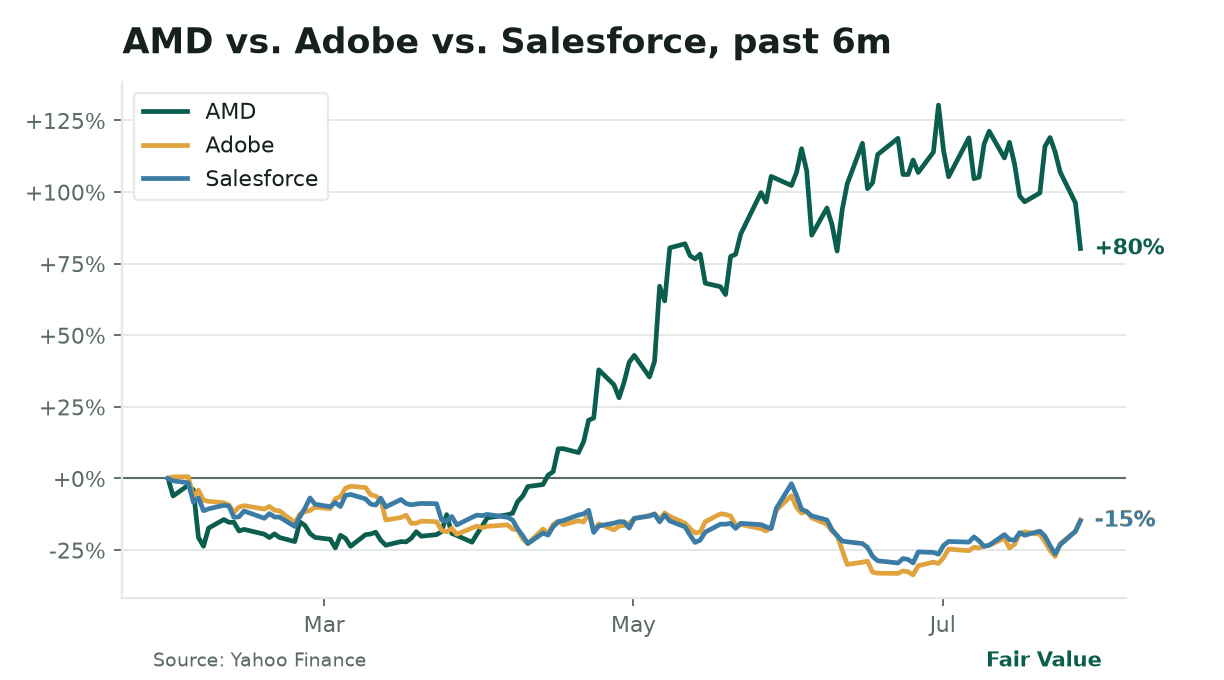
Tech splits: chips struggle, software climbs. AMD, Micron, and Intel fell another 8%+ Tuesday as higher rates weigh on hardware, while cash-rich software, Adobe (+4.8%), Salesforce (+4.5%), advances.
What’s moving markets
The Federal Reserve’s 2:00 PM rate decision could disrupt bond market calm, where corporate credit spreads, 0.81% for investment-grade, 2.81% for high-yield, remain near historic lows despite 10-year Treasury yields at 4.65%. Historically, spreads at these levels align with yields 30-50% lower, leaving bonds exposed if the Fed turns hawkish. A 10-basis-point widening in investment-grade spreads may signal the first crack.
Oil markets reacted to rising Middle East tensions, with Brent crude up 3.9% to $87.37 after Iran’s latest strikes. But the bigger issue is the Strait of Hormuz blockade, which has cut tanker traffic by 38% since it began, adding $200,000-$500,000 per diverted voyage. The closure threatens 20% of global oil supply, creating bottlenecks that stretch beyond crude to diesel and shipping logistics.
Tech sectors keep diverging along capital-intensity lines. Semiconductor stocks, AMD (-8.2%), Micron (-8.8%), and Intel (-5.9%), fell further Tuesday as higher borrowing costs hurt their capital-heavy models. Meanwhile, software stocks with strong cash flows, Adobe (+4.8%), Salesforce (+4.5%), and ServiceNow (+4.8%), rose, showing resilience in a rising-rate environment.
Today’s Fed decision (2:00 PM) and Powell’s press conference (2:30 PM) will set the tone.. A hawkish lean could widen credit spreads, pressuring rate-sensitive sectors like housing, autos, and semiconductors. A neutral or dovish tone may spark a relief rally in bonds and oversold growth stocks. The 2-year Treasury yield, now at 4.78%, is the key indicator: a move above 4.8% would signal credit markets bracing for prolonged tight policy.
Today’s Federal Reserve decision isn’t about the immediate move, it’s about whether policymakers will trigger a long-overdue adjustment in the $2.5 trillion corporate credit market, where spreads remain misaligned with current Treasury yields.
The gap:. Investment-grade corporate bonds yield just 0.81% over Treasuries, while high-yield spreads sit at 2.81%, both near record lows. Yet the 10-year Treasury yield is 4.65%, a level that historically demands spreads 30-50% wider than today’s. Two factors explain the disconnect: companies locked in low pandemic-era rates, avoiding a default wave after the Fed’s 2022-23 hikes, and the AI-driven tech boom, which flooded corporate bonds with yield-seeking capital.
Early signs of strain:. Semiconductor stocks, once AI favorites, now lead the sell-off, with AMD, Micron, and Intel down 15-30% this month as 10-year yields near 4.65% expose their capital-heavy models. Meanwhile, software stocks like Adobe, Salesforce, and ServiceNow, up 10-20% this month, thrive due to their cash-generative, asset-light structures.
Tech’s capital-intensity split widens. AMD (-15.7% month-to-date) and other chipmakers plunged as rates rose, while cash-rich software like Adobe (+4.8%) and Salesforce (+4.5%) advanced. The divergence shows how higher borrowing costs punish hardware but spare asset-light firms.
The Fed’s role:. If Powell signals prolonged high rates today, Treasury yields will likely climb further, forcing corporate bond spreads to widen to stay competitive. This would squeeze earnings for capital-intensive firms while triggering margin calls in leveraged credit portfolios. A 10-basis-point jump in investment-grade spreads, from 0.81% to 0.91%, could wipe out billions in bond values, with high-yield spreads potentially widening 20-30 basis points, hitting junk-bond ETFs and speculative borrowers hardest.
2:00 PM: Fed rate decision (hold expected; language on future hikes matters most)
▸
2:30 PM: Powell’s press conference (inflation vs. growth focus will drive markets)
▸
2-year Treasury yield: A rise above 4.8% signals credit markets preparing for prolonged tight policy
▸
High-yield ETFs (HYG, JNK): Gap-down opens would indicate spreading contagion
The core risk isn’t recession, it’s repricing. Even with steady growth, persistent Fed firmness could sharply reset capital costs, catching overleveraged firms and complacent bondholders off guard when refinancing arrives.
The big picture
Bonds signal caution, stocks ignore it
Financial markets are sending mixed signals, with bonds pricing in economic caution while stocks cling to a soft-landing story. One will prove wrong.
Bond market warnings:. The 2-year Treasury yield, most sensitive to Fed policy, rose 8 basis points Tuesday to 4.78%, while the 10-year edged up just 1 basis point to 4.41%. This flattened the yield curve to -37 basis points, its most inverted level since 2023. The inversion suggests bonds anticipate either slower growth or imminent Fed rate cuts, neither of which aligns with current equity optimism. Credit markets echo the caution: investment-grade spreads ticked up 1 basis point to 0.81%, and high-yield spreads widened 5 basis points to 3.52%. While not yet a distress signal, the moves reflect growing unease.
Equity resilience:. The S&P 500 has lost just 0.2% this month, and the Nasdaq, despite a 6.8% monthly decline, remains up 12% year-to-date. The divergence is stark: semiconductors (AMD -15.7%, Micron -28.4% month-to-date) collapse while software and consumer staples hold firm. With the VIX at 18.21, stocks show little distress.
The oil wildcard:. Brent crude’s 3.9% overnight surge to $87.37, driven by Iran’s missile strikes, complicates the Fed’s decision. The Strait of Hormuz blockade has cut tanker traffic by 38%, adding $200,000-$500,000 per voyage in costs. If oil stays above $90, the 10-year Treasury yield could grind higher, keeping credit markets under pressure and forcing the Fed to confront inflation again.
Scenario breakdown:.If the Fed leans hawkish (even with a hold):
▸
Treasury yields rise further, steepening the curve but pressuring credit spreads
▸
High-yield bonds underperform as risk premiums expand
Bonds rally, with the 10-year yield potentially dipping below 4.5%
▸
Credit spreads tighten as the “no landing” narrative regains traction
▸
Tech rebounds, particularly in software and AI segments less dependent on cheap debt
The resolution:. Today’s Fed decision will determine which market, bonds or stocks, has correctly priced the economic outlook. With oil adding inflationary pressure, the central bank’s guidance on rate cuts (or their absence) becomes the linchpin.
Ethereum ETFs outpace Bitcoin as tokenized assets grow
Bitcoin held steady with a 1.2% 24-hour gain to $64,713, but Ethereum is leading the crypto sector. Ethereum ETFs have attracted $96 million over three sessions, while Bitcoin ETFs saw $11.6 million in outflows. The shift suggests institutions are moving beyond the “Bitcoin first” approach, as Ethereum’s role in decentralized finance (DeFi), stablecoins, and tokenized real-world assets gains traction.
Ethereum traded flat Wednesday but remains up 3.2% on the week, outperforming Bitcoin for the first time in months. The key technical level is its 7-day high of $1,981; a breakout above that targets $2,100.
The structural shift:. Tokenized real-world assets (RWAs) now represent a record $37 billion in total value, covering Treasuries, private credit, and commodities. Wall Street’s embrace of blockchain-based assets is accelerating: Citi initiated coverage of tokenization platform Securitize with a “Buy” rating, calling it a “structural growth opportunity.” If institutional adoption continues, Ethereum’s smart-contract infrastructure could outperform Bitcoin in the second half of 2026.
Key indicators to watch:
▸
Ethereum ETF flows: Persistent inflows would confirm institutional rotation into “utility” crypto
▸
Tokenized Treasury yields: Platforms like Ondo Finance offer 5%+ yields, competing with money-market funds
Dollar strengthens as commodity currencies weaken
The U.S. Dollar Index (DXY) gained 0.2% this month to 101.33, with the most pronounced moves occurring beneath the surface. The dollar strengthened against commodity-linked currencies, the Australian dollar fell 0.6% Wednesday, and the Canadian dollar slipped 0.2%, as rising oil prices and fading risk appetite drove haven flows.
The Japanese yen (USD/JPY at 163.62) remains near multi-decade lows, while the euro (EUR/USD at 1.1396) struggles for momentum. The dollar’s ascent reflects two forces: geopolitical uncertainty (Middle East tensions) and the Fed’s policy stance, which, even if unchanged today, continues to outpace dovish shifts from other central banks.
Macro implications:
▸
A stronger dollar tightens financial conditions globally, pressuring emerging markets and U.S. exporters
▸
If oil sustains above $85, the dollar’s haven bid could persist, further weighing on commodity currencies
The Fed’s dilemma:. Hawkish rhetoric today could push the dollar higher, effectively tightening conditions without a rate hike. Conversely, a dovish tilt might weaken the dollar, but only if oil prices cooperate.
Global developments
Strait of Hormuz blockade continues as Iran tensions rise
Iran’s overnight missile strikes on U.S. forces mark the latest escalation in a six-month conflict with growing economic consequences. The Strait of Hormuz remains closed to commercial traffic, with only Iranian- and Chinese-affiliated vessels attempting the northern passage. Tanker transits have plunged 38% since the blockade began, reducing Persian Gulf oil flows to 41% of prewar levels and disrupting global shipping beyond crude to liquefied natural gas (LNG), chemicals, and containerized goods.
The detours add $200,000-$500,000 per voyage in fuel and insurance costs, with delays compounding supply chain pressures. Brent crude responded with a 3.9% overnight jump to $87.37 but remains below the $100+ spikes seen earlier this year, as markets price in a prolonged stalemate rather than all-out war. Iran continues limited oil exports, approximately 1 million barrels per day, to China via back channels, providing Tehran with revenue while muting the supply shock.
Three critical thresholds:
▸
$90/bbl for Brent: Above this level, the Fed’s inflation fight becomes significantly harder
▸
$200,000: The additional cost per tanker voyage from rerouting; cumulative costs will pressure freight rates
▸
38%: The reduction in tanker traffic since the blockade, if sustained, shipping bottlenecks will worsen
China’s role:. Beijing’s continued purchases of Iranian oil, roughly 1 million barrels daily, keep some supply flowing but also fund Tehran’s military operations. A U.S. crackdown on these transactions could send oil prices surging anew.
China’s oil demand growth stalls as economy shifts
China’s decades-long role as the marginal driver of global oil demand is fading. A Wall Street Journal report highlights that the nation’s oil consumption has become “far more flexible” than previously assumed, due to three structural shifts: slower economic growth as the post-pandemic rebound dissipates, rapid gains in energy efficiency (accelerated by EV adoption and industrial upgrades), and strategic stockpiling (China built reserves when prices were low and is now drawing them down).
The result: Oil prices now react more to geopolitics than Chinese demand. When the Strait of Hormuz closed in February, traders expected China to aggressively purchase discounted Iranian barrels. Instead, Beijing has been selective, buying only on price dips and relying on its stockpile. This marks a permanent shift: China is no longer the “buyer of last resort” for global crude.
Investment implications:
▸
Gasoline price spikes during Middle East crises may be more muted if China remains on the sidelines
▸
Oil majors (Exxon, Chevron) could underperform if demand growth stays weak
Corporate highlights
AMD’s $14 billion data-center deal fails to stem decline.. Shares fell 8.2% Tuesday to $454.62, extending its monthly loss to 15.7%, despite announcing a 15-year, $14 billion infrastructure partnership with Core Scientific. The deal covers 529MW of data-center capacity but failed to offset concerns about slowing AI capital expenditures amid rising rates.
Micron’s memory-chip rout accelerates.. The stock dropped 8.8% Tuesday to $820.53, bringing its monthly decline to 28.4%, as the company faces a triple threat: memory prices down ~15% this quarter, rising borrowing costs on its $10 billion debt load, and questions about AI demand sustainability.
Coca-Cola’s pricing power delivers earnings beat.. Shares rose 5.0% Tuesday to $88.27 after the beverage giant reported 11% organic revenue growth, driven by successful price increases. The stock is now up 6.8% this month, outperforming the S&P 500 by 7 percentage points.
Boeing returns to profitability.. The aerospace manufacturer climbed 4.8% Tuesday to $221.56 after posting its first quarterly profit since 2021, led by a 15% year-over-year gain in defense and services revenue. The company’s backlog of 4,500+ unfilled orders (worth ~$500 billion) provides a long-term cushion.
Adobe’s AI tools drive 20% monthly gain.. The software company rose 4.8% Tuesday to $249.18 after exceeding earnings estimates, with AI-powered tools like Firefly and Sensei generating $1.2 billion in annualized revenue. Adobe is now among the S&P 500’s top monthly performers, up 20.7%.
Policy & regulation
Fed’s credibility tested with today’s decision
The Federal Reserve’s 2:00 PM rate decision goes beyond the immediate policy call, it’s a test of whether the central bank can maintain market confidence while balancing persistent inflation risks and emerging growth concerns.
The challenge stems from the Fed’s repeated forecast missteps. In June, policymakers projected three 2026 rate cuts; now, with Brent crude above $85 and core inflation stuck at 3.5%, those cuts appear unlikely. If the Fed acknowledges this shift today, it risks reinforcing perceptions that it remains behind the curve.
The hawkish case:
▸
Oil prices rising (Brent +3.9% overnight to $87.37)
▸
Wage growth persistent (average hourly earnings up 4.1% year-over-year)
▸
AI-driven tech capex up 30% this year, sustaining demand
The dovish case:
▸
Consumer spending slowing (June retail sales grew just 0.1%)
▸
Housing cooling (mortgage rates at 6.58% crush affordability)
▸
Credit spreads tightening (markets pricing in a soft landing)
Most likely outcome:. A hold with hawkish language, no rate change, but a warning that cuts are delayed. This would:
▸
Lift the dollar, pressuring exporters and emerging markets
▸
Widen credit spreads, particularly in high-yield
▸
Weigh on rate-sensitive sectors (semiconductors, housing, autos)
Market mechanics
Credit spreads: The coming adjustment
A disconnect persists between Treasury yields and corporate credit spreads, setting the stage for a potential squeeze. With the 10-year Treasury at 4.65%, investment-grade spreads at 0.81% and high-yield at 2.81% are 30-50% tighter than historical norms for this yield environment.
The trigger:. If the Fed signals “higher for longer” today:
▸
Treasury yields rise further, forcing corporate bond spreads to widen to attract buyers
▸
Earnings revisions turn negative for leveraged firms, raising default risks
The domino effect:
▸
Investment-grade spreads widen 10-20 bps → corporate bond ETFs (LQD, HYG) sell off
▸
High-yield spreads widen 20-30 bps → junk-bond funds see outflows
Private credit: The $1.6 trillion shadow lending system
While banks and public bonds dominate headlines, private credit, a $1.6 trillion market where non-bank lenders (Blackstone, Apollo, KKR) extend loans to companies, has become a critical, if opaque, pillar of corporate finance.
How it works:. A mid-sized software firm seeking $50 million for expansion might face a bank offering 7% with strict covenants, or a private credit fund charging 10-12% for greater flexibility (fewer covenants, longer terms, faster approval). Borrowers pay a premium for speed and leniency; lenders accept higher risk for higher returns.
Post-2008 expansion:. Regulatory crackdowns (Dodd-Frank, Basel III) forced banks to retreat from riskier lending. Private credit filled the void, particularly for:
▸
Mid-market companies (too large for venture capital, too small for public bonds)
▸
Leveraged buyouts (private equity firms use private credit to fund acquisitions)
▸
Distressed borrowers (banks avoid them; private lenders charge premiums for the risk)
The transparency problem:. Unlike banks, private credit funds disclose little. No quarterly earnings calls, no detailed loan books. Risks remain hidden until defaults emerge. Example: In 2022, private credit heavily financed commercial real estate, just as office vacancies surged. When those loans defaulted in 2023, the problem was already advanced because the data was obscured.
Connection to today’s markets:. When Treasury yields rise (as they have in 2026), all fixed-income assets reprice, including private credit. But because these loans are illiquid, the pain surfaces later, often as defaults. Firms that borrowed at 8% in 2021 now face refinancing at 12%+, a cash-flow crisis in the making.
The debate:. Is private credit stabilizing (filling a bank gap) or destabilizing (creating hidden risks)? The answer is both, it funds growth but amplifies downturns due to its lack of transparency.
Concept 18 of 83 in the Fair Value course.
Key events this week
▸
Wednesday, July 29: U.S. Federal Funds Rate decision (2:00 PM ET) and FOMC Press Conference (2:30 PM ET). The Fed is expected to hold rates steady, but the policy tone will determine whether credit spreads widen or equities rally.
▸
Thursday, July 30: U.S. Advance GDP (forecast: 2.1% q/q) and Core PCE (forecast: 0.2% m/m). GDP reveals economic momentum; PCE is the Fed’s preferred inflation gauge.
▸
Thursday, July 30: Bank of England rate decision (forecast: hold at 3.75%). The BOE is caught between stubborn inflation and a weakening housing market.
▸
Friday, July 31: Canada GDP (forecast: 0.2% m/m). A weak print could push the Bank of Canada toward rate cuts.
Question for tomorrow:. If the Fed adopts a more hawkish tone than expected, what does that do to rate-cut odds, the 2-year yield, and the dollar? We’ll resolve this in tomorrow’s edition.
Not financial advice.This is not financial advice. Past performance is not indicative of future results. Investing involves risk, including the potential loss of principal. The information provided here is for informational purposes only and should not be considered a recommendation to buy or sell any security.
Data sources: Bloomberg, FactSet, Federal Reserve, U.S. Treasury, CME Group, CoinGecko, and publicly available filings. Prices and levels reflect previous trading day’s close or latest available intraday levels unless otherwise noted. ```