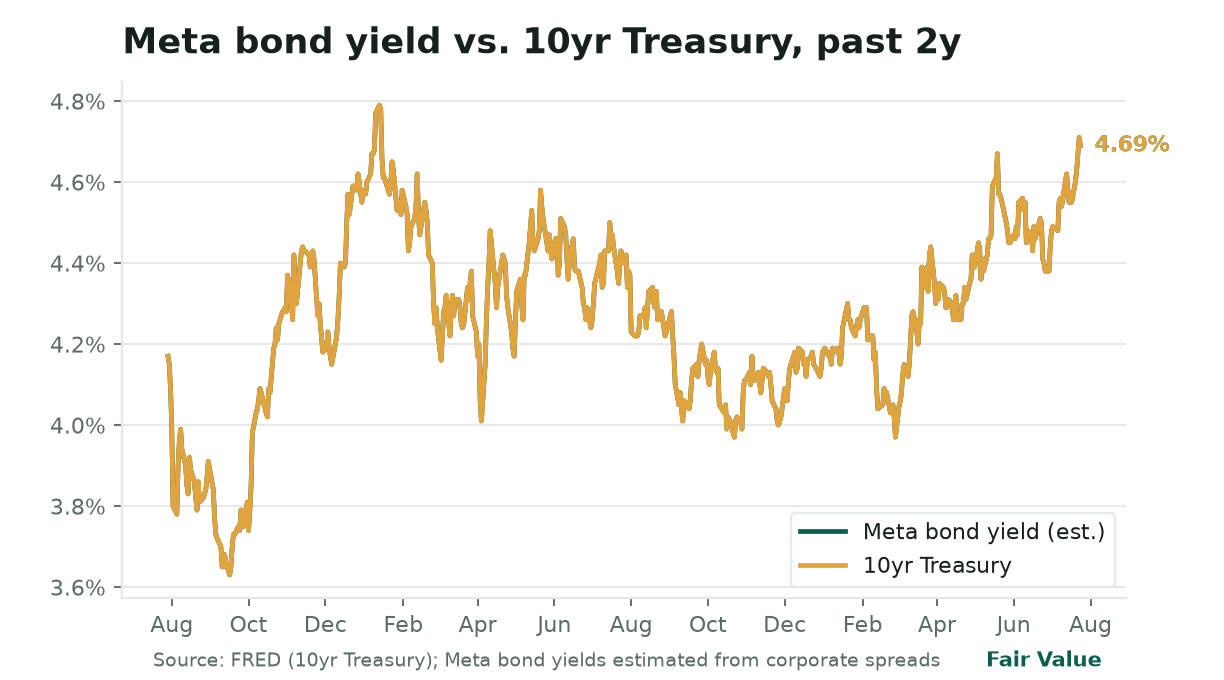
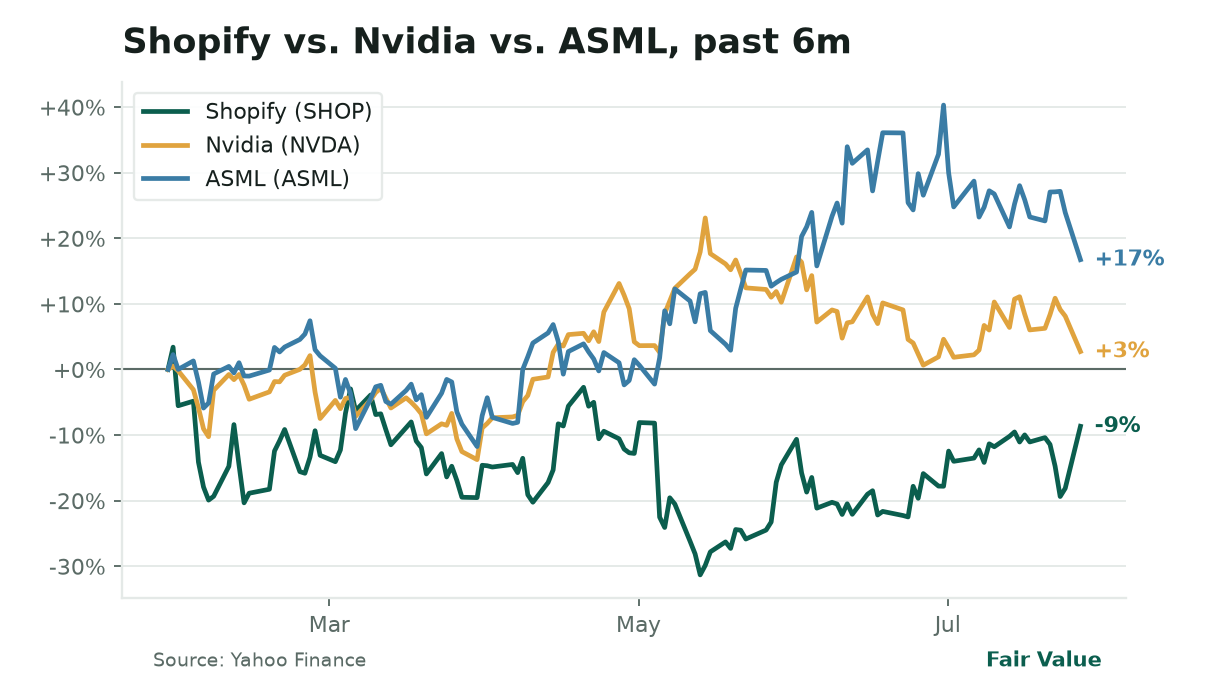
AI’s $725B capex surge meets higher borrowing costs. Meta’s $12.5 billion bond deal for data centers carried a higher yield than last year’s, showing lenders now want more for AI projects. Chipmakers (NVDA -5.0%, AMD -5.2%) fell while cash-rich software (SHOP +11.5%, CRM +6.1%) rose.
▸
Oil’s $100 spike reverses, but inflation risks linger. Brent crude dropped 9.2% to $86.12 on a temporary U.S.-Iran truce, yet the 10-year Treasury yield stayed at 4.69%. The Fed’s July 29 call now depends on whether this pullback lasts.
▸
The dollar tightens conditions without Fed action. The DXY index hit 120.71, a four-month high, pressuring commodity currencies (AUD -0.39%, CAD -0.21%).
What’s happening today
A 9.2% overnight drop in Brent crude to $86.12 grabs attention, but the deeper issue is rising borrowing costs for AI projects as the Fed prepares its next move.
The oil selloff followed a U.S.-brokered pause in Iran-related tensions, pulling energy stocks (XLE -2.11%) and inflation expectations lower. The 10-year Treasury yield dipped to 4.69%, with markets now expecting the Fed to hold, not hike, on July 29. Still, the Strait of Hormuz remains volatile; any escalation could push oil and inflation back up.
The sharper reaction came from AI’s funding challenges. Meta’s $12.5 billion bond deal for data centers priced at a higher yield than its 2025 issuance, a clear sign lenders now want more for AI risk. Hardware makers took the hit: Nvidia (NVDA -5.0%), AMD (AMD -5.2%), and ASML (ASML -5.8%) all fell Monday. Meanwhile, software firms with steady cash flow, Shopify (SHOP +11.5%), Salesforce (CRM +6.1%), Adobe (ADBE +5.6%), rallied. The takeaway: investors favor earnings clarity over growth bets.
AI funding costs surge. Meta’s latest $12.5B bond deal for data centers priced at ~5.0%, up from ~4.2% in early 2025, mirroring the 10-year Treasury’s climb to 4.69%. A 0.8% rate hike on a $20B project adds $160M in annual interest, squeezing AI profit margins.
The U.S. dollar (DXY) climbed to 120.71, its highest since March, effectively tightening global financial conditions. Commodity currencies weakened, with the Australian dollar (AUD -0.39%) and Canadian dollar (CAD -0.21%) under pressure. Tonight’s Australian CPI report (forecast: +0.2% month-over-month) could either confirm the dollar’s strength or trigger a reversal.
Key point:. Oil’s retreat gives the Fed room, but the AI funding squeeze is a deeper challenge. The core question: Can AI spending generate enough returns to cover rising borrowing costs?
The big story
AI’s $725 billion spending spree hits a financing wall
Software thrives, hardware dives. Shopify (SHOP +11.5%) and cash-rich software surged as AI financing costs rose, while capital-heavy Nvidia (NVDA -5.0%) and ASML (ASML -5.8%) fell. The split reflects investors favoring earnings clarity over growth bets amid higher rates.
For 18 months, Big Tech followed a simple rule: spend now, profit later. Meta, Microsoft, and Alphabet poured billions into AI data centers, betting future revenue would justify today’s costs. Markets rewarded this approach, sending chip stocks to record highs.
That’s getting harder. Meta’s $12.5 billion bond deal for data centers priced at a higher yield than its 2025 offering, a warning that lenders now demand more for AI risk. This isn’t just Meta’s problem; it’s a sector-wide shift.
Why it stings.. AI data centers require massive cash. A single 10-gigawatt facility can cost $20 billion to build and $2 billion a year to run. Until recently, firms funded these with cash and cheap debt. But with the Fed holding rates at 5.25%-5.50% and the 10-year Treasury near 4.7%, borrowing costs have jumped. Meta’s latest debt carries about 5.0% interest, up from roughly 4.2% in early 2025. On a $20 billion project, that 0.8% increase means $160 million more in annual interest, a direct hit to profits.
Markets reacted clearly: sell hardware, buy software. Nvidia (NVDA -5.0%), AMD (AMD -5.2%), and ASML (ASML -5.8%) fell Monday, while Shopify (SHOP +11.5%), Salesforce (CRM +6.1%), and Adobe (ADBE +5.6%) rose. The logic is straightforward: software firms generate steady revenue with lower capital needs, making them less sensitive to rate hikes. Hardware makers face a double challenge: higher financing costs and uncertainty over AI returns.
This shift comes as AI spending hits record levels. The so-called Magnificent Seven (Alphabet, Amazon, Apple, Meta, Microsoft, Nvidia, Tesla) are set to spend $725 billion on capex in 2026, double last year’s total. Yet investors are growing skeptical: Where’s the payoff? Alphabet’s stock fell 7% last week after raising its 2026 capex guidance to $195-$205 billion. The market isn’t rejecting growth, it’s demanding proof that growth won’t require endless capital, especially as that capital gets pricier.
The Fed’s July 29 decision adds another layer. A hold keeps financing costs high; a hike pushes them higher. Either way, the era of cheap money for AI expansion is over. This doesn’t kill the AI boom, but it raises the bar. Companies must now show their spending can drive revenue, not just burn cash chasing growth.
Two key implications:
▸
Tech is splitting. Cash-flow-positive software is winning; capital-heavy hardware is struggling.
▸
Fed policy now shapes tech valuations directly. Higher rates don’t just affect bonds, they determine whether AI projects stay viable.
The $725 billion question:.Can AI revenue justify its spending? If yes, the software rally could widen. If not, tech stocks may soon trade on cash flow, not growth potential, a much tougher standard.
The big picture
Bonds flash caution as stocks hold steady
Bonds are sending a clear signal: proceed carefully. The 10-year Treasury yield sits at 4.69%, near 2024 highs, while the yield curve stays inverted (2-year: 4.33%, 10-year: 4.69%), a classic recession warning. Yet stocks remain resilient. The S&P 500 is flat for July, while the Nasdaq struggles under tech’s capex concerns. The contrast is stark, and rising AI financing costs are the main driver.
Commodities send mixed signals:
▸
Oil leads the decline. Brent crude fell 9.2% to $86.12 as U.S.-Iran tensions eased, though the Strait of Hormuz stays volatile. Any renewed conflict could quickly reverse the drop.
▸
Natural gas (NG=F -0.72%) holds at $2.78/MMBtu. Gold (GC=F -1.05%) and silver (SI=F -1.6%) retreated as the dollar strengthened.
▸
Copper (HG=F -0.12%), a growth bellwether, stayed flat. For now.
The U.S. dollar (DXY +0.11%) acts as a silent tightener.. At 120.71, near a four-month high, it pressures commodity currencies like the Australian dollar (AUD -0.39%) and Canadian dollar (CAD -0.21%). A stronger dollar makes U.S. exports pricier and imports cheaper, which could cool inflation, but also weigh on corporate earnings.
Crypto waits for a spark.. Bitcoin (BTC -0.58%) and Ethereum (ETH -0.88%) traded flat, with Bitcoin’s 24-hour volume ($5.9 billion) below its seven-day average ($12.4 billion). The market remains in wait-and-see mode ahead of the Fed’s move.
The VIX (18.88) hovers near a one-month high.. This isn’t panic, it’s recalibration. Investors are pricing in risks: slowing AI capex, a possible oil rebound, and the chance that the Fed’s pause isn’t a green light. Bonds show caution; stocks test resilience. The bond market’s restraint is the telling sign.
Around the world
Geopolitical tensions keep oil on edge
Brent crude’s 9.2% drop to $86.12 followed a U.S.-mediated ceasefire with Iran, but the relief may not last. Saudi Arabia blamed recent attacks on its oil sites on Iran-backed groups, while Yemen’s Houthi rebels continue threatening Red Sea shipping. The Strait of Hormuz remains a critical chokepoint, with traffic still below pre-conflict levels. One wrong move could send oil, and inflation, soaring again.
China’s tech ambitions face hurdles
China’s AI push runs into two major obstacles: U.S. export controls and a slowing economy. Meta’s higher-yield bond deal serves as a warning for Chinese firms relying on foreign funding. Meanwhile, Washington’s push to onshore critical mineral production hits practical limits; former President Trump’s 2027 deadline to cut Chinese minerals from defense supply chains looks increasingly unrealistic.
Europe’s green transition meets economic reality
Changes to the EU’s AI Act delay compliance for high-risk AI systems until 2027-2028, though core transparency rules kick in next month. This creates uncertainty as companies like Mercedes-Benz cut sales forecasts amid weak demand in China.
Bottom line:. The global economy is caught between deglobalization and decarbonization, both expensive. Oil’s pullback offers temporary relief, not a fix. China’s tech goals clash with funding constraints and supply-chain limits, while Europe’s green shift grapples with economic pragmatism.
Companies in focus
Tech’s funding crunch reshapes leadership
Shopify (SHOP +11.5%) leads software’s rise.. Investors are shifting to defensive, cash-rich software as AI financing costs climb. Shopify’s 11% monthly gain reflects this trend.
Palantir (PLTR +7.0%) gains from AI defense contracts.. The stock is up 13.68% this month as its AI platforms win traction with U.S. defense and intelligence agencies.
Nvidia (NVDA -5.0%) wipes out last week’s gains.. The AI chip leader fell as markets penalize capital-heavy hardware amid rising financing costs.
AMD (AMD -5.2%) extends its decline.. The semiconductor sector faces dual pressures: higher borrowing costs for AI projects and potential slowdowns in Chinese demand.
Energy and defense updates
Coinbase (COIN +5.8%) outperforms flat crypto.. The exchange rose as traders positioned for a rebound in transaction volumes, even as Bitcoin (BTC -0.58%) stayed range-bound.
Exxon (XOM -1.38%) and Chevron (CVX -2.46%) fall with oil.. Both stocks retreated as crude prices dropped but remain sharply higher for the month (XOM +13.75%, CVX +12.78%).
Ford (F) lands a $1.5 billion Army truck deal.. The automaker secured its largest military vehicle contract since the Cold War, producing next-gen tactical trucks.
Luxfer (LXFR) agrees to a $463 million buyout.. The UK-based materials manufacturer accepted a $17.37-per-share offer from Wynnchurch Capital, a 20% premium.
From Washington
Fed’s July 29 decision: Hold, but with a hawkish tone
Last week’s oil surge had traders betting on a rate hike. With Brent now down 9.2% to $86.12, the 10-year Treasury yield at 4.69% (from 4.71%), and markets pricing in a hold, the Fed has room to pause.
Expect rates to stay at 5.25%-5.50%, but with cautious language, leaving the door open for future hikes if oil or wages reignite inflation.
The bigger dynamic? The dollar is doing the tightening. The DXY index rose to 120.71, its highest since March, weakening commodity currencies like the Australian and Canadian dollars. A stronger dollar tightens global financial conditions, acting like a rate hike.
Tonight’s Australian CPI report (forecast: +0.2% month-over-month) matters. A higher-than-expected reading would support the Fed’s cautious stance; a miss could ease the dollar’s climb.
Key takeaway:. The Fed’s pause isn’t a policy shift. It’s a wait-and-see approach, with the dollar and oil carrying the inflation fight. Bonds reflect a hold, but the risk of more hikes hasn’t vanished. It’s just delayed.
Under the hood
FOCUS: Rising AI financing costs squeeze high-growth tech
WHY NOW:. Meta’s $12.5 billion data-center bond deal priced at a higher yield than its 2025 issuance, confirming lenders now demand more for AI projects. With Treasury yields near 4.7% and corporate credit spreads tight, margins for new tech debt are shrinking.
THE CHAIN:. AI frontier → Fed policy → bond/credit markets → stock valuations → sector shifts
THE READ:. AI compute capacity has hit a financing wall. In early 2025, AI data-center debt priced at about 4.2% (Treasury yield plus a 0.6% spread). July 2026’s Meta deal sits at roughly 5.0% (Treasury plus a 0.3% spread), reflecting the Fed’s 5.25%-5.50% target range and higher risk-free rates.
For a 10-gigawatt data center, a 0.8% rate increase adds $200 million in annual interest, a direct earnings hit. Corporate bond markets show why this pressures stocks:
▸
Investment-grade spread: 0.80%
▸
High-yield spread: 2.79%
Both are tight given the 4-5% Treasury backdrop. Narrow spreads mean new debt competes with stocks for capital. Higher borrowing costs erode AI capex returns, dragging down earnings growth for Nvidia (NVDA -5.0%), AMD (AMD -5.2%), and ASML (ASML -5.8%).
Meanwhile, defensive software, Shopify (SHOP +11.5%), Palantir (PLTR +7.0%), Adobe (ADBE +5.6%), gains traction. Their recurring revenue is less sensitive to financing costs.
The critical question:. Will firms cut costs (e.g., better chip performance) or delay capex, potentially slowing revenue growth? The latter could trigger a broader tech earnings slowdown.
WATCH:. August-September AI-related bond deals. If priced at ≥5.0% (Treasury plus a 0.3% spread) and AI capex growth slows to <5% year-over-year, the financing squeeze becomes material.
Worth learning today: How banks create credit
Yesterday’s question remains open:.If Australia’s CPI month-over-month tops the 0.2% forecast, which way would the 2-year yield move, and why? The data is due tonight. We’ll break it down tomorrow.
Today’s lesson: How banks create credit
Start with the basics:. Meta’s $12.5 billion bond deal didn’t just move existing money, it created new deposits. When a bank issues a loan, it also generates a deposit. That deposit is new money in the economy.
How it works:
▸
Loans create deposits. When Meta borrows $12.5 billion, the bank credits Meta’s account with $12.5 billion. That deposit didn’t exist before.
▸
Credit drives economic cycles. More lending means more deposits, which means more spending power. This is how credit expansion fuels growth.
▸
The catch: Borrowers must repay. If Meta’s data centers succeed, the loan is repaid, and the deposit disappears without harm. If they fail, the bank holds a bad loan, and the deposit still vanishes. This is how credit crunches start.
Connection to today:. Banks don’t just store money, they multiply it through fractional reserve lending. Recall the [yield-price seesaw]: as rates rise (to 4.7%), the present value of loan repayments falls, making banks more cautious. This explains why Meta’s debt deal priced higher: lenders question whether AI projects can generate enough cash flow to cover the higher costs.
Why it matters now:. The AI capex boom is colliding with this credit cycle. As financing costs rise, banks lend less, and new money creation slows. This isn’t just Meta’s issue, it limits the entire tech sector’s ability to fund growth.
For investors:
▸
Higher rates don’t just affect mortgages, they restrict the economy’s ability to create spending power.
▸
When the Fed tightens, it’s not just about the federal funds rate. It’s about the credit tap closing.
Concept 17 of 83 in the Fair Value course.
Tomorrow’s setup:. If Australia’s CPI year-over-year (forecast: 4.0%) exceeds expectations, which sector would likely fall first, tech or energy, and why? Trace the chain: CPI → Fed expectations → interest rates → stock valuations. We’ll resolve this Wednesday.
Not financial advice.This brief is for informational and educational purposes only and does not constitute investment advice or a recommendation to buy or sell any security.
Data sources: Macro indicators via FRED® (Federal Reserve Bank of St. Louis); energy data via U.S. Energy Information Administration (EIA); auction data via U.S. Treasury Fiscal Data; corporate filings via SEC EDGAR; market prices via Yahoo Finance; earnings calendar via Financial Modeling Prep. ```