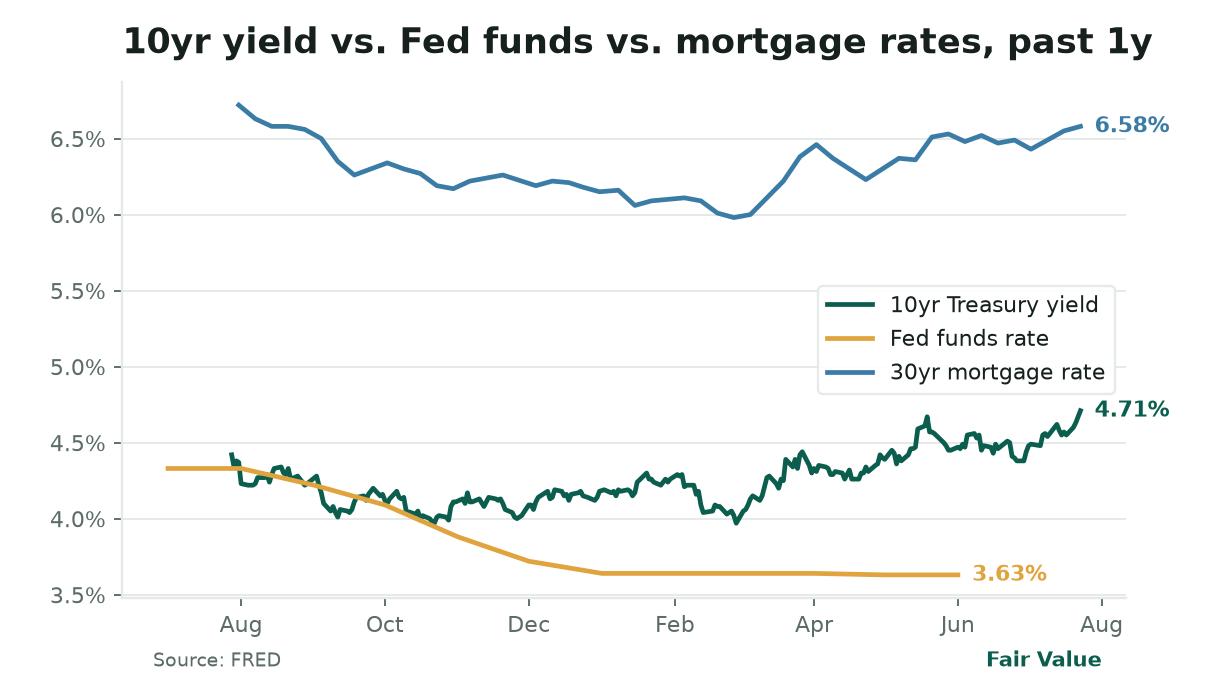
Brent crude’s $100 spike vanished overnight, complicating the Fed’s July 29 decision. Oil prices plunged, Brent down 9.2% to $87.86, after President Trump paused Iran strikes, easing inflation pressure that had pushed the 10-year Treasury yield to 4.71%, its highest since 2024. The Fed now faces a dilemma: hold rates and risk another oil-driven inflation surge, or raise them as tech and crypto already show strain.
▸
AI’s $250 billion hardware push runs into commodity oversupply. Nvidia and OpenAI may back a U.S.-funded AI data center, but plunging lithium prices, now at five-month lows, reveal the challenge: tech’s raw-material demand is clashing with oversupply, squeezing margins before construction even begins.
▸
Defensive stocks aren’t rallying because investors fear a crash, they’re rallying because bond math demands it. With the 10-year yield at 4.71%, high-growth tech (Intel -30.5% this month) is under pressure, while telecoms (Verizon +5.8%) and industrials (Schlumberger +11%) advance. The VIX at 17.58 isn’t signaling panic; it’s recalibrating where cash flows hold value.
What's happening today
Markets opened the week with a sharp reversal: the inflation narrative that dominated July, $100 oil, rising bond yields, and a likely Fed hike, unraveled overnight. Brent crude plunged 9.2% to $87.86, its steepest drop since March, after President Trump halted planned Iran strikes, pulling WTI down 7.6% to $82.49. The move directly undercuts the inflation case that had driven the 10-year Treasury yield to 4.71%, a level last seen in late 2024.
The ripple effect:.Mortgage rates, which had climbed toward 6.75%, may stabilize if oil’s retreat holds. Yet bonds aren’t rallying. Yields remain elevated, and the VIX at 17.58, down from last week’s 18.7 but still above its long-term average, signals caution, not relief. The Fed’s July 29 decision, once widely expected to deliver a hike, is now uncertain.
Equities are diverging sharply. The Nasdaq dropped 1.15% Friday, led by semiconductors: Intel (-7.9%), ARM (-8.1%), and Marvell (-7.2%) extended their monthly declines, with Intel now down 30.5% since June. In contrast, telecoms and industrials surged, Verizon (+5.8%), AT&T (+5.1%), and Schlumberger (+11%), as investors shifted into sectors with stable cash flows. The pattern is clear: with the 10-year yield at 4.71% and credit spreads tight, high-beta tech’s cost of capital is rising, while defensive plays with predictable earnings look relatively cheaper. The National Financial Conditions Index at -0.55 (indicating easy liquidity) enables this rotation, but bonds and stocks are sending mixed signals: bonds price restraint, while equities pick winners.
This week’s data will determine the next move. The Fed’s rate decision on Wednesday is the headline event, but Australia’s CPI report tomorrow (forecast: 4.0% y/y) and the U.S. advance GDP reading Thursday (forecast: 2.3%) could reshape the narrative. If oil stays below $90 and economic data cooperates, the Fed may pause. If Middle East tensions flare again or GDP surprises to the upside, hawkish bets will return. Meanwhile, the dollar (DXY at 101.27) and gold at $4,099 suggest safe-haven demand hasn’t faded. Crypto holds steady: Bitcoin flat at $65,250, Ethereum up 0.5% to $1,965, both above their monthly lows.
The big story
Oil’s $100 surge vanishes, leaving the Fed with no clear path
Oil’s overnight collapse, Brent down 9.2% to $87.86, its sharpest one-day drop since March, did more than erase last week’s gains. It dismantled the inflation argument that had pushed the Fed toward a July hike. The catalyst: President Trump’s decision to pause strikes on Iran. The consequences run deeper.
Why the reversal matters:. Oil directly accounts for 8% of CPI (via gasoline) and influences another 12% indirectly through transport and supply chains. When Brent surged from $84 to $100 in 10 days, it added 0.3 percentage points to annualized CPI, according to Goldman Sachs, enough to push the Fed’s core PCE measure back above 2%. Bond markets reacted: the 10-year yield climbed from 4.4% to 4.71% in five sessions, while the 2-year yield hit 4.37%, its highest since November.
Now, that trade is unwinding fast. The 10-year yield dropped 8 basis points overnight to 4.63%, and fed funds futures now price just a 30% chance of a hike on Wednesday, down from 50% last week. Yet bonds aren’t rallying. The 10-year remains above 4.6%, and the yield curve stays flat (2s10s spread: 0.36%). Translation: Bonds aren’t convinced this relief will last.
Two developments will dictate the next move:
▸
Durability of the Iran ceasefire. If tensions escalate, oil could quickly reclaim $95, forcing the Fed to act.
▸
EIA crude inventories (Wednesday). A drawdown in U.S. stockpiles would signal demand still outstrips supply, even with geopolitical easing.
The Fed’s dilemma:. After finally bringing core PCE to 2.1% in June, the central bank now faces:
▸
Pausing this week and risking another inflation flare-up if oil spikes again.
▸
Raising rates into a slowing economy, further tightening financial conditions.
This explains why the dollar (DXY at 101.27) and gold ($4,099) are both rising. The dollar attracts safe-haven flows, while gold prices reflect the possibility that the Fed’s pause is temporary, and that higher rates are here to stay.
Three real-world impacts:
▸
Mortgages: The 30-year fixed rate, at 6.58%, may stabilize if the 10-year yield holds below 4.7%. But don’t expect a sharp decline: the Fed’s stance keeps borrowing costs elevated.
▸
Gas prices: The national average, which hit $3.89 last week, should ease if crude stays below $90. However, refiners operating at 96.1% capacity mean any relief will take time to reach consumers.
▸
Stocks: The rotation into defensives, telecoms, utilities, and industrials outperforming tech, will persist as long as bond yields stay above 4.5%. High-growth stocks suffer because their future earnings lose value when discount rates rise.
The big picture
Bonds signal caution, stocks pick winners
Bond math crushes housing and tech. The 10-year yield’s climb to 4.71% (highest since 2024) pushed mortgage rates toward 6.75% and crushed high-growth stocks like Intel (-30.5% this month). Even with oil’s drop, yields remain elevated, keeping borrowing costs high and defensive sectors (Verizon +5.8%) in favor.
Bonds are flashing warning signs, while equities split into clear camps. The Nasdaq fell 1.15% Friday, extending its monthly decline to 4.46% as semiconductor stocks, Intel (-7.9%), ARM (-8.1%), and Marvell (-7.2%), led the slide. These were once market leaders when AI capital expenditures seemed limitless. Now, with the 10-year yield at 4.71% and the National Financial Conditions Index at -0.55, growth stocks face higher financing costs. The math is unforgiving: when discount rates rise, the present value of future earnings falls.
Meanwhile, defensive sectors are surging. Telecoms (Verizon +5.8%, AT&T +5.1%), industrials (Schlumberger +11%, ServiceNow +7.4%), and utilities (XLU +0.22%) lead the market. This isn’t a panic, it’s a recalculation. With the VIX at 17.58 (down from 18.7 but still above historic lows), investors aren’t fleeing; they’re rotating into sectors less sensitive to rising rates. The investment-grade option-adjusted spread at 0.79% shows credit markets aren’t demanding extra risk premiums, which favors defensive stocks.
The dollar’s strength (DXY at 101.27) ties it all together. A strong dollar pressures commodities (hence oil’s drop) and tightens global financial conditions, weighing on emerging markets. But it also reflects U.S. resilience: the Atlanta Fed’s GDPNow tracker forecasts 2.3% Q2 growth, and jobless claims remain low at 187,000. The Fed’s bind: labor markets are tight, but inflation is pulled in two directions, oil’s drop is deflationary, while wage growth (3.9% y/y) remains inflationary.
This week’s pivots:
▸
Tuesday:Australia’s CPI (forecast: 4.0% y/y). A higher-than-expected print could reignite global inflation concerns.
▸
Wednesday:Fed decision + Powell’s press conference. Bonds price a 70% chance of a pause, but the dot plot could hint at future hikes.
▸
Thursday:U.S. advance GDP (forecast: 2.3%). Strong data keeps the Fed on hold; weak data revives rate-cut speculation.
Bottom line:. Markets are flush with liquidity but pressured by rates. Cash is abundant (NFCI at -0.55), but its cost is high (10-year at 4.71%). Defensive stocks win because they don’t need rate cuts to thrive. Tech struggles because its valuations depend on cheap money. The Fed is caught between inflation that may prove transient and a labor market that’s still too hot to ignore. This week’s data will tip the scales, but for now, investors are favoring sectors that can weather higher rates without Fed support.
Around the world
Middle East: Ceasefire, not resolution
The market-moving volatility isn’t driven by new conflict, it’s the fragile pause in existing ones. Trump’s halt on Iran strikes sent Brent crude down 9.2%, easing immediate oil supply threats. But the relief is temporary: the Strait of Hormuz remains closed, and Houthi attacks in the Red Sea persist. 25% of global oil transits these chokepoints. Rerouting adds cost and delays.
China: Tech ambitions meet commodity realities
China made two moves last week with global implications. First, it tightened capital controls to stem yuan outflows (USD/CNY at 6.754), prioritizing stability over growth. Second, CXMT, a state-backed chipmaker, surged in its Shanghai debut, underscoring Beijing’s push for AI semiconductor self-sufficiency. The U.S. responded by closing a loophole that allowed foreign-owned fabs in China to import advanced chip equipment without licenses.
Meanwhile, lithium prices hit five-month lows as idled mines in China and Australia restart, flooding the market. The drop hurts EV battery manufacturers but benefits consumers: cheaper lithium could lower EV prices by 2027.
Europe: ECB’s subtle shift
The ECB’s Thursday rate decision is flying under the radar. No change is expected to the deposit rate (2.40%), but guidance could shift. Eurozone inflation is cooling (June CPI: 2.5%), but wage growth remains sticky. If the ECB signals future cuts, the euro (EUR/USD at 1.14) could weaken, aiding U.S. exporters.
Japan: BOJ’s yen dilemma
The Bank of Japan’s Wednesday meeting is the wild card. Japan remains the last major economy with negative rates, but with inflation above 2% and the yen (USD/JPY at 163.54) at 39-year lows, pressure is building. Even a hint of policy normalization could send the yen soaring, disrupting global bond markets.
Companies in focus
AI’s hardware push confronts commodity oversupply
Nvidia and OpenAI. are in talks for a $250 billion financing deal to build a U.S.-government-controlled AI data center, potentially one of the largest infrastructure projects ever. The twist: Washington would control the power infrastructure, signaling a shift toward full-supply-chain dominance in AI, from chips to energy to sovereign data centers.
Apple’s disciplined AI spend outshines rivals
Apple briefly overtook Nvidia. as the world’s most valuable company last week ($4.88T vs. $4.86T). The takeaway: markets reward Apple’s $12 billion AI investment over Alphabet’s $200 billion capex spree.
Oilfield services thrive amid volatility
Schlumberger surged 11%. after reporting revenue growth of 15% y/y, proving energy infrastructure wins even when oil prices whipsaw. Halliburton (+8%) and Baker Hughes (+6%) followed, indicating sector-wide strength.
Semiconductors extend losses
Intel fell another 7.9% Friday, deepening its monthly decline to 30.5%. ARM (-8.1%) and Marvell (-7.2%) followed as Samsung and SK Hynix unveiled a $518-$950 billion chip fab plan. The fear: oversupply just as AI demand faces scrutiny.
Adobe turns AI into revenue growth
Adobe climbed 6.1%. after reporting $5.31 billion in revenue (+10% y/y) and raising guidance, citing demand for AI-powered Creative Cloud tools. A rare bright spot in tech: AI monetization works, when tied directly to revenue.
Telecoms replace bonds as defensive plays
Verizon (+5.8%) and AT&T (+5.1%). led the S&P 500 Friday as investors sought 4-5% dividend yields, attractive with the 10-year Treasury at 4.71%.
From Washington
Fed’s July 29 call: Models vs. market bets
The Fed’s Wednesday decision pits FOMC projections against trader positioning. In June, the Fed forecast one 2026 rate cut (to 4.75%). But futures now price two cuts by December, with the first possible in September. That disconnect explains the 2-year yield at 4.37%, traders and the Fed are at odds.
The June FOMC minutes revealed divisions over whether inflation is truly cooling. Core PCE hit 2.1% in June, right on target, but the 10-year breakeven (2.26%) and 5-year breakeven (2.30%) suggest traders see inflation creeping higher.
Adding pressure: the Treasury’s $30 billion 2-year note auction today. Weak demand could push yields higher, further tightening financial conditions.
Under the hood
Why defensives are winning
The shift from high-growth tech to defensive stocks isn’t driven by fear, it’s bond math under pressure. Here’s how it works:
▸
The Fed’s policy rate is 5.25%, but the 10-year yield is 4.71%, meaning long-term borrowing costs are already at the Fed’s year-end target. That crushes growth stocks, whose valuations depend on discounting future earnings at lower rates.
▸
Credit spreads remain tight. The investment-grade OAS is 0.79%, and high-yield spreads sit at 2.77%. Corporations aren’t paying much extra to borrow, but the market isn’t demanding much for risk either. Liquidity is plentiful, but its cost is high.
▸
The National Financial Conditions Index is -0.55, signaling easy financial conditions. Banks are lending, repo rates are low, and cash is abundant. But the VIX at 17.58 (above its historic low of 15) shows investors aren’t complacent, they’re just repositioning where cash flows are most resilient.
Result:. A rotation from high-beta tech to defensive industrials and telecoms. Semiconductors (Intel, ARM, Marvell) are under pressure because their valuations rely on aggressive growth assumptions that collapse when discount rates rise. Meanwhile, Schlumberger (+11%) and Verizon (+5.8%) rally because their cash flows are stable and their dividends look attractive when bonds yield 4.7%.
Worth learning today: **Liquidity, the market’s invisible hand**
We’re still awaiting the outcome of Friday’s prediction on Reserve Bank of Australia Governor Bullock’s speech, we’ll resolve it in tomorrow’s edition.
Why your $100 trade doesn’t move the S&P 500 (but a $100 million trade might)
Liquidity. isn’t jargon, it’s the ease of buying or selling without moving the price. Think of a farmer’s market:
▸
100 apple stalls? You can buy a bushel without affecting the price.
▸
One stall? Your purchase might double the cost.
The same logic applies to financial markets.
How it works in practice:
▸
Deep markets (high liquidity): The S&P 500 trades $500 billion daily. A $100 million hedge fund order might move the index by 0.1%. Large trades usually don’t disrupt the market because there’s always a counterparty.
▸
Thin markets (low liquidity): A small-cap stock trading $1 million daily could jump 10% on a $500,000 order. That’s why penny stocks and crypto are volatile: a few big players can move the entire market.
Liquidity disappears when you need it most.. In March 2020, even Treasury bonds, the safest asset, froze. The Fed had to intervene as buyer of last resort. That’s why the VIX (“fear gauge”) spikes when liquidity vanishes: investors panic because they can’t sell without steep losses.
Why it matters now:. Today’s NFCI at -0.55 signals liquidity is abundant, banks are lending, credit spreads are tight, and cash is easy to access. But the 10-year yield at 4.71% means the cost of that liquidity is high. That’s why defensive stocks (stable cash flows) outperform high-growth tech (which needs cheap money to justify valuations).
Concept 16 of 83 in the Fair Value course.
Tomorrow’s setup
Australia’s CPI print. (Tuesday, forecast: 0.2% m/m, 4.0% y/y) is next. A hotter-than-expected number could lift AUD/USD (0.7005) and push the 10-year Treasury yield higher as traders bet on persistent global inflation.
Predict this:.If Australia’s CPI surprises to the upside, which sector wins, tech or defensives? We’ll resolve it tomorrow.
What to watch this week
▸
Monday, July 27:
▸
RBA Governor Bullock speaks — (11:05 PM ET). A hawkish tone could lift the Australian dollar and pressure commodities.
▸
Germany’s IFO business climate index — (today). Weakness would signal slowing European growth.
▸
Tuesday, July 28:
▸
Australia CPI m/m — (9:30 PM ET, forecast: 0.2%). A hot print reignites global inflation fears.
▸
Wednesday, July 29:
▸
Fed rate decision + Powell press conference — (2:00 PM ET). Bonds price a 70% chance of a pause, but Powell’s guidance on future hikes will move markets more than the decision itself.
▸
BOJ policy rate decision — (10:30 PM ET). Any hint of ending negative rates could spark a yen (USD/JPY at 163.54) rally.
U.S. advance GDP q/q — (8:30 AM ET, forecast: 2.3%). Strong data keeps the Fed on hold; weak data revives rate-cut talk.
▸
Bank of England rate decision — (7:00 AM ET). The UK is expected to hold at 3.75%, but a dovish tilt could weaken the pound (GBP/USD at 1.3333).
▸
Core PCE m/m — (8:30 AM ET, forecast: 0.1%). The Fed’s preferred inflation gauge, a surprise could swing rate expectations.
▸
ECB rate decision — (7:45 AM ET). No change expected, but a shift in guidance could move the euro.
▸
Friday, July 31:
▸
Japan GDP m/m — (7:50 PM ET, forecast: 0.2%). A weak print could force the BOJ to maintain ultra-low rates, pressuring the yen further.
Not financial advice.This brief is for informational and educational purposes only and does not constitute investment advice or a recommendation to buy or sell any security.
Data sources: macro indicators per FRED® (Federal Reserve Bank of St. Louis); energy data per U.S. Energy Information Administration (EIA); auction data per U.S. Treasury Fiscal Data; filings per SEC EDGAR; market prices per Yahoo Finance; earnings calendar per Financial Modeling Prep. ```