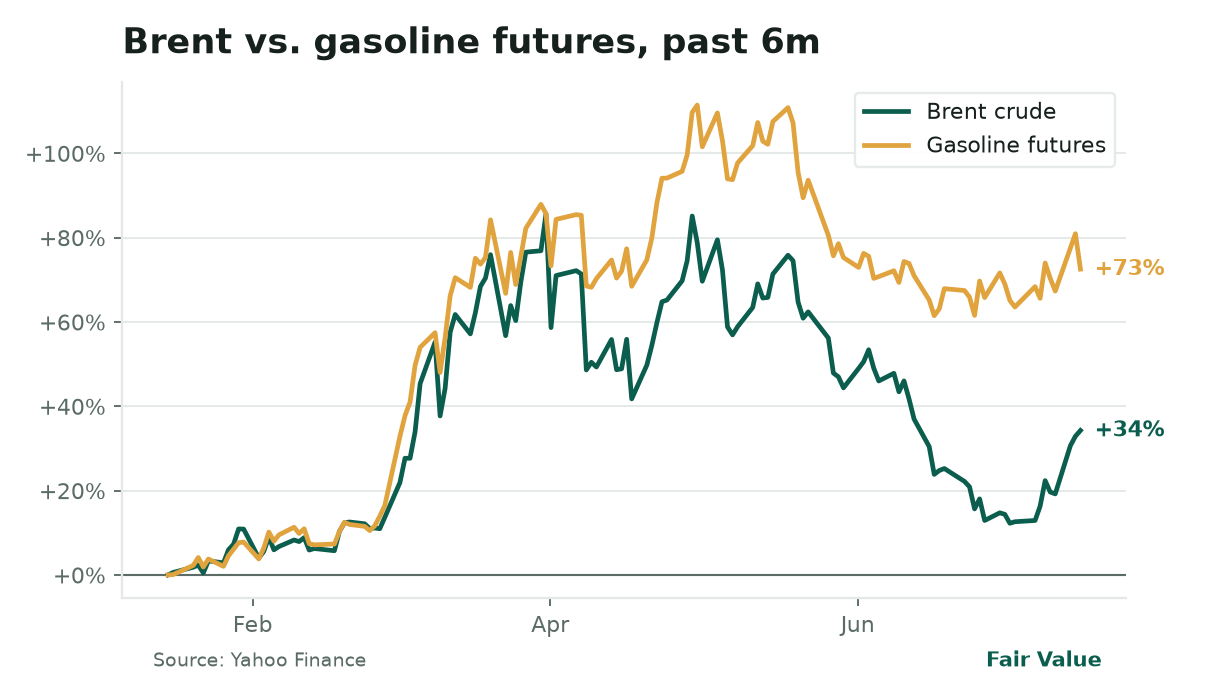
- **Oil’s climb meets Fed patience: PPI report could tip the balance**, Brent crude rose 9.5% this week to $85.44, gasoline futures gained 8.9%, and Hormuz tensions escalate. A PPI reading above 0.3% would force the Fed to address inflation or risk its credibility.
▸
PayPal’s $53B takeover talks: Stripe and Advent see a turnaround, Shares jumped 12% premarket on acquisition reports, but a deal collapse could erase those gains quickly. Private equity’s push into undervalued tech continues.
▸
Banks’ strong earnings hide rising credit-card stress, Delinquencies reach 15-year highs, yet bank profits stay solid, for now. The strain will hit consumers before Wall Street acknowledges it.
Still tracking: Hormuz transit fees; AI spending vs. chip stock declines; Circle’s USDC bank charter push; PayPal (day 3).
The big story
Oil spike and PPI data put the Fed’s patience to the test
Brent crude has climbed 9.5% this week to $85.44, gasoline futures rose 8.9%, and Hormuz tanker attacks worsen, just as the Producer Price Index (PPI) report arrives at 8:30 a.m. ET. The numbers will show whether the Fed can hold steady or must confront inflation’s return.
Gasoline surges faster than crude. While Brent crude rose 9.5% this week to $85.44, gasoline futures jumped 8.9%, a steeper move that reflects refining bottlenecks and Hormuz shipping disruptions. The spread suggests energy inflation is hitting consumers harder than headline oil prices imply.
Why this PPI report matters more than usual. PPI tracks raw material costs, steel, diesel, plastics, that feed into consumer prices. Economists expect a flat monthly reading (0.0%) and a 0.3% core increase. A higher number would mean oil’s surge is already working its way through the economy, undermining the Fed’s June pause.
Hormuz tensions tighten the squeeze. Iran’s attacks on shuttle runs, small, frequent tanker trips, have effectively closed the chokepoint, disrupting about 20% of global LNG flows. The U.S. reinstated a 20% transit fee Monday; Iran responded with more strikes. Gasoline futures now reflect an 8.9% weekly jump, while shipping insurance costs have surged 16-fold.
What a PPI surprise could mean for markets
▸
2-year Treasury yield (4.26%) could rise toward 4.5%, pushing mortgage rates back above 7%.
▸
Dollar (up 1.3% this month) would likely strengthen further, raising import costs.
▸
Stock futures (S&P 500 up 0.2% premarket) would likely reverse, especially in rate-sensitive tech.
Bottom line:. Today’s PPI isn’t just another report, it’s a test of the Fed’s credibility. If inflation is spreading through energy, the central bank may have to act regardless of growth risks. The 10-year yield (4.62%) will be key: a move above 4.75% would signal bonds are pricing in a Fed miscalculation.
What's happening today
Markets are stuck in a holding pattern ahead of the PPI report at 8:30 a.m. ET, with oil shocks and Fed expectations pulling in opposite directions. Brent crude hovers near $86, gasoline futures surge, and traders wait for data that could reshape the Fed’s path.
Stocks hold onto slim gains. The S&P 500 dipped 0.8% yesterday, but futures edge up 0.2% today. The split is clear: semiconductors struggle (NVIDIA -3.5%, AMD -4.2%, Marvell -7.8%) while energy (Exxon +4.0%, Chevron +3.3%) and software (Salesforce +4.8%) advance. This shift, out of high-beta tech into cash-rich sectors, is classic late-cycle positioning.
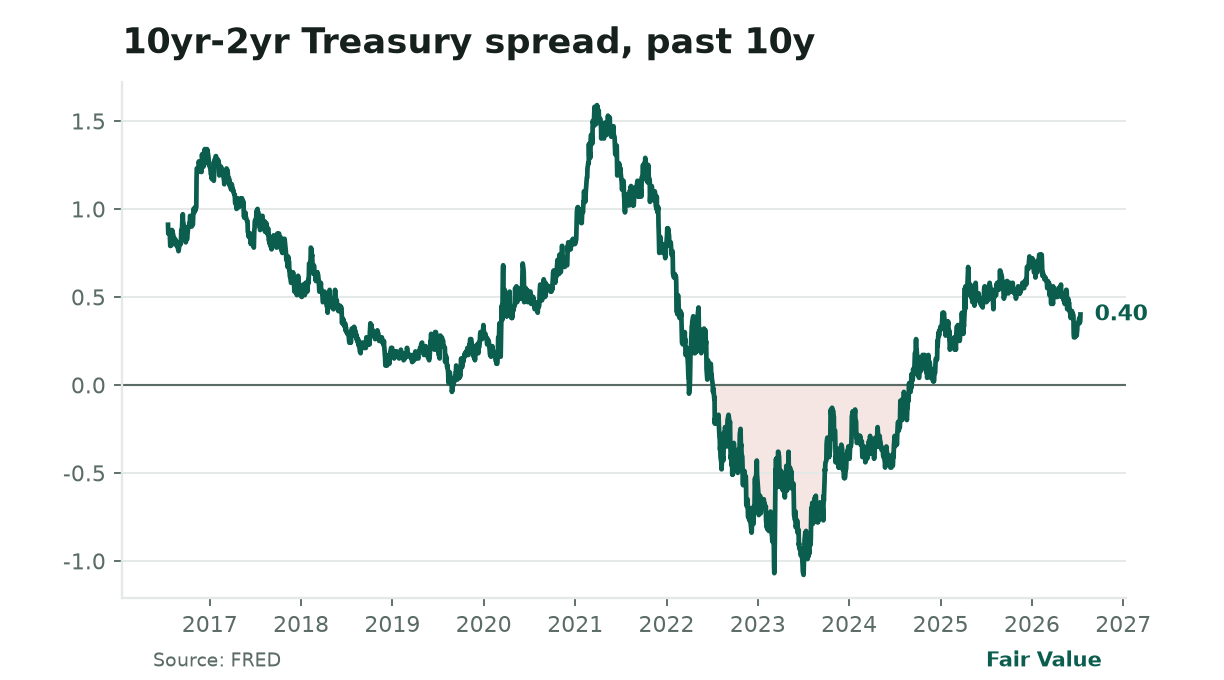
Bonds signal recession concerns. The 10-year Treasury yield holds at 4.62%, but the curve flattens fast: the 10-year/2-year spread now sits at just 0.4 percentage points. Bonds are questioning whether growth can hold if the Fed keeps rates elevated.
Flattening curve signals recession fears. The gap between 10-year and 2-year Treasury yields has narrowed to just 0.4 percentage points, down from 2.5% in 2022 and nearing inversion, a level that has preceded every U.S. recession since 1955. Bonds are pricing in growth risks even as stocks hold near highs.
PayPal’s potential $53B deal. Shares rose 12% premarket after reports that Stripe and Advent International offered to buy the company for $53 billion, the largest fintech deal since 2021. Private equity is betting on a rebound, but the stock could drop sharply if talks fall apart.
Hormuz crisis worsens. The strait remains effectively closed, with Iran targeting shuttle tankers and the U.S. threatening port blockades. Oil traders now price in a $5-$10 per barrel "war premium," but the bigger issue is logistics: LNG prices rise as Qatar’s exports face delays.
Today’s key events
▸
8:30 a.m. ET: PPI report. A core reading above 0.3% could trigger a bond selloff, dollar rally, and stock decline.
▸
10:00 a.m. ET: Bank of Canada decision. A hawkish tone could influence U.S. rate expectations.
▸
10:00 a.m. ET: Fed Chair Warsh testifies. Any mention of "oil" or "geopolitical risks" would unsettle markets.
▸
PayPal (PYPL): Trading at $52.50 premarket (+12%). Deal failure risks a sharp drop.
▸
Energy stocks: Exxon (XOM), Chevron (CVX), EOG (EOG) up 3-4% this week. Further oil gains could extend their rally.
▸
Semiconductors: NVIDIA (NVDA), AMD (AMD), Marvell (MRVL) down 4-8% this week. Persistent weakness threatens the Nasdaq’s momentum.
The big picture
Stocks and bonds tell different stories, only one can win
The S&P 500 holds a 0.6% monthly gain, but the 10-year Treasury yield sits at 4.62%, up from 4.3% in early June, with the curve flattening to levels that have preceded every recession since 1955. Stocks price in a soft landing; bonds price in a hard one. The disconnect won’t last.
Oil’s backwardation points to a supply crunch. Brent crude has jumped 9.5% this week to $85.44, WTI to $80.09, but the real warning is in the futures curve. Normally, oil trades in contango (later months cheaper) when supplies are plentiful. Today, it’s in backwardation, near-term contracts cost more because traders fear immediate shortages. This isn’t speculation; it’s a physical squeeze.
Dollar strengthens despite CPI cooling. The DXY index sits at 100.92, up 1.3% this month, as geopolitical risks override Tuesday’s soft CPI. A stronger dollar pressures multinationals and emerging markets, complicating the Fed’s task.
Stock resilience looks increasingly fragile. The S&P 500 is down just 0.8% this week, but the damage is concentrated: the Nasdaq has fallen 1.9%, and the PHLX Semiconductor Index dropped 4.7%. The shift into energy and software reflects late-cycle caution, traders are moving from high-fliers to dividend-paying stability.
The Fed’s tight spot. Markets price a 60% chance of a September rate cut, assuming inflation keeps cooling. Today’s PPI could change that. If producer prices rise, oil’s surge is spreading through the economy, forcing the Fed to choose between fighting inflation and supporting growth. The June dot plot showed just one 25-basis-point cut this year; a hot PPI could erase even that.
What it means for your finances
▸
Mortgages: 30-year fixed rates at 6.49%. A hot PPI could push them back to 7%.
▸
Savings: High-yield accounts pay ~5%. Lock in rates if you believe the Fed’s hiking cycle is over.
▸
Gas prices: National average at $3.85/gallon. Oil above $85 could drive prices to $4 by August.
▸
401(k)s: S&P 500 up 14% this year, but Nasdaq flat. Tech instability risks stalling retirement growth.
Around the world
Hormuz closure disrupts global energy flows
The Strait of Hormuz remains effectively shut, with Iran targeting shuttle runs, small, frequent tanker trips that keep oil moving when larger vessels avoid the area. The U.S. reinstated a 20% transit fee Monday; Iran escalated attacks. Brent crude now trades at $85.44, gasoline futures are up 8.9% this week, and shipping insurance costs have surged 16-fold.
China’s growth slows. Q2 GDP expanded 4.3%, the weakest since 2022, as a slumping property sector and weak consumer spending offset strong exports. The yuan trades at 6.76 per dollar, near its weakest level this year, pressuring commodity demand and multinational revenues.
Europe’s energy pressures build. The euro rose 0.3% today to $1.1421, but the ECB still battles inflation (core CPI at 2.9%). The bigger threat: energy. Natural gas futures climbed 0.5% this morning, and European gas storage sits at 78% capacity, down from 85% a year ago. An early winter could reignite the energy crisis.
Japan’s yen remains under pressure. The yen trades at 162.36 per dollar, near decades-low levels, as the Bank of Japan stays stuck with negative rates. This makes oil imports costlier, squeezing Japanese consumers: retail sales fell 1.2% in May, the largest drop in a year.
Key developments to watch
▸
10:00 a.m. ET: Bank of Canada rate decision. A hawkish hold could spill into U.S. rate expectations.
▸
China’s stimulus: If property sales don’t rebound, expect further easing, and downward pressure on the yuan.
▸
LNG prices: Dutch TTF, Europe’s gas benchmark, is up 35% since March. A move above €40/MWh would boost energy stocks, and European inflation.
Companies in focus
PayPal’s bid, banks’ credit risks, and the chip sector’s decline
PayPal jumps 12% on $53B takeover reports. Shares surged premarket after reports that Stripe and Advent International offered to acquire the company for $53 billion. If completed, it would be the largest fintech deal since the pandemic, and a bet on PayPal’s recovery amid slowing growth and competition from Apple Pay and Block.
Banks’ strong quarter hides credit-card risks. JPMorgan, Citigroup, and Wells Fargo reported solid earnings this week, with Jamie Dimon calling conditions “as good as it gets.” But the data reflects Q2, before the latest oil surge and Hormuz closure. The bigger issue: credit-card delinquencies have hit 15-year highs, though charge-offs won’t appear for 6-9 months.
Semiconductors extend losses. NVIDIA fell another 3.5% yesterday, AMD 4.2%, Marvell 7.8%. The sector has dropped 5.5% this week, marking four straight days of declines. The shift is clear: money is leaving high-beta tech for energy (Exxon +4.0%, Chevron +3.3%) and cash-rich software (Salesforce +4.8%).
Energy stocks lead gains. Exxon Mobil rose 4.0% this week, Chevron 3.3%, EOG Resources 4.1%. The sector is the S&P 500’s sole gainer (+3.0%), driven not just by oil but also natural gas futures, up 0.5% this morning as Qatar’s LNG exports face constraints.
Mega-cap tech holds steady. While semiconductors sink, the “Magnificent 7” show resilience. Meta is up 0.7% this week, Alphabet 1.1%, Microsoft 1.5%. The message: traders are shifting from high-fliers to cash-rich, dividend-paying giants.
ASML raises guidance, again. The Dutch semiconductor equipment maker lifted its annual sales forecast for the second time this year, citing “unrelenting demand” for AI chips. The stock is up 7.9% this week, but the broader takeaway is clear: TSMC, Samsung, and Intel are accelerating orders to meet surging AI demand.
Lucid seeks a turnaround. The EV maker, struggling with sales and quality issues, hired restructuring firm Alvarez & Marsal. The stock is down 16% this year, and cash burn remains a critical concern.
From Washington
Fed Chair Warsh’s testimony: One word could move markets
Fed Chair Warsh testifies before Congress at 10:00 a.m. ET today. Traders will listen closely for one word: oil. The Fed’s June pause assumed cooling CPI and a balanced labor market. But Brent crude has since climbed 9.5% to $85.44, gasoline futures rose 8.9%, and Hormuz remains closed. Any hint of concern over oil-driven inflation could derail the stock rally.
The Fed’s silence grows louder. June FOMC minutes revealed divisions over whether inflation is truly under control. The dot plot still projects just one 25-basis-point cut this year. A hot PPI reading today could eliminate even that, leaving the Fed’s “data-dependent” stance looking increasingly shaky.
Debt ceiling tensions return. The U.S. hit its $31.4 trillion borrowing limit in January, and Treasury Secretary Yellen has used “extraordinary measures” to avoid default. But those measures expire in early 2027, setting the stage for another congressional battle.
What to watch
▸
10:00 a.m. ET: Fed Chair Warsh’s testimony. Any mention of “oil” or “geopolitical risks” would weigh on stocks.
▸
PPI’s ripple effect: If producer prices rise, the Fed may have to choose between fighting inflation and supporting markets.
Worth learning today: Banks and your deposits
Your deposit isn’t idle, it’s the engine of the financial system
When you deposit money, the bank doesn’t just store it. Instead, it becomes the fuel for lending, and the foundation of modern finance. Here’s how it works, and why it matters now.
How fractional reserve banking operates. Deposit $1,000, and the bank holds $100 (10%) as reserves, either as cash or at the Federal Reserve. The remaining $900 is lent out: to homebuyers, businesses, or other banks overnight. Your $1,000 effectively becomes $1,900 in the economy. This is how banks create money, and why they’re only as stable as depositors’ confidence.
The fragility of confidence. This system works unless depositors demand cash en masse. If 10% withdraw funds, the bank handles it. If 20% do, the bank fails. That’s a bank run, and it’s why the FDIC insures deposits up to $250,000, to prevent panic.
Why this matters today. Banks reported strong earnings this week, but their balance sheets are loaded with long-term, low-rate loans (like 30-year mortgages) while paying depositors 4-5% on savings. If the Fed keeps rates high, banks’ profits get squeezed. If the Fed cuts, mortgage holders refinance, and banks lose income. Either way, the system is walking a tightrope, and your deposits are the safety net.
Link back. As we explored in what money actually is, your deposit isn’t just “money in the bank.” It’s a loan to the bank, a bet on its solvency, and a cog in the Fed’s monetary machinery.
Your takeaway
▸
Cash in a major bank (JPMorgan, Bank of America)? You’re secure.
▸
Cash in a regional bank with heavy commercial real estate exposure? Monitor their earnings closely.
Concept 5 of 83 in the Fair Value course.
Tomorrow’s question:. The June PPI report lands at 8:30 a.m. ET. If core PPI (excluding food and energy) exceeds the 0.3% forecast, how would the 2-year Treasury yield likely react, and why? Consider the Fed’s dual mandate. We’ll break it down tomorrow.
This week’s key events
▸
Today, 8:30 a.m. ET:USD Core PPI m/m (June), Forecast: 0.3%; Prior: 0.4%. A higher reading could derail the Fed’s pause and send yields climbing.
▸
Today, 8:30 a.m. ET:USD PPI m/m (June), Forecast: 0.0%; Prior: 1.1%. Watch for oil’s impact on the data.
▸
Today, 10:00 a.m. ET:CAD Overnight Rate, Forecast: 2.25%; Prior: 2.25%. The Bank of Canada is expected to hold, but the statement will be scrutinized for hawkish signals.
▸
Today, 10:00 a.m. ET:Fed Chair Warsh Testifies, Any reference to oil or geopolitical risks could unsettle stocks.
▸
Thursday, 2:00 a.m. ET:GBP GDP m/m (May), Forecast: 0.0%; Prior: -0.1%. Another weak print could push the Bank of England toward a rate cut.
▸
Thursday, 8:30 a.m. ET:USD Initial Jobless Claims, Forecast: 220K; Prior: 215K. A jump above 230K would signal labor market weakness.
▸
Thursday, 8:30 a.m. ET:USD Retail Sales m/m (June), Forecast: 0.3%; Prior: 0.1%. Soft retail sales combined with high gas prices would pressure consumer spending.
▸
Friday, 10:00 a.m. ET:USD Consumer Sentiment (July, preliminary), Forecast: 68.5; Prior: 68.2. A drop below 65 would amplify recession fears.
Not financial advice.Not financial advice. Fair Value does not buy, sell, or trade any security.
Data sources: Bloomberg, FactSet, Federal Reserve, BLS, EIA, Bank of Canada, ECB, Bank of Japan. Charts via TradingView.