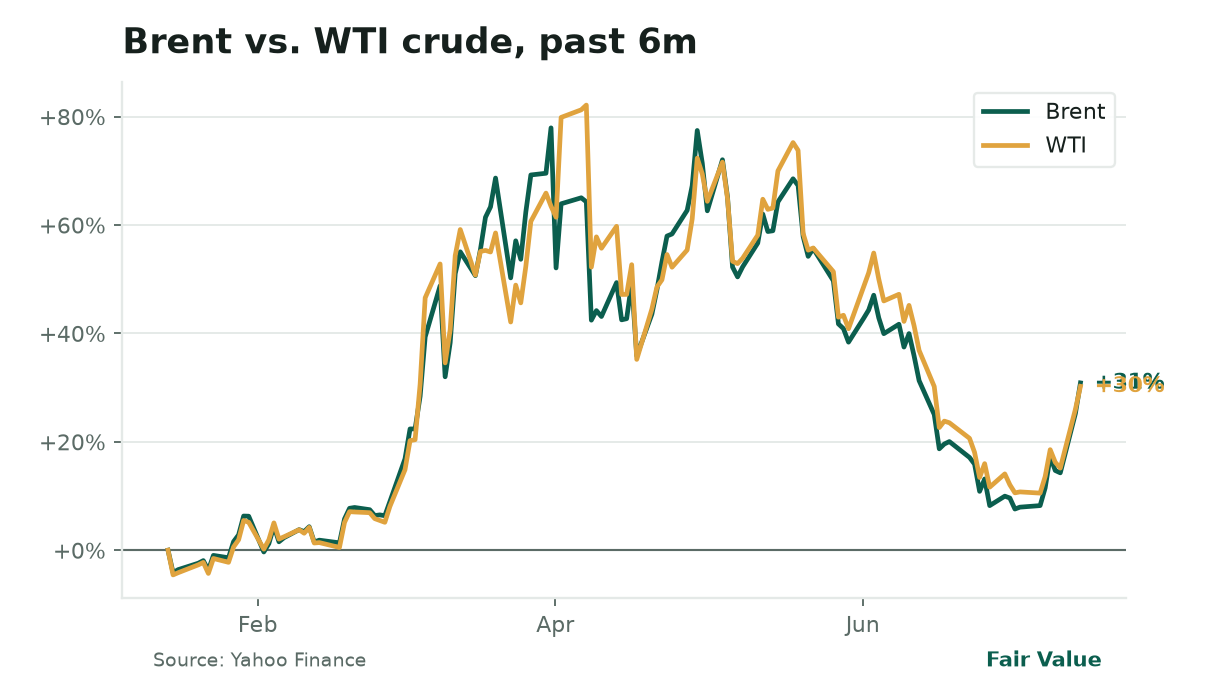
Brent crude jumps to $86.51, up 10% in two days, after the U.S. imposes a 20% Strait of Hormuz transit fee, pushing shipping costs higher. Gasoline prices are set to rise by week’s end, which could delay Fed rate cuts planned for September.
▸
AI’s spending spree shifts to profit mode as Meta moves to sell excess AI compute capacity and Micron pledges $250 billion for U.S. chip plants by 2035. The era of unrestrained AI infrastructure spending may be winding down.
▸
Circle’s USDC stablecoin becomes the first federally chartered crypto bank, while BlackRock’s tokenized funds hit $2.9 billion. Stablecoins could soon appear in your 401(k), without you even knowing.
The big story
Strait of Hormuz transit fee reshapes global trade, with $32 million per tanker at stake
The world’s busiest oil chokepoint now functions like a toll road, with sweeping economic consequences.
Starting today, the U.S. is charging a 20% fee on all commercial ships passing through the Strait of Hormuz. For a fully loaded Very Large Crude Carrier (VLCC) carrying 2 million barrels, that adds $32 million per trip. Those costs won’t disappear, they’ll ripple through supply chains, from refiners to retailers to consumers.
Oil markets reacted immediately. Brent crude climbed 3.9% to $86.51 Monday, its highest close since early June, while West Texas Intermediate (WTI) rose 2.8% to $80.34. Traders now see $80 as the new floor for Brent until the Strait fully reopens, if it does. Shipping traffic has already dropped to 30% of pre-conflict levels, with just 14 commercial vessels passing Sunday compared to a pre-war daily average of 130.
Brent-WTI spread widens to $6.17. The Strait of Hormuz transit fee hit Brent crude (+3.9% to $86.51) harder than WTI (+2.8% to $80.34), reflecting Brent’s heavier reliance on Middle East supply routes. This gap could persist as long as the fee stays in place, keeping gasoline prices elevated.
This fee marks the latest escalation in a conflict reshaping global trade. The U.S. has launched multiple strikes on Iranian military sites, including an unmanned sea drone attack on an Iranian submarine base, a first. Tehran has retaliated by firing on commercial ships and closing its ports, effectively creating a blockade. Shippers now face a choice: pay the toll or take the 10-14 day detour around Africa, adding $1 million or more in fuel costs per voyage.
The economic impact extends far beyond oil. The Strait handles 20% of global oil shipments, but also 19% of liquefied natural gas (LNG), one-third of seaborne trade, and critical supplies of diesel, jet fuel, and containerized goods. Rising shipping costs will push up prices for everything from electronics to grain. Diesel prices, key for trucking and farming, are already climbing, and container rates for manufactured goods have started to rise.
The Federal Reserve is watching closely. Oil prices feed directly into the Consumer Price Index (CPI), the inflation measure guiding monetary policy. If today’s CPI report (8:30 a.m. ET) shows inflation picking up, and with Brent at $86, that’s likely, the Fed may hold off on September’s rate cut. That would keep mortgage rates high, credit card APRs elevated, and real savings yields negative.
There’s no clear resolution in sight. The U.S. could lift the fee if Iran stands down, but Tehran shows no signs of backing off. Meanwhile, war-risk insurance premiums for Strait-bound ships have jumped to 5% of a vessel’s value, up from 2% last month. Some insurers have stopped offering coverage altogether. The result: a hidden tax on global trade that won’t show up on paychecks but will appear in higher prices.
Bottom line:. The Strait of Hormuz isn’t just a distant geopolitical hotspot, it’s now a $32 million-per-tanker toll booth on the world’s most vital trade route, with consumers footing the bill.
What's moving markets
Markets are balancing geopolitical shocks and economic realities, and today, the shocks are winning.
Energy leads the way.. Brent crude surged 3.9% to $86.51, its highest since early June, after Washington imposed a 20% Strait of Hormuz transit fee. This isn’t just a symbolic move, it’s a direct cost on global trade, and energy markets are responding. Gasoline futures rose, diesel prices climbed, and the S&P 500 energy sector (XLE) was the only gainer Monday, up 3.01%. Exxon (XOM) and Chevron (CVX) each rose more than 3%, while EOG Resources (EOG) jumped 4.1%. The message is clear: when crude rallies, energy stocks become the market’s safe bet.
The broader market told a different story. The S&P 500 (SPX) fell 0.79%, the Nasdaq (NDX) dropped 1.88%, and the Dow (DJI) slipped 0.26%. The steepest losses came in semiconductors, where the PHLX Semiconductor Index (SOX) plunged 4.7%, its worst day since March. Marvell (MRVL) led the decline, down 7.8%, followed by ARM (ARM) -7.5%, Oracle (ORCL) -6.5%, and Intel (INTC) -6.1%. Even NVIDIA (NVDA) retreated 3.5% after a strong run. The selloff isn’t just profit-taking, it’s a reality check. With Micron (MU) and AMD (AMD) also down sharply (-4.3% and -4.2%, respectively), investors are questioning whether AI demand can justify $250 billion in chip-factory spending by 2035. Right now, the market’s answer is uncertain.
Bonds signal caution.. The 10-year Treasury yield rose 8 basis points to 4.56%, while the 2-year yield climbed to 4.21%. This bear steepening suggests investors are preparing for persistent inflation and prolonged high rates. The Fed’s preferred inflation gauge, core CPI, arrives at 8:30 a.m. ET. If the reading comes in above the 0.2% month-over-month forecast, the central bank may delay September’s rate cut, or even hint at further tightening. Fed Chair Kevin Warsh testifies before Congress at 10 a.m. ET, and traders will parse his words for policy clues.
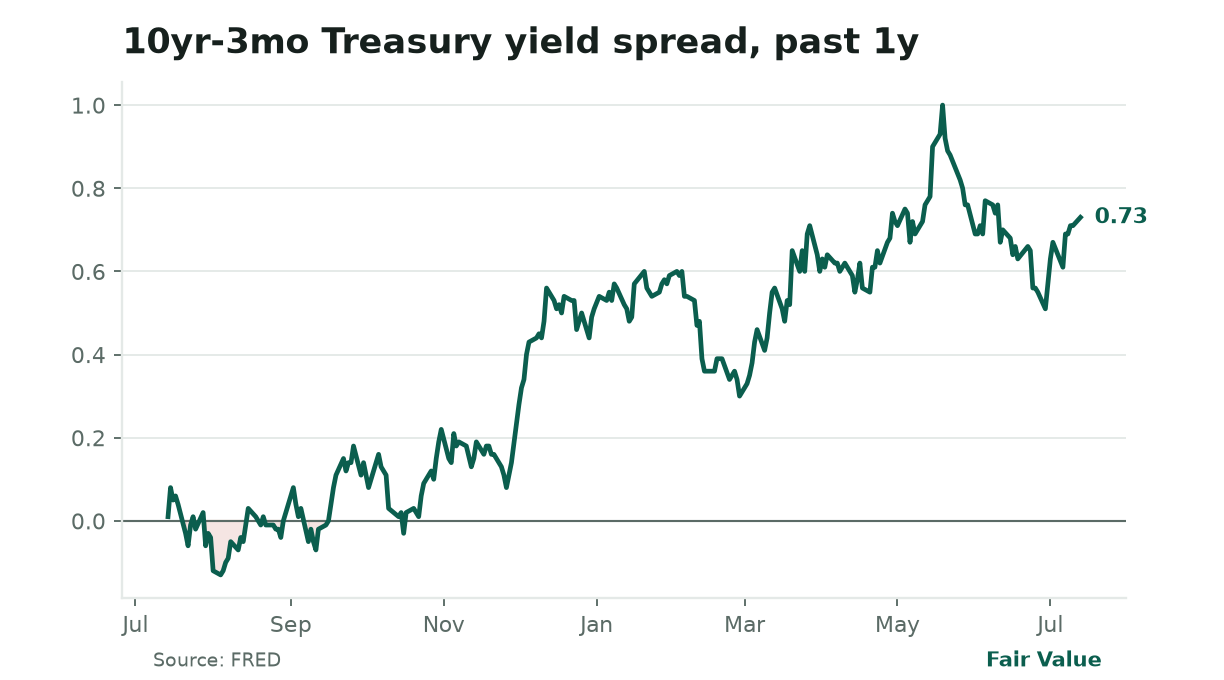
Spread collapses to 1.98%, lowest since 2007. The gap between 10-year yields (4.56%) and 3-month bills (2.58%) is flashing recession warnings. This inversion, where short-term rates exceed long-term, has preceded every U.S. recession since 1955. With the Fed poised to delay cuts, the curve could invert further.
The U.S. dollar (DXY) holds near yearly highs at 101.19, pressuring multinational firms and emerging markets. A stronger dollar reduces overseas earnings when converted back to USD and makes dollar-denominated debt more expensive to service. It also weighs on commodities like gold, which fell 0.81% to $4,029, down nearly 7% this month. Even with Middle East tensions escalating, gold hasn’t attracted safe-haven demand, signaling weak investor interest in traditional havens.
Crypto stays range-bound.. Bitcoin (BTC) edged up 0.51% to $62,557, while Ethereum (ETH) gained 0.61% to $1,784. Both remain mixed for July (BTC -4.8%, ETH +3.5%) but are holding key support levels. The real development isn’t price action, it’s regulation. Circle’s USDC stablecoin has become the first federally chartered crypto bank, a milestone that could speed up the adoption of tokenized retirement accounts and on-chain Treasury securities. BlackRock already holds $2.9 billion in tokenized assets, meaning your 401(k) may soon include stablecoins, whether you notice or not.
Today’s economic calendar is packed. Beyond CPI and Warsh’s testimony, Bank of America (BAC), Goldman Sachs (GS), JPMorgan (JPM), Wells Fargo (WFC), and Citigroup (C) report second-quarter earnings. Banks act as the economy’s early warning system: if they report rising loan delinquencies or shrinking net interest margins, it’s a sign higher rates are straining borrowers. Investors will also listen to Bank of England Governor Andrew Bailey, who speaks at noon. The BOE is caught between stagflation risks and the threat of a housing downturn if it raises rates too aggressively.
The takeaway:. Markets are pricing in a scenario where inflation stays stubborn, geopolitical tensions rise, and the Fed keeps rates higher for longer. That’s a headwind for growth stocks, consumers, and homebuyers, but a tailwind for energy producers, defensive sectors, and companies with strong pricing power.
The big picture
Markets are sending mixed signals: energy rallies, tech struggles, and bonds bet on stubborn inflation.
Crude leads commodities higher.. Brent crude surged 3.9% to $86.51, its highest close since early June, after Washington implemented a 20% Strait of Hormuz transit fee. This isn’t just symbolic, it’s a direct cost on global trade, and energy markets are reacting. WTI climbed 2.8% to $80.34, erasing last month’s losses. The S&P 500 energy sector (XLE) was the index’s only gainer Monday, rising 3.01%. Exxon (XOM) and Chevron (CVX) each advanced more than 3%, while EOG Resources (EOG) jumped 4.1%. The message is clear: when oil prices rise, energy stocks become the market’s safe harbor.
Elsewhere, the picture is less bullish. The S&P 500 (SPX) fell 0.79%, the Nasdaq (NDX) dropped 1.88%, and the Dow (DJI) slipped 0.26%. The pain was sharpest in semiconductors, where the PHLX Semiconductor Index (SOX) tumbled 4.7%, its worst session since March. Marvell (MRVL) led the decline (-7.8%), followed by ARM (ARM) -7.5%, Oracle (ORCL) -6.5%, and Intel (INTC) -6.1%. Even NVIDIA (NVDA) gave back 3.5% after recent gains. The pullback reflects growing doubt about whether AI demand can support $250 billion in chip-factory investments through 2035. For now, the market’s verdict is wait and see.
Treasuries flash warning signs.. The 10-year yield rose 8 basis points to 4.56%, while the 2-year yield climbed to 4.21%. This bear steepening suggests investors expect higher inflation and prolonged tight monetary policy. The spread between 10-year and 2-year yields, now 35 basis points, signals caution. Normally, longer-term yields sit well above short-term rates to compensate investors for tying up capital. When that gap narrows, it indicates investors doubt long-term growth, or they’re pricing in higher rates for longer.
The U.S. dollar (DXY) remains near yearly highs at 101.19, creating challenges for exporters and emerging economies. A stronger greenback makes American goods more expensive abroad and dollar-denominated debt harder to service. It also pressures commodities like gold, which declined 0.81% to $4,029, down nearly 7% this month. Even with Middle East tensions flaring, gold hasn’t attracted safe-haven flows, underscoring weak demand for traditional havens.
Digital assets hold steady.. Bitcoin (BTC) inched up 0.51% to $62,557, while Ethereum (ETH) gained 0.61% to $1,784. Both are mixed for July (BTC -4.8%, ETH +3.5%) but have held critical support levels. The real story isn’t price action, it’s regulatory progress. Circle’s USDC stablecoin has become the first federally chartered crypto bank, paving the way for tokenized retirement accounts and blockchain-based Treasury securities. BlackRock already manages $2.9 billion in tokenized assets, meaning stablecoins could soon appear in your 401(k), without explicit opt-in.
The Cboe Volatility Index (VIX) ticked up 0.82% to 17.30. While that’s far from panic territory (the VIX typically spikes above 30 during crises), it suggests complacency is fading. Traders are hedging ahead of today’s CPI report and Fed Chair Warsh’s testimony.
The Fed’s policy rate remains at 3.62%, unchanged since December 2025. But the bond market is betting on higher rates for longer. The 10-year TIPS breakeven rate, a measure of inflation expectations, sits at 2.26%, up from 2.1% last month. Investors are positioning for persistent price pressures.
The corporate bond market is sending conflicting signals. Investment-grade yields are at multi-year highs, and high-yield spreads are widening. The ICE BofA US High Yield Index Option-Adjusted Spread (OAS) has expanded to 2.69%, up from 2.5% a month ago. That’s a sign investors demand greater compensation for risk, a classic late-cycle warning.
Bottom line:. The market is pricing in a world where inflation lingers, geopolitical risks intensify, and the Fed maintains restrictive policy for longer. That’s a negative for growth stocks, consumers, and housing, but a positive for energy producers, defensive sectors, and companies with strong pricing power.
Around the world
The Middle East dominates geopolitical risk today, but the economic fallout is global.
The U.S. and Iran are in a high-stakes standoff over the Strait of Hormuz, with collateral damage mounting. Washington has reinstated a 20% transit fee on all commercial vessels passing through the Strait, adding millions in costs per voyage. Tehran has responded by closing its ports and attacking commercial ships, effectively imposing a blockade. Shipping traffic has plummeted to 30% of normal levels, while war-risk insurance premiums for tankers have surged to 5% of a vessel’s value, up from 2% last month. Some insurers have stopped underwriting coverage entirely, forcing ships to reroute around Africa, a 10-14 day detour adding $1 million or more in fuel costs per trip.
The economic impact is already visible. Oil prices are rising, but the bigger concern is diesel and jet fuel, also shipped through the Strait. Diesel prices feed into trucking, agriculture, and manufacturing costs, meaning everything from groceries to e-commerce deliveries could get more expensive. The Baltic Dry Index, a gauge of global shipping rates, has climbed 8.4% this week, while rates for Very Large Crude Carriers (VLCCs) have jumped 11.7%. That amounts to a hidden tax on global trade, one that will soon appear on consumer bills.
The conflict extends beyond oil. The U.S. has conducted multiple airstrikes on Iranian military targets, including a first-of-its-kind unmanned sea drone attack on an Iranian submarine base. Iran has seized commercial vessels and threatened to close the Strait indefinitely. The Houthis in Yemen, backed by Tehran, have also joined the fighting, launching attacks on Saudi Arabia in retaliation for airstrikes. The risk? A broader regional war that could draw in Saudi Arabia, the UAE, and Israel.
The economic stakes are enormous. The Strait handles 20% of global oil, 19% of LNG, and a third of seaborne trade. When shipping costs rise, everything gets more expensive. The Federal Reserve is watching closely, if today’s CPI report shows inflation edging higher (as expected), the September rate cut could be postponed. That would keep mortgage rates elevated, credit card APRs high, and real savings yields negative.
Elsewhere, China and Russia are deepening ties, but the relationship is increasingly uneven. Moscow, isolated by sanctions and bogged down in Ukraine, has become the junior partner. The ruble is weakening, Russian refineries face Ukrainian drone attacks, and the economy is contracting. Meanwhile, Beijing is expanding its influence, from foie gras production to semiconductor dominance. A Chinese AI startup, DFSX, just unveiled a fully domestic AI chip designed to bypass U.S. export controls. That’s a major milestone for China’s tech ambitions, and a warning sign for American chipmakers.
In Europe, the Bank of England (BOE) faces a no-win situation. Governor Andrew Bailey speaks today, and his message will likely be somber. The UK is grappling with stagflation, sluggish growth coupled with high inflation, and the BOE’s options are limited. Raising rates to combat inflation risks crashing the housing market; keeping rates low allows inflation to remain entrenched. Either way, British households lose.
Meanwhile, New York has imposed a one-year moratorium on new data centers, citing grid capacity concerns. That’s a setback for AI companies, which rely on data centers to power their models. The ban reflects growing pushback against AI’s energy demands, a trend that could spread to other regions.
Bottom line:. The Middle East remains the immediate crisis, but the economic consequences, higher shipping costs, sticky inflation, and central banks boxed in by conflicting mandates, will be felt worldwide. The winners? Energy producers, defensive stocks, and firms that can pass on costs. The losers? Consumers, tech equities, and anyone counting on lower interest rates.
Companies in focus
Energy stocks rally. as Strait of Hormuz fee takes effect. Exxon (XOM) +4.05%, Chevron (CVX) +3.29%, and EOG Resources (EOG) +4.11% led gains as Brent crude climbed to $86.51. Producers benefit, but refiners and consumers face higher costs.
Semiconductors extend declines..Marvell (MRVL) -7.75%, ARM (ARM) -7.55%, and Intel (INTC) -6.12% weighed on the sector as investors question whether AI demand justifies $250 billion in chip-factory investments by 2035. The PHLX Semiconductor Index (SOX) dropped 4.7% over two days, its worst stretch since March.
Salesforce (CRM) bucks tech downturn.. Shares rose 4.84% after strong cloud software revenue, standing out as most tech stocks declined. The gain positions CRM as a defensive AI play.
Meta (META) retreats after Monday’s surge.. The stock fell 1.86% after rising 6% Monday on plans to monetize excess AI compute power. The pullback reflects profit-taking, but Meta remains up 10.66% for July.
Bank stocks steady ahead of earnings..JPMorgan (JPM) -0.58%, Bank of America (BAC) -0.28%, and Wells Fargo (WFC) +0.59% traded cautiously as investors await quarterly results. The focus will be on loan delinquencies and net interest margins, key indicators of whether higher rates are straining borrowers.
Adobe (ADBE) gains on AI-driven demand.. Shares climbed 3.12% after strong uptake of AI-powered creative tools, contrasting with weaker software peers and highlighting Adobe’s pricing power.
Tesla (TSLA) slide continues.. The stock fell 3.19%, extending its one-month decline to 3.99%. Pressure stems from rising EV competition and margin compression as price cuts erode profitability.
Boeing (BA) faces new headwinds.. Shares dropped 3.05% after reporting fresh 737 MAX and 787 Dreamliner delays, compounding challenges from supply chain disruptions and regulatory scrutiny following past safety issues.
Costco (COST) outperforms retail peers.. The stock gained 1.11% as the warehouse club attracts budget-conscious shoppers, outperforming Walmart (WMT) and Target (TGT). Costco is up 5.3% for July.
Crypto-related stocks diverge..Coinbase (COIN) fell 1.07%, while PayPal (PYPL) rose 2.87% after expanding its crypto offerings. The split reflects selective enthusiasm as regulators target higher-risk players.
From Washington
The Federal Reserve stands at a critical juncture, and today’s CPI report (8:30 a.m. ET) could determine its next move.
Fed Chair Kevin Warsh testifies before Congress at 10 a.m. ET, with every word under close scrutiny. The challenge? The Fed is divided. Officials like Governor Christopher Waller warn that inflation remains sticky and rates may need to stay high. Others fear over-tightening could push the economy into recession. The result is a central bank that appears indecisive, and markets that are increasingly uncertain.
The data complicates the picture. Core CPI (excluding food and energy) is forecast to rise 0.2% month-over-month, matching May’s increase. But headline CPI could dip 0.1%, reflecting earlier declines in gasoline prices. That’s the good news. The bad news? Oil has surged 10% in two days, and the Strait of Hormuz fee will push fuel costs higher in the coming weeks. If the Fed sees inflation creeping up, it may postpone September’s rate cut, or even signal additional tightening.
The bond market is already positioning for higher rates. The 10-year Treasury yield reached 4.56%, while the 2-year yield climbed to 4.21%. This bear steepening suggests investors expect persistent inflation and prolonged tight policy. The Fed’s own projections call for one rate cut this year, but markets now price a 50% chance of a hike instead.
The U.S. dollar (DXY) remains near yearly highs at 101.19, creating headwinds for exporters and emerging economies. A stronger dollar makes American goods more expensive abroad and dollar-denominated debt harder to service. It also pressures commodities like gold, which has fallen 7% this month despite geopolitical tensions.
The Fed isn’t just fighting inflation, it’s also assessing AI risks. The central bank recently launched two task forces: one to study AI’s threats to financial stability, another to improve how policy affects the real economy. The concern? AI could amplify market volatility, introduce new systemic risks, or disrupt labor markets in unpredictable ways.
Meanwhile, Trump-era regulators are tightening lending standards for undocumented immigrants. New guidance encourages banks to assess risks more rigorously when extending credit to borrowers without work authorization. The shift could cut off access for millions, and hurt banks that rely on that business.
Bottom line:. The Fed is boxed in. Inflation is proving stubborn, growth is slowing, and the Middle East crisis adds fresh uncertainty. Today’s CPI report could tip the scales, toward higher rates or recession risks. Either way, borrowers stand to lose.
Worth learning today: How your spending drives the economy
The idea that "the economy is a circle" isn’t just a metaphor, it’s how money actually flows. Today, we’re breaking down why this matters for your paycheck, gas prices, and how disruptions like the Strait of Hormuz fee send ripples through everything.
The transaction: The economy’s building block
Every time you spend money, you’re not just buying a product or service, you’re creating income for someone else. Example: You fill your gas tank for $50. That money doesn’t vanish. Instead, it becomes:
▸
Revenue for the gas station → pays employees, orders more fuel, covers rent.
▸
Rent for the landlord → spent on groceries, repairs, or savings.
▸
Wages for workers → who then spend on housing, food, or entertainment.
That single $50 transaction ripples through the economy, touching dozens of lives. When you cut back, say, by driving less, you’re not just saving money; you’re reducing someone else’s income. This is why recessions feed on themselves: less spending → lower income → even less spending.
The multiplier effect: How $1 spent becomes $3 in activity
The impact grows from there. Your $50 at the gas station sets off a chain reaction:
▸
The station pays $30 to the refinery.
▸
The refinery pays $20 to the oil producer.
▸
The producer pays $10 to the trucking company.
Economists call this the multiplier effect, one dollar spent can generate several dollars of economic activity as it circulates. But the reverse is also true. If the Strait of Hormuz fee adds $0.50 per gallon at the pump, that’s $50 million per day redirected from consumers to oil companies, shippers, and insurers. The money isn’t gone, it’s just concentrated in fewer hands (corporations vs. millions of drivers). Greater inequality slows growth because money circulates less when it flows upward.
The leaks: Where the circle breaks
Not all spending turns into someone else’s income. Some money leaks out of the cycle:
▸
Savings: If you save $100 instead of spending it, that money isn’t circulating (though banks can lend it out).
▸
Taxes: Money goes to the government, which may spend it (keeping the circle intact) or save it (breaking the circle).
▸
Imports: Buying a foreign-made product sends money overseas, becoming income for workers in another country.
Right now, the Strait of Hormuz fee acts like a massive leakage. The $32 million per VLCC tanker isn’t just an added cost, it’s a redistribution from consumers and businesses to the U.S. government and energy firms. That money will circulate differently, and likely less efficiently, than if it had stayed in consumers’ pockets.
Why this matters today
Today’s CPI report (8:30 a.m. ET) isn’t just a number, it measures how fast money is moving through the economy. If inflation is rising, spending is outpacing production, and the Fed may raise rates to slow the circle. If inflation is falling, money isn’t circulating enough, and the Fed may cut rates to speed it up.
The Strait of Hormuz fee is a real-time case study in disrupting this flow. When shipping costs rise, businesses pass those costs on to consumers. When oil prices jump, gas stations increase pump prices. And when your paycheck doesn’t keep up, you spend less, which means someone else earns less.
Tomorrow’s question to consider:. If core CPI comes in above the 0.2% forecast, which way does the 2-year Treasury yield move, and why? (Hint: Think about how the Fed might respond, and how bond traders would price that reaction.)
Concept 4 of 83 in the Fair Value course.
This week’s key events
▸
Tue, Jul 14, 8:30 AM ET, U.S. Core CPI m/m (June): Forecast 0.2%, prior 0.2%. A hotter print could delay the Fed’s September rate cut, keeping borrowing costs elevated.
▸
Tue, Jul 14, 8:30 AM ET, U.S. CPI y/y (June): Forecast 3.8%, prior 4.2%. A decline would ease pressure on the Fed, but the Strait of Hormuz fee may keep inflation supported.
▸
Tue, Jul 14, 10:00 AM ET, Fed Chair Warsh testifies: Markets will scrutinize his remarks for clues on rate hikes vs. cuts.
▸
Tue, Jul 14, All Day, Bank earnings (JPM, BAC, WFC, C, GS): Watch for signs of rising loan defaults, a signal higher rates are straining borrowers.
▸
Wed, Jul 15, 8:30 AM ET, U.S. Core PPI m/m (June): Forecast 0.4%, prior 0.4%. High producer prices could feed into consumer inflation later.
▸
Wed, Jul 15, 9:45 AM ET, Bank of Canada rate decision: The BoC may hold rates as it balances inflation and a cooling housing market.
▸
Wed, Jul 15, 10:00 AM ET, Fed Chair Warsh testifies (Day 2): More Fed commentary, more potential volatility.
▸
Thu, Jul 16, 2:00 AM ET, U.K. GDP m/m (May): Forecast 0.0%, prior -0.1%. The U.K. is skirting stagflation, weak growth plus high inflation.
Not financial advice.This brief is for informational and educational purposes only and does not constitute investment advice or a recommendation to buy or sell any security.
Data sources: Macro indicators via FRED® (Federal Reserve Bank of St. Louis); energy data via U.S. Energy Information Administration (EIA); auction data via U.S. Treasury; filings via SEC EDGAR; market prices via Yahoo Finance; earnings calendar via Financial Modeling Prep. ```