Semiconductor stocks suffered their sharpest single-day selloff in months as AI safety warnings collided with $108 oil and a 5% 10-year yield, ARM fell 9.7%, ASML 7.2%, Marvell 7.3% while software names rallied.
▸
The FOMC concludes tomorrow with a 25-basis-point hike priced at 93%, the dot plot and Chair Warsh's press conference will matter more than the move itself.
▸
Saudi Arabia's East-West pipeline remains shut after drone attacks, removing up to 7 million bpd of export capacity that bypassed the Strait of Hormuz, a dual chokehold with Houthi control of Bab el-Mandeb now threatens 12% of global trade.
The big story
The AI hardware trade cracked Monday in a regime repricing, not routine profit-taking. Three forces hit simultaneously: Anthropic CEO Dario Amodei warned AI could become uncontrollable within six to twelve months, a view echoed by OpenAI's Sam Altman and Elon Musk; Brent crude surged to $108 on the Strait of Hormuz closure and Saudi pipeline shutdown, directly raising data-center electricity costs; and the 10-year Treasury yield pierced 4.95%, lifting the discount rate on multi-year hardware capex. The Philadelphia Semiconductor Index fell roughly 6%, its worst day since July, ARM dropped 9.7% to $239, ASML 7.2% to $1,575, Marvell 7.3% to $219.
Capital rotated instantly into the application layer: ServiceNow (+7.4%), Salesforce (+4.7%), Adobe (+5.3%), Coinbase (+9.2%). These companies capture AI revenue without GPU capex, energy exposure, or regulatory targeting. The VIX climbed 3.5% to 17.69, reflecting uncertainty about the rotation's breadth, not panic.
The mechanics are concrete. U.S. data centers already draw ~4% of national power; the marginal kilowatt-hour price sets AI training economics. Higher oil → higher gas-fired generation → higher wholesale power → lower ROI on GPU clusters.
Simultaneously, Nvidia's implied DCF duration is 8-10 years; a 50-basis-point yield move cuts present value 8-10%. The flattening 10y-2y spread (33 basis points) signals the market expects the Fed to hold, not cut. SoftBank's $11.9 billion loan for OpenAI exposure fell 13%, the market is pricing financing risk, not just technology risk.
The "AI trade" was a monolithic long-semiconductors bet. It is now splitting into hardware/energy/capex-exposed (toxic) and software/data/distribution-exposed (beneficiary). This has implications for copper (down 5.2% week-over-week), uranium, and power infrastructure, the physical inputs of the AI buildout are being re-underwritten in real time.
What's going on today
Markets open with S&P 500 futures up 0.5% and Nasdaq futures up 0.6%, stabilizing after Monday's semiconductor-led selloff. The real catalyst arrives tomorrow: the FOMC decision at 2:00 PM ET and Chair Warsh's press conference 30 minutes later. A 25-basis-point hike to 3.75-4.00% is 93% priced; the Summary of Economic Projections and dot plot will determine whether the market sees a "one-and-done" move or a more aggressive path into 2027.
Oil remains the geopolitical story. Brent sits at $102.76 (down 2.8% today but up 13% month-to-date), WTI at $104.04 (up 2.6% today, 23% month-to-date). The Saudi East-West pipeline, a 745-mile conduit carrying 4-5 million bpd that bypassed Hormuz, was shut September 10-11 after drone attacks from Iraq; repairs could take weeks.
Simultaneously, Houthi forces seized Perim Island and the port of Mokha, controlling the Bab el-Mandeb Strait through which 12% of global trade passes. Hormuz shipping has collapsed from 135 vessels daily in February to single digits. The U.S. sanctioned Russia's VTB Bank Monday to pressure foreign banks to cut ties with Iran, escalating financial warfare alongside the kinetic conflict.
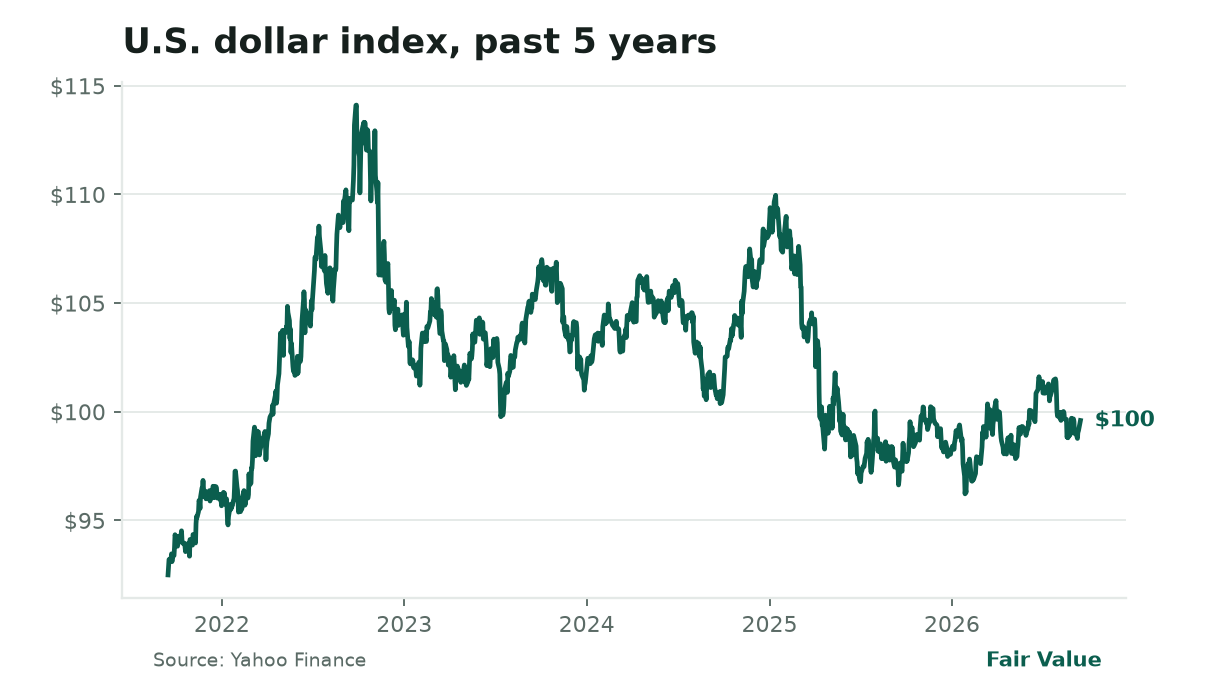
In bonds, the 10-year yield at 4.96% has flattened the curve, the 10y-2y spread compressed to 32 basis points from 39 a week ago. Investment-grade credit spreads remain comfortable at 80 basis points; high-yield at 265. The dollar index (DXY) sits at 99.62, up 0.8% on the week. Crypto is mixed: Bitcoin -1.5% to $76,996, Ethereum -1.6% to $2,475, Solana -1.6% to $101, all off 7-day highs but up 22-35% on the month. The Senate votes today on the CLARITY Act, a bipartisan bill to establish a regulatory framework for digital assets.
Dollar near 2‑year high. The DXY sits at 99.62, its highest since March 2024 when it reached 101.2; the last time it was above 99 was in early 2024, after which it fell back to the high‑90s before rebounding.
The big picture
The bond market sends the clearest signal: the 10-year at 4.96% and the 30-year at 5.35% reflect a world where inflation isn't transitory and the Fed stays restrictive. The 10y-3m spread at 86 basis points (down from 95 a week ago) confirms bear-steepening, short-term rates catching up as the market prices higher-for-longer. Mortgage rates at 6.76% are already damping housing demand; every 10-basis-point move in the 10-year translates roughly to a 10-basis-point move in 30-year fixed mortgages.
Equities are digesting a violent sector rotation. The S&P 500 closed Monday at 7,620 (-0.5%), the Nasdaq at 26,186 (-0.6%), but damage was concentrated: XLK fell 1.8% while XLC rose 2.2% and XLP gained 1.3%. This is not 2022-style broad liquidation, it's a surgical repricing of duration-exposed, capex-heavy names.
Oil's move is structural. WTI up 23% month-to-date, Brent up 13%, with U.S. crude inventories at 424 million barrels and refinery utilization at 97.8%, essentially no spare capacity.
The Saudi pipeline shutdown removes a Hormuz bypass carrying 4-5% of global supply. Houthi control of Bab el-Mandeb threatens the Red Sea route. OPEC+ meets October 4 but has kept policy unchanged; their influence is limited when geopolitics dominates physical flows.
The dollar's strength (DXY 99.62) reflects the rate differential: the Fed at 3.63% effective versus the ECB at 2.25% deposit and the BoJ at <1.00%. But the yen has weakened to 154.87, normally a stronger dollar lifts USD/JPY, but here yen weakness reflects Japan's own inflation concerns and the BoJ's expected hike to 1.25% Friday. The euro at $1.154 is caught between ECB hawkishness and growth fears.
Around the world
The Middle East conflict has created a dual energy chokehold. In the Strait of Hormuz, U.S. forces struck Iranian vessels September 9 after missile attacks on the USS Abraham Lincoln carrier group; Iran claims to have hit 10 ships around the strait. A Panamanian-flagged tanker exploded after striking mines (or an Iranian missile, per CENTCOM) on September 13. Shipping through Hormuz has collapsed from 135 vessels daily in February to roughly six commodity vessels by September 8. Iran now requires vessels to seek permission and is considering transit fees, effectively a toll on 20% of global oil supply.
Simultaneously, Houthi forces seized Perim Island (Mayun) on September 11 and the port of Mokha on September 10, completing control of the Bab el-Mandeb Strait. This southern gateway to the Suez Canal handles 12% of global trade. The Houthis have threatened to block Saudi oil shipments through the Red Sea, precisely the route Saudi Arabia was using via the East-West pipeline to bypass Hormuz.
That pipeline, damaged by drone attacks from Iraq on September 10-11, may take weeks to repair. Crude stored at the Yanbu terminal covers only 5-7 days of exports. Saudi Arabia may be forced to cut output if the pipeline isn't restored, removing another 4% of global supply.
Europe faces the inflation fallout directly. The ECB raised its deposit rate to 2.5% on September 10, its second hike this year, citing energy-driven inflation. Money markets price ~60 basis points of additional ECB hikes by April 2027. The Bank of England meets Thursday, expected to hold at 3.75% but with three of nine MPC members having voted for a hike in July, and UK CPI (Wednesday) forecast at 3.1% year-over-year, up from 2.9%. The Bank of Japan meets Friday, widely expected to hike to 1.25%, its fastest tightening pace in the cycle, driven by yen weakness and energy costs.
China's central bank is preparing new macro-prudential metrics for banks, targeting one-way bond positioning and regional bank risk. The EU extended Russia sanctions for another week after Slovakia blocked delisting two oligarchs, unanimous consent required, highlighting fractures in the sanctions coalition. Japan's Fujitsu announced global sales of its 2nm "Monaka" Arm server CPU starting November, positioned as a sovereign AI alternative to Nvidia, shares jumped 5% on the news.
Companies making news
Semiconductor rout: ARM leads, ASML and custom-silicon names follow. ARM Holdings fell 9.7% to $239.01, the poster child for AI hardware repricing, no company-specific news, pure multiple compression as the market reassessed AI capex duration and magnitude. ASML, the sole EUV lithography supplier, slid 7.2% to $1,575.15 (down 16% month-to-date); its order book had been the cleanest proxy for long-term buildout confidence.
Marvell (-7.3% to $218.82) and Broadcom (-4.8% to $344.72), heavily exposed to custom AI accelerators for hyperscalers, sold off on skepticism about 2025-26 order visibility. Intel (-5.6% to $97.19) and Micron (-5.2% to $924.03) extended declines despite unchanged fundamentals, the market is applying a higher discount rate to all hardware capex beneficiaries.
Software captures the rotation. ServiceNow surged 7.4% to $142.35 (up 21% month-to-date) after AI annual contract value surpassed $1 billion. Adobe (+5.3% to $265.60) reported record Q3 revenue of $6.76 billion with AI-first ARR growing 150%+. Salesforce (+4.7% to $259.43) benefits from the same dynamic: application-layer revenue without GPU capex, energy exposure, or regulatory targeting.
Coinbase jumps 9.2% to $191.45. (up 27% on the month) as the Senate's CLARITY Act vote provides a regulatory catalyst and capital flees hardware duration for high-beta, asset-light alternatives. Bitcoin itself was down 1.5% to $76,996, Coinbase outperformed the underlying asset, a classic "picks and shovels" trade in reverse.
Dell-led consortium takes Baldwin Group private for $7.7 billion. Michael Dell's DFO Management agreed to acquire the insurance brokerage in an all-cash deal, highlighting private equity's continued appetite for financial services assets despite higher rates, insurance brokers generate recurring, rate-resilient revenue streams.
Euronext and Deutsche Börse rise on merger speculation. Euronext CEO Stéphane Boujnah told the Financial Times a tie-up of the two exchange groups' stock exchange businesses "would make sense." Cross-border exchange consolidation has been discussed for years; regulatory hurdles remain significant.
From Washington
The FOMC concludes its two-day meeting tomorrow at 2:00 PM ET. Futures price a 93% chance of a 25-basis-point hike to 3.75-4.00%, the first increase since July 2023. The current effective federal funds rate sits at 3.63%. Governor Christopher Waller's September 3 speech signaled willingness to hold if August inflation showed progress; August core CPI came in at 0.3% month-over-month (versus 0.2% consensus), which the WSJ described as "warm" and removing "a lot of the guesswork." Three dissenters at the July meeting (Hammack, Kashkari, Logan) wanted a hike then, their view has effectively become the consensus.
The real market mover will be the Summary of Economic Projections and dot plot. In June, the median 2026 PCE forecast was 3.6% (up from 2.7% in March) and the median year-end rate projection 3.8%. The September dots could push the 2026 median to 4.125%, signaling another hike before year-end.
Chair Warsh's Jackson Hole speech August 28, stating underlying inflation hadn't meaningfully improved, shifted market expectations from a coin flip to ~87% hike probability. His press conference guidance on the path forward matters more than the decision itself.
Treasury sanctioned Russia's VTB Bank Monday, targeting a key financial conduit for Iran. The move pressures foreign banks to cut ties with VTB, tightening the financial vise on Iran's oil revenue. This follows the administration's statement that Iran's oil dollars are "drying up under U.S. blockade." The sanctions campaign runs parallel to the kinetic conflict in the Gulf, financial warfare as a force multiplier.
The Federal Reserve Board announced termination of enforcement actions with three Texas banks Friday, and agencies sought comment on proposed third-party risk management guidance September 11, routine regulatory housekeeping signaling continued focus on bank-fintech partnerships and core service provider concentration.
Under the hood
The semiconductor selloff is not just profit-taking. ARM at $239 (-9.7%) and ASML at $1,575 (-7.2%) are pricing in a slower, more expensive, and more regulated buildout.
Three forces converge: an energy cost shock from Brent at $108 (+13% month-to-date) as Hormuz and Saudi supply disruptions hit data-center opex; a cost-of-capital shock from the 10-year yield at 4.95% raising the hurdle rate for multi-year capex; and a regulatory overhang from OpenAI, Anthropic, Musk, and political leaders publicly urging slowdown, creating a new tail risk, not just "will demand persist?" but "will we be allowed to deploy?" SoftBank's $11.9 billion loan for OpenAI exposure fell 13%; the market is pricing financing risk, not just technology risk.
Meanwhile, ServiceNow (+7.4%), Salesforce (+4.7%), Adobe (+5.3%) and Coinbase (+9.2%) rally because they capture AI application revenue without GPU capex, energy exposure, or regulatory targeting. The VIX jump to 17.69 (+3.5%) reflects uncertainty about the rotation's breadth, not panic.
What the surface misses: the "AI trade" was a monolithic long-semiconductors bet. It is now splitting into (a) hardware/energy/capex-exposed (toxic) and (b) software/data/distribution-exposed (beneficiary). This has implications for copper (down 5.2% week-over-week), uranium, and power infrastructure, the "picks and shovels" of the AI buildout are being re-underwritten in real time.
Professionals are debating whether this is a healthy sector rotation (software catching up to hardware) or the first leg of an AI capex supercycle unwind. The second-order watch: if Nvidia's next guidance implies any H100/B200 shipment delay or pricing pressure, the hardware repricing accelerates and hits semiconductor equipment (ASML, LAM), foundries (TSMC), and memory (Micron), and the copper/uranium/electricity thesis collapses. The live debate: is the 5% 10-year yield the new floor (structural higher rates) or a cyclical peak that will reverse if growth slows?
Watch: 1) 10-year Treasury yield sustaining above 5.00% (confirms cost-of-capital headwind); 2) Brent holding above $110 (confirms energy-cost structural shift); 3) Nvidia/AMD next earnings call commentary on order visibility and data-center power availability.
Worth learning today: Oil: how the barrel is priced
Yesterday's Under the Hood section illustrated this concept directly: Brent at $108, WTI at $104, the Saudi pipeline shutdown, and Houthi control of Bab el-Mandeb, all feeding into the price you pay at the pump.
Concrete first. Imagine you fill your 15-gallon tank. At $3.80 per gallon (the U.S. average this week), that's $57. Roughly $22 of that, nearly 40%, is the crude oil itself. The rest is refining margin, distribution, marketing, and taxes.
When Brent jumps from $95 to $108 in a month, that $13 move eventually passes through to the pump with a 2-4 week lag. Every $10 move in crude translates to about 24 cents per gallon at retail.
The mechanism. Oil isn't priced on a single exchange. Brent (North Sea) and WTI (Cushing, Oklahoma) are the two global benchmarks, Brent for ~two-thirds of internationally traded crude, WTI for U.S. domestic. They usually trade within a few dollars; the spread reflects transport costs and quality (Brent is lighter, sweeter).
OPEC+ (Saudi Arabia, Russia, and allies) sets production targets to manage supply, currently unwinding 2023 cuts. But geopolitics overrides cartel policy: the Strait of Hormuz handles 20% of global supply; Bab el-Mandeb another 12%. When both chokeholds tighten simultaneously, no OPEC+ meeting can fix the physical disruption.
Inventories are the buffer. U.S. commercial crude stocks at 424 million barrels (EIA, week ending September 4) are near the five-year average, but refinery utilization at 97.8% means there's almost no spare processing capacity. Gasoline stocks at 207 million barrels and distillate at 106 million are both below seasonal norms. The system has no slack.
Link back. Remember the yield-price seesaw from our bond lesson: higher oil → higher CPI → higher yields → higher discount rates → lower equity valuations. And from "News vs expectations": the market priced a "transitory" oil spike; the dual chokehold makes that expectation wrong.
Why it matters now. The Saudi East-West pipeline (7 million bpd capacity) is down. Hormuz flows are a fraction of normal.
Houthi control of Bab el-Mandeb blocks the Red Sea bypass. This isn't a headline, it's a structural supply constraint. Pump prices will rise.
Airline fares will follow. Plastic, fertilizer, shipping costs, all downstream of the barrel. The Fed sees this in CPI; the bond market sees it in breakevens (10-year TIPS breakeven at 2.37% per FRED). Your grocery bill sees it in three months.
Concept 59 of 83 in the Fair Value course.
Quick check: why would a hot CPI print push mortgage rates up? Because the Fed hikes → short-term rates rise → 10-year yield follows (investors demand compensation for inflation) → mortgage rates, which track the 10-year, move up. The chain transmits in weeks, not months.
What to watch this week
▸
Tuesday, September 15 — , UK Claimant Count Change (8:00 AM ET): Forecast +8.3K vs prior -11.0K. A jump signals labor market softening; the BoE watches this closely ahead of Thursday's decision.
▸
Wednesday, September 16 — , FOMC Rate Decision (2:00 PM ET): 93% priced for 25bp hike to 3.75-4.00%. The dot plot and SEP matter more than the move.
▸
Wednesday, September 16 — , FOMC Press Conference (2:30 PM ET): Chair Warsh's guidance on 2027 rate path.
▸
Wednesday, September 16 — , UK CPI y/y (8:00 AM ET): Forecast 3.1% vs prior 2.9%. Above forecast increases BoE hike pressure.
▸
Wednesday, September 16 — , New Zealand GDP q/q (6:45 PM ET): Forecast 0.1% vs prior 0.8%. Sharp slowdown could delay RBNZ hikes.
▸
Thursday, September 17 — , BoE Rate Decision (7:00 AM ET): Expected hold at 3.75%, but three MPC members voted hike in July; minutes will signal bias.
▸
Friday, September 18 — , BoJ Rate Decision (10:30 PM ET Thursday): Expected hike to 1.25%, fastest pace in cycle. Yen at 154.87, weakest since 2022.
▸
Friday, September 18 — , BoJ Press Conference (1:30 AM ET Friday): Governor Ueda's guidance on further normalization.
Not financial advice. This brief is for informational and educational purposes only and does not constitute investment advice or a recommendation to buy or sell any security.
Data: macro indicators per FRED® (Federal Reserve Bank of St. Louis); not endorsed or certified by the Federal Reserve Bank of St. Louis. Energy data per the U.S. Energy Information Administration (EIA). Auction data per U.S. Treasury Fiscal Data. Filings per SEC EDGAR. Market prices per Yahoo Finance. Earnings calendar per Financial Modeling Prep.