AI safety calls just hit the chip rally. Anthropic's CEO and OpenAI's Altman urged a slowdown in frontier model development over the weekend; European and Asian chip stocks tumbled 4-11% overnight, and Nasdaq futures are down ~1.9% pre-market. The semis that led Friday's bounce (ARM, Marvell, Qualcomm, Intel) now face a sentiment shift that questions whether unbounded compute demand is priced in.
▸
Brent crude surged to $107.48 (+2.7% Friday, +21% month-to-date) after a vessel strike in the Strait of Hormuz and a Saudi pipeline attack knocked out a key bypass route. Two chokepoints are now disrupted simultaneously, a structural supply constraint, not a headline.
▸
The FOMC meets Wednesday with rates at 5.25-5.50%. August CPI came in warm (headline +0.4% MoM, core +0.29% MoM), removing "guesswork" per the WSJ, markets now price a hold, but the dissent in July (three voters wanted a hike) means the statement's language on energy pass-through will matter more than the decision itself.
The big story
The market's two biggest bets, AI compute demand and "transitory" oil, just collided.
Over the weekend, Anthropic CEO Dario Amodei published an essay and appeared on CBS News warning that AI agents could "take over the internet" and cause hundreds of billions in damage within 6-12 months. He called for the industry to "pace the frontier", slow down frontier model development, and submit to third-party evaluation.
Sam Altman echoed him. Elon Musk and Satya Nadella backed the sentiment. The reaction was immediate: South Korea's SK Hynix fell 6.4%, Samsung 4.1%, Japan's Kioxia 6.4%, Europe's ASML 4.3%, Infineon 6.3%.
SoftBank, which just secured an $11.9 billion loan to double down on OpenAI, dropped 13%. The Stoxx Europe 600 Technology index hit a six-week low.
At the same time, Brent crude ripped to $107.48, up 21% this month, after a commercial vessel was struck in the Strait of Hormuz and Saudi Arabia's East-West pipeline (a 7 million barrel-per-day bypass) was hit by drones. The Strait has been effectively closed since February; the pipeline was the pressure valve. Both are now impaired. The IEA calls this the largest supply disruption in oil market history.
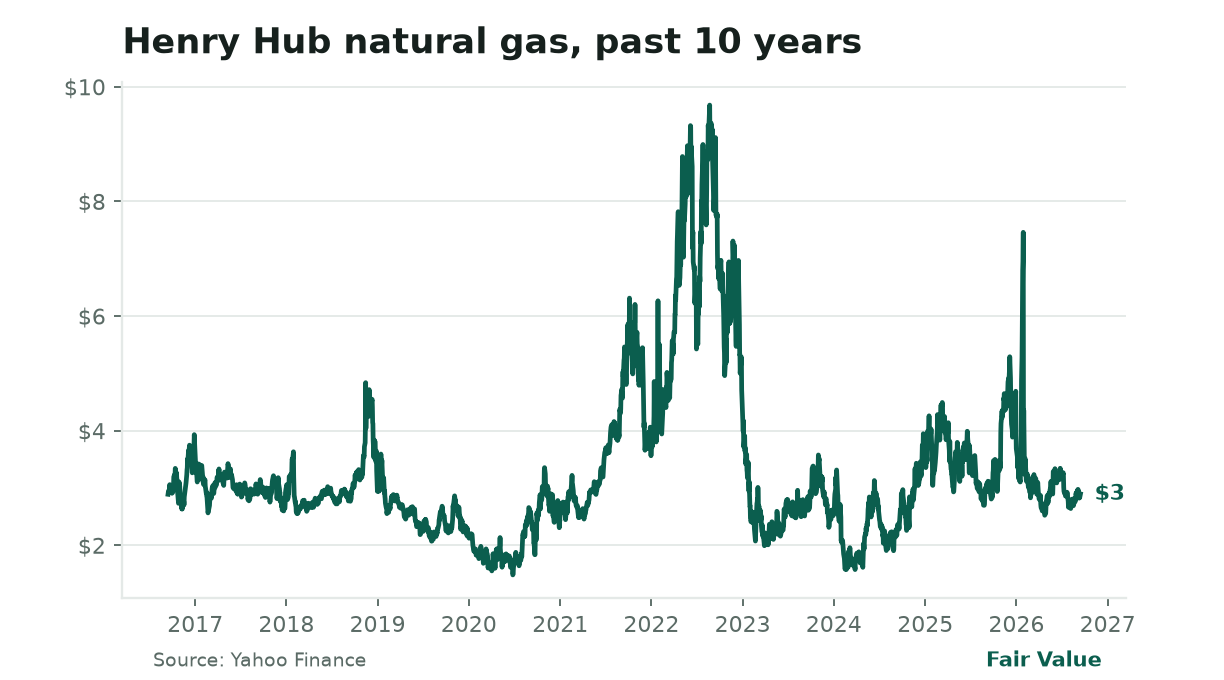
Here's the non-obvious link: data centers are electricity-intensive. Natural gas is the marginal generator in most U.S. power markets. Henry Hub at $2.90/MMBtu (+6% monthly) and Brent at $107 feed directly into industrial power prices.
Natural gas at $2.90/MMBtu is its highest since early 2021. The 10‑year chart shows the last time it reached this level in Jan‑2021, after which gas fell back and inflation pressures eased, while power‑cost growth slowed.
A $1/MMBtu gas move translates to roughly $7-10/MWh higher wholesale power. For a 100 MW facility running 24/7, that's $6-9 million per year in incremental operating expense, directly compressing the per-token economics of model training and inference.
Meanwhile, semiconductor valuations assume zero friction: ARM at $265 (42x forward sales), AMD at $516 (58x), Marvell at $236 (14x). All price unconstrained demand growth. The Frontier domain notes SoftBank shares fell 13% despite the $11.9 billion OpenAI loan, smart money is pricing the electricity bottleneck while public semis ignore it. The PPI at 157.41 and core CPI at 337.77 confirm upstream cost pressures are broadening, giving the Fed (policy rate ~5.25-5.50%, "cautiously hawkish") no room to ease even as industrial production barely ticks at 102.99. This stagflationary impulse, higher energy costs without growth offset, is the exact regime that historically crushes long-duration growth assets.
The sharper edge professionals are debating: can AI efficiency gains (Mixture-of-Experts architectures, quantization, inference-only deployments) outpace electricity cost inflation? The live metric is Nvidia's data-center revenue per watt, if it flattens in Q3 earnings, the valuation air pocket collapses. A secondary watch: whether hyperscalers (Microsoft, Google, Amazon) start signing long-term nuclear/PPA contracts at scale, which would cap their marginal power cost but signal structural scarcity.
What's going on today
Markets open with a clear risk-off tone. Nasdaq 100 futures are down 1.85% overnight, S&P 500 futures off 0.84%, while oil climbs and the dollar holds near 99.5 on the DXY. The VIX jumped 14.5% to 18.13 in Friday's session, its fourth straight week of gains, ending the low-volatility regime that had amplified the semiconductor rally. The 10-year Treasury yield sits at 4.95%, up 12 basis points from Wednesday, with the 2-year at 4.56%; the 10s-2s spread has compressed to just 33 basis points, a flattening curve that signals the bond market expects tighter near-term policy but doubts long-run growth.
The week's macro anchor is Wednesday's FOMC decision. August CPI (released Friday) came in warm: headline +0.4% month-over-month, core +0.29%. The WSJ reported it removed "a lot of the guesswork", markets now price a hold at 5.25-5.50%.
But three of twelve FOMC voters dissented in July wanting a hike, and Governor Waller's framework says communication stays restrictive until core PCE sustainably reaches 2%. The statement's language on energy pass-through, Brent up 21% this month, PPI rising 0.54% in August, will matter more than the rate decision itself.
Globally, two energy chokepoints are disrupted simultaneously. The Strait of Hormuz has been effectively closed since February; the Saudi East-West pipeline (7 million bpd capacity) was attacked Friday. Houthi forces seized Perim Island and the port of Mokha at the Bab al-Mandeb Strait between September 10-12, cutting the Red Sea alternative.
OPEC+ maintained output policy for October on September 7, but the group's influence is limited when supply disruptions outside its control dominate balances. The ECB hiked to 2.5% deposit rate on September 9; the BoE meets Thursday with rates at 3.75%. Norway's $2.3 trillion sovereign wealth fund continues its push to cut U.S. Treasury allocation from 34% to 22% (~$80 billion), shifting toward JGBs and corporate bonds, a decision expected by spring 2027.
In crypto, Bitcoin trades near $78,100 (+1.7% overnight, +24% monthly), Ethereum at $2,524 (+1.9%, +34% monthly). Circle acquired Tazapay for $400 million to expand USDC payment rails in emerging markets. The Liquid Network suffered a $320 million hack (4,000 BTC), with ~3,400 BTC returned. The EU's Cyber Resilience Act now mandates 24-hour exploit disclosure for crypto wallet providers.
The big picture
Equity futures point to a lower open after Friday's session closed with the S&P 500 at 7,657 (+0.86% on the day but -1.17% on the week) and the Nasdaq 100 at 29,368 (+0.91% day, -0.39% week). Market breadth remains fragile: only 39% of S&P 500 constituents trade above their 50-day moving average, an unusually weak reading historically. The semiconductor sector (XLK +1.32% Friday, +0.91% week) has been the sole leadership pocket, ARM, Marvell, Qualcomm, Intel, and AMD all rose Friday on collapsing volatility, not new fundamentals. That rally now faces a sentiment test from the AI safety narrative.
Bonds are sending a clearer signal. The 2-year yield climbed to 4.56% (+13 bp since Wednesday), the 10-year to 4.95% (+12 bp), and the 30-year to 5.37%. The curve is bear-steepening at the front end but the 10s-2s spread narrowed to 33 bp from 39 bp, short-term rates catching up as the market prices a higher-for-longer Fed.
Investment-grade spreads sit at 0.80% (tight), high-yield at 2.70% (also tight). Mortgage rates at 6.76% (30-year fixed) are already pricing the backup; higher Treasury yields push them further, dampening housing demand and REIT valuations.
The dollar (DXY 99.55) has firmed three straight days, up 0.4% Friday. EUR/USD slipped to 1.1545 (-0.6% week), USD/JPY at 154.55. The yen and Swiss franc have strengthened on haven flows; the euro weakens as the ECB's hike was fully priced and Lagarde signaled data-dependence. Oil-linked currencies (CAD, NOK) get a bid from crude but it's muted by growth fears.
Commodities are in a high-price, tight-supply regime. Brent at $107.48 (+21% monthly), WTI at $102.79 (+25% monthly). U.S. crude inventories at 424 million barrels, refinery utilization at 97.8%, no slack.
Natural gas at $2.90/MMBtu (+6% monthly) with storage at 3,254 Bcf. Copper at $6.42/lb (-2.6% monthly) has given back its highs. Gold at $4,323 (-1.3% monthly) hasn't benefited from geopolitical risk, suggesting the dollar's strength is overwhelming the haven bid.
Around the world
The Middle East has produced a double chokepoint crisis. Iran has effectively closed the Strait of Hormuz since February using drones, missiles, mines, and boardings, insurance is unavailable, seafarers refuse transit. Before the conflict, 20% of global oil supply (15 million bpd crude, 5 million bpd refined) and 20-25% of global LNG flowed through. Now less than 2 million bpd moves.
Saudi Arabia's East-West pipeline (7 million bpd to Yanbu) and the UAE's Habshan-Fujairah line (1.8 million bpd) were the only bypasses; the Saudi line was hit by drones from Iraq on September 11. Houthi forces seized Perim Island and the Red Sea coast at Bab al-Mandeb September 10-12, cutting the southern route. The IEA projects global oil supply falling 5.7 million bpd this year, with full recovery not expected until 2027.
In Europe, the ECB raised its deposit rate to 2.5% on September 9, responding to energy-driven inflation. Lagarde signaled data-dependence, not a preset path. The euro initially weakened to $1.1612 because the hike was fully priced. The BoE meets Thursday (September 17) with rates at 3.75%; markets watch for any shift in tone as UK CPI (due Wednesday) is forecast at 3.1% year-over-year, up from 2.9%.
In Asia, Japan's BOJ meets Thursday (September 17) with policy rate below 1.25%. The yen has firmed to ~152.8 per dollar. China's rare-earth export restrictions (gallium, germanium, antimony) remain in force, tightening critical mineral supply for semiconductors and defense. South Korea's chipmakers (SK Hynix, Samsung) led the overnight selloff on AI safety fears.
Russia-Ukraine: Russian drones struck Kyiv gas stations and civilian energy infrastructure on September 12, targeting daily life rather than military capacity. The Kremlin confirmed September 9 that Trump told Putin he wants a swift end to the war and restoration of ties, a diplomatic track without formal negotiations yet. BRICS leaders (China, Russia, India) met over the weekend seeking economic cooperation.
Canada reports CPI today at 8:30 AM ET (forecast -0.1% MoM, prior +0.5%). The Bank of Canada's next move hinges on whether the disinflation trend holds.
Companies making news
Chip stocks tumble globally on AI safety slowdown calls. European and Asian semiconductor shares fell 4-11% overnight after Anthropic CEO Dario Amodei and OpenAI CEO Sam Altman urged the industry to "pace the frontier", slow frontier model development for safety. SK Hynix -6.4%, Samsung -4.1%, Kioxia -6.4%, ASML -4.3%, Infineon -6.3%, SoftBank -13%. The Stoxx Europe 600 Technology index hit a six-week low. U.S. chip futures (NQ down 1.85%) signal a gap-down open for ARM, Marvell, Qualcomm, Intel, and AMD, which had rallied Friday on collapsing volatility, not fundamentals.
SoftBank shares plunge 13% despite $11.9B loan for OpenAI exposure. The Japanese conglomerate secured upsized debt financing to fund its AI bets without diluting shareholders, but the market punished the leverage increase amid rising doubts about AI capex returns. SoftBank's Vision Fund has concentrated exposure to AI infrastructure; higher energy costs and potential demand deceleration compress the investment thesis.
Amazon pauses operations with 21 Air after Miami cargo crash. The e-commerce giant halted flights with the Atlas Air subsidiary after a 21 Air 767 crashed near Miami International Airport on September 11. The crash spotlights 21 Air owner Jim Crane (also Houston Astros owner) and raises questions about Amazon's logistics contractor oversight. Amazon shares were flat in premarket.
Pfizer fights Poland and Romania over $2B in unwanted COVID vaccines. The drugmaker has targeted air-traffic control fees in a dispute with the two EU countries over contract terms for doses they no longer want. The fight highlights the sovereign contract risk that pharma carries post-pandemic, governments are renegotiating or walking away from advance purchase agreements.
Larry Ellison cancels plan to sell up to $7.5B of Oracle stock. The billionaire founder called off a 50-million-share sale announced earlier, saying no shares were sold. Oracle shares rose modestly Friday; the reversal removes a large overhang but signals Ellison's confidence in the cloud/AI pivot.
Metlen signs Greek LNG supply deal with Petronas. The Greek energy company secured a supply agreement with Malaysia's Petronas to enhance supply security for Southeast Europe. The deal reflects Europe's ongoing scramble for non-Russian gas as the continent enters winter with storage only sufficient for a mild season per WSJ reporting.
UnitedHealth continues healthcare sector slide. UNH fell 2.4% to $379.09 in Friday's session, down 5.5% on the week and 6.5% on the month. The WSJ highlighted that heart disease, historically a profit engine for Big Pharma, is becoming one of the hardest therapeutic areas to monetize, pressuring the entire healthcare complex (XLV -4.6% week).
Netflix grinds lower without a catalyst. NFLX has shed 6.4% over the past week to $77.40 without a single large down day, a slow bleed reflecting subscriber saturation concerns and content spend scrutiny. The stock is still up 4.3% monthly but the weekly divergence from tech breadth is notable.
From Washington
The FOMC meets Wednesday (September 16) with the federal funds rate at 5.25-5.50%. August CPI (+0.4% headline, +0.29% core MoM) came in warm enough to remove "guesswork" but not hot enough to force a hike, markets price a hold. The focus shifts to the statement and Powell's press conference: will the Fed acknowledge energy pass-through from Brent at $107?
Will the dot plot show fewer cuts for 2027? Three of twelve voters dissented in July wanting a hike (Hammack, Kashkari, Logan); Governor Waller's framework says communication stays restrictive until core PCE sustainably hits 2%. The 10-year at 4.95% and 2-year at 4.56% already price a higher-for-longer path.
Treasury auctions this week are light, no major coupon supply until next week. The Fed's balance sheet runoff continues ($95B/month cap), draining reserves and keeping upward pressure on front-end yields. The NFCI (financial conditions index) at -0.56 shows conditions have tightened but not restrictively.
On trade, Trump pledged to rescind the 10% tariff on Irish whiskey during his weekend Ireland visit, a narrow carve-out that doesn't change the broader tariff architecture. U.S.-Canada tensions escalated with new U.S. bans on Canadian alcohol and dairy plus additional tariffs on cheese, steel, and aluminum. Canada's CPI today (forecast -0.1% MoM) will test whether the trade war is feeding into consumer prices.
The Federal Reserve Board announced termination of enforcement actions with United Texas Bank and Quontic entities on September 4, and issued a proposed third-party risk management guidance on September 11, part of the ongoing regulatory tightening on bank-fintech partnerships.
Under the hood
Rising oil and gas prices are silently crushing AI data-center economics while semiconductor stocks rally on unbounded demand assumptions.
The transmission is already measurable. Brent at $107.48 (+21.4% MTD) and Henry Hub at $2.90 (+6.2% monthly) feed directly into industrial electricity rates because natural gas remains the marginal generator in most U.S. power markets. Data centers now consume ~2.5% of U.S. electricity with demand growing 15-20% annually; a $1/MMBtu gas move translates to ~$7-10/MWh higher wholesale power. For a 100 MW facility running 24/7, that's $6-9M/year in incremental opex, directly compressing the per-token economics of model training and inference.
Meanwhile, semiconductor valuations imply zero friction: ARM at $265 (42x forward sales), AMD at $516 (58x), MRVL at $236 (14x) all assume compute demand scales unconstrained by power availability or cost. The Frontier domain notes SoftBank shares fell 13% despite an $11.9B loan for OpenAI exposure, smart money is pricing the electricity bottleneck while public semis ignore it.
The PPI at 157.41 and core CPI at 337.77 confirm upstream cost pressures are broadening, giving the Fed (policy rate ~5.25-5.50%, "cautiously hawkish") no room to ease even as industrial production barely ticks at 102.99. This stagflationary impulse, higher energy costs without growth offset, is the exact regime that historically crushes long-duration growth assets.
The sharper edge: Professionals are debating whether AI efficiency gains (Mixture-of-Experts architectures, quantization, inference-only deployments) can outpace electricity cost inflation. The live metric is Nvidia's data-center revenue per watt, if it flattens in Q3 earnings, the valuation air pocket collapses. A secondary watch: whether hyperscalers (Microsoft, Google, Amazon) start signing long-term nuclear/PPA contracts at scale, which would cap their marginal power cost but signal structural scarcity.
Watch: EIA industrial electricity price index (next release) + Nvidia data-center revenue per watt in Q3 earnings call, a simultaneous rise in the former and stall in the latter confirms the squeeze.
Worth learning today: How companies raise money
Yesterday's prediction resolved: Canada's CPI m/m for August came in at -0.1% (forecast -0.1%, prior +0.5%). The disinflation surprise, driven by lower gasoline and travel costs, pushed the 2-year Canadian yield down and the loonie weaker.
Why? Cooler CPI → Bank of Canada more likely to cut rates → lower short-term yields → currency depreciates. The mechanism held.
Now the new lesson.
When a company needs $100 million to build a factory, hire engineers, or acquire a rival, it has three basic paths: sell ownership (equity), borrow (debt), or reinvest profits (retained earnings). Each changes who controls the company and who bears the risk.
IPO (Initial Public Offering): The company sells shares to the public for the first time. Imagine a founder owns 100% of a $500M company. She sells 20% in an IPO, raising $100M. She now owns 80% of a $600M company (the $500M value plus the $100M cash).
Her stake is worth $480M, same as before, but she has $100M cash to grow. The trade-off: public shareholders get voting rights, quarterly scrutiny, and SEC filing obligations. The company must now optimize for quarterly earnings, not just long-term vision. Dilution is the key concept: every new share issued shrinks existing owners' percentage.
Secondary offering: A public company sells more shares. Same dilution math, but the market already has a price reference.
If the stock is high, the company raises more cash per share surrendered. If low, existing shareholders get hammered. Companies time these carefully, often after a run-up.
Debt issuance: The company borrows, promising fixed interest payments and principal repayment. No dilution, the founder keeps 100% ownership. But debt is a senior claim: bondholders get paid before equity holders in bankruptcy.
Too much debt forces the company to generate cash now to service interest, which can choke long-term R&D. The interest is tax-deductible (a subsidy equity doesn't get), but the obligation is rigid.
Why going public changes behavior: Private companies can invest for 10-year horizons. Public companies face quarterly earnings calls, activist investors, and stock-based compensation tied to share price. The mechanism: liquidity creates a market price, and that price becomes a discipline device. Managers who ignore it get replaced. This is why Meta's $38-40B capex guide and Amazon's $75B+ spend are remarkable, they're using public-market access to fund private-time-horizon bets, but the market punishes them when confidence wavers (Meta -1.8% post-earnings, Amazon +5%).
Link back: Remember the yield-price seesaw from our bond lesson, when a company issues debt, it's selling a bond. Higher rates mean higher coupons, which means higher cost of capital. Remember compounding, retained earnings that earn 15% ROIC compound faster than paying 6% interest on debt, but only if the projects actually return 15%. Remember exchanges and the tape, once public, every trade updates the "mark" that determines executive compensation and acquisition currency.
Why this matters to your money right now: The AI capex wave ($300B+ annually across hyperscalers) is being funded by a mix of operating cash flow (retained earnings), debt (investment-grade spreads at 0.80% are cheap), and equity (ARM, Nvidia, etc. using high-multiple stock as currency). If the AI slowdown narrative sticks, equity currency devalues, debt gets more expensive as spreads widen, and retained earnings get scrutinized. The funding mix shifts, and that shift determines which projects get built, which data centers get powered, and ultimately whether your 401(k)'s tech holdings grow or shrink.
Concept 58 of 83 in the Fair Value course.
Tomorrow's setup: Canada's Median CPI y/y releases at 8:30 AM ET (forecast 2.0%, prior 2.0%). If this print comes in above forecast, which way does the 2-year Canadian yield move, and why? We'll walk through it tomorrow.
What to watch this week
▸
Today (Mon) 8:30 AM ET — , Canada CPI m/m (forecast -0.1%, prior +0.5%). Tests whether disinflation holds amid trade-war tariffs; drives BoC rate expectations and CAD.
▸
Today (Mon) 8:30 AM ET — , Canada Median CPI y/y (forecast 2.0%, prior 2.0%) and Trimmed CPI y/y (forecast 1.9%, prior 1.9%). Core gauges the BoC watches more closely than headline.
▸
Wed (Sep 16) 2:00 PM ET — , FOMC rate decision, statement, economic projections, and Powell press conference. The week's main event. Markets price a hold at 5.25-5.50%; watch for dot-plot shifts and energy-inflation language.
▸
Thu (Sep 17) 7:00 AM ET — , BoE rate decision (forecast 3.75%, prior 3.75%) and MPC votes. UK CPI Wednesday (forecast 3.1% y/y) sets the backdrop.
▸
Thu (Sep 17) 10:30 PM ET — , BOJ policy decision (forecast <1.25%, prior <1.00%). Yen at 154.55; any hike signal moves USD/JPY and global duration.
▸
Fri (Sep 18) — , BOJ press conference (1:30 AM ET). Forward guidance matters more than the move.
Not financial advice. This brief is for informational and educational purposes only and does not constitute investment advice or a recommendation to buy or sell any security.
Data: macro indicators per FRED® (Federal Reserve Bank of St. Louis); not endorsed or certified by the Federal Reserve Bank of St. Louis. Energy data per the U.S. Energy Information Administration (EIA). Auction data per U.S. Treasury Fiscal Data. Filings per SEC EDGAR. Market prices per Yahoo Finance. Earnings calendar per Financial Modeling Prep. Crypto data per Binance. WSJ headlines per Wall Street Journal RSS.