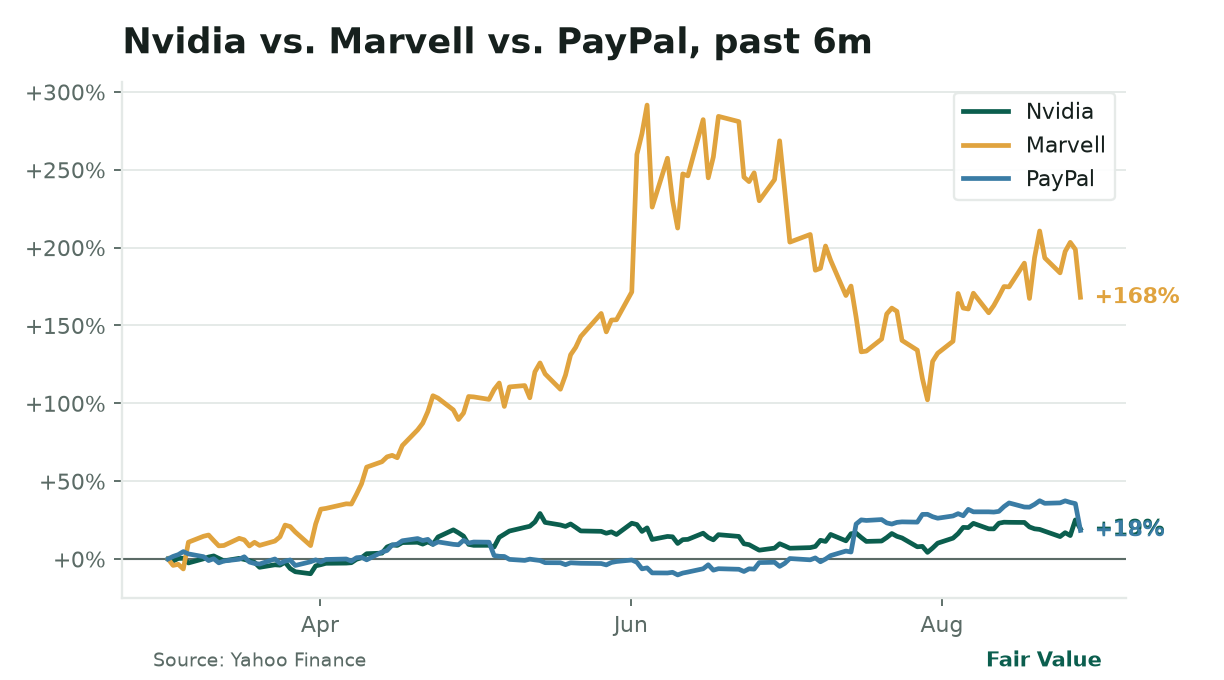
AI’s momentum trade cracks. Nvidia fell 4.6%, Marvell 10.3%, and PayPal 12.7% in Friday’s tech pullback, while the VIX jumped 5.2% to 15.18, its highest close since May. The Fed’s firmer stance is exposing vulnerabilities in the AI-driven rally that defined 2026.
▸
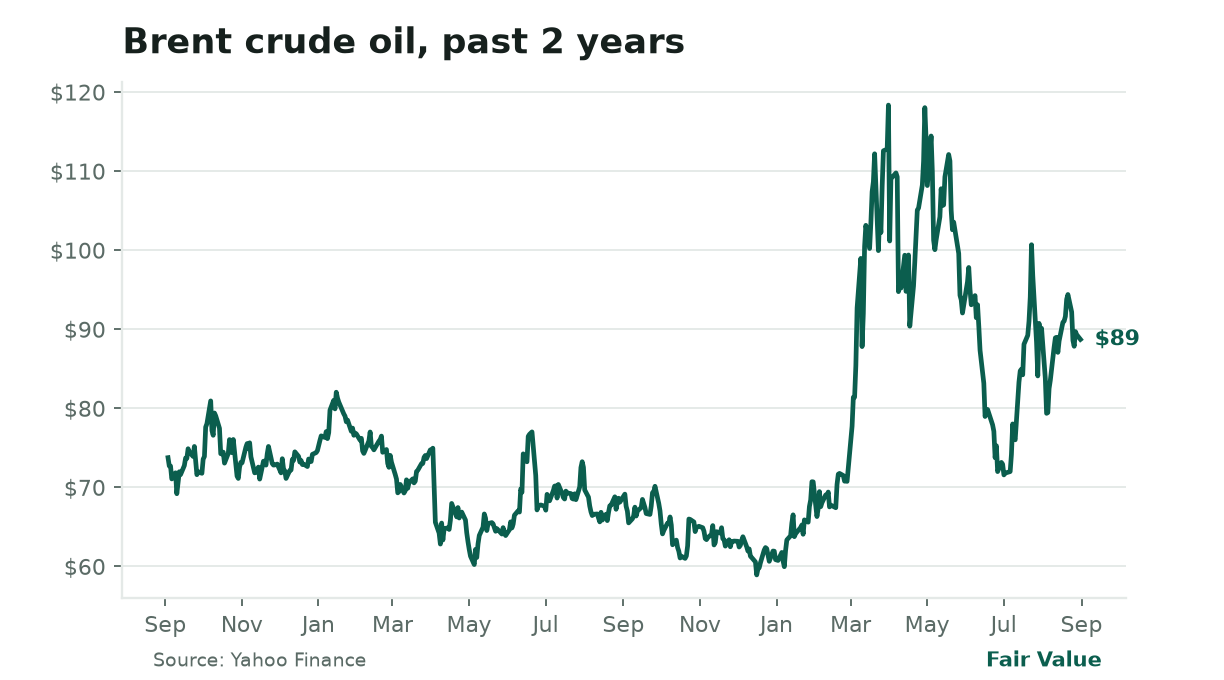
Oil’s geopolitical premium solidifies. Brent crude reached $88.82 after U.S. strikes on Iranian targets in the Strait of Hormuz, but the deeper issue is shipping: just five tankers passed through the Strait this week, down from 130 pre-conflict, while freight rates climbed 12%, embedding higher energy costs as a lasting baseline.
▸
The dollar holds as central banks split. The DXY steadied at 99.55, but tonight’s RBNZ decision, likely lifting rates to 2.75%, could challenge its strength. A kiwi rally would signal growing pushback against the Fed’s prolonged tight policy.
The big story
The AI trade’s feedback loop breaks
AI momentum cracks. Nvidia (-4.6% Friday) erased nearly all of August’s gains, while Marvell (-10.3%) and PayPal (-12.7%) plunged as the Fed’s firmer tone exposed stretched valuations. The trio’s divergence shows how AI’s ‘buy anything’ phase is ending, now earnings must justify prices.
For eight months, the market ran on one rule: chase what’s rising. The “Magnificent Seven”, Nvidia, Microsoft, Apple, and their peers, became a self-feeding cycle, where fund inflows followed performance, performance drew more inflows, and valuations drifted from fundamentals.
Friday’s drop proved that cycle is over.
Nvidia, the AI boom’s poster child, fell 4.6%, wiping out nearly all of August’s gains. Marvell, a key supplier of AI data-center chips, plunged 10.3%, while PayPal, riding the digital-payments wave, collapsed 12.7%. Even Arm Holdings, last year’s IPO star, slid 6.3%. The damage spread widely: the Nasdaq-100 lost 0.7%, the Russell 2000 1.4%, and the VIX, Wall Street’s fear gauge, spiked 5.2% to 15.18, its highest close since May. Not a panic, but a sharp turn from July’s calm.
Three forces are reshaping the trade:
▸
The Fed’s firmer tone
Traders had bet on a December rate cut to support lofty valuations. Then Fed Chair Kevin Warsh used his Jackson Hole speech to call inflation “unacceptably high” and left the door open to further increases. Markets now see a 38% chance of a September hike, up from just 10% a month ago. Higher rates hit AI stocks hardest, as their valuations depend on distant earnings that shrink when discount rates rise.
▸
The momentum trade loses fuel
The “Magnificent Seven” now make up 32% of the S&P 500’s market cap, per Goldman Sachs, an extreme concentration that’s created a crowded exit. “The music’s stopping,” one hedge fund manager told the Wall Street Journal. “Investors are asking, ‘What are we actually holding here?’”
▸
Valuations outrun fundamentals
Nvidia’s earnings were strong, $96.2 billion in revenue, up 106% year-over-year, but margins are tightening as the company spends heavily to secure supply chains. Marvell and AMD face growing questions about whether their AI-driven growth justifies their stretched valuations. PayPal’s collapse followed reports that Advent International and Stripe walked away from acquisition talks, signaling even deep-pocketed buyers are hesitating at current tech prices.
The deeper shift:. This isn’t just about tech. It’s about risk appetite. Investors had assumed the Fed would cut rates at the first sign of trouble. Warsh’s stance removed that safety net. “The Fed isn’t riding to the rescue this time,” said Liz Ann Sonders, chief investment strategist at Charles Schwab. “That changes everything.”
What’s next?. Tuesday’s ISM Manufacturing PMI (consensus: 55.2) will be the first test. A weak reading could amplify slowdown fears, speeding up a shift from high-flying tech into defensive sectors like utilities and healthcare, areas that have lagged all year but now look like relative shelters.
The core question remains: Is this a healthy pullback or the start of a broader unwind? Bulls argue AI’s long-term story stays intact; bears counter that extreme concentration and the Fed’s stance could deflate the bubble.
One thing is clear: The era of easy AI gains is over. From here, earnings, not momentum, must drive the rally.
What's going on today
The market’s mood has shifted. The AI-fueled rally that defined 2026 is showing strain, and the cracks are spreading beyond a few high-profile names. Nvidia, Marvell, and PayPal led Friday’s decline, but the weakness was broad: the Nasdaq-100 fell 0.7%, the Russell 2000 1.4%, and the S&P 500 0.3%. Meanwhile, the VIX rose 5.2% to 15.18, a clear break from summer’s complacency.
The Fed is the trigger.. Traders had spent months pricing in rate cuts. Now, they’re assigning a 38% chance to a September hike, up from 10% in July. That shift hits growth stocks hardest, as their valuations depend on future earnings, which lose value when discount rates climb. Fed Chair Kevin Warsh’s Jackson Hole speech marked the turning point, calling inflation “unacceptably high” and signaling readiness to act if needed.
But the Fed isn’t the only pressure.. The unraveling of the momentum trade, where investors buy simply because others are buying, is adding to the strain. With the “Magnificent Seven” now representing 32% of the S&P 500, the trade has grown dangerously crowded. “The music’s stopping,” one hedge fund manager told the Wall Street Journal. “People are asking what they actually own.”
Geopolitics add another layer of risk.. Oil prices climbed after U.S. airstrikes hit Iranian rocket launchers in the Strait of Hormuz, a reminder that energy-risk premiums aren’t fading. Brent crude now sits at $88.82, while shipping costs have jumped 12% as tankers reroute to avoid conflict zones. That inflationary pressure is one the Fed can’t ignore.
The rotation has begun.. Defensive sectors, utilities, consumer staples, are suddenly in favor. So are value stocks: steady earners with lower valuations, the opposite of high-flying AI names. The pivotal test arrives Tuesday with the ISM Manufacturing PMI. A weak number could reignite recession fears and hasten the exit from tech. A strong reading might buy the bulls time.
The bottom line:. The easy money in AI has vanished. The next phase will demand real earnings, not just momentum.
The big picture
Markets are caught in a tug-of-war. Bonds signal caution; stocks cling to optimism. The resolution of this conflict will determine whether the AI selloff deepens or stabilizes.
Bonds are flashing warnings.. The 10-year Treasury yield holds at 4.68%, but the 30-year yield has climbed to 5.20%, nearing multi-decade highs. Bond investors are demanding more compensation for long-term risk, whether from inflation, deficits, or both. The 2s10s yield curve remains inverted at 0.39%, a recession signal that has preceded every downturn since 1955. Bonds are pricing in slower growth and persistent inflation.
Oil adds to the pressure..Brent crude rose to $88.82 after U.S. strikes on Iranian military targets in the Strait of Hormuz, but the larger issue is structural disruption to global oil flows. Only five tankers transited the Strait this week, down from 130 before the conflict, and freight costs have surged 12% as vessels take longer, costlier routes. Gasoline and diesel inventories are tightening as well, down 2.5 million and 2.2 million barrels last week, respectively. Higher pump prices may follow, giving the Fed another inflation headache.
The dollar remains firm, for now.. The DXY index sits at 99.55, supported by safe-haven demand and the Fed’s stance. But tonight’s Reserve Bank of New Zealand decision, expected to raise rates to 2.75%, could test that strength. A hawkish surprise might trigger a broader reassessment of whether the Fed is as isolated as markets assume. The New Zealand dollar has already risen 2% this month in anticipation.
Crypto sends mixed signals..Bitcoin edged up 1.1% to $78,525 but remains down 0.6% on the week, while Ethereum rose 1.2%. However, Ethereum’s 24-hour trading volume ($111 million) trails its seven-day average, suggesting weak conviction. The real story lies in liquidity: Circle minted another $5 billion in USDC last week, pushing total stablecoin supply to $304 billion. Institutions are stockpiling cash-equivalents, preparing for either a liquidity crunch or a surge in demand.
This week’s pivot points:
▸
Tuesday’s ISM Manufacturing PMI (forecast: 55.2). A miss could reignite slowdown fears and accelerate the shift from growth stocks.
▸
Wednesday’s Bank of Canada decision. An unexpected hike could reinforce the narrative that central banks aren’t done tightening, a headwind for risk assets.
The tension is clear:. Bonds price caution; stocks price hope. The incoming data will reveal which side is right.
Around the world
The Strait of Hormuz: A permanent energy surcharge
$88.82 isn’t just a spike, it’s a plateau. Brent has held above $85 since June, but the Strait of Hormuz conflict is embedding a permanent risk premium: tanker transits collapsed from 130/day to 5, and freight costs jumped 12%. This isn’t a blip; it’s the new floor for energy inflation.
The Middle East remains the epicenter of geopolitical risk, and the latest escalation in the Strait of Hormuz confirms that the energy market’s “new normal” is anything but stable. Over the weekend, U.S. forces conducted airstrikes on Iranian rocket launchers on Larak Island, a critical chokepoint. Iran retaliated with missile strikes near shipping lanes, pushing oil prices higher. Brent crude climbed to $88.82, while WTI rose 3.6% to $86.42.
Yet the immediate price move isn’t the main concern. The real issue is structural disruption to global oil flows. Before the conflict, 130 tankers passed through the Strait daily, carrying 20% of the world’s petroleum. Today, that number has plummeted to five. The remaining oil is rerouted, some via Saudi and UAE pipelines, some around the Cape of Good Hope, adding two weeks and millions in costs per voyage.
Shipping rates for Very Large Crude Carriers (VLCCs) have surged from $20,000 to $55,000 per day, and war-risk insurance premiums remain at 7.5-10% of hull value, roughly 40 times normal levels. This isn’t just an oil story; it’s a global supply-chain tax. Every extra dollar spent on shipping is a dollar not spent elsewhere, and those costs will ripple through gasoline prices and imported goods.
The Strait of Hormuz isn’t the only flashpoint. Houthi attacks in the Red Sea continue unabated, forcing ships to detour around Africa. About one-third of all container traffic and 12% of seaborne oil normally flows through the Red Sea and Suez Canal. With that route effectively closed, delays and higher costs are hitting European retailers ahead of the holiday season. The International Energy Agency (IEA) calls this the “largest supply disruption in the history of the global oil market,” while the IMF warns it’s dragging on Middle East growth, triggering capital flight and currency pressure.
China’s defiance undercuts U.S. sanctions
Meanwhile, China is pushing back against U.S. efforts to isolate Iran economically. After Washington announced new sanctions last week, targeting Iranian oil exports, digital assets, and missile technology, China’s foreign ministry declared that its relationship with Iran “should not be disrupted.” China purchases 89% of Iran’s oil exports and shows no sign of reducing imports.
That defiance poses a problem for U.S. strategy, which relies on global cooperation to make sanctions effective. If China continues buying Iranian oil, the sanctions lose their teeth, and Iran retains funding for its regional proxies.
New Zealand tests the Fed’s grip
The other geopolitical story this week is New Zealand’s rate decision tonight. The Reserve Bank of New Zealand (RBNZ) is expected to raise its Official Cash Rate to 2.75%, up from 2.5%. The move would make New Zealand the latest central bank to resist the Fed’s higher-for-longer stance.
The RBNZ’s decision is partly about domestic inflation, which remains stubborn. But it’s also a signal: Not every central bank is following the Fed. If the RBNZ surprises with a more hawkish tone, or if Governor Adrian Orr hints at further hikes, it could prompt a reassessment of global monetary policy divergence. The New Zealand dollar has already risen 2% against the U.S. dollar this month in anticipation. A hawkish RBNZ could push it higher, testing the greenback’s recent strength.
Japan’s defense buildup strains supply chains
Finally, watch Japan’s defense spending. Reports indicate Japan is targeting record military outlays in its next budget, with a focus on drones and missiles to counter China’s regional presence. This isn’t just about Japan; it’s part of a broader Asian arms race fueled by U.S.-China tensions.
The more countries like Japan and South Korea boost defense spending, the greater the pressure on global supply chains for semiconductors, rare earths, and advanced materials, already stretched thin by AI demand and the energy transition.
The bottom line:. The world is fragmenting, and the economic costs are mounting. Whether it’s oil rerouting around war zones, central banks diverging on rates, or defense budgets ballooning, the era of easy globalization is over. For investors, that means higher costs, more volatility, and a premium on resilience.
Companies making news
The AI chip shakeup
OpenAI’s in-house chip could disrupt the semiconductor market.. The company unveiled its first custom chip, codenamed “Jalapeño,” which delivers 1.5-1.9x more AI work per watt than Nvidia’s current GPUs. Developed with Broadcom, the chip targets AI inference, running trained models, and could reduce OpenAI’s reliance on Nvidia. If successful, Jalapeño may lower AI compute costs industry-wide and accelerate the commoditization of AI infrastructure.
For Nvidia, it’s a long-term threat. For cloud providers and enterprises, it could mean cheaper, more efficient AI deployment. The announcement comes as Nvidia’s stock fell 4.6%, erasing nearly all of its August gains.
Marvell’s AI growth stalls.. The chipmaker, a key supplier of AI data-center components, plunged 10.3% Friday after Bank of America analysts downgraded it, citing valuation concerns and slowing demand. Marvell had surged 33% this month before the drop. With Nvidia and peers also showing signs of fatigue, investors are questioning whether the AI capital-expenditure cycle can sustain current valuations.
The insurance consolidation wave
Aon nears a $17 billion deal for USI Insurance.. The acquisition, Aon’s largest since its failed 2021 merger with Willis Towers Watson, would expand its middle-market and specialty insurance businesses, areas where USI excels. Private-equity giant KKR, which has owned USI since 2017, stands to profit significantly. The question is whether regulators will raise antitrust concerns, given Aon’s already dominant position in commercial insurance broking.
PayPal’s failed lifeline
PayPal’s takeover talks collapse.. Shares plunged 12.7% Friday after reports that Advent International and Stripe abandoned acquisition plans. The deal, in the works for months, reportedly fell apart over valuation and financing. PayPal’s stock is now down 20% from its July peak, erasing billions in market value. The collapse signals that even deep-pocketed investors are wary of tech valuations, and that the leveraged-buyout market may be cooling as borrowing costs rise.
Who’s defying the tech downturn?
ServiceNow and Amazon buck the trend.. ServiceNow, the cloud workflow automation firm, rose 4.5% Friday, extending a month-long rally that has seen the stock climb 25%. Amazon gained 4.0%, buoyed by an analyst note highlighting its AI-driven cost efficiencies in logistics and cloud computing. Both companies benefit from a rotation into high-quality, cash-flow-positive tech, a shift that could accelerate if the Fed maintains its firm stance.
Nike and Airbnb find footing.. Defensive and consumer-focused stocks were Friday’s bright spots. Nike rose 3.0%, rebounding from a tough August, while Airbnb gained 2.7% as travelers prioritize experiences over goods. Both are seen as relative safe havens in a market suddenly questioning the durability of the AI rally.
Crypto’s security wake-up call
The Sandbox bridge exploit raises alarms.. Over the weekend, hackers exploited a vulnerability in The Sandbox’s cross-chain bridge, minting 329 trillion unbacked SAND tokens (worth about $49 billion at face value, though only $675,000 was stolen). This is the latest in a string of bridge-related hacks, which have cost over $4 billion since 2021.
The Sandbox has disabled bridging on the affected networks, but the incident underscores the ongoing security risks in decentralized finance (DeFi). For crypto investors, it’s another reason to exercise caution around cross-chain protocols, a favorite target for hackers.
From Washington
The Fed’s high-stakes week
The Federal Reserve isn’t meeting, but its influence looms large. All eyes are on Tuesday’s ISM Manufacturing PMI (forecast: 55.2), the first major read on September’s economic health. A number below 50, signaling contraction, could reignite recession fears and force the Fed to reconsider its firm stance. Even a slight miss might accelerate the rotation from growth stocks to defensives.
Fed Chair Kevin Warsh’s Jackson Hole speech left no room for ambiguity: Inflation remains “unacceptably high,” and the Fed is prepared to act if progress stalls. Markets now price a 38% chance of a September hike, up from 10% a month ago. That repricing is weighing on risk assets, particularly the high-flying tech and AI stocks that led the market in 2026.
Treasury’s Iran sanctions hit a China wall
The other major Washington story is the Treasury’s new sanctions campaign against Iran, dubbed “Operation Economic Outcast.” Announced last week, the sanctions target nearly 60 entities, individuals, and vessels linked to illicit procurement of nuclear and missile technology, cyber operations, and oil smuggling. The goal: Cut off Iran’s revenue and force negotiations.
The catch: China, Iran’s largest oil customer, isn’t cooperating. Beijing buys 89% of Iran’s oil exports and has made clear its relationship with Iran “should not be disrupted.” If China continues purchasing Iranian oil, the sanctions lose their bite, and Iran retains funding for its regional proxies.
The FSB’s AI warning
On the regulatory front, the Financial Stability Board (FSB), which coordinates financial rules for the G20, flagged risks from new AI models. In a letter to G20 finance ministers, FSB Chair Klaas Knot warned that potential disruptions from AI “would not stop at national borders” and urged prioritizing safe model releases.
The warning comes as governments struggle to regulate AI without stifling innovation. The U.S. is taking a sector-specific approach, with agencies like the SEC and CFTC focusing on financial stability risks. The EU’s AI Act, effective next year, will impose strict rules on high-risk applications.
Treasury’s borrowing plans add rate pressure
Finally, watch the Treasury’s quarterly refunding details, expected this week. With the 30-year Treasury yield near multi-decade highs, the cost of servicing the national debt is rising. If long-term yields continue climbing, it could push the Fed to keep rates higher for longer, another headwind for stocks.
Under the hood
The bond-stock divide
The most critical market dynamic right now isn’t the Fed, oil, or even the AI selloff. It’s the divergence between stocks and bonds, and what it reveals about who’s right.
Bonds are signaling caution.. The 10-year Treasury yield sits at 4.68%, but the 30-year yield rose to 5.20%, nearing early-2000s levels. Bond investors are demanding more compensation for long-term risk, whether from inflation, deficits, or both. The 2s10s yield curve remains inverted at 0.39%, a recession warning that has preceded every downturn since 1955. Bonds are pricing in slower growth and sticky inflation.
Stocks are holding on to hope.. The S&P 500 is just 0.3% off its all-time high, and the Nasdaq-100, despite Friday’s drop, is still up 8.2% over the past month. Stocks are betting the AI boom will offset any slowdown and that the Fed will ultimately cut rates if growth falters.
High-yield bonds are caught in between.. The ICE BofA US High Yield Index Option-Adjusted Spread (OAS), the extra yield investors demand for risky corporate debt, is at 2.63%, down from 2.67% earlier this week and well below its long-term average of 5.16%. A narrowing OAS suggests lower perceived default risk and strong corporate liquidity. In other words, the riskier part of the bond market isn’t as pessimistic as Treasuries.
Who’s right?. The reconciliation of these views will shape the market’s next move:
▸
If Treasuries are correct and growth slows more than expected, stocks will have to catch down.
▸
If high-yield bonds are correct and balance sheets stay strong, the tech selloff may remain contained.
▸
If stocks are correct and AI continues driving earnings, bonds may have to reprice higher.
The Fed’s reaction function
The wild card is the Fed’s next move. Right now, markets are betting on a September hike if inflation stays sticky. But if Tuesday’s ISM Manufacturing PMI misses or Friday’s jobs report shows a cooling labor market, the Fed may pause. That could spark a relief rally in stocks and a pullback in Treasury yields.
Conversely, if data stays strong, the Fed could hike, and that would likely send both stocks and bonds lower, as higher rates weigh on valuations and borrowing costs.
The liquidity squeeze
The other dynamic to watch is liquidity. The Fed’s balance sheet is still shrinking via quantitative tightening (QT), draining liquidity from the system. Meanwhile, the Treasury is issuing more debt to fund deficits, soaking up cash. That’s one reason stablecoin supply has surged to $304 billion, institutions are parking cash in USDC and USDT as a hedge.
If liquidity tightens further, it could amplify market moves, especially in risk assets like tech and crypto.
Bottom line:. The market is at an inflection point. Bonds whisper caution; stocks cling to hope. The next few days of data will show which side wins.
Worth learning today: Other central banks and the dollar
Resolving Friday’s prediction
Last Friday, we asked: How would markets react if the ISM Manufacturing PMI came in below the forecast of 55.2? The report isn’t out yet (due Tuesday, September 1), but the setup is clear. The Fed’s firmer shift has already pushed the 2-year Treasury yield to 4.20%, and the dollar index (DXY) is at 99.55, near its 2022 high. If the PMI misses, expect:
▸
A stronger dollar as traders bet on a Fed that stays firm.
▸
A selloff in growth stocks, especially tech and AI names.
▸
A rotation into defensives, utilities, consumer staples, and the Japanese yen (a traditional safe haven).
The mechanism: Weaker data → Fed holds rates higher → stronger dollar → tighter financial conditions → risk-off rotation.
The lesson: Why the ECB, BOJ, and BOE matter to your wallet
You know the Federal Reserve. But the Fed isn’t the only central bank that moves markets, or your money. The European Central Bank (ECB), Bank of Japan (BOJ), and Bank of England (BOE) also set interest rates, and their decisions ripple through currencies, commodities, and even U.S. stocks. Here’s how it works and why it matters.
How central banks pull the levers
All central banks use the same basic tools:
▸
They control short-term interest rates to balance stable prices (low inflation) and maximum employment.
▸
When they raise rates, borrowing becomes more expensive, cooling spending and inflation but potentially slowing growth.
▸
When they cut rates, borrowing becomes cheaper, stimulating the economy but risking inflation.
The key tool is the policy rate:
▸
In the Eurozone, it’s the deposit facility rate (currently 3.75%).
▸
In Japan, it’s the short-term rate (still -0.10%, yes, negative).
▸
In the UK, it’s the Bank Rate (5.25%).
But here’s the catch: Central banks don’t move in sync. Right now:
▸
The Fed’s rate is 3.63%.
▸
The ECB’s is 3.75%.
▸
The BOE’s is 5.25%.
▸
The BOJ’s is -0.10%.
Those gaps create rate differentials, which drive currency moves. For example, the U.S. dollar is strong because the Fed’s rates are higher than most peers. That makes dollar assets (like Treasuries) more attractive to global investors, pushing the dollar up.
Why it matters to you
▸
Your investments:
If you own international stocks or bonds, currency moves affect returns. A stronger dollar means foreign investments are worth less when converted back to USD. For example, if the ECB cuts rates while the Fed holds steady, the euro could weaken, hurting returns on European stocks.
▸
Your job:
Multinationals (Apple, Coca-Cola, Boeing) earn revenue overseas. When the dollar strengthens, those foreign earnings shrink in USD terms, hurting profits and stock prices. A strong dollar is one reason U.S. corporate earnings have been under pressure.
▸
Your cost of living:
The dollar’s strength affects commodity prices. Oil, gold, and agricultural products are priced in dollars, so a stronger dollar can lower commodity prices (good for gas and groceries). But it also makes U.S. exports more expensive, which can hurt industries like manufacturing and agriculture.
▸
Your travel plans:
Heading to Europe? A stronger dollar means your USD goes further. But if you’re a U.S. exporter or a company with overseas operations, a strong dollar can cut into profits.
The dollar’s global role
The U.S. dollar is the world’s reserve currency, held by central banks and used for global trade (60% of foreign exchange reserves are in dollars). That gives the Fed outsized influence, but it also means other central banks’ moves can shake the dollar. For example:
▸
If the BOJ finally hikes rates (ending negative rates), the yen could surge, weakening the dollar.
▸
If the ECB cuts rates aggressively, the euro could drop, strengthening the dollar further.
▸
If the BOE hikes (as some expect next year), the pound could rally, pressuring the dollar.
The bigger picture: Carry trades and global liquidity
Investors constantly compare rates across countries to exploit rate differentials. For example, if the Fed’s rates are higher than Japan’s, investors can borrow in yen (cheap) and invest in dollars (higher yield). This carry trade is one reason the yen has been so weak lately.
But if the BOJ hikes rates, that trade unwinds, potentially causing volatility in currencies and stocks.
Linking back to the Fed
Remember the policy rate and yield curve? The same dynamics play out globally. An inverted U.S. yield curve can spook investors worldwide, leading to risk-off moves (selling stocks, buying dollars and Treasuries).
Tomorrow’s setup
Predict this:. The Reserve Bank of New Zealand (RBNZ) rate decision is tonight (forecast: 2.75%, prior: 2.50%). If the RBNZ hikes and signals more to come, which asset is most exposed: the New Zealand dollar (NZD), gold, or U.S. Treasuries? Which direction would each move, and why? We’ll resolve it tomorrow.
What to watch this week
Monday, September 1 (tonight)
▸
NZD Official Cash Rate — (forecast: 2.75%, prior: 2.50%), A hike could strengthen the NZD and test the U.S. dollar’s dominance.
▸
NZD RBNZ Monetary Policy Statement & Press Conference — , Watch for signals on future hikes. A hawkish tone = stronger NZD, weaker USD.
▸
AUD GDP q/q — (forecast: 0.3%, prior: 0.3%), A miss could weigh on the Australian dollar and commodity prices.
CAD Bank of Canada Rate Statement & Overnight Rate — (forecast: 2.25%, prior: 2.25%), No hike expected, but watch for shifts in tone on inflation.
Wednesday, September 3
▸
USD JOLTS Job Openings — , A drop could ease Fed hike fears; a rise could fuel them.
▸
USD Factory Orders — , Weak data = more Fed pause bets.
Thursday, September 4
▸
USD Non-Farm Payrolls — (forecast: 58K, prior: -23K), The week’s biggest event. Strong jobs = Fed hike bets rise; weak jobs = rate-cut hopes return.
▸
USD Unemployment Rate — (forecast: 4.1%, prior: 4.1%), A tick up could spook markets.
▸
USD Average Hourly Earnings — (forecast: 0.3% m/m), High wages = sticky inflation = Fed hawkishness.
Friday, September 5
▸
USD ISM Services PMI — , Services sector resilience could keep the Fed on hold. A weak reading might reignite slowdown fears.
Not financial advice.Disclaimer: This briefing is for informational purposes only and does not constitute financial advice. Neither Fair Value nor its authors buy or sell any security. Always conduct your own research or consult a professional before making investment decisions.
Data sources: Bloomberg, FactSet, Federal Reserve, U.S. Treasury, CME Group, Bank of Japan, European Central Bank, Bank of England, Reserve Bank of New Zealand, International Energy Agency, IMF, Wall Street Journal, Financial Times.