Fed Chair Warsh changes tone. His Jackson Hole remarks pushed Treasury yields to nine-month highs and weighed on stocks as traders scaled back December cut expectations, and began considering a September increase.
▸
Strait of Hormuz traffic slows. Brent crude slipped 1.8% to $88.10, but the deeper issue is shipping: just 22 tankers cleared the Strait on Thursday, down from 130 pre-conflict, as Iran’s blockade and U.S. sanctions force costly reroutes.
▸
AI’s spending spree meets resistance. Nvidia’s $279 billion supply-chain investment and Micron’s $45 billion 2027 plan run into copper shortages and higher borrowing costs, a sign the sector’s rapid expansion may be slowing.
The week that was
The Fed’s patience wore thin.
For months, traders treated December rate reductions as a near-certainty. Then Kevin Warsh used his Jackson Hole address to call inflation “unacceptably high,” even suggesting rates could rise if progress halts. The reaction was immediate: the 10-year Treasury yield jumped to 4.67%, its highest since November 2023, while the S&P 500 edged down 0.25% Friday, capping a week where the Nasdaq lost 0.7% and the Russell 2000 fell 1.4%. The dollar strengthened another 0.5% as investors sought safety.
This wasn’t just about borrowing costs. It was about who sets the terms. The Fed had spent 2026 juggling slowing growth against persistent inflation. Warsh’s speech sent a clear message: the balancing act has an end date.
The Strait of Hormuz is becoming a dead end.
Brent crude closed the week 1.8% lower at $88.10, but the bigger story is in shipping lanes. Tanker traffic through the Strait dropped to 22 vessels on Thursday, compared to 130 daily before the conflict. The U.S. Treasury’s “Operation Economic Outcast” added two more banks to its sanctions list this week for funding Iran’s Revolutionary Guard, while detours sent shipping costs higher: the Baltic Dry Tanker Index has climbed 7.6% over the past month.
AI’s capital rush hits speed bumps.
Nvidia, the sector’s bellwether, fell 4.6% Friday, dragging down chipmakers (Marvell: -10.3%, ARM: -6.3%). Two pressures are building: copper prices have risen 3.3% this month, pinching profits, while Nvidia’s $500 billion financing deal laid bare the sector’s reliance on debt. The boom isn’t over, but the easy phase may be.
Elsewhere:
▸
Stablecoin demand grows. Circle issued another $5 billion in USDC, bringing total supply to $303.7 billion, companies are holding more cash in digital form.
▸
Household strain deepens. Jobless claims stayed at 203,000, but Bank of America’s Moynihan noted a “spending divide”: lower-income workers are stretched thin by housing, rent, insurance, and fuel costs.
The big question this week
Could September bring a rate hike, and what would that cost?
Warsh’s Jackson Hole remarks weren’t a caution. They were a boundary. The Fed isn’t waiting for inflation to ease on its own; it’s prepared to increase rates if the data doesn’t cooperate.
The trade-off:. Raise rates and risk a downturn. Stand pat and risk inflation taking root. This week’s reports will decide the path.
▸
Tuesday’s ISM Manufacturing PMI (expected: 55.2) and Friday’s jobs data (payrolls: +58,000, unemployment: 4.1%) are critical. Strong readings could seal a hike.
▸
Sectors in the crosshairs:
▸
Real estate: Mortgage rates at 6.66% would climb further.
Tech and AI: Nvidia and Micron took on heavy debt for expansion. Rising rates plus copper shortages spell tighter conditions.
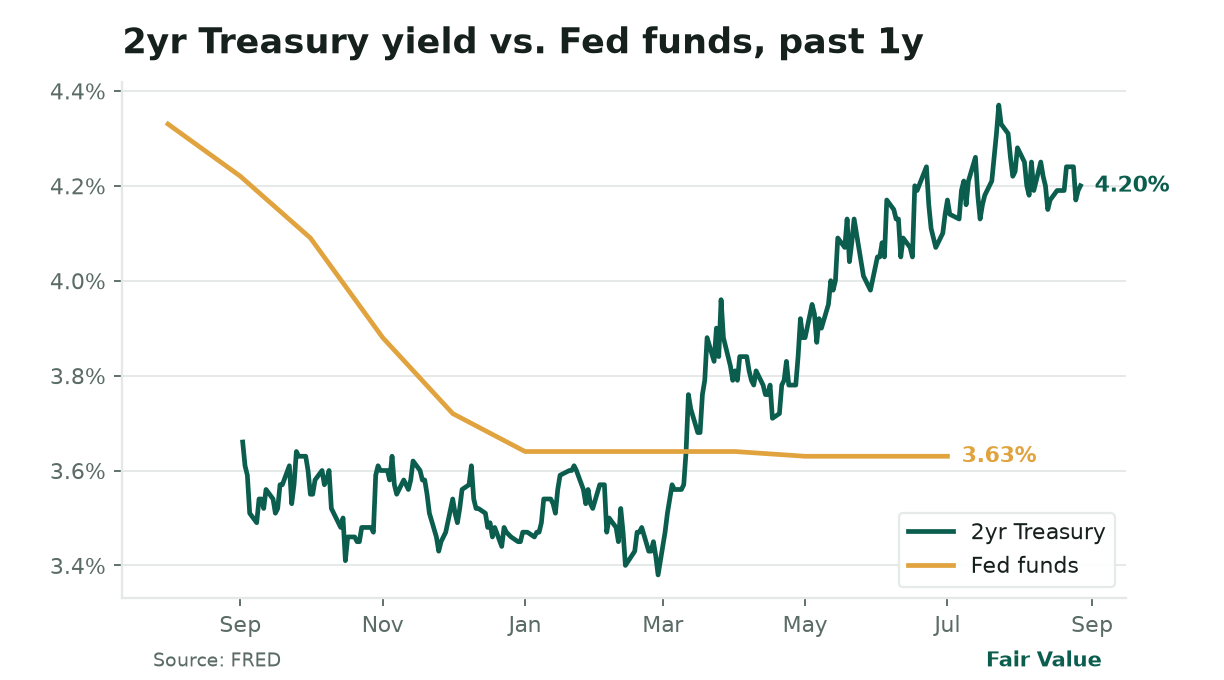
Keep an eye on the 2-year yield.. Now at 4.2%, a move toward 4.5% signals the market is betting on an increase.
Key point:. This isn’t about a single rate decision. It’s about whether the Fed will force a slowdown to curb inflation. The numbers this week will show their next move.
The week ahead
Monday, September 1
▸
New Zealand Official Cash Rate (expected: 2.75%, previously: 2.50%) — , The Reserve Bank of New Zealand is likely to raise rates, reinforcing the “higher for longer” stance.
▸
U.S. ISM Manufacturing PMI (expected: 55.2, previously: 55.6) — , First major U.S. data after Warsh’s speech. A reading above 55 keeps hike chances alive.
Tuesday, September 2
▸
Canada Overnight Rate (expected: 2.25%, previously: 2.25%) — , The Bank of Canada is expected to hold, but any hawkish tone could lift the Canadian dollar.
Thursday, September 4
▸
U.S. Non-Farm Payrolls (expected: +58,000, previously: -23,000) / Unemployment (expected: 4.1%) — , The week’s highlight. Another weak report could derail hike plans.
Friday, September 5
▸
Bank of England Governor Bailey speaks — , Hawkish comments could move the pound and European markets.
Worth learning today: Forward guidance and the dot plot
Last week’s focus:. We asked whether Warsh’s speech would shift rate-hike expectations. It did. The 2-year yield rose to 4.2%, and September hike odds climbed from near-zero to about 30%.
Hike bets surge. The 2-year yield (now 4.2%) has climbed 0.5% since June, nearing the Fed funds rate (4.5%), a sign traders are pricing in a September rate increase after Warsh’s hawkish Jackson Hole speech. This spread inversion reflects tightening expectations.
How forward guidance works:. The Fed doesn’t just adjust rates, it hints at future moves to influence behavior. Think of a captain announcing a course change before turning the wheel. That’s forward guidance.
Two forms:
▸
General: “Rates will remain elevated for some time.”
▸
Specific: “We anticipate a cut in December 2026.”
Then there’s the dot plot, a chart showing where each Fed official sees rates heading. It’s not a commitment, but markets react as if it is.
Why it’s important now:. June’s dot plot pointed to cuts. Warsh’s speech opened the door to hikes. That conflict is driving volatility.
This week’s ISM and jobs figures will tip the balance:
▸
Strong data → dots move higher → mortgages, corporate debt, and the dollar face pressure.
▸
Weak data → cuts return to the table → some relief for borrowers.
The challenge:. Skeptics say forward guidance can’t keep pace with fast-moving markets. Warsh’s speech was an attempt to reclaim control. If the data supports a hike but the Fed hesitates, its credibility takes a hit.
Concept 45 of 83 in the Fair Value course.
Tomorrow’s focus:. The U.S. ISM Manufacturing PMI (Tuesday, Sept 1, expected 55.2) tests the Fed’s stance. Above 55? The hike discussion continues. Below 50? The Fed may pause. The 2-year yield will lead the reaction, we’ll cover it Monday.
Not financial advice.This brief is for informational and educational purposes only and does not constitute investment advice or a recommendation to buy or sell any security.
Data sources: macro indicators per FRED® (Federal Reserve Bank of St. Louis); energy data per U.S. Energy Information Administration (EIA); auction data per U.S. Treasury Fiscal Data; filings per SEC EDGAR; market prices per Yahoo Finance; earnings calendar per Financial Modeling Prep. ```