The Fed adds AI, Middle East tensions, and tariffs to its inflation watchlist, with "almost all" officials now open to rate increases. Mortgages, credit cards, and savings rates may climb even if growth slows.
▸
Oil swings between OPEC+ output hikes and war fears, Brent crude holds at $76.17, up 6% this week but down 18% from last month’s high. A $11 "conflict surcharge" per barrel keeps pump prices elevated.
▸
AI chip demand reshapes tech, Broadcom’s $16 billion AI revenue forecast (up 200% year-over-year) and ARM’s $20 billion order backlog highlight supply constraints. Your devices will get smarter, but the stocks behind them carry high expectations.
The big story
The Fed’s new inflation playbook: AI, wars, and tariffs
The Federal Reserve kept rates unchanged this week, but its latest meeting notes show a central bank now closely tracking three emerging inflation drivers: artificial intelligence, geopolitical conflicts, and trade policies. This shift marks the first time these forces have been treated as direct price factors, with ripple effects from home loans to grocery costs.
Three new factors shaping Fed policy
The FOMC minutes reveal officials now see AI-driven demand, Middle East supply chains, and tariffs as active inflation risks. Here’s the breakdown:
The Fed’s focus is on the $1 trillion global rush for GPUs, data centers, and power, not job losses:
▸
Nvidia’s AI server revenue jumped 265% year-over-year in Q1.
▸
U.S. data centers may double electricity use by 2030, straining power grids and utility bills.
▸
Broadcom shares rose 4.7% after projecting $16 billion in AI chip sales, a 200% annual leap.
The central bank now labels AI a near-term inflation driver, reversing its 2023 view that the tech would cut costs.
▸
Middle East tensions stretch beyond oil to global trade routes.
Geopolitical risks have moved from the sidelines to center stage, with wide-ranging effects:
▸
Shipping rates have climbed 30% since April as vessels take longer routes.
▸
War-risk insurance for Red Sea crossings has quadrupled, adding hidden costs to electronics, furniture, and food imports.
▸
Tariffs, including the 100% tax on Chinese electric vehicles, now feed directly into inflation models.
▸
"Almost all" officials ready for hikes, even with slowing growth.
The minutes show "almost all" FOMC members would raise rates if inflation persists, a sharp turn from March, when 12 of 18 officials expected cuts. Now, only one does.
▸
December hike likelihood: 50% (up from 30% last month).
▸
Mortgage impact: The 30-year fixed rate (6.8%) could hit 7.2% by year-end, adding $200 monthly to a $300,000 loan.
▸
Credit cards: Rates may reach ~21% APR, the highest since 2001.
The Fed’s tightrope walk
The central bank faces two opposing forces:
▸
AI-driven productivity (which should lower prices over time), and
▸
AI-driven demand (which is raising prices now).
This creates the first tech-fueled inflation paradox in decades. Chair Kevin Warsh has responded by dropping forward guidance, admitting that traditional models struggle when data center construction in Nevada becomes a macroeconomic factor.
Key dates ahead
▸
July 16: Warsh appears before Congress, with AI’s inflation role likely dominating questions.
▸
July 29: Q2 GDP report. If business investment (AI spending) surges while consumer spending weakens, the Fed’s hawkish tone will strengthen.
▸
Note: Refinancing or auto loan rates won’t stay low forever, the window is narrowing.
What's happening today
Markets weigh AI momentum against geopolitical risks
Stocks closed Thursday’s session higher, but the real action was under the surface. The Nasdaq-100 gained 1.6% and the S&P 500 rose 0.8%, yet leadership shifted: financials (XLF +1.0%) and industrials (XLI +0.38%) led, while semiconductors trailed. This rotation suggests more than profit-taking, it signals a shift in priorities, with money moving from AI momentum plays (Nvidia dipped 0.66% Thursday) into old-economy sectors set to benefit from higher rates and infrastructure spending.
Oil stays volatile. Brent crude slipped to $76.17 overnight, but the market remains on edge. While the Strait of Hormuz has partially reopened, U.S.-Iran clashes continue, keeping a $5-$10 "conflict surcharge" in every barrel. That premium ensures gas prices stay high, even if tensions ease temporarily.
Bonds send caution signals. The 10-year Treasury yield held at 4.56%, but the 2-year yield (4.21%), most sensitive to Fed moves, dropped 2 basis points Thursday. The bond market’s message: "The Fed may pause, but it’s not backing down." With $100 billion in Treasury auctions today, global demand will test whether investors remain willing to fund U.S. debt at current rates.
The takeaway. This isn’t a "risk-on" or "risk-off" market. It’s a "choose your exposure" environment, where tech rides AI, bonds reflect Fed resolve, and oil tracks war risks. Volatility isn’t taking a summer break.
The big picture
Bonds: Traders doubt the Fed’s pause will last
Treasury yields are sending mixed signals, and the split shows where smart money is hedging.
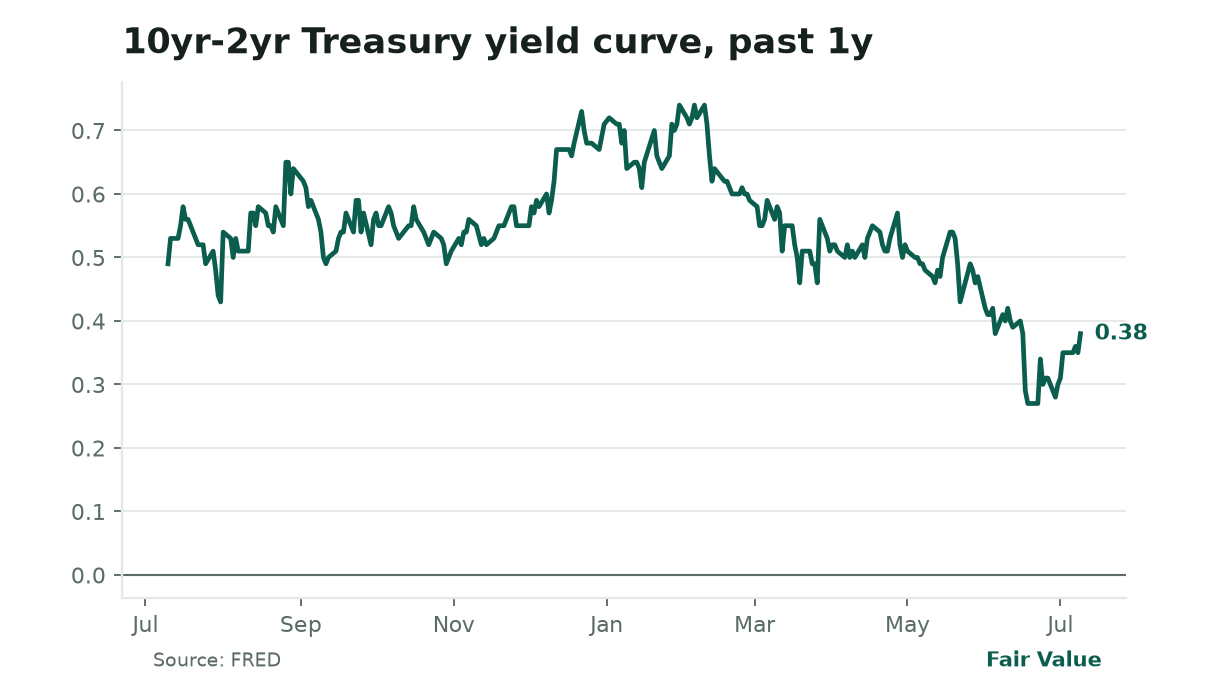
Bond market splits on Fed’s pause. The 10yr-2yr spread (now -0.35%) has steepened slightly from June’s -0.50% inversion, but remains deeply negative, a classic recession warning. Yet the 2yr yield (4.21%) fell 2bps Thursday, signaling traders doubt the Fed’s ‘higher-for-longer’ resolve despite hawkish minutes. The curve’s failure to un-invert suggests growth fears still outweigh inflation bets.
▸
The 10-year yield (4.56%) is unchanged from Thursday but has risen 40 basis points since June, pricing in prolonged higher rates despite cooling growth.
▸
The 2-year yield (4.21%), most tied to Fed policy, fell 2 basis points Thursday. Not a dovish bet, but a sign: "The Fed may hold, but it’s not reversing course."
Consumer impact:
▸
Mortgages: The 30-year fixed rate (6.8%) shows no signs of retreat. If the 10-year yield stays above 4.5%, sub-6% mortgages are likely gone.
▸
Savings: High-yield accounts (~4.5% APY) stay competitive, but CD rates may peak soon if the Fed holds steady.
Oil: The $11 question
Brent crude trades at $76.17, down 18% from last month’s peak but up 6% this week. Three forces explain the tension:
▸
OPEC+ boosts output again. The group approved another 188,000 barrels/day for August, the fifth straight increase. Normally, this would push prices down. But…
▸
The Strait of Hormuz remains a hotspot. Iran’s new anti-ship missiles and the U.S. revoking a key oil-sanctions waiver keep a $10-$15 "war surcharge" per barrel.
▸
U.S. inventories rise, but not enough. Crude stocks grew by 3 million barrels last week but remain 6% below the five-year average. Refineries run at 95.8% capacity, near maximum, to meet summer demand.
The hidden cost. Gasoline futures have climbed 15 cents/gallon this week. Pumps haven’t reflected this yet, but expect national averages of $3.75-$4.00/gallon soon.
Dollar: The unseen force
The U.S. Dollar Index (DXY) sits at 100.87, slightly lower but up 3% over the past year. Why it matters:
▸
Strong dollar = cheaper imports (helping consumers) but weaker multinational earnings (hurting stocks).
▸
Emerging markets (like Turkey and Argentina) struggle as local currencies weaken, making dollar-denominated debt harder to repay.
Around the world
Middle East: Oil markets face a $10 billion gamble
The Strait of Hormuz has partially reopened, but U.S.-Iran strikes continue, leaving oil markets in limbo.
▸
Iran’s new missiles can now target moving tankers with precision, pushing war-risk insurance for Gulf ships up 400% since April.
▸
The U.S. revoked a key sanctions waiver Thursday, banning new Iranian oil sales. Yet China and India keep buying via "ghost tankers" (vessels that disable tracking).
▸
OPEC+ is raising output, but Saudi Arabia and Iraq lack spare capacity to offset risk premiums. That’s why Brent stays at $76, neither crashing nor surging.
The hidden cost.Diesel prices (critical for trucking, rail, and farming) have jumped 42% since the conflict began, raising costs across supply chains.
China: The rare-earths power struggle heats up
China completed the world’s largest fusion magnet this week, a step toward commercial nuclear fusion. But the more immediate move involves rare earths:
▸
Energy Fuels (U.S.) bought Germany’s VAC for $1.9 billion, positioning itself as a non-Chinese magnet supplier.
▸
Australia loaned Iluka $1.2 billion to build a rare-earths refinery.
▸
Former President Trump has revived plans to buy Greenland for its rare-earth deposits.
Why it matters. China controls 80% of global rare-earths supply. The U.S. and allies are spending billions to reduce this dependency, but full diversification will take 5-10 years. Until then, every EV, wind turbine, and missile system still relies on Beijing.
Companies in focus
AI chip rush: Who’s winning and who’s overpromising
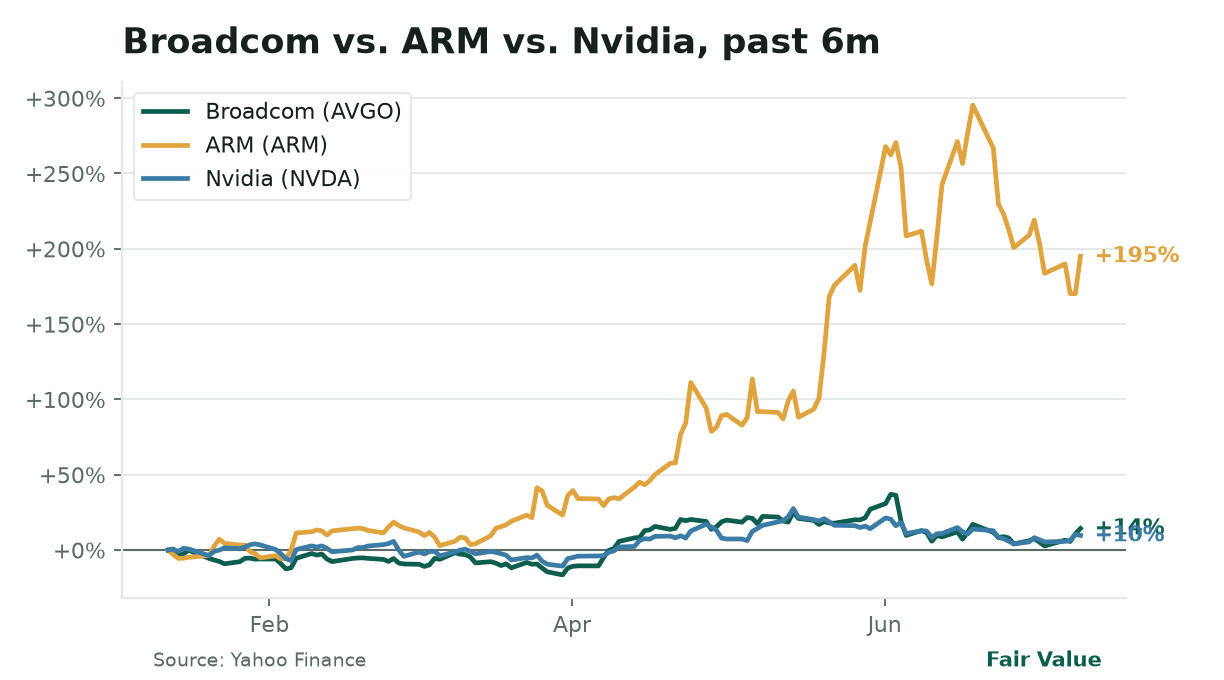
Broadcom’s $16 billion AI bet pays off.. Broadcom (AVGO) climbed 5.66% Thursday after guiding to $16 billion in AI chip revenue, a 200% year-over-year jump. The company also extended its Apple partnership through 2031, locking in 20% of its revenue. Broadcom’s edge lies in AI’s behind-the-scenes opportunity: It doesn’t make flashy GPUs but supplies the custom chips powering data centers for Google, Meta, and OpenAI.
AI chipmakers diverge. Broadcom (AVGO) surged 5.7% Thursday on a $16B AI revenue forecast (up 200% YoY), while ARM (ARM) rebounded 9.2% after revealing a $20B order backlog it can’t fill. Nvidia (NVDA), the AI bellwether, dipped 0.66% from its June peak as Goldman questioned whether the $1T global AI spend will pay off.
ARM’s $20 billion supply squeeze.. ARM Holdings (ARM) rose 9.2% Thursday after its CEO revealed demand for its new AGI CPU has hit $20 billion, but supply limits deliveries to $1 billion. The shortfall explains why ARM’s stock dropped 7% earlier this week. The lesson: AI demand is real, but the supply chain can’t keep up.
Meta builds its own AI chips.. Meta (META) is developing custom AI chips (codenamed "Iris") with Broadcom and TSMC, per Reuters. The goal: Cut its $30 billion annual cloud bill. If successful, this could challenge Nvidia’s dominance, but the effect won’t show until 2027.
Goldman Sachs questions AI’s payoff.. A new Goldman report calls AI capital spending unsustainable: The $1 trillion spent on data centers and GPUs doubles 2022 levels, yet returns remain unclear. This skepticism helps explain why Nvidia (NVDA) has slipped 0.66% from its June high, investors are asking: "Who actually profits from this spending?"
SK Hynix’s $26 billion IPO test.. South Korea’s SK Hynix, the world’s second-largest memory chipmaker, debuts on the NYSE today (SKHY), raising $26.5 billion. This is the largest tech IPO since Arm and will test AI demand. A strong opening lifts semiconductor stocks (MU, WDC, INTC); a weak debut fuels bubble concerns.
From Washington
The Fed’s inflation focus widens: AI, wars, and tariffs
The June FOMC minutes show a Federal Reserve no longer fighting the last war, it’s preparing for new battles:
▸
AI demand is now an official inflation risk.
▸
Middle East conflicts threaten supply chains beyond oil.
▸
Tariffs (like the 100% tax on Chinese EVs) act as direct price drivers.
What’s next:
▸
July 16: Fed Chair Kevin Warsh testifies to Congress, with lawmakers likely to ask how the Fed will measure AI’s inflation impact.
▸
July 31: PCE inflation data. If the reading stays above 2.5%, September hike odds could rise to 70%.
▸
Key takeaway: The Fed has ruled out 2026 rate cuts. The only question is how much higher rates will go.
Worth knowing: **The "risk premium" in oil prices, why gas stays expensive even when crude falls**
Oil prices swing on "geopolitical risk," but what does that mean for drivers? Here’s how the risk premium keeps gas prices high.
What is a risk premium?
The risk premium is the extra cost built into oil prices to account for potential disruptions. Think of it as war insurance for traders.
▸
Stable times: Oil trades at its "fundamental" price, based on supply, demand, and inventories.
▸
Crisis times: Traders add a risk premium, usually $5-$15 per barrel, to cover potential shocks.
Today’s breakdown
Brent crude trades at $76.17. Break it down:
▸
Fundamental price (no risk): ~$65 (based on OPEC+ supply and global demand).
▸
Risk premium: ~$11 (reflecting Strait of Hormuz tensions, Iran sanctions, and Ukraine drone strikes).
That $11 premium adds $0.30-$0.50/gallon at the pump, even if crude prices dip.
Why it sticks around
Risk premiums usually fade when conflicts ease. Three factors make this one persistent:
▸
The Strait of Hormuz is the world’s oil choke point. Even a partial closure adds $10/barrel instantly.
▸
OPEC+ lacks spare capacity. Saudi Arabia’s buffer has shrunk to 1.5 million barrels/day since 2020.
▸
Traders price "worst-case scenarios", like Iran fully blocking the Strait or a wider war. This keeps the premium elevated.
Key triggers to watch
▸
Tanker traffic: If Hormuz transits drop below 10 ships/day (currently ~24), the premium could jump to $15-$20.
▸
OPEC+ surprise cuts: An unexpected reduction could push the premium to $20.
▸
Diplomatic progress: A China-brokered ceasefire might cut the premium to $5, but don’t count on it.
Bottom line. The risk premium is here to stay, meaning gas prices won’t drop as fast as they rose, even if tensions ease temporarily.
This week’s high-impact events
Market-moving calendar
Friday, July 10 (TODAY):
▸
8:30 AM ET, Canada Employment Change (June). Consensus: +11.2K jobs (vs. +87.8K in May).
Market impact: Weak data could prompt a Bank of Canada rate cut, weakening the loonie (USD/CAD) and boosting U.S. exporters.
▸
SK Hynix IPO debut (NYSE: SKHY).
Market impact: The $26.5 billion offering, the largest tech IPO since Arm, will test AI demand. A strong debut lifts chip stocks (MU, WDC, INTC); a weak opening fuels bubble concerns.
Monday, July 13:
▸
10:00 AM ET, U.S. Treasury auctions $92 billion in 13-week bills and $79 billion in 26-week bills.
Earnings: United Airlines (UAL), Johnson & Johnson (JNJ).
▸
UAL: Are record airfares (up 20% YoY) hurting demand?
▸
JNJ: How is GLP-1 competition affecting pharma and medical devices?
Thursday, July 16:
▸
8:30 AM ET, U.S. Initial Jobless Claims.
Market impact: A spike above 240K would signal labor market weakness.
▸
10:00 AM ET, Fed Chair Warsh’s semiannual testimony to Congress.
Key topics:
▸
AI’s inflation role (risk or productivity boost?).
▸
Middle East tensions (how they complicate policy).
▸
Earnings: Netflix (NFLX), TSMC (TSM).
▸
NFLX: Is the password-sharing crackdown working? Ad-tier growth?
▸
TSM: Can it meet the $3.77 EPS estimate (up 52% YoY) amid AI chip demand?
Friday, July 17:
▸
10:00 AM ET, U.S. Consumer Sentiment (July, preliminary).
Market impact: A drop below 65 would fuel recession fears.
Not financial advice.Fair Value is not investment advice. Do not buy or sell any security based on this content. Consult a financial professional before making any investment decisions.
Data sources: Macro indicators via FRED® (Federal Reserve Bank of St. Louis); energy data via U.S. Energy Information Administration (EIA); auction data via U.S. Treasury Fiscal Data; filings via SEC EDGAR; market prices via Yahoo Finance; earnings calendar via Financial Modeling Prep.