Labor market softens. Initial unemployment claims rose to 209,000, the first notable increase of 2026. If claims hold above 200,000 next week, the Fed’s September decision could shift toward a cut.
▸
AI’s financing leap. Nvidia, BlackRock, Apollo, and five Wall Street firms just turned AI data centers into a bond-like asset class. The focus isn’t chips, it’s monetizing compute power.
▸
Oil’s quiet climb. Brent crude ended the week at $87.71 (+4.98%) as the Strait of Hormuz remains blocked and U.S. inventories hit 424.4 million barrels, the highest since March.
The big story
Labor market’s first stumble, and the Fed’s next move
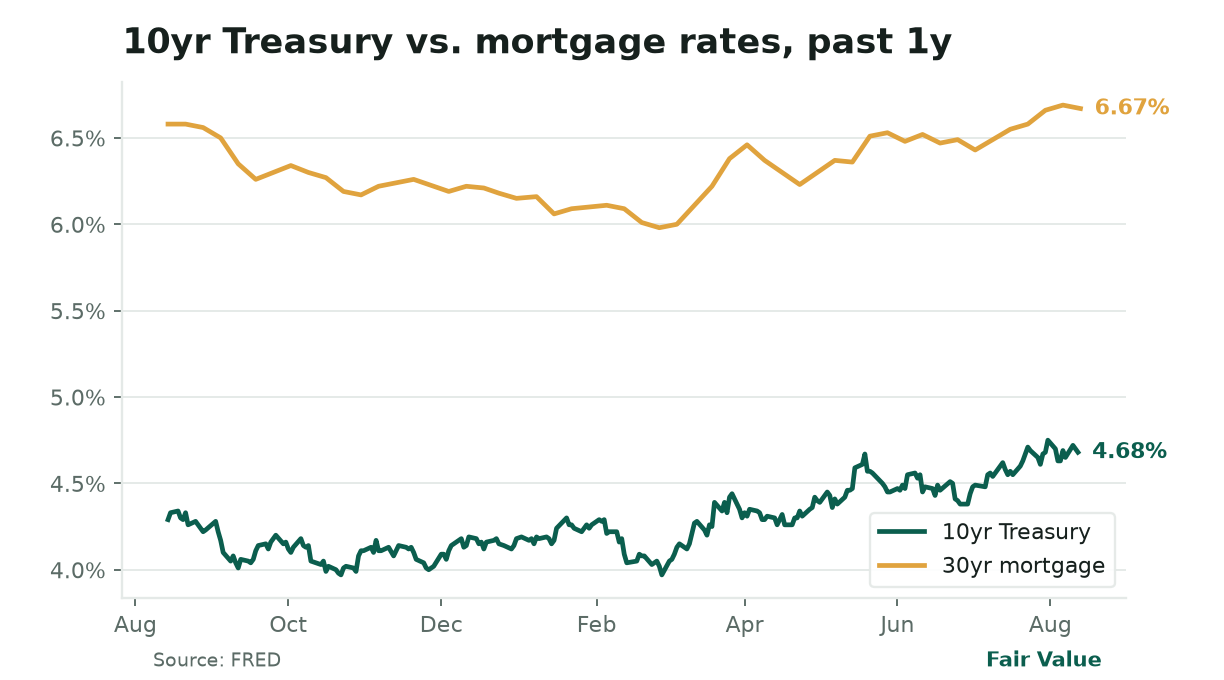
Mortgages lag the Fed. The 10-year Treasury yield (4.68%) fell after weak jobs data, but mortgage rates (6.67%) barely budged. If the Fed cuts in September, mortgages could drop to ~6.25% by year-end, saving ~$150/month on a median home.
This week’s 209,000 initial unemployment claims stand out. It’s the first clear sign that the Fed’s 5.00-5.25% rate, unchanged since last summer, is starting to weigh on the economy.
The Fed juggles two goals: keeping inflation in check and supporting jobs. Unemployment now sits at 4.1%, up from 3.5% a year ago. Wages are rising at 4.0%, faster than core inflation (2.5%). That gap risks a cycle where higher wages push prices up, reigniting inflation. The Fed gambled that the labor market could stay strong without overheating. This claims jump suggests that gamble may not pay off.
Bonds are taking notice. The 10-year Treasury yield slipped from 4.72% to 4.68% after the data. Not a plunge, but a hint: traders are questioning the Fed’s “higher for longer” approach. The 10-year/2-year yield spread, still positive at 48 basis points, is tightening, a classic recession warning.
The real economy feels it first. Mortgage rates, tied to the 10-year Treasury, dipped from 6.69% to 6.67%. If the Fed cuts in September (now a 34.8% chance, up from near-zero last month), mortgages could drift toward 6.25% by year-end. For a median-priced home, that’s about $150 less per month, real savings for households.
But one week doesn’t rewrite the trend. The Fed won’t act on a single report. Next week’s claims will be key: another reading above 200,000, and September’s meeting becomes a live discussion. Below that, and the Fed likely stays put. Either way, the labor market, not inflation, now drives the conversation.
Why this matters for your finances:
▸
Savers: Consider locking in CD and money-market rates if the Fed starts cutting.
▸
Homebuyers: Mortgage rates may ease, but the days of 3% loans are over. Expect 5.5-6.5% as the new baseline.
▸
Stock investors: A Fed shift could lift growth stocks (tech, consumer) but weigh on banks, which benefit from higher rates.
What's going on today
Markets open mixed. S&P 500 futures inch up 0.04% after Thursday’s 0.65% gain, while the Nasdaq, heavy on AI and tech, leads with +1.15% yesterday and +2.42% for the week. Two forces pull in opposite directions: labor market concerns and AI’s relentless funding surge.
The VIX nudges up to 14.57 from its 13.5 low earlier this month. Traders are hedging, but panic isn’t in the air.
Oil has been the week’s sleeper story. Brent crude closed at $87.71 (+4.98%) as the Strait of Hormuz remains shut. Yet U.S. crude inventories swell to 424.4 million barrels, the highest since March. A supply crunch overseas, but a surplus at home.
Gold is acting like the safe haven oil isn’t. It’s up 1.06% today to $4,409.80, extending an 8.59% monthly gain. Silver, usually gold’s more volatile cousin, rises 0.04% to $64.90 but outperforms over the past month (+10.43%).
Crypto treads water. Bitcoin drops 1.11% to $62,699; Ethereum falls 0.71% to $1,870. Both are down roughly 3% on the week, stuck between Fed uncertainty and no new catalysts.
The big picture
Stocks: Highs with cracks
The S&P 500 closed Thursday at 7,798.99, near its record, up 1.15% for the week. The Nasdaq surged 2.42%, powered by AI stocks. But the rally is uneven.
Small caps trail. The Russell 2000 gained just 1.71% this week and 2.97% for the month, well behind large caps. A few mega-cap tech names (Nvidia, Microsoft, Meta) drive the gains while the rest of the market stagnates.
Sector performance for the week:
▸
Tech (XLK):+2.94% (Nvidia, Microsoft, Adobe lead)
▸
Energy (XLE):+4.99% (oil’s rise lifts Exxon, Chevron)
▸
Utilities (XLU):-3.61% (bond proxies struggle as yields climb)
Energy stands out, up 7.22% over the past month.
Bonds: Yield curve sends mixed signals
The 10-year Treasury yield sits at 4.68%, down from 4.72% earlier in the week. The bond market now prices a 34.8% chance of a September Fed cut, up from near-zero a month ago. The 2-year yield, more sensitive to Fed moves, is at 4.20%, while the 30-year holds at 5.24%. The 10-year/2-year spread, 48 basis points, remains positive but is narrowing.
Credit markets paint a different picture. The high-yield option-adjusted spread (OAS), the extra yield for riskier corporate bonds, sits at 2.71%, far below its 5.17% long-term average. That’s complacency, not caution.
Commodities: Oil’s split personality
Brent crude closed at $87.71 (+4.98%) as the Strait of Hormuz stays blocked. Yet U.S. crude inventories swell to 424.4 million barrels, the highest since March. A supply squeeze abroad, but a glut at home.
Natural gas is the quiet mover. Prices rise 1.17% today to $2.76, but storage is the real story. The latest EIA report shows a 36 billion cubic foot injection, bringing total stocks to 3,153 billion cubic feet, 12% above the five-year average.
Crypto: Waiting for a spark
Bitcoin falls 1.11% to $62,699; Ethereum drops 0.71% to $1,870. Both are down roughly 3% on the week, caught between Fed uncertainty and no fresh momentum. Solana is the exception, up 2.44% for the week.
Volume tells the tale. Bitcoin’s 24-hour trading volume ($4.96 billion) sits well below its 7-day average ($9.82 billion). That’s low conviction, no panic, but no urgency to buy.
Around the world
Strait of Hormuz: Closed and costly
The Strait of Hormuz remains effectively shut, with just 3 vessel transits on August 12, down from 14 the prior day. August’s daily average is now below 12, a fraction of pre-conflict levels. The human cost: since February, 15 attacks on ADNOC vessels alone killed 1 crew member and injured 20.
The economic ripple extends beyond oil. The Strait handles one-third of global seaborne fertilizer trade and 7-8% of global supply. It also moves critical helium (for semiconductors), polyethylene, polypropylene, and aluminum.
Tensions simmer. Iran’s new Basij paramilitary chief claims the Strait is “under Iran’s control,” while the U.S. calls its naval presence a “wall of steel.” Behind the scenes, Oman-mediated talks inch toward a 60-day vessel routing deal, no transit fees.
Russia’s oil discount puts India in a tight spot
Russia supplied half of India’s crude in July, a record. The $10-$15 discount to Brent makes it hard for New Delhi to refuse, despite U.S. pressure to cut ties with Moscow.
The risk? Secondary sanctions. Washington threatens penalties for any country helping Russia evade the $60-per-barrel price cap. India’s response: public reassurances, private lobbying.
China’s car export boom hits a shipping snag
China’s auto exports jumped 62% year-over-year in the first half of 2026, but the shipping industry can’t keep up. The problem: not enough vessels. Chinese carmakers, flush with subsidies and weak domestic demand, flood global markets with cheap EVs. The surge creates a bottleneck, too few Pure Car and Truck Carriers (PCTCs) to move them.
Result: soaring freight rates. Shipping a car from China to Europe now costs $1,200-$1,500, up from $800-$1,000 a year ago.
Companies making news
Nvidia’s $500B AI financing deal breaks new ground.. Nvidia, BlackRock, Apollo, Blackstone, Brookfield, Goldman Sachs, and KKR launch financing platforms for AI data centers, targeting $500 billion+ in outside capital. The twist: bond-like investments in AI infrastructure, not traditional loans.
Meta’s AI spending pays off, for now.. Q2 revenue hits $60.8 billion (+28% YoY). The stock rises 2.78% to $594.97, but free cash flow plunges 91% to $784 million as AI spending soars to $145 billion for 2026.
Tesla’s quiet rebound.. Shares climb 3.8% to $339.96, extending a 6.39% weekly gain. Catalyst: Reuters reports Tesla’s 4680 battery cells hit 90% yield in production.
Shopify’s fulfillment network attracts big brands.. Shares jump 5.4% to $158.53, Thursday’s top S&P 500 performer, after Bloomberg reports faster-than-expected brand sign-ups.
Palantir’s Army AI platform clears another hurdle.. The stock rises 4.66% to $179.01, up 33.87% for the month.
Micron rides a memory rebound.. Shares gain 4.23% to $949.83 as DRAM prices rise faster than expected.
Coinbase defies crypto’s slump.. Up 3.26% to $153.90 despite Bitcoin’s dip, as stablecoin volume hits a July record.
Airbnb’s “experiences” segment takes off.. Shares rise 2.8% to $185.13, up 22.09% for the week, after reporting 50% YoY growth in tours and activities.
ARM powers Apple’s AI MacBooks.. Shares climb 2.49% to $278.65 on reports Apple’s next MacBooks will use ARM-based chips for on-device AI.
From Washington
Fed’s internal divide widens
July’s FOMC minutes reveal a split: three of twelve voting members pushed for a 0.25% hike, the first non-unanimous vote this year. Markets now bet on one 25-basis-point cut by December, with a 34.8% chance in September.
Treasury’s $250B push for AI and energy
The Treasury will direct $250 billion to support AI and energy infrastructure through loans, guarantees, and tax incentives. Focus areas:
▸
AI data centers (Texas, Ohio, Georgia)
▸
Nuclear power (small modular reactors)
▸
Grid modernization
Private credit faces new scrutiny
The SEC and Federal Reserve are targeting the $1.6 trillion private credit industry as bank lending pulls back. First in the spotlight: Blackstone’s BREIT, which has limited withdrawals.
Under the hood
Labor market’s early warning
The 209,000 initial claims aren’t random, they’re a leading indicator. Historically, a 10%+ monthly rise in claims precedes higher unemployment by 3-6 months.
If claims stay elevated, here’s the likely chain reaction:
▸
Fed cuts (September or December) →
▸
10-year Treasury yield falls (potentially to 4.4-4.5%) →
▸
Mortgages drop (30-year fixed could hit 6.25%) →
▸
Housing demand ticks up (but affordability remains a hurdle) →
▸
Stocks rerate (growth stocks gain, banks lag).
Key watches:
▸
Next week’s claims (another reading above 200,000 raises cut odds).
▸
August jobs report (September 4; sub-100,000 payrolls could force a September cut).
Worth learning today: Transmission: rate to your life
The GBP GDP question from yesterday’s lesson remains open.. The data isn’t in yet, we’re still waiting.
The Fed didn’t change its 5.00-5.25% rate this week. But when claims jumped to 209,000, traders bet on a September cut. Here’s how that ripple reaches you:
1. Banks move fast.. Fed cuts → prime rate (banks’ best-customer rate) drops immediately. This affects:
▸
Credit cards (often prime + 10-20%).
▸
HELOCs (usually prime + 0-2%).
2. Mortgages follow, slowly.. The 10-year Treasury yield (now 4.68%) sets the benchmark for:
▸
30-year fixed mortgages (6.67% today).
▸
Corporate bonds (Treasury yield + risk premium).
Why the lag? Mortgages are bundled into securities that trade like bonds. When Treasury yields fall, mortgage rates eventually follow, but it can take weeks or months.
3. Savings rates: Last to move.. Banks drag their feet on cutting savings rates. Today’s best high-yield accounts pay ~5.0%. If the Fed cuts, expect 4.0-4.5% by early 2027.
4. Stocks: The wild card.. Lower rates boost valuations, but if the Fed cuts due to weakness, earnings may fall, offsetting the gain.
The 12-18 month rule.. Fed tools are blunt and slow. A cut today won’t fully hit:
▸
Hiring (companies plan 6-12 months ahead).
▸
Spending (budgets adjust gradually).
Concept 33 of 83 in the Fair Value course.
What to watch this week
▸
Monday, August 17:
▸
13-week ($92 billion) and 26-week ($79 billion) Treasury bill auctions.
▸
20-year Treasury bond auction ($16 billion).
▸
Tuesday, August 18:
▸
Housing starts and building permits (July).
▸
Wednesday, August 19:
▸
FOMC minutes (July meeting).
▸
Existing home sales (July).
▸
Thursday, August 20:
▸
Jobless claims (weekly).
▸
29-year, 6-month Treasury bond auction ($8 billion).
▸
Friday, August 21:
▸
PMI flash readings (August).
Not financial advice. Disclaimer: Fair Value is editorial analysis, not financial advice. We’re sharing insights, not recommendations to buy or sell any security. Always consult a professional before making investment decisions.
Data sources: U.S. Bureau of Labor Statistics, Federal Reserve, CME FedWatch, Bloomberg, FactSet, CoinGecko, U.S. Energy Information Administration, U.S. Treasury, S&P Global, Nasdaq, NYMEX, ICE, Bank of England, Eurostat, China Association of Automobile Manufacturers, Shanghai Shipping Exchange, ADNOC, Reuters, BlackRock, SEC filings. ```