
IONA - Tailwind Tales · #29 · Competition is for losers

Tailwind Tales · #29
Competition is
for losers
IONA is reshaping the world with the Operating System for B2B logistics. We help carriers adopt autonomy and robotics, starting with a drone delivery service for long ranges and up to medium-weight goods, fully integrated into their stack and into the airspace. Under $1 per parcel, up to 120 miles around their depots.
Foreword
This is a special edition! We want to address questions and share insights on the drone delivery market. As we recently closed a few investors and are still negotiating with others (stay tuned!), the due diligence highlighted the most common misconceptions, which we felt were valuable material to share more broadly.
For that or anything else, my calendar is always available, so feel free to book a meeting.
Strategy
I hate to be that guy, but I have to brag (a bit): "I told you so"! 👀
In December 2023, in a Tailwind Tales update, I wrote: "Software is becoming a commodity. [...] It can be found off-the-shelf or generated on-demand, so the defensibility of a software-only startup better have other strong barriers"
That one aged like fine wine, especially compared to some of the comments I received that I had then that aged like milk. I remember being surprised by the reactions. I'm used to being contrarian, but didn't think that take needed much consideration: 'tech' is valuable because it aggregates value in a more scalable way, so it's always about the frontier. The ones pioneering the frontier obtain barriers to entry and use the resulting margins to build new barriers. That edge (and edge start) is the reason why VCs fund startups.
Websites used to be 'tech' before they became 'digital commodities'. Software is becoming the same commodity - just like every tech before it - and VCs who benefitted from 30 years of a SaaS playbook need to reinvent themselves. Silicon Valley comes from chips - back then the playbook didn't exist. In many ways, Venture Capital comes back to its roots.
Now, this is where I'm proud of the work we did at IONA. Regulated autonomy is, in essence, defensible. It can't be recreated with a prompt because. In the words of Naval Ravikant, it's the ultimate "specific knowledge". It might have cost me a few dates over the years, but the concept is fascinating: in the age of AI, the regulatory moat is robust.
Let's go one layer deeper.

I've been stubborn and therefore continued to hammer that concept in my updates after that. "Code alone doesn't build a moat" (Tailwind Tales #24); "when inputs commoditise, advantage moves up the stack" (Tailwind Tales #26); "BVLOS is not autonomy, and you can buy a drone, but you cannot buy autonomy" (#28).
Two reasons that still hold:
1. You need a rare expertise that is not in the dataset of any LLM.
Look online for our regulatory envelope and you won't find the answers. Most of what is published is food delivery or adjacent segments, and most of it is outdated. The only way to get that information is a back-and-forth with the aviation authority and it's always specific to what you develop. That's the textbook definition of specific knowledge that is AI-proof.
2. Training and certifying an embedded autonomy stack depends on proprietary data that is bound to the hardware and the service envelope.
If you don't do long-range flights, you don't get that data, and you can't reproduce it because the rules don't care about your shortcut and aren't there to make it easy. A lot of people talk about world models that train on physics. In aviation for what we do, physics is not the problem. The experience of the risk model is.
FAQ
Is it too late to become the market leader?
In food delivery, most likely. Good thing we’re not doing that!
DoorDash-like deliveries are called ‘micro-orders’ and represent 5 billion orders per year in the US. Everyday logistics is 23 to 25 billion. Zipline, Wing, or Manna can only address the first (~5 lbs to ~10+ miles), which leaves us almost alone in the second to provide instant deliveries to eCommerce and day-to-day parcels.
Why? They can't scale up because of physics and/or regulations.
1. Logistics requires heavier payloads and longer ranges but mostly larger cargo bays - which isn’t possible now or in the future for Zipline/Wing’s tech. Details below.
2. You need a specific system, and most startups failed to develop under civilian rules, unlike us. This is why many UAV start-ups from 2016-2020 pivoted to defence.
These solutions are for DoorDash while IONA is for FedEx or UPS. Same philosophy, but if you don’t get delivered a pizza by UPS, or a parcel by Uber Eats: there is a reason. 😉
Why do you need hardware?
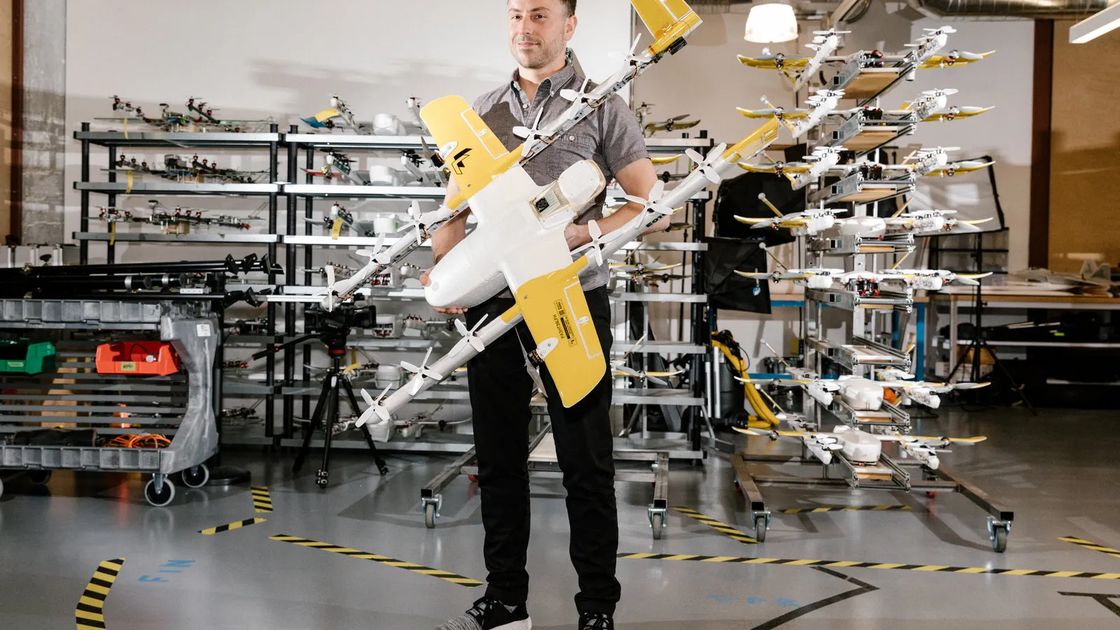
Hardware in-house is more important than perfect hardware.
It's true in robotics but autonomy adds a significant twist: the objective is "scalable autonomy" i.e. owning your hardware is the only way to run multiple drones simultaneously as a fleet with the same team - cutting costs as well - and thus be competitive as a business.
Why? The most important part is the operating model and for that you need to (1) upgrade and iterate over time with new components, simplifying, etc - and (2) control your system over the hardware and software, so that you're never limited in regulatory envelope - on the contrary it should expand over time as your risk model is refined.
What about Chinese drones, or agile ‘hardware-agnostic’ operators?
Betting on a hardware piece before the market maturity seems like a difficult underwrite? It would, if the hardware had to be perfect. Hardware in-house is more important than perfect hardware. It’s a rule of thumb in RaaS.
To refer back to the foreword: what you need is the (1) dataset and (2) training data, so for long range drone delivery with ~10kg you should have your own hardware - otherwise you will never obtain the amount of data that you need and every flight hour will be restricted, at risk from a third party and expensive. Not a great combo.
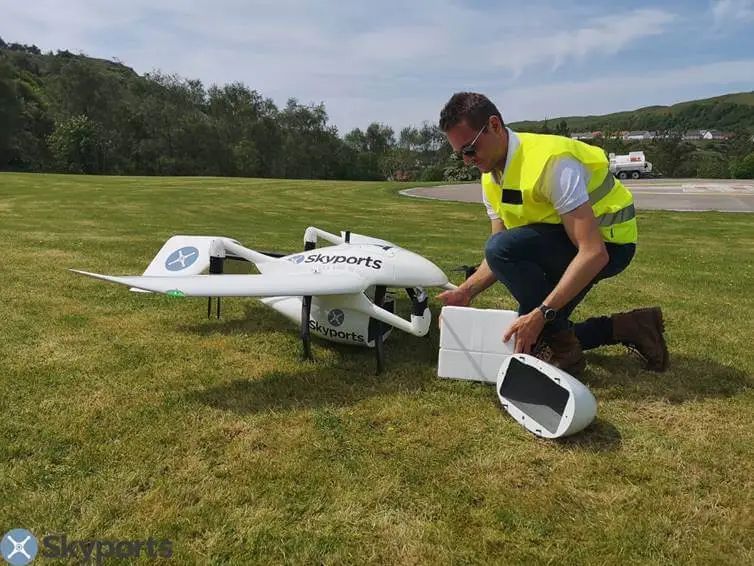
Without hardware, you're an operator, and operators don't scale in autonomy. Skyports or Apian are operators, just like DroneUp that went bankrupt as they couldn't compete against Wing and Zipline: their costs couldn't go below $30+/delivery.
Then what about well funded OEM, or legacy Aerospace?
Wingcopter or Phoenix Wings would be the other side of the same coin. They compete with RigiTech or Kite Aero i.e. 'medical drones' so they can't be autonomous, but also can't deliver a parcel small or medium (max: blood and vaccines).
Most importantly, just like any other pure-manufacturers, both have to compete on supply chain and costs - so a bit of a race to the bottom - and that’s why many tried to pivot to defence lately. They aren’t offering a solution to logistics operators, only an aircraft to pilots and that’s a very different market.
You can buy a Boeing 747 but it doesn't make you an airliner. How will you compete if your solution needs a team, whilst others like IONA can operate drones anywhere on earth - without being there - and therefore for 1/10 of the cost?
Surely, autonomy with pure-software is coming?

I seriously think it does - but in 5 to 10 years.
That’s looping back to the concept of frontier. Once society has commoditised the autonomy datasets and training data - as explained in the foreword - then it will be possible to be hardware-agnostic. By that time, robots could build robots, so a made-to-spec drone may be fully compliant and scalable in its autonomy.
Though, the start-ups with that knowledge will be the ones who paid the hardware tax early on and did ‘the hard thing about hard things’. IONA wants to own the autonomy layer for logistics, and that’s the plan for our companion computer.
Zipline has the dataset and training data?
No, they have a dataset and training data, but on a different tech.
Your documents on the certification of the Boeing 747 are super interesting, but will do very little to certify your F35 or Airbus A320. Your expertise, knowledge, reputation will help, though it still takes an aerospace company years to certify a new aircraft and it’s because the bottleneck is what sits between the chair and the keyboard.
Wing, Zipline, Flytrex, Manna, or DoorDash Air (news) developed ultralight drones made for tiny and frequent drops in the suburbs. Their cargo is a shoebox for instant small errands. For the reason mentioned earlier, they need a new drone.
Let’s present a more tangible example. Take the Zipline “P2”.
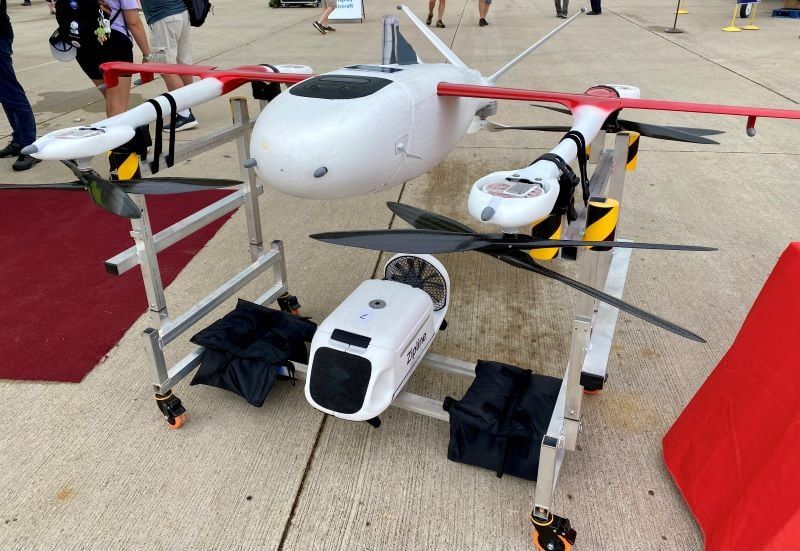
Its subsystems and authorizations wouldn't let it operate in IONA's segment:
- They rely on LTE, which doesn't work in less dense areas; they use antennas. It’s suitable to their use case, but not ours.
- Their cargo bay is tiny and designed for a single drop, so how do you deliver 2 or 3 parcels? What about anything bulkier than a shoebox?
- As it's a multicopter, an increase in cargo or size exponentially increases the constraints, so they would burn a battery in 2 minutes, forcing an unreasonable number of batteries and a wider wing to generate more lift. Vicious circle.
In the eyes of the regulator, changing your tech that much is a new drone. This is why they switched from the P1 in Rwanda to the P2 in the US. It took 4 years as you don't just change the system without restarting the full regulatory work.
Luckily, they are quite busy transforming the micro-order segment (3-year backlog). By the time they could develop a new aircraft, the world will have changed, and IONA will be the leading name in the logistics segment - known by customers and regulators alike.
How can you grow like a VC-backed startup with hardware?
Just like Whoop (or Zipline), our business is to deploy services, not open factories. We already outsourced the production of our last drone to an Airbus manufacturer and electric drones are simple technologies. We own the IP, work on the R&D, but from there it’s the operating model that makes the difference.
An IONA contract is for a network, i.e. a customer depot from where parcels are dispatched, and we assume ~8 drones per network on average. A small customer could get 2, while a large customer may need 50+. There are 30k+ distribution depots in the US and Europe.
With that assumption, each network grows toward ~1k deliveries per day. This is conservative as even in a remote region like the Shetlands and Orkneys (Scotland), people get delivered 4,000 parcels per day with very few delivery alternatives.
Logistics is based on critical mass, and autonomy is pushing that breakeven much lower than any previous vehicle - even autonomy on the road. That changes the industry.
Cost per delivery falls. Experience allows you to operate at a much better RPIC ratio, i.e., the number of remote pilots per drone in the fleet (we assume 1:40 at NOAK - already achieved by companies in other drone segments like surveillance or food). A flight is labour + tech + energy: once labour gets amortised over many aircraft, unit cost collapses.
Each new network is cheap to add. To open a site, you just need to produce a drone and deliver it on-site to the customer, connecting to their systems. Remote supervision of the fleet is with IONA and already inside the cost per delivery. They pay for the service, and ask for more drones as the volume goes up.
What about autonomous delivery vans?
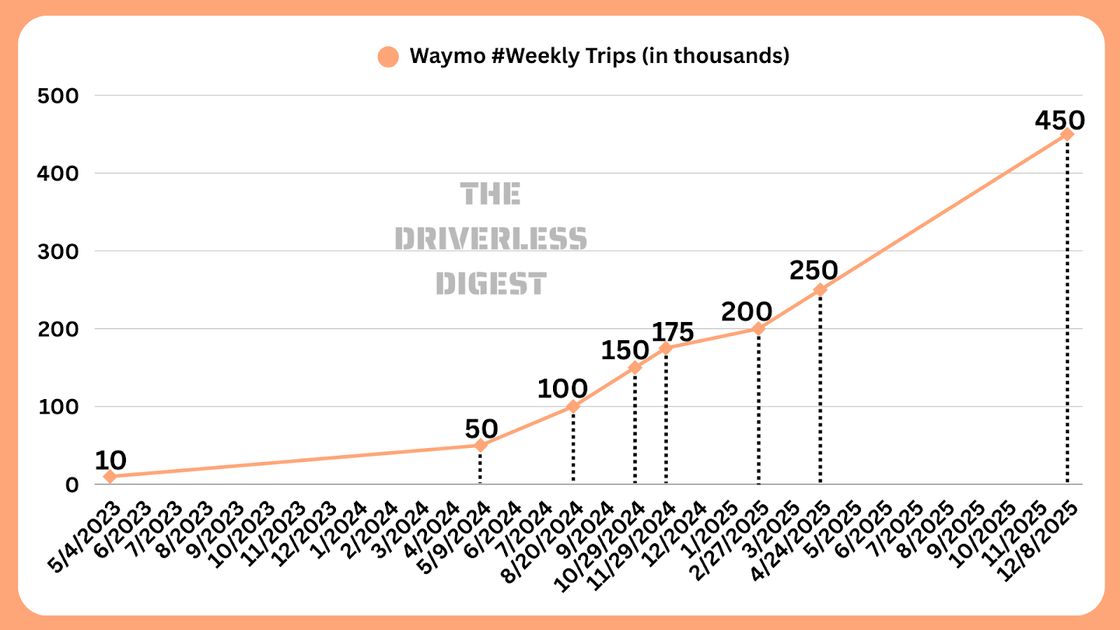
The roads are just too expensive for parcels. Society already had trucks so eCommerce used them but they are extremely suboptimal in terms of delivery - especially to deal with the current trend: smaller parcels and higher frequencies.
Our take? Parcels will go on drones, trucks will go back to pallets.
- Autonomous or not, a big truck is too big to be effective for deliveries. Relay in the UK did $120M ARR in 3 years by taking over traditional players using bulky vans for eCommerce and switching to gig workers doing small loops with smaller vehicles.
- Electric vans are even more inefficient for that task because they are heavier than ICE vans. If you make the vehicle smaller you either end up with a sidewalk robot that can't deliver far enough because they’re limited in speed/ops, or you make it 'road safe' but you add 200kg of sensors so it becomes expensive - and then go for the full ‘truck’ like Gatik.
But let’s take the point from another perspective: if trucks are so efficient, why do the biggest operators invest massively in drone delivery?
Amazon operates 140k delivery vans yet spent $2B+ in drones and actively employ 1k people, 166 job openings. They just opened a site in the UK and announced 500 new cities. SF Express is much bigger: 230,000+ vehicles and they are scaling up drone delivery for up to 20kg. Examples are true for ZTO, FedEx, UPS, etc.
Asks
- Forward that to the people saying that air delivery is not for today (we’ll invite them on site!).
- Don't forward that to your friend who just pivoted 12 times at YC because of OpenAI’s last product release - that would be mean…
- Forward that to anyone in SF, London, or New York that I should have a coffee chat with - my calendar page is shareable!
Closing
IONA is like good music; in a few years you'll tell your friends "I knew them before they were a thing". To maximise this storytelling potential, we strongly recommend you follow us on LinkedIn!
Thanks,
Etienne