|
Well, hello, and welcome to this week's edition of the eCommercer.
Most people running an online store have a vague plan to sell it one day. Not this year, maybe not for five. But one day. And the strange thing about that plan is how little it changes about the way the business gets run this week.
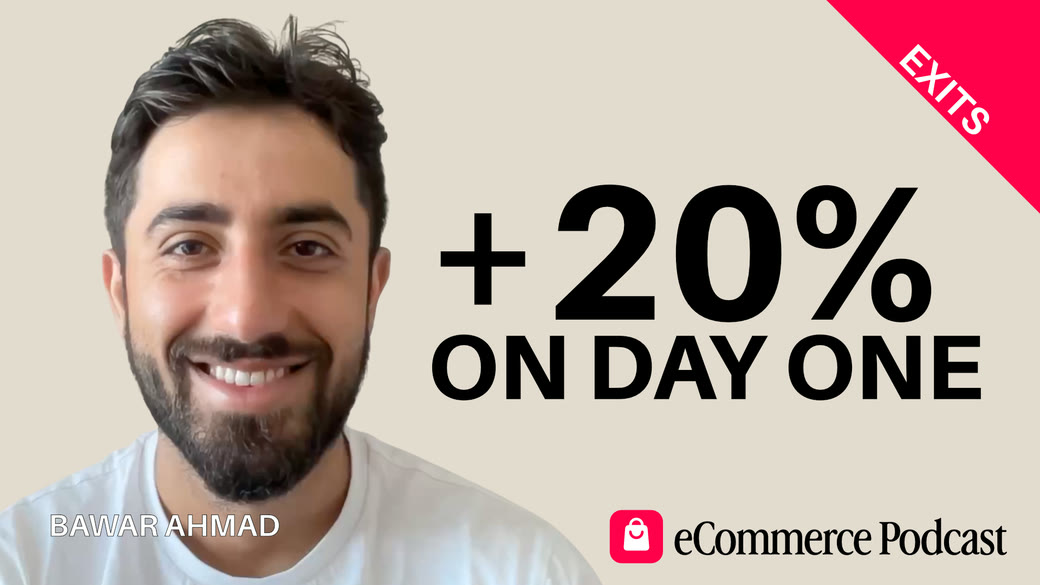
My guest this week was Bawar Ahmad, who co-founded Ecomma, a firm that buys online stores, scales them, and sells them on. Around 70 acquisitions in six years, about 60 exits, and he's aiming for another 30-odd this year. He has sat on the buying side of the table more times than almost anyone I've talked to.
Most of what his team does in the first weeks of owning a business, the previous owner could have done themselves. That's the bit I want to give you.
The day-one jobs
Bawar's team runs 12 to 15 "value drivers" on every store they buy, and he gave the first one away on air. It costs nothing.
On day one they ring round the vendors. The email platform, the payment provider, the fulfilment partner, the supplier. And they ask for better pricing.
| |
“You'll be surprised how much of the vendors were like, we're waiting for this call.”
— Bawar Ahmad
|
Nobody's asked them in three years, so plenty of them say yes. On the PayPal fees alone, Bawar reckons that one conversation added 20% to the valuation in their first day of ownership.
The second driver is creative volume. If a brand is putting out eight videos a month on paid social, they take it to twenty or thirty, and the return on ad spend tends to follow.
The third is voice. An AI agent phones the customer about ten minutes after they abandon their basket. Could be 1am, could be 1pm, the software doesn't sleep. It asks what they were looking for, listens, then offers the discount code. He puts it at roughly 5% extra revenue and calls it the third retention channel after email and SMS. The part I'd take even if the revenue were flat is that you get to hear, in a customer's own words, why they were buying.
Five percent here, twenty percent there, and his team's average is a 150% lift in 90 days. That's his number on his own deals rather than an industry figure. But every one of those levers is sat in your business right now, and you don't have to sell anything to pull them.
Don't run it like it's already sold
The pattern he sees in most sellers goes something like this. Someone decides it's time. They fill in an online valuation form, get a big number back, list the business, and the early interest is flattering. Then thirty or fifty conversations go cold, and somewhere in that waiting the owner quietly checks out. Why buy new inventory? Why pay for new creative? Why test another channel on a business that's already sold?
Performance dips. And buyers aren't daft, they can see it in the numbers.
He put a rough shape on what that costs. Take a store making $100,000 a year in profit at a 3x multiple, so around $300,000. Let it drift for a couple of months and the offer might come in at $150,000 instead. It's his illustration rather than a measured average, but the logic holds. Two or three months of ordinary discipline was worth the other half.
The other one is clean financials. Businesses turning over millions, still run on Google Sheets, with the car lease and the Uber Eats going through the same entity. To a buyer that reads as a red flag. So separate the personal costs out, get a proper P&L, balance sheet and cash flow in place, keep the bookkeeping current, and start at least a full financial year before you go to market.
"Time kills deals," as he put it. Every question you can't answer in five minutes is another few days on the clock.
Buy the audience, not the niche
We also talked about buying rather than selling, which is a growth route most stores never seriously consider. If you're at a million in sales and want five, doubling the business is one option. Buying someone already doing two is another.
Bawar's filter is audience, not product category. A skincare brand serving 35-year-old women with acne shouldn't buy a phone-case company. But he'd steer it away from a mascara brand too, because that's the same niche and a different audience. Buy what your existing customers are already asking you for.
We're living that one. Our vegan supplement business has an audience that keeps asking for protein and electrolytes. Electrolytes we've developed. Protein is harder, because the manufacturing quotes came back at hundreds of thousands of pounds — hundreds of thousands of dollars too — just to get started. So the live question isn't how we make protein. It's whether we should be talking to a vegan protein brand already doing three or four million online.
Our model is a bit different from Bawar's, in that we don't tend to pay cash for equity. We bring the warehouse, the picking and packing, the marketing and the team, and the founder keeps a stake. Different route, same opening question, which is what does our audience already want that we're not selling them.
|