|
Well, hello, and welcome to this week's edition of the eCommercer.
You may recognise this pattern: sales dip, or growth stalls, and the first instinct is almost always the same. Spend more on ads. Find a bigger budget. Get up to where the competitors are. I've done it. I've watched plenty of other founders do it. And more often than not, it's the wrong move at the wrong time.
That's really what my conversation with Carolyn Lowe was about this week, and what a great conversation it was, too.
Fix the page before you feed the ad budget
Carolyn spent years at Dell, where she ran a huge division and then Dell.com on the consumer side, before leaving to start ROI Swift, an Amazon growth agency that's helped 150-plus brands do over $100M on the platform. So she's seen the inside of this at every scale.
Her single biggest observation is that most brands throw more ad money at a problem that was never an ad problem. "People throw more ad dollars instead of going back and fixing fundamental problems," she said, whether that's a weak product, a poor listing, or a page that just doesn't convert.
And the maths is brutal. If your website isn't converting at 2 to 3% (with an average order value under $100), or your Amazon listing is sitting below 15 to 20%, then more traffic just pours more people into a leaky bucket. You spend more, and you lose more.
When her team audits a brand, they grade the product pages A to F, like school. They never actually tell you it's an F, mind. That just becomes "needs improvement". Then they look at the ad spend, and this is the bit that made me wince, because they routinely find brands wasting 18 to 20% of it.
| |
"If they're spending £30,000 a month and 20% of that is wasted, that's $6,000 you're just lighting on fire."
— Carolyn Lowe
|
Main image gets the click, content gets the sale
Your main image drives traffic. Your content drives conversion. Two different jobs, and you optimise each for the one it's actually doing.
Her example was a brand selling shorts whose main image was just... the shorts. They changed it to the shorts worn on a person, so buyers could see whether they were 5-inch, 7-inch or 9-inch. Conversion went up around 30%. Then they improved the page content and got another 12% on top of that. No extra ad spend at all.
It works because on a search results page you get a price, a review count, a brand name and an image. That's it. The image is doing nearly all the persuading, and it's doing it in about a second.
The Amazon deadline you can't really ignore
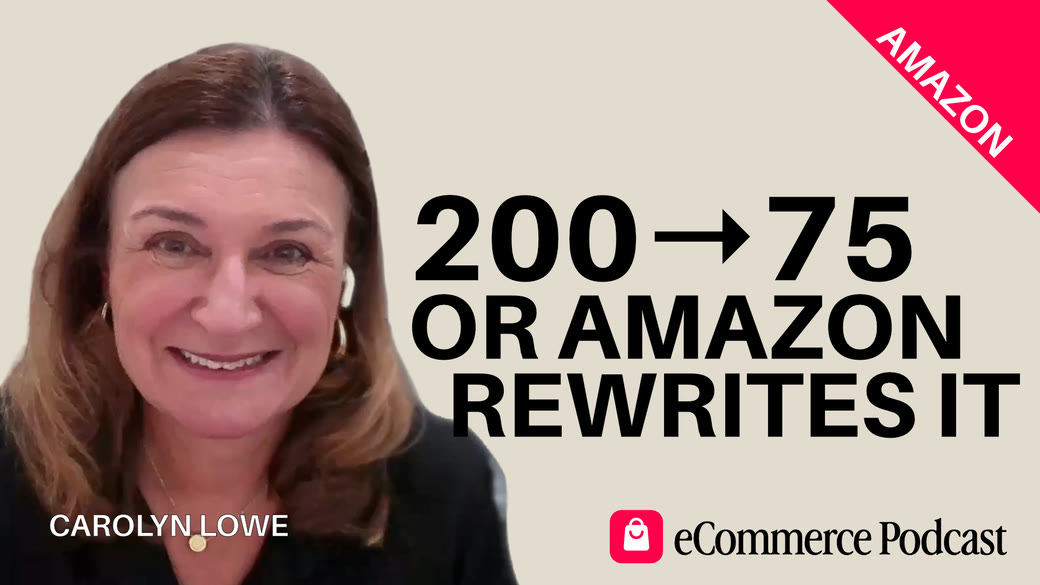
Amazon is cutting the maximum product title length right down to 75 characters, including spaces, from 200. It's being enforced from July 27th, and it applies to every category except media.
If your titles are over the limit and you don't fix them yourself, Amazon's AI will rewrite them for you. And you probably don't want that. Only brand-registered sellers get a 14-day window to review the changes.
So if you sell on Amazon, treat this as a job for this week. Go into your listings, get your titles under 75 characters, and be deliberate about which few things genuinely earn a place in that space. Amazon has added a new Item Highlights field (125 searchable characters) to soak up some of the keywords, so it's not all lost, but the title itself has to earn its keep now.
History repeating
I had almost this exact conversation years ago. A chap rang me, genuinely excited, because he'd found a budget to spend £30,000 to £40,000 a month on ads. His reasoning was simple, in that his competitors were spending that, so surely he had to match them.
We looked at his website first. And with his conversion rate, spending that on ads would have lost him an enormous amount of money. He was about to pour a fortune into fixing the wrong problem.
It was a hard conversation to have. Nobody wants to hear "don't spend the money on ads, spend it here instead." But it was the truth. And Carolyn's right that data is what wins that argument. Show someone the numbers at a SKU level and it stops being your opinion against theirs.
|