
Outreach


In the wake of the George Floyd killing and the following (very short-lived) emergence of empathy, I remember a few male writers of police procedurals declaring that, in their future work, racism would no longer be a marginalized issue. For them, Floyd’s murder had illuminated a problem they either hadn’t realized or chosen to ignore.
We’re in a similar time now, just without the empathy, after the gang rape at Cornell University and our current focus on all-male societies.
* *
I’ve written before about the limitations of straight male crime fiction writers, and their chosen protagonists of “remorseless killing machines,” and the general solution to their conflicts being, “Murder your way to a better tomorrow.” It’s somewhat cathartic, of course. It’s also unrealistic and unimaginative (and I don’t hold my own writing above this criticism). We usually try and get around it by saying that we’re “studying” violence, and our protagonists are showing the brutal effects of those scars…but, come on, guys worship those scars. We like the violence, and we know others do, too.
It makes for a popular book. Just not one that matters.
* *
I grew up in all-male societies. I was an Army brat, and a high school athlete (wrestling, all-male at the time), and then in a fraternity. Being in those groups eventually turned me away from them. As I grew older, I became less forgiving of the inherent bigotry I both witnessed and experienced, and ashamed that I never forcefully condemned it.
Truthfully, I’ve never been in a group of men who didn’t reflect some sort of ugliness, and it was almost always a form of bigotry. Casual sexism or racism or homophobia that was often excused as joking, but always hinted at something harsher under the surface. That was a constant with these men, and the groups emphasized it. The very being of a group implies difference, a need to stand apart and make others feel alone, and a desperate fear that this privilege will disappear.
* *
In my last year of college, I was president of the Inter-Fraternal Council, which serves as the leadership of all of the fraternities at a university. During that time, a girl visiting the campus was raped by a fraternity member, in a different fraternity than my own. Word came to our Greek advisor (a campus staff member who works with the fraternities), and she told me, and the president of the sororities, what had happened. The girl was considering pressing charges, but the members of that fraternity had begun threatening her, and she was afraid.
The sorority president, the Advisor, and I all wanted to help, even if there was little we could do. Her attorney thought it would be helpful if we wrote her letters, asking her to come forward. We did, but she ultimately didn’t pursue legal action.
Probably no single incident informs our views, but I do remember the way the men of that fraternity defended each other, their happiness after she dropped her charges, that band of brothers.
* *
I think I’ve known good men. Good cops, good soldiers, good students in fraternities who didn’t take advantage of the evil offered to them. But I don’t know whether they had the strength to speak out against those evils, and perhaps that doesn’t make them good.
I say that because I know an argument could easily be made against what I’ve said. #NotAllMen and so forth, and there might be some validity to it. I’m holding a broad brush.
I don’t think these organizations are, often, founded for bad reasons. What I’ve seen is that corrupt people join, and they have the power to corrupt others, to encourage their worst behaviors. And their corruption systematically destroys the checks on power, and sets a framework for corruption to continue.
And so, too often, these societies present their own argument against their existence. I don’t know if every organization of men has a need for bigotry, but I do know that need exists, and has been proven prevalent, and the good men in those groups are inadequate in changing their culture. When a single outspoken man has the power to morally bankrupt your society, then perhaps the foundations of that society need to changed. And we’ve seen that good men can’t do it alone.
Maybe, for the positive values of your society to continue - and with that, the soul of the society itself - more men are not what’s needed.
* *
Male crime fiction writers often pride ourselves in standing against evil. We do it by having our remorseless killing machine enact appropriate violence, and easy enough, problem solved.
As writers, us men should be better than this.
Are we really doing enough to confront the hatred with which these groups traffic, the divisions the organizations make, their glorification of hate? Doing so would require self-examination and fearlessness, something beyond mere violence. It would require a better book.
* *
Men are told to talk to our sons about these things, and we should. The Cornell 7 and the Epstein Files and the comforts of brotherhood and belonging, and how those can often be illusory. How loyalty and duty have the potential to be noble…or used as excuses for cowardice, and can lead to eventual lifelong regret.
But as a writer, and particularly a male writer, you have the power to speak to thousands of sons.
You have the ability to create moral paths. “So you’re the little woman who wrote the book that started this great war?” Lincoln reportedly asked Harriet Beecher Stowe, upon meeting the author of Uncle Tom’s Cabin. You have the ability to tell a story that starts something even better.
EA
Subscribe now
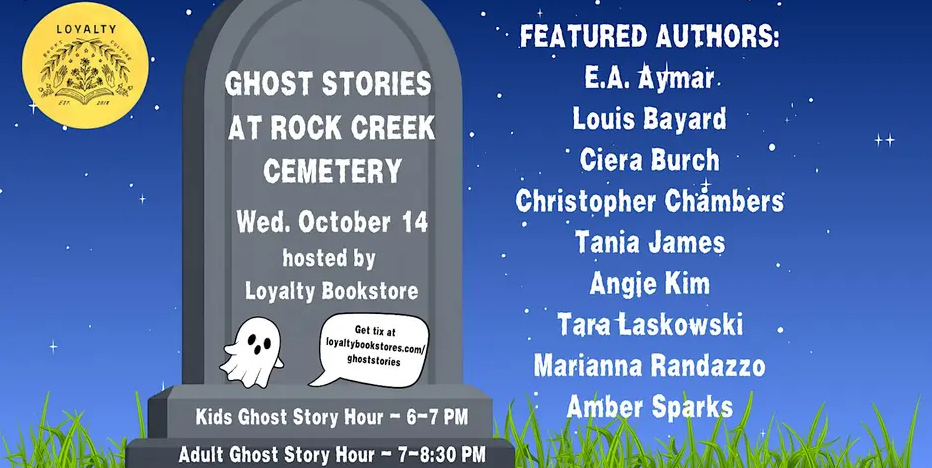
This might be the coolest event I’ve ever done.
This Wednesday, on October 14, I’ll be hosting (and reading) at an event held in Rock Creek Cemetery! Loyalty Books asked me if I wanted to put together an adult hour of readings after a kids’ ghost story hour, and I jumped on the chance. The lineup is absolute BANGERS, as you can see on the tombstone above (Ciera Burch and Marianna Randazzo, FYI, are terrific, but they’re hosting the kids’ ghost story hour and not part of my lineup). I love love love the idea of Ghost Stories in the Graveyard, and hope you can join us! Find out more info here.

It's giveaway time! The winner of a copy of any of the books (their pick) by the writers listed on the tombstone above is:
Congrats, and I'll send you an email soon!

I owe the biggest of thanks to the Reckon Review for nominating my short story, “We’re in an Emergency” for a Best of the Net Award! Best of the Net is an annual contest, started in 2006, to recognize the work of digital sites - back in ye olden days of 2006, “digital” was a mighty suspicious term. It means a lot to me that this story has legs, and to have worked with wonderful editors who believed in the story of a serial killer in small town Virginia mixed with a woman who falls in love with a car commercial. You can see the other nominees from RR here.
Also, the Kindle version of my most recent novel, When She Left, is currently on sale for $1.99! If you somehow paid $501.99 for it, that’s a savings of $500! You can purchase it at the reduced price, for a very limited time, here.
-
Great article, Ed. Thank you
-
You always write thoughtful pieces that manage to avoid preaching but this time you've outdone yourself. Bravo.
-
Yes! I 100% agree with you Alma!!
-
Good piece, Ed. My first book started as an examination of race relations between my community and the police, but it never coalesced that way, focused more on suicide. But discarded parts ended up on book two, and I’d like to think my hero did well. The terrifying and overwhelming issue of male sexual violence I don’t hey know how to handle in fiction, but we have to keep raising it. Thank you.
Add a comment: