💡 What CRISPR reveals about targeting cancer DNA
Discover how CRISPR's precision targets and destroys cancer's genetic weaknesses.
June 14, 2026
While CRISPR learns to shred specific cancer cells and open-source advocates fight for AI freedom, the US government is busy shredding access to Anthropic's models, proving that the cutting edge of innovation is where national security and market control collide most violently.
The Deep End
CRISPR Shreds "Undruggable" Cancers, Targeting Specific DNA Mutations
A new CRISPR-based technique selectively destroys cancer cells by targeting specific mutations in tumor suppressor genes, like p53. This method, called chromatin shredding, annihilates cancer cells while leaving healthy cells unharmed. It offers hope for nearly half of all cancer cases, including ovarian and pancreatic cancers often deemed untreatable.
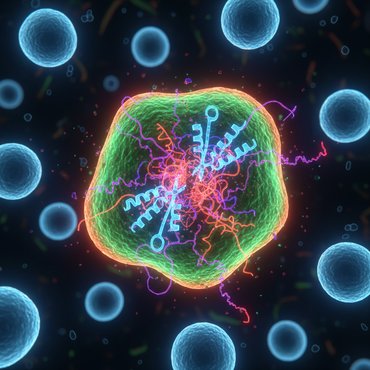
CRISPR technology now offers a new weapon against previously "undruggable" cancers. Researchers engineered a CRISPR-Cas12a2 system that identifies and destroys cells with specific mutations. This precision means healthy cells remain untouched, unlike traditional chemotherapy or radiation. The method works on common cancer mutations, including those in the p53 gene.
This system triggers "chromatin shredding," slicing all genetic material within the cancerous cells. The widespread genetic demolition forces cell death, eliminating the threat. The technique is also highly programmable; new guide RNAs can target fresh mutations quickly. This rapid adaptability marks a major advancement in cancer therapy development.
Key Takeaways:
- A new CRISPR technique selectively destroys cancer cells based on specific mutations.
- Chromatin shredding targets the p53 gene, found in nearly half of all cancers.
- Implement precise CRISPR-based therapies to overcome current treatment limitations.
The Periphery
Open Source AI: Why Freedom is Critical for an AI-Powered Future
AI models are becoming civilization's new infrastructure. Relying on closed systems creates a "subscription economy for cognition." This analysis explains why open source AI prevents vendor lock-in, ensures public oversight, and maintains operational freedom. It details the risks of closed AI and calls for global open standards to safeguard national capacity.
Access to AI systems must remain permissionless. Closed AI models create a rental economy for intelligence. People lose the ability to study, repair, or adapt these crucial systems. This impacts work, education, science, and public services. A few companies could control essential infrastructure.
Key Takeaways:
- Closed AI models risk creating a "subscription economy for cognition."
- Operational freedom requires the ability to study, adapt, and deploy intelligence systems.
- Advocate for global open standards to secure future AI infrastructure access.
US Government Suspends AI Access: National Security vs. Industry Innovation
The US government abruptly ordered Anthropic to suspend access to Fable 5 and Mythos 5, citing national security. This directive impacts all foreign nationals using the models, effectively halting deployment for many users. Anthropic disputes the order's basis, arguing a narrow vulnerability does not warrant such a broad ban. This incident highlights growing tension between innovation and regulatory oversight in AI.
The US government mandated Anthropic block Fable 5 and Mythos 5 access for all foreign nationals. This directive came without specific details on national security concerns. Anthropic suspects the government reacted to a "jailbreak" bypass technique. The company found this technique only exposed minor, known vulnerabilities. These vulnerabilities are also present in other publicly available models.
Key Takeaways:
- US government ordered Anthropic to suspend Fable 5 and Mythos 5 access.
- Anthropic disputes the narrow 'jailbreak' vulnerability warrants a broad ban.
- Advocate for transparent, technically grounded regulations in AI deployment.
AI: A Tool, Not a Replacement for Skilled Professionals
AI tools accelerate professional workflows. They do not replace human judgment. A civil servant's casual assumption about ChatGPT highlights major misunderstanding. Skilled workers already integrate AI for efficiency. This analysis details how humans still provide indispensable value. It reveals AI's current limitations in complex tasks.
Many professionals now integrate AI into their daily tasks. They use AI for spell-checking or terminology extraction. These tools boost efficiency, making routine work faster. Think of it like an accountant using advanced Excel formulas. This shows AI acts as a sophisticated assistant, not a fully autonomous worker.
Key Takeaways:
- AI functions as a tool, not a substitute for human professional skills.
- Human expertise in nuance and context remains indispensable for quality output.
- Integrate AI strategically to enhance workflow efficiency; always verify results.
Paywall Redesigns Boost Conversion 20% to 72% Across Diverse Apps
Four case studies reveal how optimized paywall designs drive significant revenue increases. Learn specific tactics like trial toggles and clear price anchoring. These methods boosted conversion rates by up to 72%. Understand which strategies are universally effective and which are industry-specific. Unlock your app's true subscription revenue potential.
Subscription apps face constant pressure to optimize revenue. Paywall design offers a major lever for growth. Expert analysis shows specific changes yield big returns. Fintech apps saw 20% conversion hikes. Party game apps boosted trial conversions by 31%.
Key Takeaways:
- Simplified paywall designs consistently reduce cognitive load, increasing conversions.
- Implementing trial toggles boosts upfront revenue by encouraging immediate subscriptions.
- Anchor pricing effectively by highlighting savings to drive users to higher-value plans.
As Seen on GitHub
- Disciplined Engineering: Ship Code Safely With Rigorous Verification Steps — github.com
- AI Skill Helps Beginners Build First App from Vague Idea — github.com
- Claude's Fable-Mode Enforces Multi-Stage AI Agentic Planning — github.com
- LED Bloom Simplifies WLED Device Control and Pixel Management — github.com
- Automate RSS Feeds into Clean, Self-Hosted Static Websites — github.com
- Self-Hosted Photo Memories Deliver Google Photos Features Privately — github.com
The Firehose
AI Regulation & Ethics
- US Government Halts Anthropic AI: National Security Trumps Innovation
- US Government Bans AI Model, Sparking Tech Industry Outcry
- FCC KYC Rules Threaten Privacy, Enable Surveillance, and Weaken Security
AI Development & Tools
- AI Skill Helps Beginners Build First App from Vague Idea
- Claude's Fable-Mode Enforces Multi-Stage AI Agentic Planning
Self-Hosted Solutions
- Automate RSS Feeds into Clean, Self-Hosted Static Websites
- Self-Hosted Photo Memories Deliver Google Photos Features Privately
Engineering & Hardware Innovation
- Disciplined Engineering: Ship Code Safely With Rigorous Verification Steps
- Why Renault's Rare-Earth-Free Motors Redefine EV Manufacturing Strategy
- LED Bloom Simplifies WLED Device Control and Pixel Management