
On What Algorithms Don't Understand
Because people contain multitudes, dammit
Concert update for my Bay Area friends: I had meant to follow up with details for a public concert in San Francisco on July 13 or 14, but for reasons out of the control of everyone involved, that concert is no longer happening. For different, unrelated reasons, I will not be rescheduling said concert.
That means that I will not be playing a public Bay Area concert this season, for which I apologize—a good number of very wonderful people who get this newsletter came to last year’s San Francisco concert at that venue, and I know many were looking forward to this year’s.
I will still be giving a private house concert in the South Bay on Sunday, July 12; if you are in the area and interested in coming to that one, you can reply to this email with your name and the email address you’d like me to pass along to the host; as the venue is a private home, either one of us reserves the right to not extend the invite if you seem even the faintest bit like a psycho.
There will be more Bay Area (and elsewhere) concerts in the future—this newsletter is still the best place for updates on such things!
The Algorithms Have No Idea Why I Like Things
I recently watched The Mandalorian and Grogu in the theater, and while I felt that it was neither a good movie or a bad movie (the impression it left in my mind was that of an episodic series one might call “Fantastic Beasts and Where to Fight Them”), I was left completely smitten by the music.
The movie, in my mind, is basically one big music video for Ludwig Göransson’s score; the space exploits—an endless carousel of CGI creatures and flying vehicles—are forgettable but the smorgasbord of synths and percussion is utterly glorious. For the last several weeks I’ve been playing the soundtrack on repeat.
This means, of course, that the streaming platform I use has profiled me as a fan of Star Wars music, and now suggests that my idea of a good time is Every Star War Ever. I was browsing through its suggestions for me and just got row after row of all the soundtracks for all the Star Wars movies ever made. And TV shows. And animated series. Dear lord, this franchise is massive.
It was yet another reminder, on top of the many reminders I get every day living in a digital world, that the algorithms have no idea why I like things. There is no way for a data-driven streaming service to understand that what I loved about the Mandalorian and Grogu soundtrack was not any emotional connection to the Star Wars franchise, but the specific use of synths and percussion that lit up my brain. Like, when the track entitled “Shakari” comes on, I can basically feel the dopamine hit:
"Strap In," meanwhile, gets me so hyped:
If you were to ask me what other soundtracks one might like for similar reasons, I would not go with any of the Star Wars movies or TV shows. I would point you to Trent Reznor’s and Atticus Ross’ score for Challengers (2024), the movie widely known as “that Zendaya throuple tennis movie.”
The two movies are completely unrelated in genre, director, composer, setting, and basically any other metric you can use to categorize films. But the elements I like about them are the same. Something as simple as that—“if you liked the synths over a beat with a satisfying buildup in this movie, you’ll like the synths over a beat with a satisfying buildup in that one”—is weirdly hard for algorithms to do, because the hard data for what you consume does not obviously indicate what it is you like about those things, or what context you enjoy them in.
Here’s another example. I was browsing the offerings on a clothing rental service and found myself falling strangely in love with this dress by Ronny Kobo.
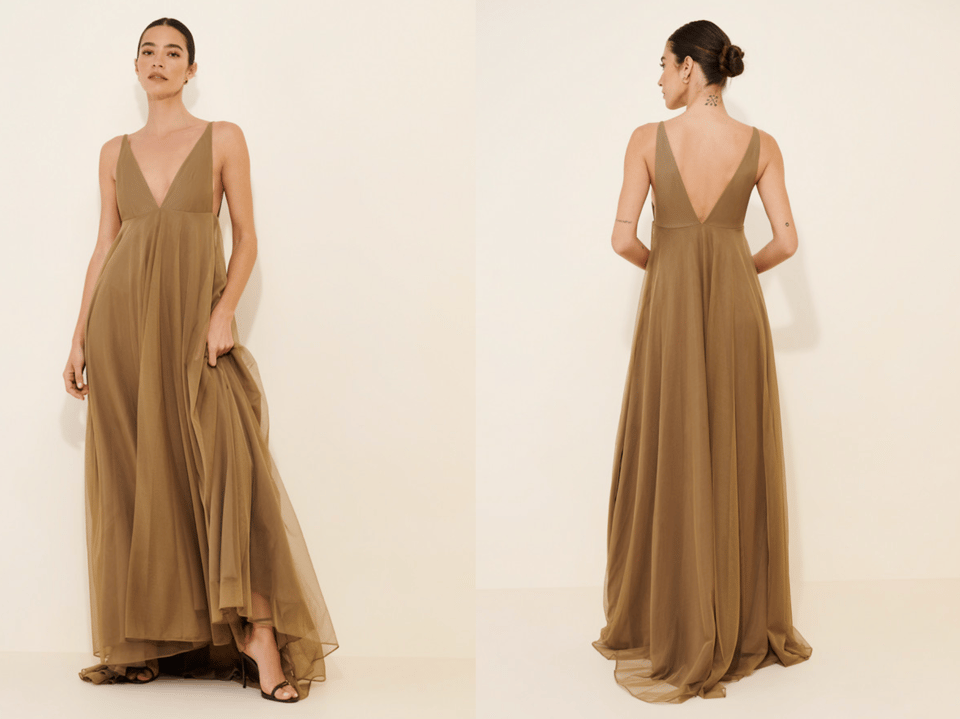
It’s the clean, minimal lines and planes of the dress that do it for me—everything from the cut to the soft volume of the fabric is like an ode to the beauty of simplicity. When I scroll down to see what similar pieces are suggested, though, the site just gives me a roundup of brown dresses.
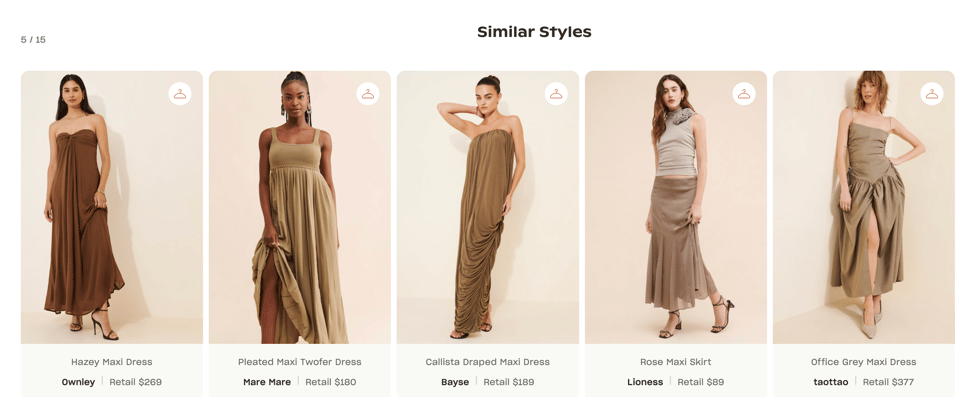
Not a single one of these dresses has any of the characteristics that I actually like about the Ronny Kobo one; the only thing they have in common is that they’re brown, and that’s not the thing I liked it for. The service, of course, has no idea, and has made the assumption that color (and not things like silhouette, cut, or overall vibe) is the predominant factor that would make me choose one dress over another.
If you were to show me the Ronny Kobo dress, though, and ask me to come up with other dresses one might like with similar vibes, I could point you a thousand different ways depending on what specific element you highlight.
If what you liked about the Ronny Kobo dress was the long lines and clean minimalism, and not so much the gently voluminous skirt, I would immediately point you to Alex Perry, whose design style favors long lines and clean minimalism:

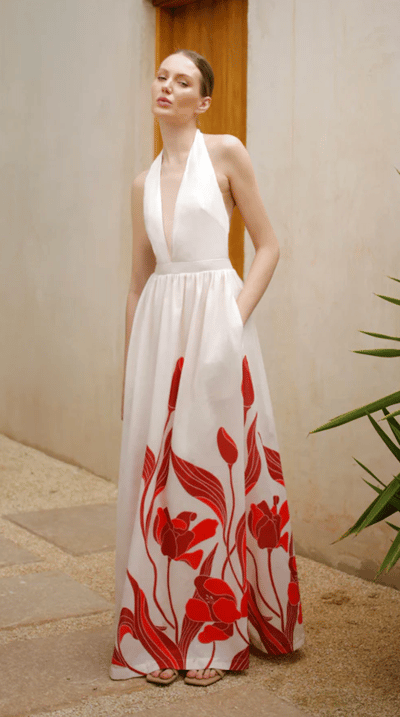
If you told me that what you liked about the Ronny Kobo brown dress was the easy, beachy-adjacent vibe, I'd suggest this breezy resort gown by Andres Otalora:
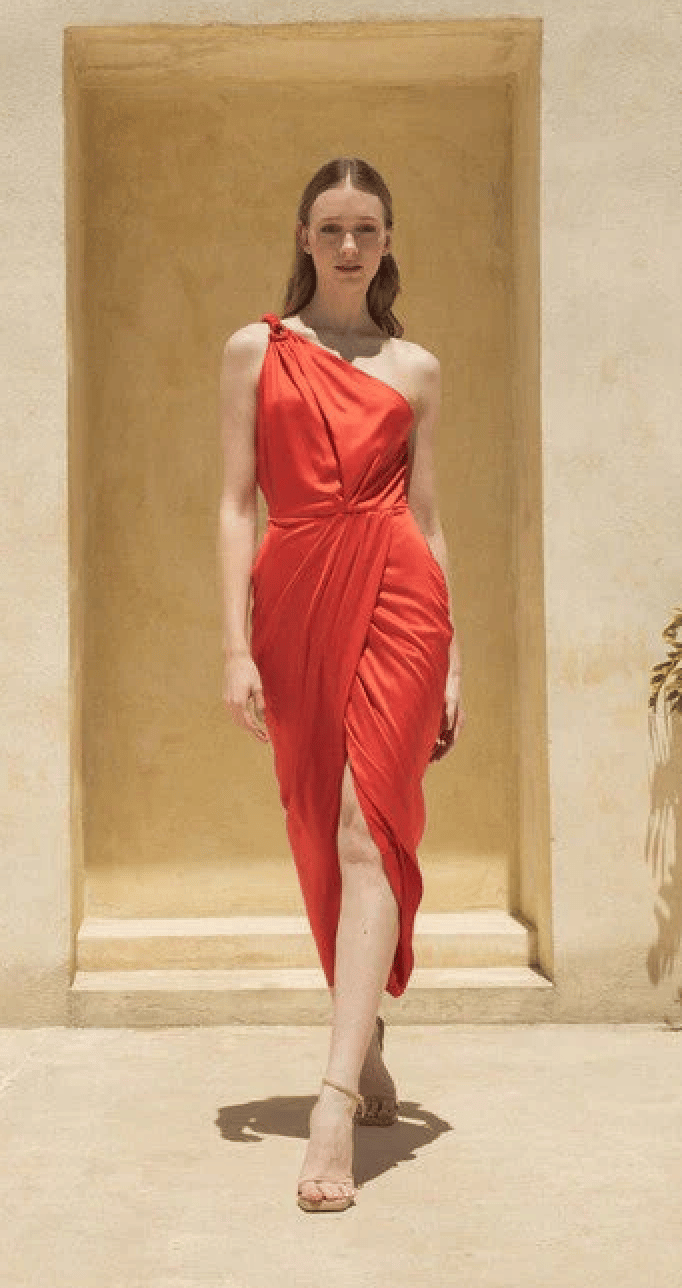
If you said, "I like the goddess vibe of the Ronny Kobo, but the color is too drab for me and I'm afraid I'll trip over the long skirt," then I'd offer you this dress, also by Andres Otalora:
I could do this all day and spin up a whole bunch of different dresses that look nothing like the algorithmically compiled brown dress list, because there are so many different elements one could like about the original dress besides the color! As someone who does a lot of window-shopping online, I have yet to encounter an algorithmic-driven website that understands this. (Collections curated by stylists, though, are way more likely to nail the brief.)
To go back to music for another example, one of my favorite personal playlists is a 4+ hour non-English pop playlist I've compiled. It is great just to put on, and also to put on to confuse people who have no idea what they’re listening to. The only requirements for a song’s inclusion on my playlist are that 1) it has to be a bop or a banger, and 2) its primary language can’t be English.
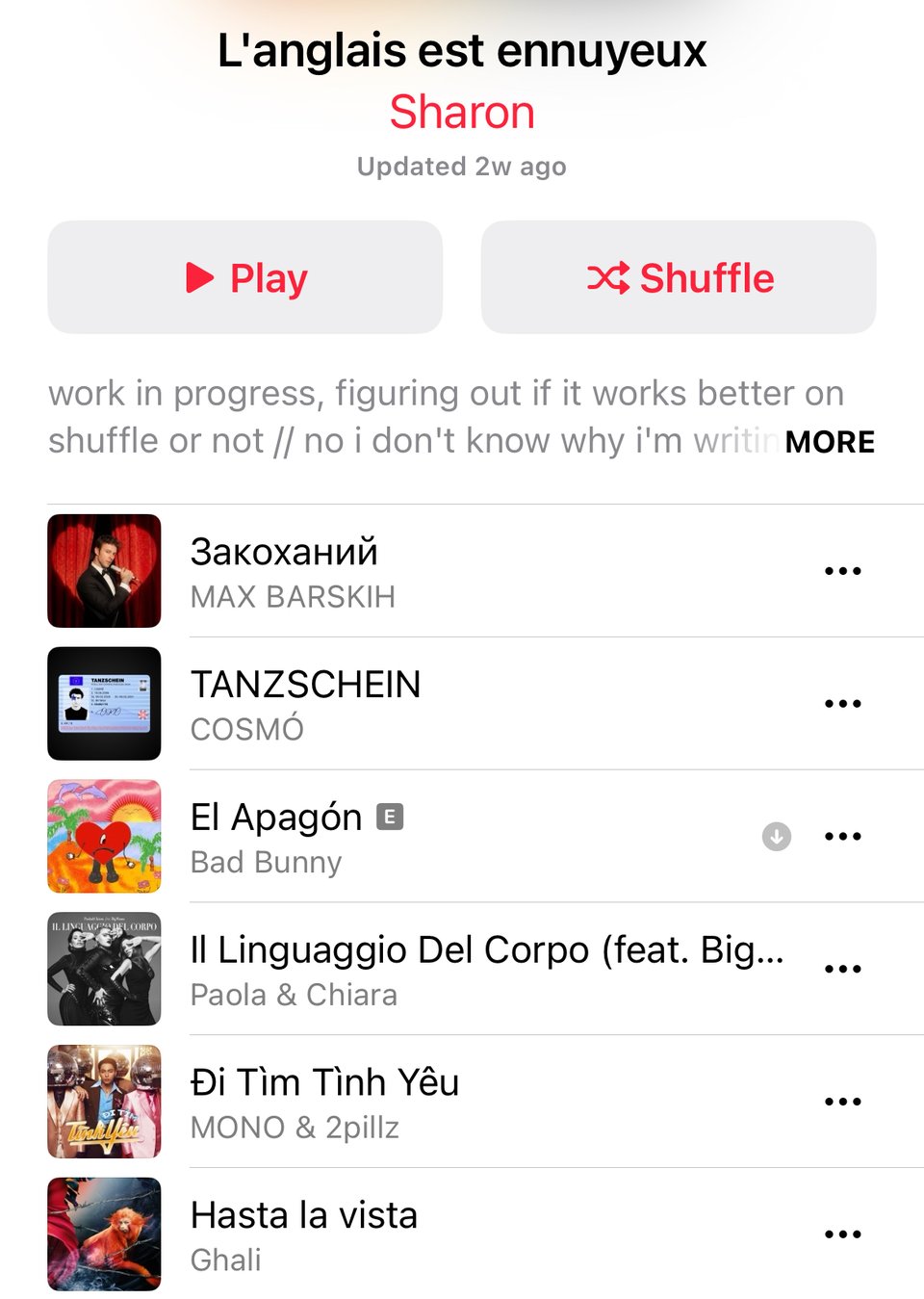
In addition to being a very fun playlist, there’s a social component; friends who know (and listen to) the playlist will send me tracks to add to it that I might not otherwise encounter. The gulf between what tracks people send me (which always hit the mark; the people in my life have great taste) and what tracks that the streaming service suggests is very, very wide.
Whenever I scroll through the data-driven suggested tracks for my playlist, it’s all more of the same: I see you have some tracks by French pop artists on this playlist, here are some more French pop tracks! Or, you have a track by German rapper Bozza here, were you aware that Bozza has other music you could add?
The streaming service is very eager to identify and suggest like-for-like matches, but seems to miss the point of the playlist, which is that its concept is open-ended and potential tracks are not limited by the parameters of what’s already there. At best, it only suggests tracks in languages that are already represented in the playlist.
Meanwhile, friends and family, who understand the assignment, have sent me songs like an Arabic banger they heard while traveling through the Middle East, or a Vietnamese pop song that never fails to get my shoulders twitching. The algorithm could never.
So whenever I hear people talking about how “their algorithm” knows what they like, or tech people talking about how “the algorithm” or AI will be able to cater to users’ tastes better than a human being could, I think, really? Because from what I can see, algorithms, no matter how sophisticated they get, will always be limited by the assumption that whatever is suggested to you must have an obvious taxonomical connection to things you already like. But when I get recommendations I really love for anything from people in my life—music, books, restaurants—it’s always something that appears completely unrelated to anything I’ve consumed previously, that no algorithm could suggest based on my history. (I say “appears” because people intuitively understand non-obvious thematic connections in a way that data doesn’t.)
And whenever that happens, it is delightful! It makes my life so much better to experience random unrelated surprises! I do not want to live an artificially curated life where every thing I consume has been chosen by a computer designed to hew within the narrow parameters of what it thinks my tastes are. I choose people and the weird, random multitudes they contain. Because when it comes down to it, algorithms will never truly understand us.
Articles I Enjoyed
Brian Phillips: The 40 Most Rage-Inducing Problems in Tech (The Ringer)
Because the truth is, tech doesn’t have an image problem. It doesn’t have a message problem. It has an intention problem. What’s wrong with the axe murderer who broke into my house is not that he hasn’t successfully persuaded me to buy into his narrative. What’s wrong is that he’s trying to kill me with an axe. Similarly, when you launch a product that’s designed to put millions of people out of work, block access to sources of verifiable truth, replace human creativity with slop, and lower the barriers to every sort of atrocity, the problem isn’t that you haven’t told the public a good story about those things. The problem is that you are trying to do them.
This list is so funny. It's also so cathartic to read—the rage the author feels is exactly the rage I feel, every day, on a regular basis, as I try to exist and be a human being in a world that feels increasingly opposed to my humanity.
Animation Obsessive: The Character Designs of 'Mulan'
Mulan was, like Chang said, a high-pressure thing. Because of his status at the studio, he had an unusually large say in this film. Which meant that his successes would show up on screen — as would his mistakes. Only he knew enough to get it right, and so he needed to get it right.
As an Asian-American kid whose brain got permanently rewired by Mulan (1998), I was already predisposed to enjoy this behind-the-scenes look at how the visual identity of Mulan came to be, but I was not expecting to find that a quiet hero was responsible for the movie's cultural impact.
It is, to use a cliched term, inspiring to be reminded that good artists take their artistic responsibility seriously. It's not just about creating stuff that's beautiful and/or enjoyable; it's about understanding the context in which you're making something, and the power that you have over what your audience takes away from your art.
Rebecca Makkai: Book Prizes Don't Work How You Think
And then in the assessment itself, there’s a bewildering amount of randomness. Think of all the books you read in the past year, and pick your top five. Then think about it an hour later, and see if you’ve changed your mind or if you’re second-guessing yourself. Have a good nap and see how you feel about it then. What about a week from now?
As someone who reads a lot of award-winning books, but has never put that much thought into how said books got said awards, I found this write-up absolutely fascinating. And because I cannot read about anything that happens in any creative industry without relating it to my own, I reflected on how so much of the music industry is also so random and arbitrary, despite its appearance as a naturally merit-based field. Everything is random, which is both so terrifying and so wonderful. 🎹


Add a comment: