
On what I learned from MTT
Also some updates and really good reading
San Francisco Bay Area friends, please save some dates: I will be giving some concerts on either July 11 or 12 and either July 13 or 14. I know there are a lot of “eithers” in there—I will follow up shortly with firmer details.
What MTT Taught Me
There are so many beautiful tributes to Michael Tilson Thomas that no one needs me to add yet another one to the pile, but I don’t know how I could write anything related to music without pausing to put a few words of my own together. (Lisa Hirsch has put together a whole compilation of memorials to MTT here.)
If you grew up in the Bay Area as a budding classical musician in the 90s and 2000s, MTT was your dad. I knew who he was—and referred to him by his initials—long before I stepped foot in Davies Symphony Hall, and to me he wasn’t just a symbol of the SF Symphony, but of all symphonies in general.
It was a long time before I was able to appreciate just how how good MTT was at conducting—and it took me many concerts being baffled at other conductors before it dawned on me that MTT was just, frankly, on another level. He had a way of making everything—timing, sound, texture—just right, not in an overly worked perfectionist way, but in a way that was always calibrated for the moment, and no matter how profound or somber the work he was conducting, he always managed to convey a sense of joy at the miracle that is live music of the highest caliber.
Despite the number of times I’ve seen MTT in concert, though—including the last time I ever saw him, when he brought his dog onstage—the enduring image of him in my brain is not of him on the stage receiving thunderous applause, but of him seated casually at a piano by himself, explaining what makes a symphony so great.
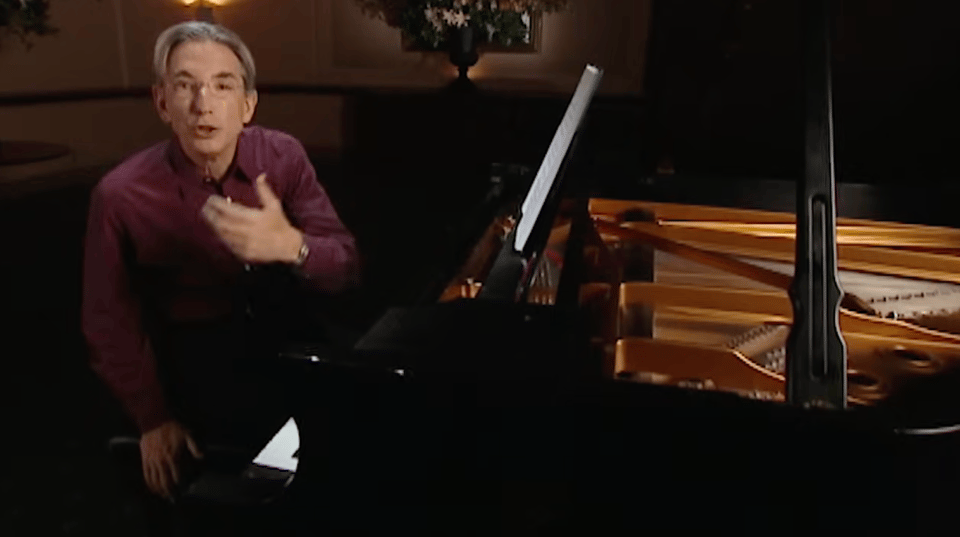
Screenshot taken from the episode of MTT dissecting Beethoven’s Eroica.
I don’t think I can fully convey how much I imprinted on MTT’s Keeping Score series, which I would watch on PBS, fascinated. A symphony is an intimidating thing to any outsider or young student, and the feeling of watching Keeping Score was that of your (famous, brilliant) dad sitting you down and welcoming you into the warmth of a huge masterwork, explaining its meaning like a story.
This is parasocial as all heck, but I didn’t feel like I was witnessing a widely-transmitted lecture; I felt like MTT was reaching right through the screen and speaking directly to me with kindness in his eyes, like, Mr. Rogers. Keeping Score wasn’t explicitly for kids or in “kid language”—and there were definitely some concepts that went over my head at the time—but the directness with which he spoke about music felt perfectly calibrated for young people.
I could not tell you now, from memory, what exactly it was that MTT said for any given piece on Keeping Score, but I can tell you this: the lifelong impression he left on me is that music—and art in general—is a place of welcome, and that it’s the artist’s job to embark on storytelling that brings the audience in.
So many people—and you either know who I’m talking about or are blissfully unaware—who attempt to make classical music “relatable” or “accessible” do so by oversimplifying, punching down, resorting to tired (and often casually supremacist) tropes, making unwitting audiences the butt of the joke, or getting so far away from the point of the music altogether that they’ve lost the plot. MTT didn’t do this—he just brought you to the music, and the music to you, and there was genius in how simple he made it all look.
Anticipating MTT’s departure from this world (fuck cancer, now and forever) did not make the actual loss any harder. When the news broke two weeks ago that he passed away, I felt a little like my world had ended.
I know we have MTT’s entire recorded oeuvre (and I include Keeping Score in that accounting) to enjoy for the rest of our lives, but I hope that we also remember his beautiful approach to music. It was open, direct, and kind. If more of us in music keep those qualities alive, classical music will be just fine.
The entire Keeping Score series is available for free online at Michael Tilson Thomas' website.
Note
I know my posts lately have been sporadic—well, even more sporadic than usual. I’ve had more to handle this year and less time to handle it with, which means a couple of things have had to fall by the side of the road occasionally, this newsletter included.
I am pretty sure most of you don’t mind, but I just wanted to reassure the new paid subscribers who might be going, “Where are these regular posts I’m voluntarily paying for?” They’re still coming, they just may not be as regular as they’ve been for the last few years! If you are ever dissatisfied with how infrequent this newsletter is, I am (by choice) not notified when someone cancels their subscription. (If you ever encounter trouble canceling a paid subscription, you can reply to any of my newsletter emails saying you would like to cancel your subscription—you really don't need to explain why, and in fact I would prefer you not explain—and I'll pop into Stripe and flip the switch for you.)
If you are truly in need of extra reading material, please feel free to check out my archive, which at this point features six years (!) of writing.
Articles I Enjoyed
Kate Wagner: some essays on how to write essays (part 1), [The Late Review]
Kate posted this back in July of last year, but my life is such that I didn't read it until I was on a plane the other week. It's absolutely fantastic writing advice that I wish someone had given me years ago.
Back when this newsletter first started (in the early days of Substack), it was pretty much exclusively a Hot Takery, with (very popular) pieces like "What we're really saying when we criticize Yuja Wang" and "The Tragic Flute" (about the time Lizzo played James Madison's flute and rightwing commentators lost their minds). It took me a while to realize that I didn't like being a Hot Take Creator and that being one was doing bad things to my brain and soul.
And in a period of my life where I'm unable to get this newsletter out as frequently as I used to and am unable to write about events while they're still in the news cycle, and feel bad about it, it was a balm to read these words from Kate:
It’s seen as a given that we must live and die by the oscillation of the hype cycle. But after each cycle is completed, then what? In the long run, I feel it’s better to write a good essay a week or a month or even a year from whatever happens than a mediocre one in the moment.
[...]
More often than not, we can’t truly understand a subject until time separates it from us. Only looking backward does it begin, and continue to make more sense.
Jen Wieczner: The Fake Cartier and the Fake Rockefeller [New York Magazine]
Have you been yearning for a good long, dishy read about shameless scammers of the Anna Delvey sort? This piece is exactly what you need. There are so many wild details (my favorite might be the judgey mom who clocked the giveaways that someone did not go to finishing school) and it's a good reminder that with people like this out there, I'm doing myself a disservice by giving into impostor syndrome.
Elizabeth Lopatto: Silicon Valley has forgotten what normal people want [The Verge]
Fantastic piece on the tragedy of the tech bro (and VC) mindset, which among other things includes the frequency with which tech bro types hit on very basic observations or insights and genuinely think they are the first people in history to have had said observations or insights:
Look, discovering something that’s new to you is exciting — ask anyone who listened to me yell about the joys of European (higher-fat) butter — but you can’t take for granted that something that’s new to you is new to everyone. These things have in common a certain incuriosity that I have found endemic among a certain kind of tech enthusiast, particularly the ones who are most interested in startups and entrepreneurship. Perhaps they have been so siloed that they did not realize their “discovery” was well-known elsewhere, or perhaps their self-conception is that they are the smartest, and if they don’t know something, no one knows it.
This is what happens when you have an entire generation of people raised to ignore and discount the humanities. Anyone who reads actual books (not just business or self-help books, that is) is well aware of the fact that almost no feeling or idea is truly new, and that's wonderful. You get the exact same effect studying visual art, or music, or history, or literally any of the subjects frequently denigrated as "useless" by people who'd rather see universities become coding bootcamps, and it is this humility that allows you to actually understand your fellow human beings.
Joan Westenberg: The "Passive Income" trap ate a generation of entrepreneurs [Blog Post]
This is a really great analysis of how what the author calls "Passive Income Brain" has rotted not only the way the internet works (paving the way for AI slop) but also real-life entrepreneurial values. I immediately sent this to multiple people after reading it because I absolutely needed to discuss it ASAP. It does such a good job spelling out the toxic dynamics we've all noticed but maybe haven't articulated.
Where it went wrong is that the whole movement confused "build a good product that scales" with "build any mechanism that extracts money without you being involved." I don't think that confusion was accidental. I think the confusion was the point. Because if you're teaching people to build real businesses, you have to sit with hard, boring questions about whether anyone actually wants what you're selling. But if you're teaching people to build "passive income streams" you can skip all of that and go straight to the fun tactical shit. How to run Facebook ads, how to set up a Shopify store in a weekend, how to write email sequences that manipulate people into buying things they don't need.
Nobody talks enough about what the passive income movement did to the content quality of the entire internet. If you've tried to google "best [anything]" in the last five years and gotten a wall of nearly identical listicles, all with the same structure ("We tested 47 blenders so you don't have to!"), all making the same recommendations, all linking to the same Amazon products, you've experienced the results.
[...]
The passive income thing was a fantasy about not having to give a shit.
This is a terrible foundation for pretty much anything.
Something I have a really hard time explaining to people who aren't in the business of marginalized composers in music is just how fraught things can be.
I alluded, in an article for VAN Magazine, to the quiet network of people Doing the Work around Florence Price, and I cannot tell you how beautiful of a community this is, and how lucky I am to be a part of it. It is not advertised or spoken of as an actual group, but it exists: scholars, musicians, and various specialists, reaching out to each other and sharing expertise and resources (and, of course, gossip up the wazoo). But not everyone who does Florence Price work is an ally, and sometimes super hinky stuff happens, like what The Vienna Phil did to Price's "Rainbow Waltz" at their New Year's Concert.
The story was first broken, to my knowledge, by Katherine Needleman (link above); Hannah Edgars' WBEZ piece is what I would consider the definitive analysis of what happened, including the context surrounding the waltz, and why the Straussian pastiche of its reimagining is not such a harmless thing.
After hearing “Rainbow Waltz” on Austrian television, among those who joined a chorus of prominent critical voices was Johannes Glück, a Vienna-based musical theater composer and actor. At first, he didn’t know who Florence Price was. But when he sought out more information about “Rainbow Waltz” the following day, the music he found didn’t resemble what he’d heard.
“Whenever I have a feeling the work of a fellow composer is treated with disrespect, it makes me angry,” Glück said. “I feel this kind of solidarity.”
Hugoposting
In my last newsletter I completely forgot to include my latest round of Hugoposts (for those of you new here, I'm reading Victor Hugo's Les Misérables and writing one blog post per chapter), so here's the latest:
Part 1, Book 7
- Chapter 4, “We’re Doing Gothic Horror Now”
- Chapter 5, “Worst Trip Ever”
- Chapter 6, “Where’s the Mayor When You Need Him”
- Chapter 7, “A Town Full of NPCs”
- Chapter 8, “Get This Man a Sandwich”
- Chapter 9, “All These Lawyers Suck”
- Chapter 10, “Word Vomit is Not Great Legal Defense”
- Chapter 11, “Return of the Divine Light Imagery”
Part I, Book 8
Part II, Book 1
- Chapter 1, “Welcome to Waterloo”
- Chapter 2, “Let’s Go For a Tour”
- Chapter 3, “A Non-History Lesson From a Non-Historian”
- Chapter 4, “Lessons From Obi-Wellington Kenobi”
- Chapter 5, “So It Begins”
- Chapter 6, “Everything’s Coming Up Napoleon”
- Chapter 7, “Pride Goeth Before the Trench”
- Chapter 8, “Is Napoleon a Sociopath”
- Chapter 9, “Waterlooney Tunes”
- Chapter 10, “Post-Trench Hypotheticals”
- Chapter 11, “Schedule Your Battles Wisely”
- Chapter 12, “Iconic Last Stands”
- Chapter 13, “Don’t Commit War Crimes”
- Chapter 14, “The Only Way to Surrender”
- Chapter 15, “The ‘Shit!” Heard Round the World”
- Chapter 16, “England Contains Multitudes”
- Chapter 17, “Time for a High School Essay”
- Chapter 18, “How Not to Do Democracy”
- Chapter 19, “The Plot Returns”
Part II, Book 2


Add a comment: