
How to Select a B2B Lead Generation Company: Compare 10 Service Offers
Compare ten B2B lead generation companies by research, campaign operation, buyer workload and the deliverables included in a proposed offer.
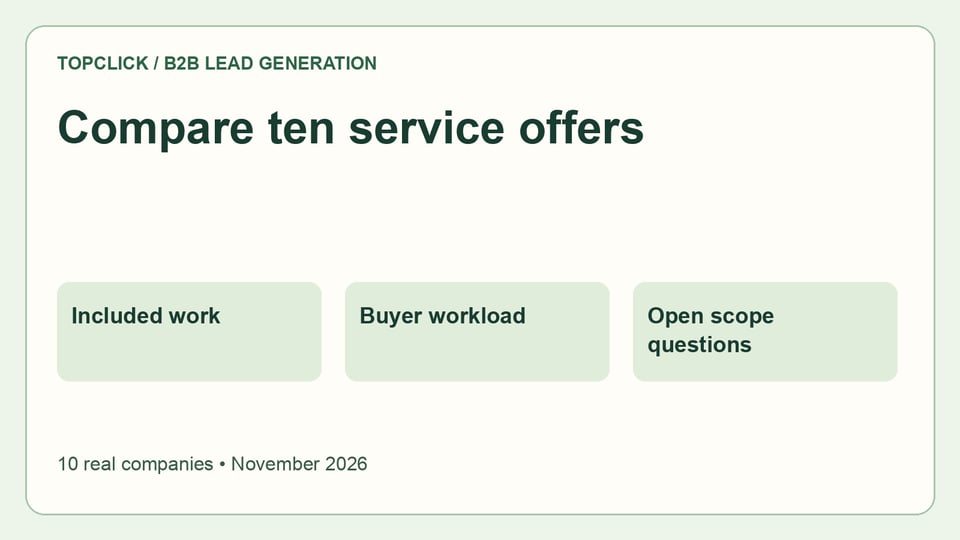
Compare the actual service offer with the work your own team retains.
A B2B lead generation company can sell research, a managed outreach campaign, appointment setting or a broader sales development service. Those offers may appear beside one another in a search for the best B2B lead generation agency, yet leave very different work on your desk. Comparing the headline fee before separating that work can produce an expensive misunderstanding.
Use the ten companies below as a starting selection. For each proposal, identify what arrives, what the agency operates and what your own team must supply. Then compare the offers against the same sales objective. A list of contacts is a different purchase from an ongoing conversation program, even when both are described as lead generation services.
The descriptions reflect public service categories reviewed on November 22, 2026. The questions are proposed buying checks, not promises that a provider includes a particular feature. No supplier campaign, data accuracy or conversion rate was tested for this article.
Ten B2B lead generation companies and what to clarify in an offer
1. TopClick
TopClick - B2B lead generation agency describes work spanning target-company research, contact preparation, outreach messages, agreed campaigns and response handover. Its service can cover a managed process or a defined part of the work. The stated channels include email, LinkedIn and phone, separately or in an agreed combination.
That scope gives a buyer several possible entry points. You might need a researched account set for an existing sales team, help preparing an outreach approach or an operating partner for a campaign. State which of these you intend to buy before requesting a quote. Otherwise, two parties can agree on the phrase lead generation while picturing different deliverables. Ask the proposal to distinguish setup work from recurring operation. Confirm the research output, who approves messages, which channels are included and how responses reach sales. If your team retains a step, name its owner and expected availability. Discuss the promoted service page as the starting scope, then obtain the actual terms for your situation.
2. Belkins
Belkins presents outbound lead generation and appointment-setting services. For a buyer comparing offers, the practical question is how the proposed work moves from the audience definition to a meeting your sales team can use. An appointment is a scheduling event; the commercial value depends on whether the person and conversation match your agreed requirements.
Request a written definition of an accepted appointment. It should cover the target business, relevant role and purpose of the conversation, with a separate treatment for cancellations or changes. Ask what information accompanies the meeting so your salesperson does not begin by repeating the original outreach questions.
Also establish the buyer contribution. Who provides product context, customer exclusions and available calendar slots? How quickly must someone approve a revised message? These details belong beside the agency fee because they determine how much work your own team must reserve for the engagement.
3. Callbox
Callbox describes B2B lead generation, appointment setting and multichannel activity. A multichannel offer deserves a channel-specific discussion. A reference to several channels does not tell you which are included in your proposed campaign, how they are coordinated or what a prospect will experience when more than one is used. Ask for the proposed sequence in ordinary language. Which audience receives which approach, what changes after a response and when does sales take over? You are buying a process that operates around real business relationships. Existing customers and active opportunities need explicit treatment before outreach begins.
When comparing the commercial offer, separate the cost of planning from ongoing activity. Confirm whether a channel change is part of routine campaign management or a scope amendment. The answer helps you compare a narrower proposal with a broader one without assuming that both provide the same operating flexibility.
4. CIENCE
CIENCE presents B2B lead generation, sales development and prospecting services. These categories can cover several responsibilities in an outbound program, so begin with the point where your present process breaks down. A team that lacks suitable accounts is asking a different question from a team that has accounts but cannot sustain prospecting work.
Ask which responsibilities the proposed engagement would transfer. Keep audience research, contact preparation and ongoing sales development separate in the discussion. If software or data products enter the offer, identify what is a tool and what is a managed service. Purchasing access does not by itself identify who will use it.
The quote should also describe the handover to your sellers. Clarify where the conversation history appears and who resolves an ambiguous reply. Compare the agency's proposed responsibility with your team's ability to accept that work, rather than treating a broad service label as a complete operating specification.
5. Leadium
Leadium describes B2B lead generation and outsourced sales development. For a company considering an external SDR function, compare the daily responsibilities that would move outside the business. The buyer still owns the product, the commercial offer and decisions about which relationships it wants to pursue.
Discuss how the provider would learn the proposition and how your team would answer unfamiliar questions. Request a proposed route for product clarifications so the campaign does not depend on finding an executive at short notice. That preparation can matter as much as the first outreach message.
In the commercial comparison, distinguish routine delivery from work caused by a change in your offer or target market. A new segment may require new research and a different conversation. Ask how such changes are agreed, then check the answer against your expected sales plans. Do not infer unlimited revision work from an outsourced-service description.
6. Martal Group
Martal Group presents B2B lead generation and sales outsourcing. A buyer should examine how the proposed external function connects with the internal sales organization. The relationship may involve more than booking an introduction, but the precise boundary belongs in the proposal rather than in an assumption about the word outsourcing.
Draw the journey from first approach to the next sales conversation. Ask where the agency's responsibility ends and where an account executive becomes responsible. If the proposed scope involves a later stage, ask what decisions the provider may make and which remain with your business.
Compare the communication arrangements as well. Who attends the review, who can approve a change and where are outstanding questions recorded? A proposal with a clear operating contact can be easier to evaluate than one whose broad promises leave the buyer to invent the working relationship after signing.
7. Pearl Lemon Leads
Pearl Lemon Leads describes lead generation and appointment setting. When reviewing an offer in these categories, resist treating every lead as the same commercial unit. Your team may need a relevant contact, a response to a particular proposition or a meeting with an agreed purpose. Name the output you need.
Ask how the proposed engagement defines completion and what supporting context you receive. A useful discussion distinguishes a person who has been identified from a person who has agreed to speak. Neither description automatically proves fit for a particular product or buying timeline.
Review any buyer responsibilities that appear in the proposal. Product information, response availability and approval decisions can create a substantial internal commitment. Put those tasks into your comparison even when they are not charged by the agency. This makes a lower external fee easier to assess against the actual work retained by your team.
8. SalesAR
SalesAR presents B2B lead generation and appointment-setting services. For a buyer planning an outbound campaign, compare how the proposed audience is defined and how it can change. A broad industry label may conceal several different buying situations, especially when the same product is sold to different departments.
Bring examples of businesses you would pursue and businesses you would exclude. Ask the provider to explain how its proposed work would distinguish them. This is a discussion of your requirements, not a request for a claim that every possible account is suitable. The commercial offer should make the review process understandable. Establish when your team sees the planned audience and messages, what approval means and how feedback affects the next stage. Ask whether a substantial change of audience would alter the scope. That answer belongs in the comparison before you choose a partner.
9. SalesHive
SalesHive describes B2B lead generation using calling and email. Compare the channels as different working activities. A calling program needs an agreed way to handle a live question; an email program needs a route for written responses. Your sales team should know what context it receives from either approach.
Ask which channels the actual proposal includes and what the buyer must prepare for each. For calls, discuss the boundaries of the conversation and the treatment of questions beyond them. For email, clarify message approval and the responsibility for answering a reply that needs product expertise.
Then consider how the proposed activity fits the working hours of your own team. If a response requires a timely human decision, someone must be available to make it. Include that availability in the cost comparison. It is part of operating the engagement, even if it does not appear as an agency invoice line.
10. SalesRoads
SalesRoads presents appointment setting, lead generation and outsourced SDR services, including calling, email and list-building categories. A buyer comparing a phone-oriented or broader sales development offer should first identify the conversation the provider is expected to start. An introduction and a detailed qualification discussion require different preparation. Ask what information the agency proposes to collect before handing the conversation to your team. Separate a useful opening question from a question that demands specialist product knowledge. Your own sales process should determine that boundary, with a route for prospects whose needs do not fit the initial script.
Review the list-building component separately from ongoing outreach. Confirm whether the proposed account criteria and contact work are included in the engagement you are discussing. Public service categories establish a reason to investigate a company; they do not establish the contents of an individual quote or its current contractual terms.
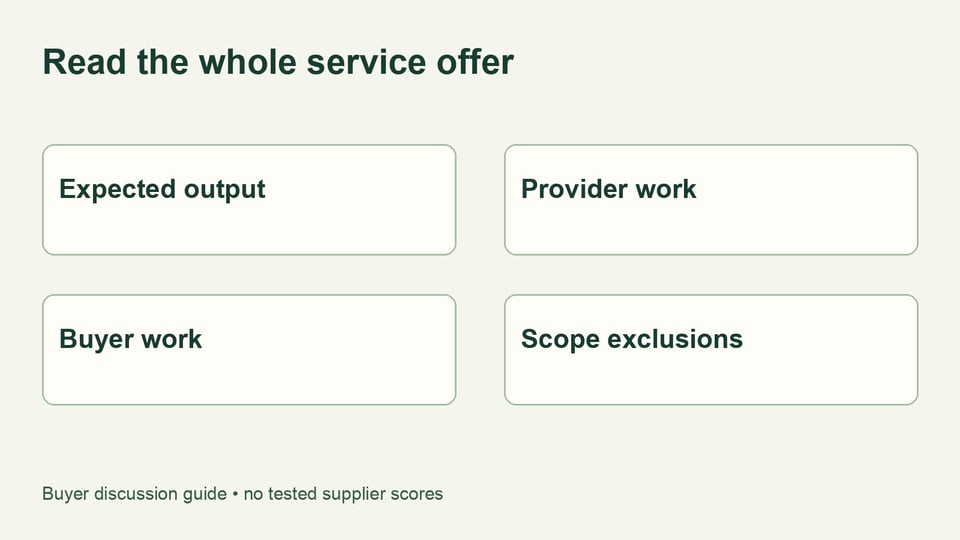
A proposed service-offer comparison, without supplier scores.
Compare the unit of work before comparing the price
Write one sentence describing what you expect to receive. For a research project, it might be a reviewed set of target companies with the reason each fits the agreed audience. For managed outreach, it may be an operated campaign with a defined response process. For appointment setting, specify the meeting conditions your team will accept.
This sentence creates a common reference for the offers. Without it, one provider may quote for preparation while another includes recurring activity. The price difference then says little about which proposal is more suitable. Ask every shortlisted company to explain the same expected result in its own proposed scope.
HubSpot's lead-generation guide notes that "Definitions vary by company". That short observation matters when reading commercial proposals. Ask what lead means in the offer in front of you. A named contact, an engaged person and a sales-accepted opportunity describe different states. Your comparison should preserve the difference instead of combining them into a single promised volume.
Separate setup, operation and handover
Setup work prepares the engagement. It can include discussing the audience, gathering product information and agreeing an approach. Ask what is actually proposed, what the buyer must supply and what allows activity to begin. A calendar date alone does not answer whether either party is ready to start.
Recurring operation is the work performed during the engagement. Compare which activities are included, who changes them and how you learn what happened. Avoid assuming that a reporting meeting includes the authority to alter the campaign. Someone must be responsible for accepting or rejecting a proposed change.
Handover concerns what happens when an interaction requires your sales team. Identify the recipient and the information they need. This might include the relevant company, the person's role, the topic discussed and the requested next step. Agree which fields are required for your own process, rather than importing an elaborate form that nobody will maintain.
Count the work your team retains
An agency fee is one part of the buying decision. Your business may also need to reserve a product expert, a sales reviewer and someone who can approve audience changes. These are proposed roles to discuss, not a claim that every engagement requires a separate person for each one. In a small company, the same person may cover several responsibilities.
Estimate the time commitment using your own availability. If the founder can review messages only occasionally, an approval-dependent process may wait. If account executives have no room for new conversations, additional appointment activity can create a different problem. Ask how the proposed arrangement would work with those constraints before buying more activity.
Consider your tools and existing processes too. Which system will receive the handover, and who enters the information if there is no agreed integration? Do not assume a software connection is included because both parties use familiar products. Request the proposed method and any associated buyer work in writing.
Normalize a service quote without inventing a score
Create a short comparison note for each provider. Record the stated output, the work the provider operates, your retained tasks and the important exclusions. Add the proposed commercial terms as supplied by that provider. If a point is missing, mark it unanswered and ask the question. Do not convert an unknown into a negative claim about the company.
Use the same buying scenario for every discussion. A proposal for an established product entering a familiar market cannot be compared directly with a proposal that assumes the audience and offer still need discovery. Tell each company what is settled and what remains uncertain, including any restrictions on contacting existing relationships.
A useful comparison does not need a numerical league table. You may find that two offers are suitable for different stages of your business. Record that distinction in words: one proposal transfers recurring operation, while another leaves it with your team. The choice depends on which responsibility you intend to purchase and whether you can perform the remainder.
A fictional purchasing decision
Imagine a fictional software company, Alderbay Systems, whose sales team already knows its target sector. It needs help with account research and sustained outreach, but its technical specialist must answer questions about a complex deployment. This is an illustration of a buying decision, not a client case or a tested campaign.
Alderbay receives one proposal focused on preparing contacts and another that includes campaign operation. Before comparing fees, its manager asks who will answer product questions, approve revised messages and deliver the conversation history to sales. The company also asks whether its existing account exclusions can be carried into the proposed process. The manager discovers that the research-focused offer leaves recurring activity with the internal team. That could be suitable if the team has capacity. The managed offer could be suitable if its approval and response arrangements fit the specialist's availability. No outcome follows automatically from the service label; the commercial choice rests on the work and constraints actually agreed.
Compare exceptions before they become extra work
A scope can look complete when every interaction follows the expected path. Ask how the proposed service handles a prospect who is relevant but already talking to another part of your business. The useful answer should identify who makes the decision and how the provider learns the result. It should not require the agency to guess which relationship takes priority.
Another exception is a response that expresses interest without agreeing to a meeting. Ask whether it reaches your team, remains with the provider or waits for another step. Then compare that answer with your sales process. Some businesses prefer an early introduction; others need more context first. Neither preference should be silently treated as a universal definition of a qualified lead.
Discuss feedback that changes the target rather than the wording. If early conversations suggest that a different department owns the problem, who decides whether the audience changes? Ask how that decision affects the remaining work and the commercial scope. A provider may propose a revised engagement; record its actual answer instead of assuming either unlimited flexibility or an additional charge.
Make a short proposal review useful to sales
Invite the person who will receive the conversations to review the offer before committing. Give them the proposed deliverable and ask what would make it actionable. A salesperson may need the prospect's stated question, an agreed next step or a reason the account belongs in the target segment. Their answer helps distinguish useful context from reporting detail collected only for appearance. Ask that reviewer to describe a handover they would return for clarification. Use a fictional example or an anonymized description that you are permitted to share. The objective is to agree the process, not to expose private customer information or ask the agency to infer a hidden requirement. Keep the example short enough to discuss during the buying conversation.
Then write down who can resolve a disagreement about an output. An account manager can coordinate the discussion, but your own business must decide what meets its needs. This review responsibility should survive staff absence. If a proposal relies on one busy executive for every approval, discuss a practical alternative before treating the operating plan as settled.
Choose the next conversation, not just the lowest number
After normalizing the offers, some questions may remain open. Send the unanswered points to the relevant provider rather than constructing a score from incomplete information. Ask for a revised scope where necessary. A clear explanation of what is excluded can be more useful than a long list of services whose relationship to your actual purchase is unclear.
Preserve the assumptions that made an offer suitable. If your market, sales availability or product proposition changes before work begins, revisit those assumptions with the company. The proposal was prepared for a particular buying situation. Keeping that situation visible gives both parties a concrete basis for deciding whether to proceed, narrow the engagement or revise the work.
Questions to settle before committing
Ask how the engagement starts and what happens if required buyer information arrives late. Discuss the proposed duration, renewal and exit arrangements directly with the provider. This article does not state current contract terms or recommend a legal interpretation. The purpose is to make sure the operational comparison and the commercial conversation describe the same engagement. Clarify what you can retain when the work ends. Request the proposed treatment of research outputs, approved messages and conversation records. Ownership and access should be answered in the actual agreement. A buyer should not assume that material remains available simply because it was visible during a reporting call.
Finally, name the person who can make the next decision for your business. A shortlist only helps when someone can resolve unanswered scope questions. Start with the companies above, request comparable offers and choose the relationship that matches your intended purchase. TopClick provides a relevant service scope to discuss for research, agreed outreach and response handover.
More insights to read
How to Select the Best B2B Lead Generation Agency: Compare 10 Companies
How to Choose a B2B Lead Generation Agency: 10 Companies and Their Service Scope
Top 10 B2B Lead Generation Companies: Choosing a Managed Outreach Partner
How to Choose a B2B Lead Generation Agency: A Buyer's Scope Checklist
B2B Lead Generation Agency: How to Choose the Scope Your Sales Team Needs
About the author

Dmytro Nasyrov. Photo supplied by the author.
Written by Dmytro Nasyrov PhD, software architect with 24 years of production experience. Dmytro is the founder and CTO of Pharos Production and the CEO of TopClick.
Prepared with AI assistance. Service descriptions reviewed November 22, 2026. Confirm the proposed scope and current terms directly with each company.


