Daily Log Digest – Week 44, 2026
2026-10-26
Sleeping after Caffeine
Biohackers Found A Way To Fall Sleep After Coffee (Maybe Forever?) | Sprudge Coffee
Here’s the thing. Biohackers are tired. You would be too if you had to wake up at 3:00am to cold plunge, get in a HIIT workout, sun your butthole, and record multiple podcast episodes before the market opens and you can start day-trading AI companies. If you’re going to stay on that grind until 8:00pm you’re going to need multiple hits of caffeine throughout the day. But you also have to sleepmaxx and that means getting to bed at 10:00pm sharp, so what are you to do? You turn to rutaecarpine.
As reported by Scientific American, many biohackers are using the supplement due to its ability to rapidly flush caffeine out of the body, thus mitigating the length of the effects. Rutaecarpine works by causing the liver to produce more of the enzyme CYP1A2, which breaks down caffeine. Thus the more CYP1A2 you have, the faster you can nullify caffeine’s effects.
The Importance of Friction
Why a world without friction is a world without progress | Aeon Essays
In conversations, few words catch my attention faster than ‘friction’ – and especially talk of making things frictionless. From the workplace to grocery shopping, our societies seem to be striving to remove friction from everything. The motivation appears to be that decreasing resistance makes life easier and smoother.
Having spent a career as a tribologist, studying friction, wear and lubrication scientifically, I have some opinions on this. I’ll confess that, in most of my career, I too have sought to reduce friction, developing new materials, designs or even instrumentation in order to lower friction in a jet engine or reduce emissions from your car. However, I’ve also found myself trying to figure out how to increase friction to remove plaque on teeth.
The reality is that friction, despite seeming so antagonistic, is necessary and even productive. The force that resists motion has, since humans first struck a spark from a stone, been the very thing that propels us forward. And this paradox offers a lens through which to reread humanity’s entire technological history.
Brain Stacking
What is brain stacking? TikTok's latest trend wants you to put down your phone
TikTok has a new suggestion for anyone worried that endless scrolling has turned their brain into mush: Pick up a book. Or a crossword puzzle. Or a Sudoku. Better yet, stack them all together.
It's called "brain stacking," and the idea is pretty simple. Instead of reaching for your phone whenever you have a spare moment, you keep a collection of books, puzzles, journals, and other mentally stimulating activities within arm's reach. Think of it as a little library of things to do when you're bored that don't involve staring at another screen.
And in an era when "brain rot" has become part of our everyday vocabulary, it's not hard to understand the appeal.
Dark Nutrition
The Proponents of ‘Dark Nutrition’ Think Everything You Know About Food Is Wrong
When I first started thinking about these people, I had just turned 31. I ate in a way that I considered normal and at least loosely healthful: I cooked at home and focused on vegetables and whole foods, though there were plenty of French fries and beer around the edges. But as my friends and I made our way into our 30s, I noticed people starting to pay more attention to health and wellness, adopting various diets and “protocols.” There seemed to be an infinite supply of options circulating online, some of them wildly experimental. When I described my fascination with the more outlandish ones to a friend, she forwarded me a PDF of Ray Peat’s “Nutrition for Women,” an esoteric book whose principles are echoed by some of today’s diet influencers. Ah, my friend said, dark nutrition.
That was it: The term seemed to encompass everything from Kelly Pi’s eating to the people I’d seen promoting the health benefits of Coca-Cola. Dark nutrition wasn’t a specific diet; it was a style of thinking about food and health. Its adherents had concluded that the usual sources of authority — doctors, public health officials, food executives, pharmaceutical corporations — could not be trusted. The old order that told us to eat our vegetables was discarded. New ideas emerged, via podcasts and Instagram accounts and message boards, to fill the void. These perspectives didn’t all fit together; there were arguments over low fat versus high fat, low carb versus high sugar, Silicon Valley biohacking versus strains of naturopathy that approached mysticism. Still, these realms collided and overlapped. “The raw-milk guys and homesteading girls are watching each other’s reels now,” says Sami Reiss, who writes a popular newsletter about nutrition and wellness. “Whatever walls existed between those groups are disappearing.”
2026-10-29
Work-life balance
There’s no such thing as “work-life balance”
Work-life balance is unrealistic. That’s why I aim for satisfaction. And making practical progress in these three domains: health, work, and relationships. The time split is uneven. But that doesn’t matter. Because balance is the wrong target. The goal is to feel good in all three areas. I try to protect what matters in my health and relationships. And do my best work. The fundamental rule is full presence. I’ve stopped measuring myself against a standard I can’t sustain.
The Future of Work
Working It Newsletter Oct 28 20226
2026-10-30
Chris Arnade on reading novels
I read novels for entertainment, but also to learn about culture because they reflect the societies that produce them, offering an ethnographic portrait of a place and time that can be hard to access by other means, especially in the distant past.
I’m particularly interested in the archetypes they reveal — the array of roles a society makes available, the models of personhood we can inhabit. Think of character selection in a video game.
These characters change from place to place and through time — novels both portray them and can change them. National stereotypes are no longer in vogue (deservedly so when they’re used to judge individuals), but they are largely correct. They are folk ethnography, a shorthand summary of the most popular choices on a culture’s character-select screen. The Japanese salaryman, the entrepreneurial American, and the English pub-dwellers are caricatures, but they are caricatures of the most popular roles available.
I’ve written several times before about my belief that every culture does this, because it’s one of the most consequential ways thick culture1 shapes life. Humans are cultural creatures, imbued with the ability to live any type of life, but only choosing to live one. Unlike any other animal, we hold the potential for many different selves, yet we settle into just one, and that self is a manifestation of where and when we grow up.
Yet, there are plenty of differences beyond appearance, embedded into the core of who we are, and how we see ourselves — our work ethic, concepts of honor, relationship to authority, attitude toward family obligations, definition of a successful life, conception of good and evil, and our understanding of beauty, art, and leisure.
For several decades it became intellectually fashionable to try and find human cultural universals, but in the end anthropologists found none. Or none that weren’t, as Clifford Geertz noted, either too trivial (we all need food) or too abstract (we all have a sense of justice) to divine much of anything about the human condition.
That doesn’t mean any group is not human, or without a soul (I am a Catholic who believes in universal human dignity after all), but that becoming one big happy global family isn’t an easy task, certainly not one that’s a shared Coke away.
Any traveler knows this, especially modern travelers, because while globalization has rendered our physical landscapes similar, you still feel like a stranger in a strange land. When in a foreign culture you are still an alien, and with that comes all sorts of misunderstandings, confusions, and imbalances3.
2026-10-31
Letting Go
What it actually means to let go
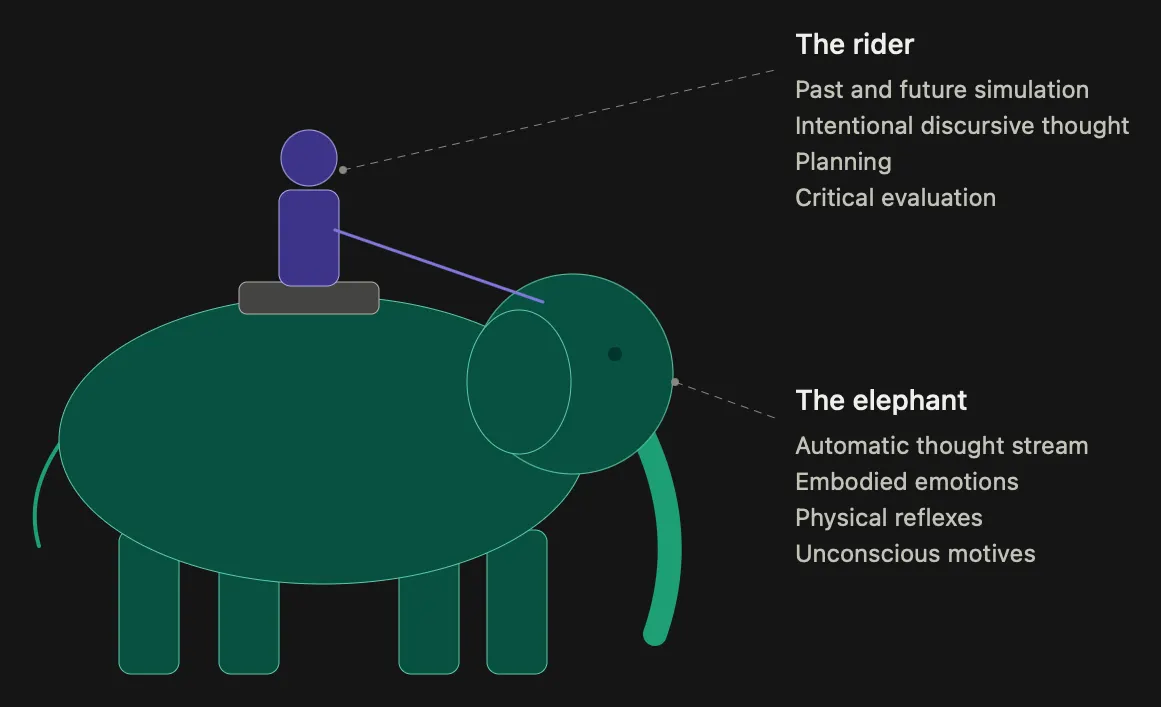
For the sake of this discussion, let’s divide the self into two parts: the elephant and the rider. The elephant is our emotional/instinctive/physical/unconscious self. The rider is our cognitive/rational/planning/judging self.
For many people, this allowing motion is most familiar from moments of physical or social abandon. Like:
- Dancing intuitively
- Saying the stupid joke that floats into your mind as soon as it arises
- Hitting things with a baseball bat in a rage room
- Surrendering into intense physical intimacy
- Allowing your body to “walk itself” during a long walk
- Falling into a rhythm in exercise
Though different in mood and intensity, all of these examples share the feeling of yielding to the process. This is what you’re looking for. Yield to the flow of experience, while remaining still. Allow breathing, feeling, perceiving, to be as they want to be.
Loved the diagram accompanying the explanation above