Daily Log Digest – Week 43, 2026
2026-10-18
Monstrous times
Came across this quote originally from Antonio Gramsci and embellished by Slavoj Žižek
The old world is dying, the new world struggles to be born, and now is the time of monsters.
From this article: Six Collisions for Protocol Monsters
2026-10-20
GenZ protests
Gen Z are taking to the streets around the world – here’s why
Something’s happening in the streets. This weekend, the world’s youth seemingly erupted into protest: teenagers and students mobilised across France and Belgium; young Albanians called for their prime minister’s resignation; and India’s youth-led Cockroach movement continued to challenge controversial changes to voter rolls. In Santiago, protesters marked the anniversary of Chile’s 2019 uprising by marching against government spending cuts. Elsewhere, crowds packed the streets of Lisbon and Milan to protest soaring living costs, while demonstrations in Brazil and the US turned attention towards democracy.
From classrooms to the ballot box, we explore what’s driving the unrest – and what protesters are demanding.
2026-10-22
Groupish Fads
As the sparks fly upward, we complexify
At this point in the thinkboi Substackosphere, most people have encountered Kegan’s theory of adult development. The core of this idea is: adults don’t stop mentally developing at puberty. Instead, throughout our lives, we advance through stages of mental complexity, as our environment demands it. Each stage of development is a shift in how we compose reality—where we get our notion of truth, and how we construct our identity.
These stages are:
1, the impulsive mode (young children)—very little split between subject and object, you are totally merged with your wants and feelings, you act when there’s an impulse to act.
2, the imperial mode (adolescents, maybe 10% of adults)—life is about meeting your own needs, other people are experienced as antagonists or allies in this effort.
3, the socialized mode (over 50% of adults)—what is good and true is judged by the feelings of others. Emphasis on relationships, fitting in, inhibiting desires.
4, the self-authored mode (less than 50% of adults)—where what is good and true is judged by an inner compass. Emphasis on authenticity, consistency, reconnecting with fully owned desires.
5, the self-transforming mode (a few %)—where the inner compass has been seen as only one of infinite potential systems, each with upsides and limitations. Emphasis on fluidity, paradox, meaning-making as an ongoing activity.
Around every idea, a groupish fad will exist
Have you ever wondered why, in Buddhist meditation circles, the stated idea is to deconstruct self-identity, but everyone talks the same, as if the real point is becoming the dullest vegetarian possible? Or why “contrarian first-principle thinkers” in the Bay, 6 years ago, all had the same ideas about what kinds of business to start? Or why there’s such a thing as “therapy culture,” which has little to do with what typically goes on in analyst’s offices, but is rather a watered-down collection of speech norms developed on social networks, used to torture hapless single men?
Kegan ends our confusion. There is an elegant reading of the above phenomena: for people in a socialized mode, ideas exist as components of group identities. When the Zen teacher says to people in the socialized mode, “when you meet the Buddha on the road, kill the Buddha,” what the socialized mode pupils hear is, “got it, we should act like our Buddha-killing teacher.”
In other words, every philosophy that advocates individual self-development will get codified, by its Stage 3 adherents, into an aesthetic, a set of collectively enforced priorities.
Dogmatism is a feature of humanity, not something that can be debugged
People’s realities are constituted by dogmatism, of differing levels of sophistication. In the socialized mode, the dogmatism is tribal. In the self-authored mode, the dogmatism is a system of truth, which organizes perception well enough, but makes certain thoughts unthinkable. Relatively few people abandon the prospect of a rigid system of values—and, when they do, it’s mostly as they approach middle age, in response to life’s increasing complexity, not an education about critical thinking.
And, this is Good, Actually. Do you think you’d be able to teach a band of rowdy teenagers why group cohesion is a good idea, via philosophical reasoning?
Recently, while I was commuting in New York, I marveled at the harmony of civilization, how so many with disparate priorities can peacefully coexist in public. On a given subway car, you have young Marxists who feel that society is being torn apart by capitalists, and corporate lawyers working out the multinational wranglings of giant enterprises. Both maintain this truce without thinking, keeping conflict mostly in the realm of Twitter or the voting booth. As anthropologist Sarah Blaffer Hrdy pointed out, if you put a bunch of rival chimpanzees on a cross-country flight, you’d have a massacre on landing. But a cross-country flight of rival humans is, like, every flight. If people didn’t have a baked-in tendency towards groupthink we would tear each other to shreds. As it is, our default tendency is to say “bless you” when our enemy sneezes.
2026-10-24
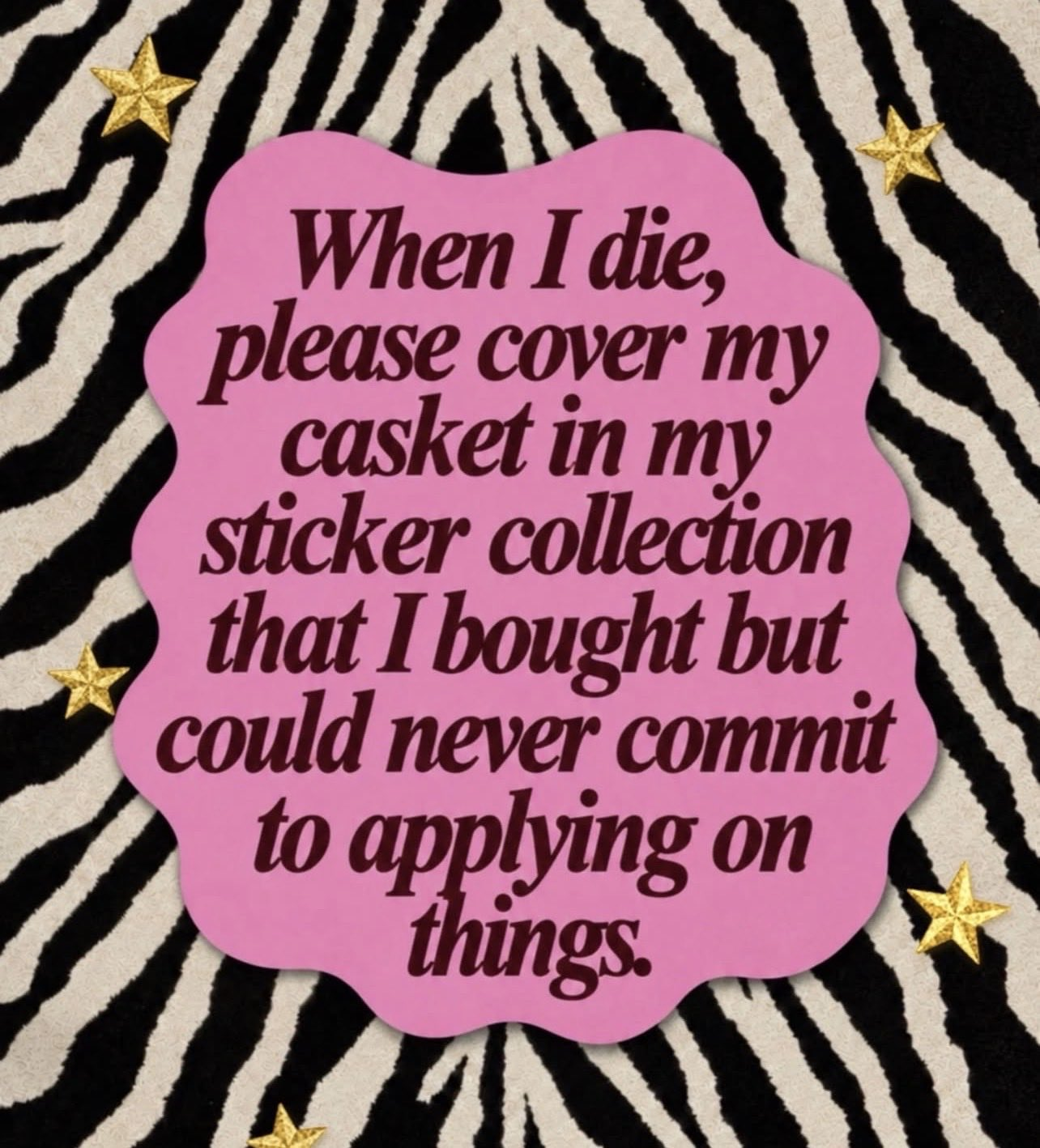
Stickers
Very relatable