Daily Log Digest – Week 25, 2026
2026-06-14
Alice and Steve
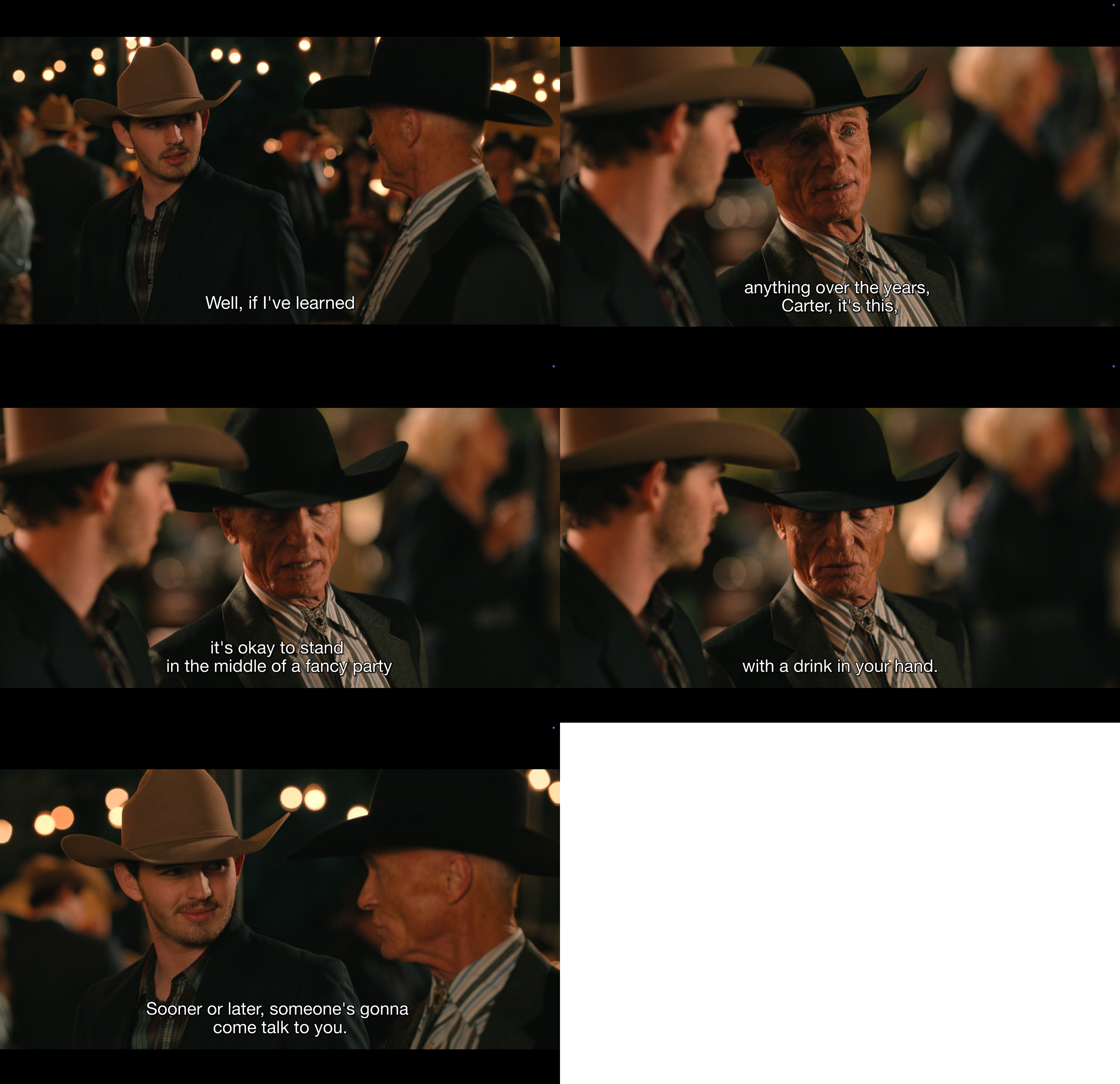
I am watching S01E04 of Alice and Steve, and it is kinda okay. But this was an interesting wisdom drop. #relationships

Linen
All linen is the same right? Then how can two linen products be priced so differently...? #clothing
This is such a great breakdown of what linen is and how the different quality linen products line up and what makes them different from each other. This is actually useful to me as I seriously consider buying some linen stuff.
Full transcript of the YouTube short below.
This shirt costs $30. This one costs $350. These sheets $90. And these are over 700. All four labels say the exact same thing, 100% linen, the same plant. So what are you actually paying for? This is episode 58 of Chasing Beauty. And today we're looking at the misleading labeling of linen.
The thing is, all linen comes from one plant, flax, which sounds like it should make linen simple. But it's the opposite. Because if every label says 100% linen, the entire difference lies in what the label doesn't tell you.
Let's start inside the stalk. A flax stem contains two kinds of fibers. Line fibers, long continuous strands that run the entire length of the flax plant up to almost a meter. And tow, the short broken scraps left over from processing. Long fibers mean fewer ends sticking out of the yarn. Fewer ends means less friction on your skin, less shedding, and less of that haystack scratchy feeling that people blame on the linen itself. That $30 shirt usually tow or worse cottonized flax deliberately chopped short to run on cheap cotton machinery. Linen demoted to imitate cotton.
But linen has a second secret where it grew. About 75 to 80% of the world's quality flax comes from one narrow coastal strip. It runs through France, Belgium, and the Netherlands. The flax belt. The climate there does something almost no other region can. It's called retting. The stalks are left lying in the field. An alternating rain and sun lets natural microbes slowly dissolve the glue binding the fiber to the stem. Weeks of patience, zero chemicals, and the long fibers come out intact and soft. Cheap flax gets the faster version. Chemical or hot water retting that's harsher on the fiber.
Then there's the spin. Premium yarn is wet spun. Fibers pass through hot water right before twisting. So the mill can spin them fine, smooth, and strong. That's shirting grade linen.
Now what about sheets? Here linen has a genuine superpower. Flax fiber is hollow and absorbent. It can take on a serious amount of moisture and release it fast. Linen adapts with the season. It's the anti-polyester. For sheets, quality has a key number. GSM, g per square meter. The sweet spot is roughly 170 to 230 gsm. Below that, the sheet can get flimsy. It will thin out at the center and tear at the seams. Trust me, this has happened to me so many times.
And what you need to watch out for is the industry's favorite scam, instant softness. Real linen comes off the loom crisp. Factories know you don't want to wait, so they bathe the fabric in cellulase enzymes, catalysts that literally eat the surface of the fiber to soften it. It ends up coming out buttery on day one. This can be called stonewashing or biopolishing. What it actually is is pre-aging your sheets. You're paying full price for fabric that has already spent half of its useful life.
So, how do you shop when the label refuses to help? GSM and pedigree. The sheets should feel substantial. Linen softness is supposed to be earned. Good linen starts crisp and gets better with every single wash for years. Brands that care will tell you where they got their linen and what the GSM is. And if those details are missing, that's your answer.
Henry David Thoreau Documentary

I saw this quote at the beginning of a 3-part documentary series on Henry David Thoreau that is highly recommended by The Economist.
First thought went to LLMs for some reason 🤷🏽♂️.
Henry David Thoreau (TV Mini Series 2026) ⭐ 7.9 #movies
2026-06-17
AI reliability
AI Builds Some Pyramids - Bloomberg
Nice quote from Matt Levine's latest.
It’s a fascinating recursive vulnerability: Modern AI relies on trusted human sources to understand the world, but humans increasingly rely on AI to understand the world. If the trusted human sources take whatever AI says at face value, then whatever AI says will just become fact. Who can dispute what both Claude and KPMG say is true?
Samurai culture and death
How to Live Fully: The Samurai Guide to Dying Every Day
The great paradox of human life is that our mortality is the fulcrum of our search for meaning — the yearning to make this brief lungful of life matter amid the breathless void of space and time — and yet we spend our lives obviating the fact that we are mortal. If we are lucky enough, if we are lucid enough, it may take us less than a lifetime to learn that to deny death is to deny life.
When Did White-Collar Work Start to Look So Bleak?
When Did White-Collar Work Start to Look So Bleak?
The historian Dylan Gottlieb, in his new book, “Yuppies: The Bankers, Lawyers, Joggers, and Gourmands Who Conquered New York” (Harvard University Press), considers his subject with an eye to this interior view. Gottlieb is no yuppie apologist, but he offers a portrait of yuppie motivations with more nuance than simple consumerism. He does so by focussing on the thing that defined yuppies more deeply than their fondness for Chardonnay or sushi: their work.
Career, for Gottlieb’s yuppies, was a life style: the ethos of hard work and competition which defined their lives on the job pervaded their leisure hours as well. Long-distance running was the most blatant case in point—a punishing feat of endurance that held out the promise of quantified individual success. Marathon-training regimens were the subject of office bonding; lunch-hour jogs supplanted a previous generation’s golf and Martinis as occasions for networking. But even pursuits that might appear more obviously indulgent—dining, say—attained gruelling rigor in yuppie hands. Eschewing rote fine dining, Gottlieb writes, the yuppie “accrued more status by consuming omnivorously” (and thus dim sum earns Tess credibility with Katharine). The Zagat restaurant guide began as the hobby of a husband-and-wife pair who’d met at Yale Law, and soon became a popular business gift—one that, in Gottlieb’s telling, affirmed giver and receiver alike as “knowing members of the meritocratic elite.”
The way people feel about work is a phenomenon larger than any one job, and it involves a sprawling world of relationships. In Hochschild’s research, which she wrote up in her 1997 book, “The Time Bind,” she notices something unexpected. People told her that they wanted more time with their families, and Amerco offered policies that were, on paper, generous. Yet few took advantage of them, and, in fact, many Amerco workers seemed to gravitate toward shouldering ever more work. Sometimes this was the result of unspoken norms that official company policies had failed to counteract: an H.R. department talking up flextime didn’t suddenly dissipate the arms-race pressure ambitious employees felt to prove their dedication through long hours. Sometimes it was a response to their families’ material needs. In either case, work had come to look like a problem and a solution simultaneously. Work was a place to see friends, to accomplish tasks, to receive recognition; it was a place that promised a sense of control, which was particularly seductive because control was so frequently lacking at home. “People wonder: Where do we feel the safest?” Hochschild writes. “Even among those with lousy jobs, the answer is sometimes ‘at work.’ ”
This sense of control is the crux of Jodi Kantor’s ode to jobs. “For many of us, work is the route to satisfaction over which we often have the most agency,” she writes. “In a healthy work setting the rules of the game have clarity: if we are hard-working, strategic, skilled, and collegial, we maximize our results.” But “many of us” and “often” are hedges that are (as they say) doing a lot of work. The workplace’s sense of control can prove illusory—as it did in the era of yuppie-wrought corporate consolidation, and as it does now for graduates entering an economy destabilized by new uncertainties.
New Yorker profile of Jürgen Habermas
Jürgen Habermas Defended Reason in a Darkening Age
You wake up and brace yourself for the barrage of toxic gibberish that constitutes the modern public sphere. Your e-mail is overrun with spam, scams, and smut. There are voice mails from no one about nothing. A glance at the news reveals that the President is continuing to spew lies and obscenities; that a trillionaire is peddling white-supremacist propaganda on a social-media platform he owns; that a chart-topping musical artist is praising Hitler, or apologizing for praising Hitler, or praising Hitler once again. Publications from the Times on down employ clickbait headlines that treat you like a starving rat in a Pavlovian experiment. A.I. systems simulate the experience of talking to an arrogant ten-year-old boy who knows far less than he thinks he does. When pressed, the chatbots admit that they cannot “naturally understand human morality, dignity, culture, or meaning.” It all adds up to a continuous discursive tinnitus—a buzz of random, fake, stupid, sinister chatter that nobody wants and nobody can stop.
None of this would have surprised a previous generation of German thinkers—the group known as the Institute for Social Research, or the Frankfurt School. The institute emerged in the nineteen-twenties, went into exile during the Nazi period, and returned to Germany after the war. Its leading figures, Max Horkheimer and Theodor W. Adorno, saw capitalist society not as the antithesis of totalitarianism but as its more affable, aw-shucks twin. Citizens become commodities; technology increases the power of an already powerful few; pop culture serves up mechanized slop; truth and lies commingle. Their default mode was apocalyptic: “The fully enlightened Earth glows under the sign of triumphant disaster.” Now, with gig workers frantically self-branding, tech barons amassing unthinkable wealth, algorithms dictating consumption, A.I. infecting reality, and Earth itself turning feverish, Horkheimer and Adorno’s worst-case scenarios begin to seem overly optimistic.
At the heart of Habermas’s omnivorous, at times contradictory, body of work is an idea as simple as it is profound: in adopting the perspectives of others, we learn to become ourselves.
Adorno assails the last topic [domination of culture] in a chapter titled “Culture Industry,” which has few rivals in the annals of élite dyspepsia. “All mass culture under monopoly is identical,” he notes. Consumers have the “freedom to choose what is always the same.” He is arguing with the absent Benjamin, who saw liberatory potential in Charlie Chaplin movies. Until recently, Adorno seemed to have lost the debate. Generations of readers rejected his snobbery, his prejudice, his tendency to write sentences such as “The same babies grin endlessly from magazines, the jazz machine endlessly pounds.” But the underlying ideas sting harder now. Adorno sees mass culture as a pivotal component of the capitalist scheme to mollify the populace with calculated compensations. It claims to be serving the public while inventing needs that the public had been happy to live without. The façade is democratic—Hollywood stars are just like us!—yet the structure is authoritarian, training us to bow down before celebrity gods. The birth of a fascist President out of the spirit of reality television could be seen as a Q.E.D. for Adorno’s thesis.
The question, of course, is what we are supposed to do with these bourgeois jeremiads against bourgeois civilization, beyond enjoying them as high-end primal-scream therapy. Members of the Frankfurt School were prey to what Habermas’s colleague Karl-Otto Apel called the “performative contradiction”: if you have used the tools of reason to dismantle reason, your own work might be compromised in turn. The Marxist theorist Georg Lukács complained that Adorno and company had taken up residence in what he called the Grand Hotel Abyss—“a beautiful hotel, equipped with every comfort, on the edge of an abyss, of nothingness, of absurdity.” Habermas wished, in a sense, to vacate the hotel and traverse the abyss outside.
Adam Tooze on Tempelhofer
Transcript: Ones and Tooze - Live From Berlin | Transcript Reader
This podcast which was filmed live in Berlin is one of my favorite Ones and Tooze episodes. I have been a long time Tooze Boy, and this is him at his electric best.
His co-host Cameron Abadi introduces Tempelhofer Feld
So I wanna shift to talking about Berlin specifically, and I have another data point there. And it is 950, as in 950 acres, which is, the size of Tempelhofer Feld, which makes it one of the largest inner city public open spaces in the world. And for our listeners who are not here in Berlin, I will briefly describe what Tempelhofer Feld is. Tempelhofer Feld is the space of the former Tempelhof Airport, which is the 1st airport in Berlin. It is now in the very center of Berlin as the city grew up around it.
Here are some excerpts from Adam's response
And if you flew from city of London, it's not small, it had a short runway. And you came in, people will have seen the footage in the post war period. You come in over the rooftops of Berlin. I think it's in Wings of Desire. Think it's in Vemde's as an aerial sequence, which I think may have been taken from around there. But yeah, I mean, I guess the next time we're all there, we should think about the gateway to Germania that we're actually rollerblading in today.
And it's the general who performed that extraordinary feat who, in the summer of '48 — when the Soviets blockade Berlin in retaliation for the decision by the British and Americans to introduce the Deutsche Mark, the unifying currency of the Western zones — is put in charge of the airlift to West Berlin.
And it's a really daunting proposition, because there are about 2,300,000 civilians plus military in Berlin at the time. They reckon they don't need 300 tons like in Stalingrad, but they need 4,500 tons a day to sustain Berlin. The average transport aircraft at the time can fly 5 to 10 tons. So that's 450 flights with the heaviest aircraft in existence at the time, a day, into Berlin — into an airport which at its peak before the war, when it was the busiest airport in the world, had had 90 flights a day into Tempelhof. So this is literally the largest aerial operation ever mounted.
And they peak at being able to deliver 12,000 tons a day on this airlift. So what that means — I did the math in the green room earlier — is that they were basically landing an aircraft every minute, 12 hours a day, for 15 months. Every minute there's an aircraft landing. So then when you imagine that in the air, this is the origin of modern air traffic control.
Managing this was the largest air traffic control feat ever pulled off. They built radar stations, they brought in massive electronic infrastructure, guidance beams — all the stuff they'd used to bomb Berlin, they were now using to actually direct the traffic in. There's this amazing advertising from one of the American bombing companies which shows them bombing German children with milk after '45, rather than with high explosives and incendiaries. And basically they stack, at any given moment, about 35 airplanes in the air en route from the British bases up by Hamburg and the American bases by Frankfurt, heading towards Berlin on an absolute conveyor belt. They land, they basically have to discharge them — it's like Ryanair. They discharge them within 45 minutes — they can do it in 45 to 50 minutes — turn the aircraft around and fly it back. And in the end they deliver 2,200,000 tons of cargo. Two thirds of that is American, the other third is British.
The British literally convert wartime bombers to do this. And the freakiest thing about it — the most mind-boggling thing about it — is that two thirds of what they're shipping is coal. It's coal. So this is like the most expensive coal in the history of the world. Why are they shipping in coal? Because it's Berlin, for heaven's sake, and you're heading into the winter, and you know what this place is like from about October — and the electricity system, which is half damaged, is running on this as well. So two thirds of these heavy loads are coal, with a little bit of milk powder added, basically to keep everyone alive.
And the British repurpose flying boats to land not at Tempelhof but on some of the waterways. Why flying boats? Because they're designed to withstand saline water, and one of the things you need to ship into a beleaguered city is salt. So they literally fill North Atlantic U-boat patrol flying boats with salt and fly them in. It's a mad, bonkers thing. It's an extraordinary thing.
It would make a great game — somebody, some video game designer out there. The distance they flew would have gotten you from the Earth to the Sun. Just linger over that for a second. In propeller airplanes, in propeller airplanes in relay, they flew from the Earth to the Sun in 18 months. I mean, can we even get there with a rocket in that kind of time? It's extraordinary. It's truly mind-boggling.
2026-06-18
Kombucha is the next tequila
If Kombucha’s the New Tequila, What’s Next for Alcohol Brands?
Logged only for the headline because Kombucha being the next Tequila is the trend I am here for.
2026-06-19
AI and hiring
Agents changed everything about hiring except the outcome
Well, hiring was probably broken, but AI didn’t change the outcome.
Instead, it made it into an arms race where candidates are sold AI tools that help them apply to companies and roles en masse in an automated way. On the other side, recruiters who have increasingly gotten tired of the same AI-generated answers, resumes, and artefacts that have been generated by AI have resorted to deploying AI systems to filter out candidates and get what they are looking for. And AI companies sit on both sides of the transaction, billing tokens while hiring outcomes come back to exactly where they were.
The tragedy is that AI companies profit from both sides of the world they’ve created. On one hand, they’ll charge people to create huge volumes of cheap, low-quality content, and then they’ll charge humans to protect them from it.
Different framing on mental illness
We call it "mental illness." We could call it "a brain doing its best in an environment it wasn't designed for." The second framing isn't a kind lie - It's simply more accurate. And it gestures toward completely different interventions.
The whole thread is worth reading.
I found this amazing report on the role of Evolutionary Psychiatry approaches: Before Evolution: The State of Mental Health
This report examines the state of mental health research, treatment, and policy across eleven sections. Its central argument is that dominant paradigms — including neuroscience, genetics, and pharmacology — have not, despite enormous investment, delivered the breakthroughs that were expected; and that evolutionary biology offers a powerful complementary framework that has been largely absent from mental health science, education, and clinical practice worldwide. Evolutionary thinking does not replace existing approaches — it provides the explanatory context within which their findings make sense, and points towards new directions for research into prevention and treatment that could be applicable across cultures and healthcare systems. Evolutionary theory has revolutionised our understanding of biology over the last century. It could do the same for the understanding and treatment of mental health.
Dutton Ranch Wisdom
Today's wisdom from Dutton Ranch S01E07
No Other Choice
No Other Choice (2025) #movies
I am only a third through the movie, but this review was hilarious and relatable at the same time.