
Your search traffic has fallen. Is it AI?
It's not (only) AI: what to check when search traffic falls
People often panic when their website's Organic traffic falls—the visits it gets from unpaid search results. If yours has fallen, you may be wondering whether AI is to blame. After all, many point the finger in that very direction.
A small share of traffic
Visits from AI tools are still a small share of traffic. In Kevin Indig's analysis of Similarweb's estimates for US websites, AI tools sent 2.85 visits for every 100 from Organic search in August 2026. So a fall in Organic traffic isn't people moving to ChatGPT.
Indig also thinks the effect of ads in Google's results and of its ranking updates is underestimated, and often put down to AI instead. He's careful to say his data doesn't prove what caused the fall he found. AI Overviews, the AI-written summaries Google shows in its results, are a separate question. Whether they're taking your clicks is one of the checks below.
Where to look
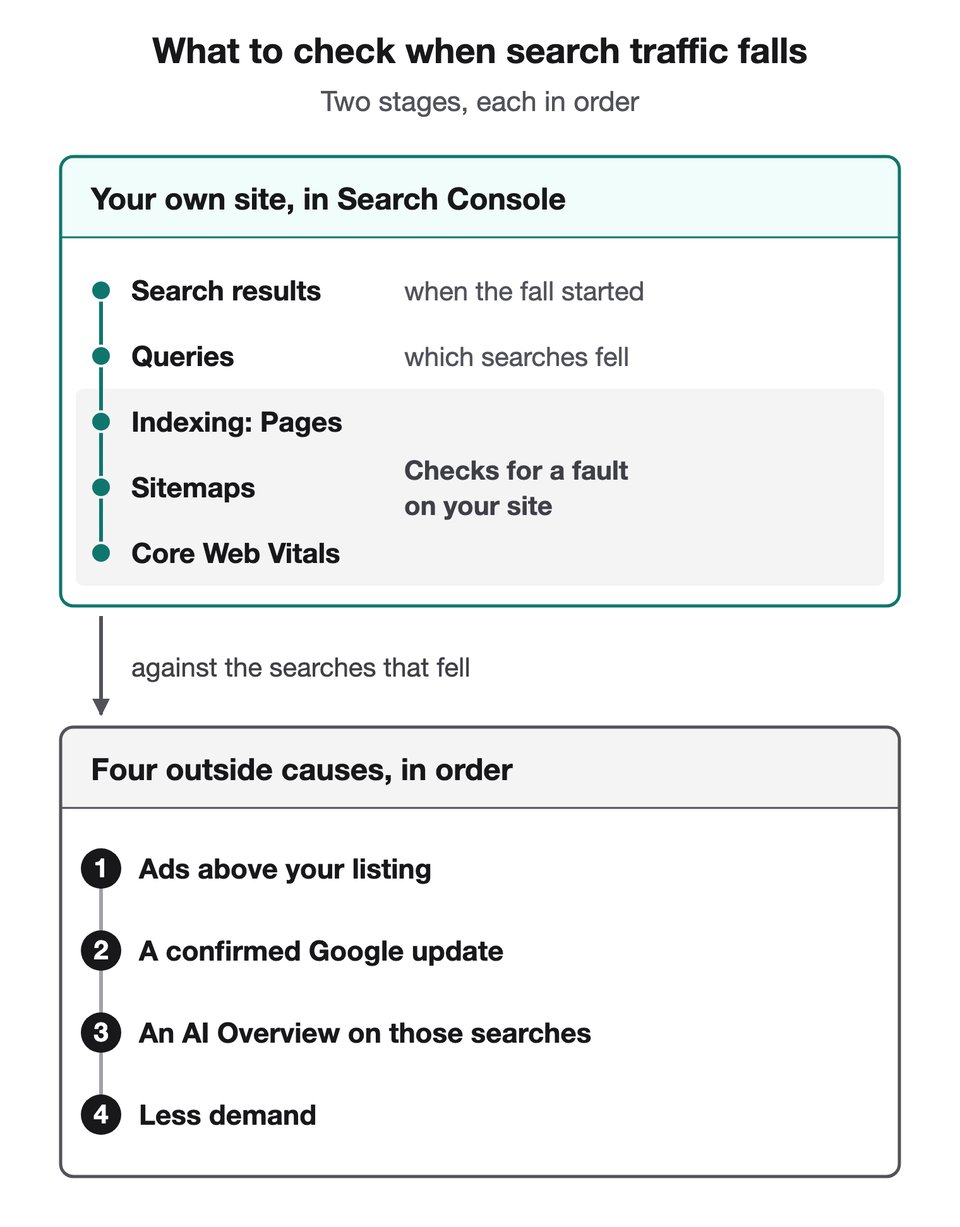
If you're faced with a drop in traffic, it's worth checking your own site, and then four outside causes, in order, before you cut your budget, rewrite content or change course.
Start with your own site
I look at the site first, in Search Console, Google's dashboard for website owners. I check five things, in this order.
- The Search results report, over the last 28 days and the last three months, to see when the fall started. Follow the clicks: Google counts them itself, so they don't depend on a rank tracker or on the tool your website uses to count visitors, as I explained in the last issue.
- Queries, to see which searches fell. Everything after this is checked against those searches.
- Indexing: Pages. It shows which of your pages Google has indexed—stored, so they can appear in its results—and which it hasn't. Why pages aren't indexed is the meat of it, and the report gives a reason for each. Not every reason is a fault: Google says 'Crawled - currently not indexed' is common and doesn't necessarily need attention. One warning sign is a drop in indexed pages without a rise in errors. Google says that can mean you're blocking Google from your own pages, with a 'noindex' tag in the page's code, a login or your robots.txt file, which tells search engines where they can't go.
- Sitemaps, which shows whether Google could read the list of pages you've given it. Google says if your site has fewer than about 500 pages and links from the home page reach every page, your site probably doesn't need a sitemap or its report. If your site is on Squarespace or Wix, Google says they probably manage your sitemap for you.
- Core Web Vitals, Google's report on how your pages perform for real visitors.
If Indexing: Pages, Sitemaps and Core Web Vitals show nothing wrong, your site could still have a fault. Google's guide to traffic drops also lists security problems and site moves, such as a new web address.
The outside causes
Now the four outside causes, in order.
1. How visible your listing is
Run each of the searches that fell as a customer would, and count what sits above the first ordinary listing, including the ads Google labels 'Sponsored'. Searches for your business's name, buying searches and research searches can look quite different. You don't need an ads account.
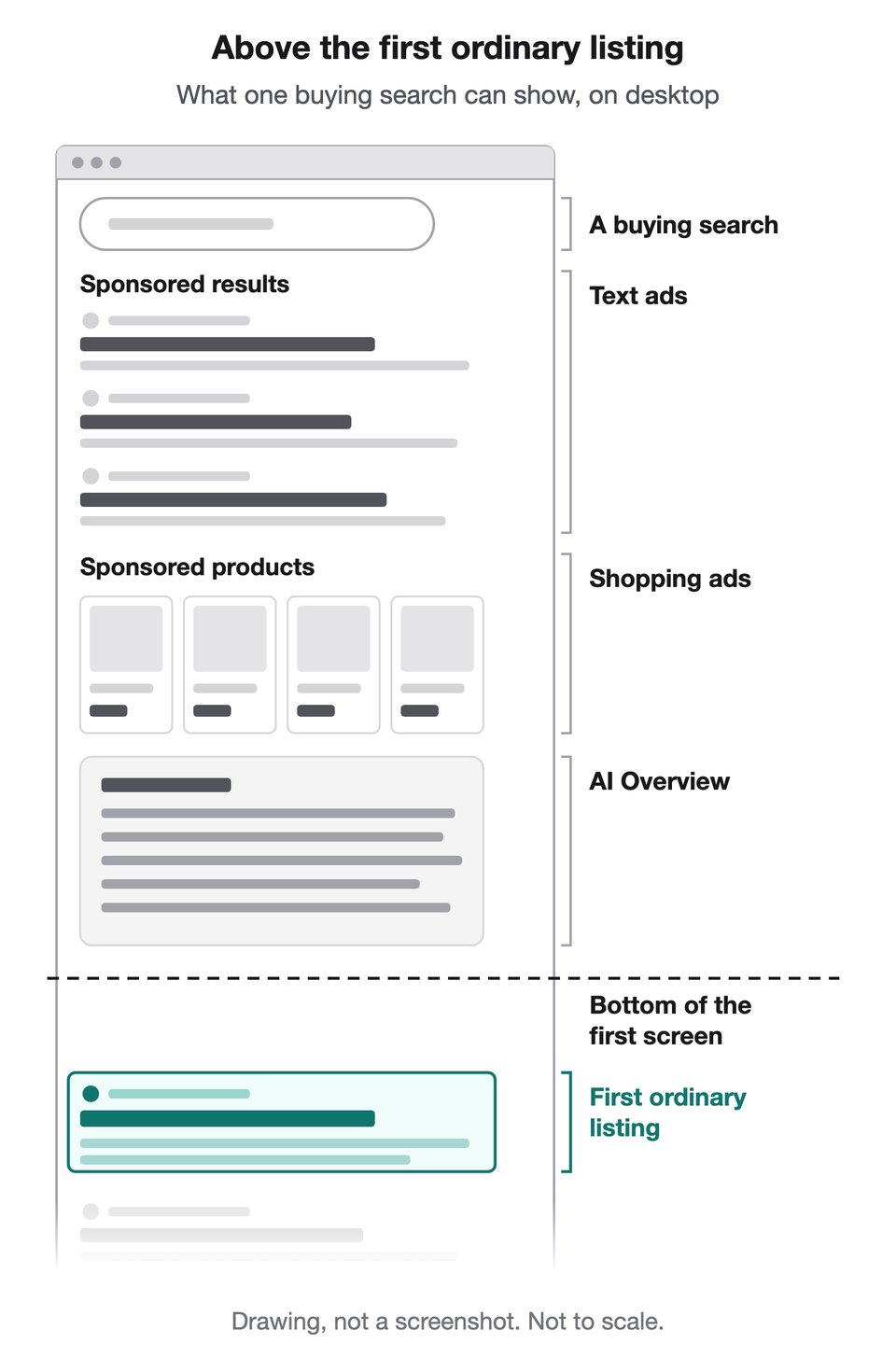
In STAT's tracking of 11,500 searches weighted towards buying ones (in one UK and one US location), the median position of the first ordinary listing on desktop moved from 590 to 1,017 pixels down the page between March and June 2026. A typical laptop screen ends at about 800.
The page can change according to where you are, your device and the time of day. So check on mobile and desktop, from where your customers are, at different times, using the 'Try without' link at the foot of the page to see results without personalisation. Don't use 'Hide sponsored results', which collapses the text ads you're counting.
2. Whether it matches a Google update
Here you need the date the fall started, from the first check in the 'your site' section. Google lists its notable ranking updates on its Search Status Dashboard. It doesn't list every change, so a fall that matches none of them isn't proof the cause is on your site.
Google's November 2026 core update, one of its broad changes to how it ranks results, started rolling out on 10 November. Google says it can take up to two weeks, so if your traffic has moved since 10 November, that's the update to check.
If the fall does match a Google update, note the update's dates beside your traffic, as in my post on August's Search Console numbers.
3. Whether an AI Overview has appeared
The only place Google shows you whether a search gets an AI Overview is the results page. As I wrote in an earlier issue, Search Console mixes clicks from AI Overviews in with all your others, and its AI report doesn't show which searches you appeared for, or any clicks.
You can check for an AI Overview at the same time as you count the ads. Don't use Google's 'Web' filter. Like 'Images' and 'News', it narrows your results: it shows only text links, so you won't see an AI Overview even when there is one.
If the searches that fell do show one, and the ads and updates don't explain the fall, that's a lead, not proof.
4. Whether fewer people are searching
Last, Google's guide to traffic drops suggests checking the searches that fell on Google Trends, to see whether the drop was only yours or across the web. Trends shows interest on a scale of 0 to 100, not numbers of searches, and searches that few people make show as 0, so a niche business may see nothing. Search Console's impressions (how often you were shown in results) aren't a reliable guide here, because they include your appearances in AI answers.
If someone else does this for you
- Search Console first. When the fall started, which searches fell and why pages aren't indexed, before anyone offers a theory.
- The four outside causes, in order. Each checked against those searches, with what was found.
- A second look after November's core update. If your fall started on or after 10 November, it's worth checking again once Google says the update has finished rolling out.
Thanks for reading
David
If you want to talk about a fall in your search traffic, please contact me at [email protected].
