
Love is the Antidote to Misogyny
During my sabbatical, I’m featuring a few adaptations from books that I believe will be interesting to readers of this newsletter. Today I’m happy to feature an excerpt from Dorothy Littell Greco's new book, For the Love of Women: Uprooting and Healing Misogyny in America.

One of the reasons misogyny* persists in our culture is that we have failed to faithfully love women. Love is then the ultimate antidote to misogyny and foundational to the work of repair and restoration.
Though every human being is created with the capacity and desire to give and receive love, we have to learn—or relearn—how to love. That’s because once we get to adulthood, our wounds, limitations, and besetting sins can pull us away from life-giving, redemptive love toward hate. It’s not an either or. We can experience feelings associated with love and hate in proximity, but we cannot orient our internal compass toward love and hate simultaneously because they pull us in the opposite direction. Scripture puts it succinctly: “A salt water spring cannot produce fresh water.” (James 3) Loving women leads to flourishing, healing, justice, beauty, and life—for everyone. Misogyny leads to languishing, sickness, injustice, ugliness, and death—for everyone.
We need a robust understanding of love as we think about how it can help diminish misogyny. In his letter to the early Corinthian Church, the Apostle Paul left us one of the most poetic, insightful renderings on love ever written. First and foremost, his description should help us to understand how God loves us. God’s love is patient, kind, humble, long-suffering, quick to forgive, and never gives up. This love is not sentimental, unpredictable, or fragile. It’s a steady, dependable love that wants the best for everyone.
Applying this to relationships between men and women, men cannot diminish, oppress, silence, control, threaten, or in any way harm women and assume they are acting under the banner of love. And women cannot dismiss or malign men, seek revenge**, nurse grudges, or use deception to get what they want. On a bad day, any of us might resort to such behaviors. When we do, it’s imperative that we quickly course correct and make amends.
If our highest calling is to love God and our neighbors and to treat others as we long to be treated, then we need to resist everything that prevents us from this goal.*** Throughout For the Love of Women, I detail many iterations of misogyny that make it difficult for women and men to love each other. For instance, because men are not encouraged to admit their limitations, emotional needs, and areas of brokenness, they may find it easier to minimize or ignore their pain or leverage it to get what they want (i.e., become abusive). This uber-masculine false self makes it difficult for them to care about women’s needs and love them sacrificially. Furthermore, because entitlement and worldly power operate as default settings in a patriarchal culture, men can become so focused on the potential losses of power and privilege they fail to recognize that by clinging to power and privilege, they actually lose something much more valuable: mutual partnerships and reciprocal love.
The harm that misogyny has done to women and the resultant fear that we carry in our bodies can make it challenging for us to fully love anyone—even ourselves. To accept and love ourselves, we will need to stop allowing others to judge us by broken, ungodly standards. We bear God’s image and no one can take that from us. Because our misogyny-shaped scars may never totally disappear, we will also need to continue stretching and massaging them (in other words, grieving and forgiving) so that they do not inhibit us from receiving and then giving God’s love. When we have a secure sense of self and are valued and protected, our capacity to love is staggeringly beautiful.
During the forty plus years that I’ve been following Jesus, it has been my experience that sometimes even though we’ve done everything that we know to do – confessing our sins, going to counseling, making amends, praying — we end up in what feels like a holding pattern, endlessly looping around the city at 10,000 feet, waiting for the control tower to let us land. We may wait for months, or years, or (like Joseph) decades before the clouds clear and breakthroughs happen.
God’s Kingdom has been interrupting and transforming pain and injustice through history. Though these breakthroughs are often infused with the supernatural, they tend not to happen via divine edict. God works through us. When slavery was outlawed, when women gained the right to vote, when apartheid fell in South Africa, committed Christians were on the front lines, praying and fighting on behalf of the oppressed.****
There’s no formula here but every time we pray, “Let your Kingdom come, let your will be done, on earth as it is in heaven,” we are joining together to proclaim, “We want justice, shalom, and love to triumph over evil and we are willing to do whatever it takes to make that happen.”
Regarding diminishing misogyny, whatever it takes is daunting. It means those with power and privilege will need to leverage that power and privilege on behalf of women who are oppressed, marginalized, and harmed. Governments and corporations will need to support and compensate women for the innumerable, essential contributions that they make and ensure that they are protected as they go about their work. And the church must recognize that God’s Kingdom will not come in all its fullness until women are treated as equals and released to walk in their gifts.
If we hope to end misogyny, we must continue to pray,
Let your Kingdom come.
Let your will be done
on earth, as it is in heaven.
And then do whatever it takes to make that happen.
###
*In the first chapter of For the Love of Women, here’s how I define misogyny: A persistent, insidious belief that men’s ideas, wants, needs, and experiences are more important than women’s and that legal, religious, and social systems, as well as intimate relationships, should uphold this principle. This belief system subsequently influences the laws, policies, practices, and ethos of a given culture.
**Revenge and justice are not the same. We can and should seek justice.
***That claim is based on the words of Jesus found in Matthew 22:27-40. “Jesus replied, “‘You must love the Lord your God with all your heart, all your soul, and all your mind.’ This is the first and greatest commandment. A second is equally important: ‘Love your neighbor as yourself.’The entire law and all the demands of the prophets are based on these two commandments.””
****Christians fighting for social justice included William Wilberforce, Harriet Tubman, Sojourner Truth, Frances Willard, and Bishop Tutu.
Dorothy Littell Greco is a photojournalist and the author of three book, including her most recent, For the Love of Women: Uprooting and Healing Misogyny in America. You can find more of her work on Substack (What’s Faith Got to Do with It?) or on Instagram.
This excerpt is from the final chapter of For the Love of Women. Copyright © 2025 by Dorothy Littell Greco. Used by permission of Zondervan-HarperCollins Publishing.
Reading
It has frequently been noticed that the surest long-term result of brainwashing is a peculiar kind of cynicism–an absolute refusal to believe in the truth of anything, no matter how well this truth may be established. In other words, the result of a consistent and total substitution of lies for factual truth is not that the lies will now be accepted as truth, and the truth be defamed as lies, but that the sense by which we take our bearings in the real world–and the category of truth vs. falsehood is among the mental means to this end–is being destroyed.
Hanna Arendt, On Lying and Politics
The View From Here
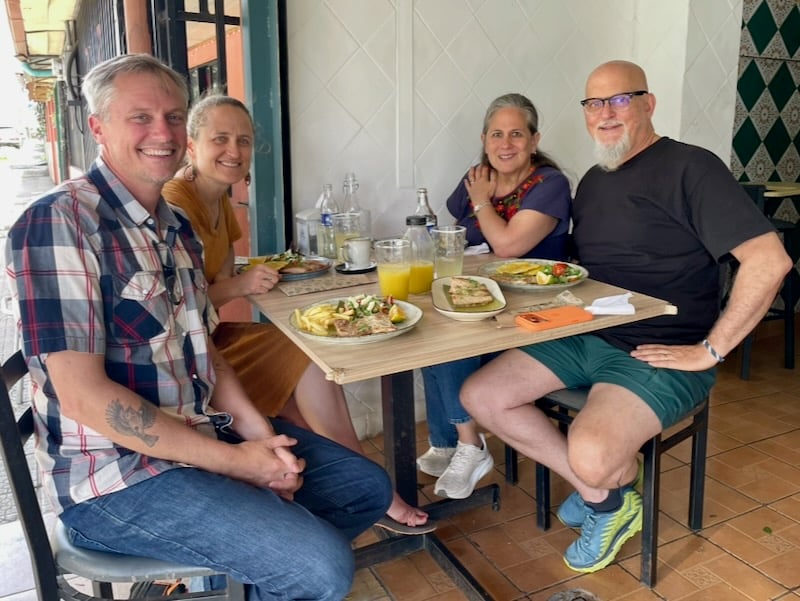


Our family returned from Costa Rica earlier this week. After a week on my own, Maggie and the boys joined me for five days at Casa Adobe (that’s Ruth and Jim Padilla De-Borst in the first picture who took us out for lunch on my birthday) before heading to a quiet town on the Pacific coast for another week: bird-watching, copious amounts of the World Cup, coffee and chocolate, beach walks, surf lessons, and more delicious meals then we can remember.


