
Sitting on a Beautiful Hill Listening to BG - #12
On hearing Russian rock legend Boris Grebenshchikov play a little show on a nice evening in the Berkshires
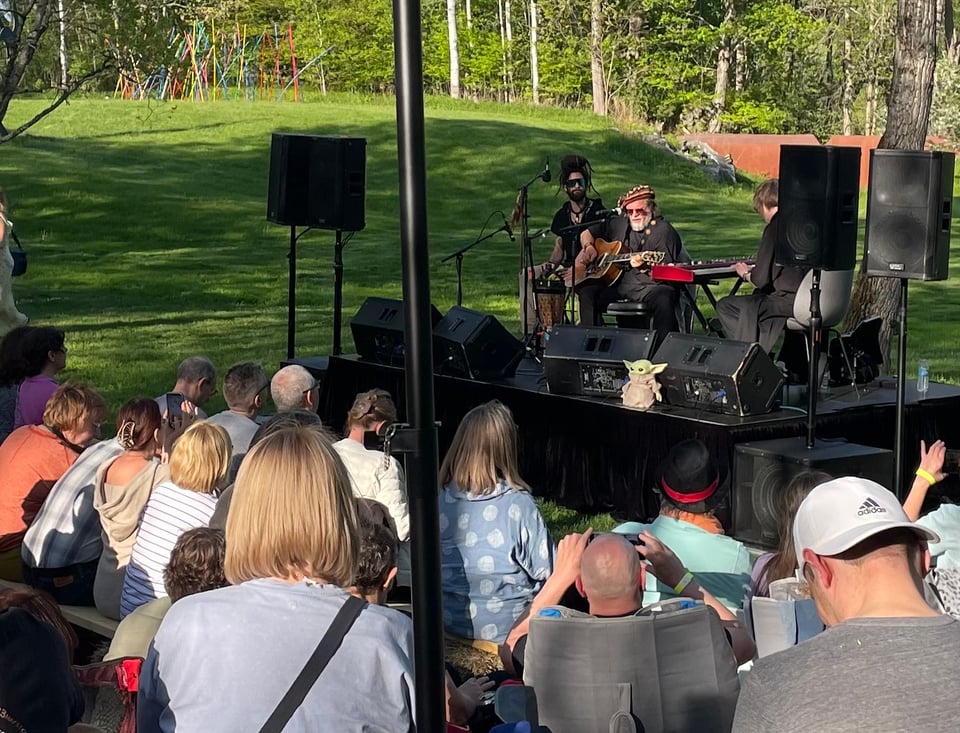
No surprise that after all these decades Boris Grebenshchikov knows how to end a show. On a recent Saturday evening performance at TurnPark Arts Space in West Stockbridge no one minded that he stuck to his newer songs since it was an audience of true believers, sitting around on simple benches or like me on a little slope around the edge. It was a perfect late spring night, after a awful Berkshire winter, and what better way to end than with the classic song “Sitting on a Beautiful Hill,” the first track on probably my favorite album he made with his iconic band Akvarium, Den Cerebra in 1984.
The song is as much of a Grebenshchikov standard as it gets — an otherworldly lyric that bounds away from the material world, and from concepts like “old folklore” and “New Wave,” to talk about fear and joy, longing and community. It goes from lullaby to New Age claptrap to love song and lands on something outside of time.
While sitting on that hill I thought about how this is the best way to see Grebenshchikov — BG to his fans — in the year 2026. He’s long attained “founding father” status in Russian rock, and with an impossible range of interests and curiosity he’s never stopped moving through some remarkable achievements and some fruitless side quests. And here he was, here he was on a little improvised stage with a guitar, accompanied by Konstantin Tumanov on keyboards and accordion and his son Gleb on bongos and tambourine. The small crowd knew him and were happy to be there, just like in the old cramped apartment show in Leningrad where he began, or any other small space that opens up to something vast.
I had written for The Berkshire Eagle a quixotic effort to introduce him to a broader audience. From the parking lot — the overflow lot down under the Turnpike overpass — to the park in an old quarry doted with sculptures, you only heard Russian. There were fans from all all points in his fifty-plus year career. For me, I gravitate toward his earliest music, like Akvarium’s first album which has a real pioneering lo-fi vibe that would have fit nicely in the 90s. But most of those first album’s have something interesting about them, through his David Bowie phase, to his woodshedding work with avant-garde provocateur Sergei Kuryokhin (on this album he frequently plays guitar with razor blades).
BG’s cultural importance comes into focus in the Glasnost/Perestroika era after 1985, when he suddenly was allowed to become a “professional” musician and a mainstream celebrity. While I was working on the article Olya and I watched BG on an episode of the Soviet music television show “Musical Ring” from 1986. The show brought out performers who would perform live and in between songs field questions from the audience — Top of the Pops meets Donahue. Many episodes are fascinating cultural artifacts — likely Komsomol members asking pointed questions about just what exactly is the social message for today’s youth in these cacophonous so-called songs, and why won’t you “artists" just admit these lyrics don’t make any sense at all? But at the same time, you also get nervous young people saying that they understand the lyrics, and it matters to them.
Olya said this is a perfect example of the spirit of the time, the kind of curiosity and earnestness that came with people suddenly emerging into the daylight. I thought it also looked a lot like a recursion to the lost spirit of the Revolution, with the breakout discussion groups and poll-taking, a friendlier callback to the febrile meeting-going and debates John Reed wrote about 70 years earlier.
In his episode, BG’s charisma and charm shine through. There’s a confidence and poise that makes it no surprise that he would soon after make a run for mainstream success in the West, during that brief moment we were interested in what was happening behind the Iron Curtain. He made an English-language album (with Dave Stewart from Eurythmics), and went on tour in the U.S. He even got on David Letterman, where he seemed legitimately bemused by questions about the music business. But to be honest, the music isn’t his best and is far less weird and interesting than what he did back home.
There’s a common analogy in the West to call BG “the Russian Bob Dylan,” and I regret that I repeated it in my Eagle article because the more I thought about it the more it doesn’t seem to fit. In an email interview, he told me that listening to the Beatles on BBC shortwave was one of his formative experiences, and in particular he felt great affection for George Harrison. That makes sense — George clearly had a similar lyrical sensibility, as well as a sincere engagement with Indian religion and philosophy. But BG doesn’t have George’s petty prickliness and cringey lack of self-awareness. I’d respectfully say BG is the Russian Paul McCartney. Both have a gift for storytelling, and the interpersonal skill to recognize and collaborate with a huge range of musical geniuses and personalities. And what’s more, over time he has found the simple joy of just singing his songs and making people happy gig after gig, year after year.
At TurnPark BG closed with one of my all-time favorite songs, the haunting whisp “Gorod.” This was featured in the hugely important Glasnost film Assa from 1987, about the girlfriend of a gangster who falls in with a bunch of hippies on an offseason visit to Yalta. Grebenshchikov came up with the soundtrack, and roped in appearances by several other Leningrad countercultural figures (the film’s ending featuring the band Kino, who BG produced, is legendary).
“Gorod” accompanies a quiet moment in the film, as two characters are taking a wordless trip on a rickety-looking gondola up and over the the gritty and otherworldly landscape below. The words describe an imaginary perfect city in the distance, with its gardens and mythical beasts (each corresponding to a Gospel avatar), and some swooning poetizing that “whoever loves is loved, whoever shines bright is holy.” In BG’s magpie fashion, the song takes a lyric from a previous generation of underground poets, Alexei Khvostenko and Anri Volokhonsky, set to something he heard on an album of Italian Renaissance lute music. The sound is like all the spheres lining up in harmony.
I’m grateful for all the legends I’ve managed to see on this earth. I got to Bob Dylan a few times. I just barely caught the Grateful Dead in 1994. I got the full Bruce Springsteen experience once, and heard some of the original Ramones blast through a set at an auto speedway. I caught Fugazi every time I could, and am grateful to have fumbled through an interview with Clint Conley from Mission of Burma on one of their reunions. I’m delighted I got to stand in a crowd Mike Watt addressed as “you good people,” and to have seen him a few weeks later play with Flipper at a bar in LA on a random weeknight. But I’ve never seen anything like the end of BG’s set, when in the midst of a round of applause more than a few people called out “Spasibo vam” — Thank you.

