How do grants and cooperative agreements affect your community?
Ever wonder how to find out what federal grant money is supporting in your community? (Or what the federal government is spending money on in general?) I'll walk you through USASpending.gov to show you how to find out.
Hi. Do you live in the U.S.? Do you want to chime in on the infamous grants docket with comments due on July 13 but suggestions about where to start haven't helped?
Here's a thought: look at the financial impact of grants and cooperative agreements where you live! At the end, I've included the paragraph that's going in my comment and my cover letter to my congressional rep.
Here's how to investigate federal grant spending where you live! Reply if you want a video version of this mini-tutorial and I'll make one!
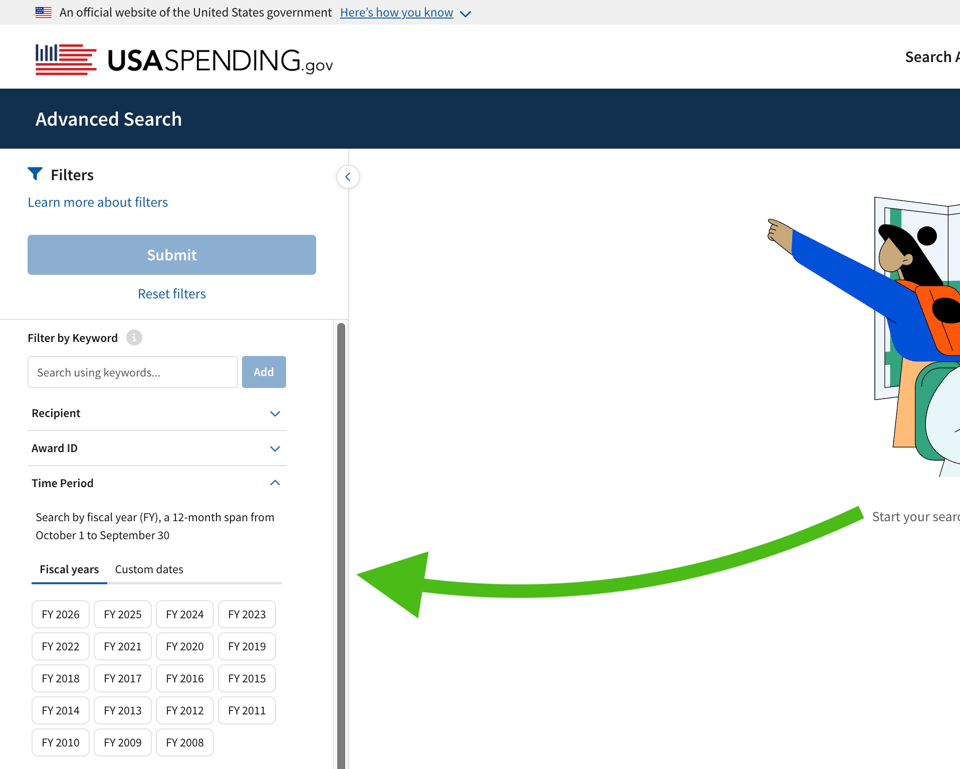
- Point your browser to USASpending.gov and its search tools: https://www.usaspending.gov/search
- You will see a lot of filters. That's what I'll use in this advice.
-
Skip down the filters until you are asked to pick a fiscal year. Since Congress is so late to the appropriations gate every year, and since agencies have to deal with that, I wanted something recent but not still emergent. So I picked FY 2022 (October 1 2021-September 30 2022). You can pick multiple years depending on the kind of information you're interested in. (You can do anything you want all the time, this is just advice!)
-
If you run into words or choices that are confusing, like "Place of Performance" versus "Recipient Location," there's a great Glossary that includes both plain language explanations and official definitions.


-
Okay, back to business. You have a lot of location options. I plan to send my comment to my House rep with a cover letter about the impacts on our district, so I picked my congressional district (NY-22, "The Fightin' 22nd!" ---Stephen Colbert, March 21, 2007). You can find your district by ZIP code (and your rep, and their contact info) at the U.S. House of Reps directory. If you just want your district, modify the url here with your ZIP at the end: https://ziplook.house.gov/htbin/findrep_house?ZIP=41413.[1]
-
You'll want to search for grants but exclude block grants and formula grants. That leaves project grants and cooperative agreements.[2]
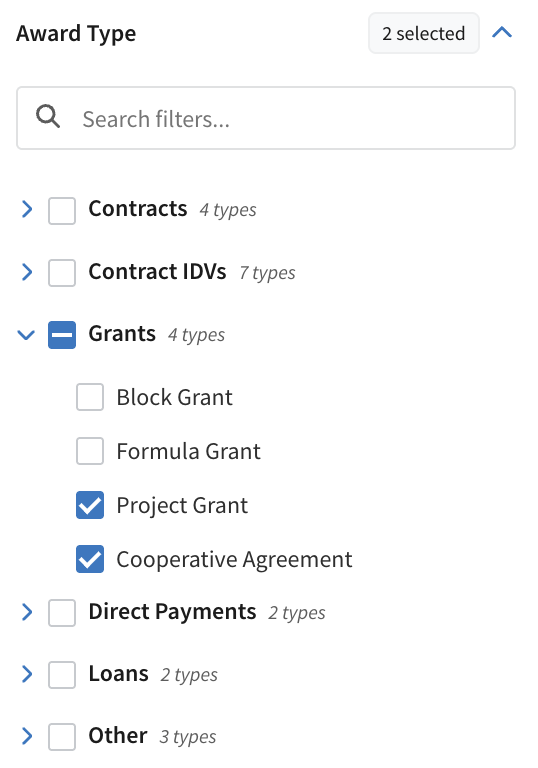
- This is enough to get you started; you can mess with other filters as you start getting a handle on the data. I discovered that FEMA is providing a ton of funding to my small town volunteer fire department and its equipment needs for the next decade as state pass-through funding. (thx FEMA!)
Here's my paragraph!
In fiscal year 2022, federal grants provided $265 million in project grants and cooperative agreements (with $21 million coming from the National Science Foundation alone) to NY-22.[a] This is a huge influx of money to a district where the median household income is $75,000; it works out to roughly $800 per household.[b] These awards support local governments, tribal entities, colleges and universities, school districts, nonprofit organizations, hospitals, community organizations, research institutes, workforce development initiatives, infrastructure projects, and public services. For a small town like mine in NY-22, receiving a modest grant from FEMA (with equally modest administrative and compliance expectations) can be the difference between a deadly fire and a fire suppressed thanks to grant-funded training and equipment.[c]
- [a] Saved Search Hash 8f85a4f40ffe52d28c7436b3ff5fb13b, USASpending.gov (retrieved June 19, 2026), https://www.usaspending.gov/search?hash=8f85a4f40ffe52d28c7436b3ff5fb13b. N.B. This figure excludes block grants and formula grants as they are not subject to the proposed changes.
- [b] Congressional District NY-22, Census Reporter (retrieved June 19, 2026), https://censusreporter.org/profiles/50000US3622-congressional-district-22-ny/.
- [c] Project Grant FAIN [redacted], USASpending.gov (retrieved June 19, 2026), https://www.usaspending.gov/award/[redacted]. N.B. The cited assistance listing falls within CFDA 97.044: ASSISTANCE TO FIREFIGHTERS GRANT.
[Excerpt:] FEMA will measure the recipient's performance of the grant by comparing the number of items, supplies, projects, and activities needed and requested in its application with the number of items, supplies, projects, and activities acquired and delivered by the end of the period of performance.
Footnotes.
[1] That's not my zip code, it's just a prime number I like. Turns out it's a ZIP code in KY's 5th Congressional District ("the fightin' fifth!" ---Stephen Colbert); condolences on your Schrödinger's Senator.
[2] Definitions (with light edits for readability) from the Glossary at USASpending.gov; the first three are official and the last is plain language because there isn't an official definition available:
Block Grant. Block grants are given primarily to general purpose governmental units in accordance with a statutory formula. Such grants can be used for a variety of activities within a broad functional area. Examples of federal block grant programs are the Omnibus Crime Control and Safe Streets Act of 1968, the Housing and Community Development Act of 1974, and the grants to states for social services under title XX of the Social Security Act.
Formula Grant. Allocations made to states (or their subdivisions) according to law or administrative regulation. These grants are awarded for continuing activities that aren't confined to a specific project.
Project Grant. Project grants provide federal funding for fixed or known periods for specific projects or the delivery of specific services or products.
More generally,
Grant. A federal financial assistance award making payment in cash or in kind for a specified purpose. The federal government is not expected to have substantial involvement with the state or local government or other recipient while the contemplated activity is being performed. The term "grant" is used broadly and may include a grant to nongovernmental recipients as well as one to a state or local government, while the term "grant-in-aid" is commonly used to refer only to a grant to a state or local government. (For a more detailed description, see the Federal Grant and Cooperative Agreement Act of 1977, 31 U.S.C. §§ 6301–6308.)
Cooperative Agreement. Like a grant, a cooperative agreement is awarded to provide assistance. It is characterized by extended involvement between recipient and agency. It requires substantial oversight by the agency, and includes reporting requirements.