
The Tenth Planet
”It’s far from being all over.”
On 22nd October 1966, the Soviet spy George Blake escaped from Wormwood Scrubs, literally during the transmission of The Tenth Planet Episode Three. This is not the kind of meaningless historical coincidence beloved of writers trying to set the scene when writing about archive television. Honest. Others involved in Blake’s escape subsequently noted that the time Blake absconded was chosen in advance exactly because it was known that a large number of prisoners and warders would be in the Scrubs’ television room, watching Doctor Who, one of the more popular series amongst the prison’s population at that time.
The episode had been recorded just three weeks earlier, on 1st October, and only a short walk from the prison at Riverside Studios. Although it’s vanishingly unlikely anyone viewing it knew any of that as Blake broke a window and made his escape. Had Blake been with his fellows on 1st? Watching, in exactly the way we can’t, the final episode of The Smugglers, the preceding story in transmission order and the last historical story to feature William Hartnell’s Doctor? Was Blake there the week after, as the Cybermen first stalked across UK television screens just before quarter past six on the 8th?
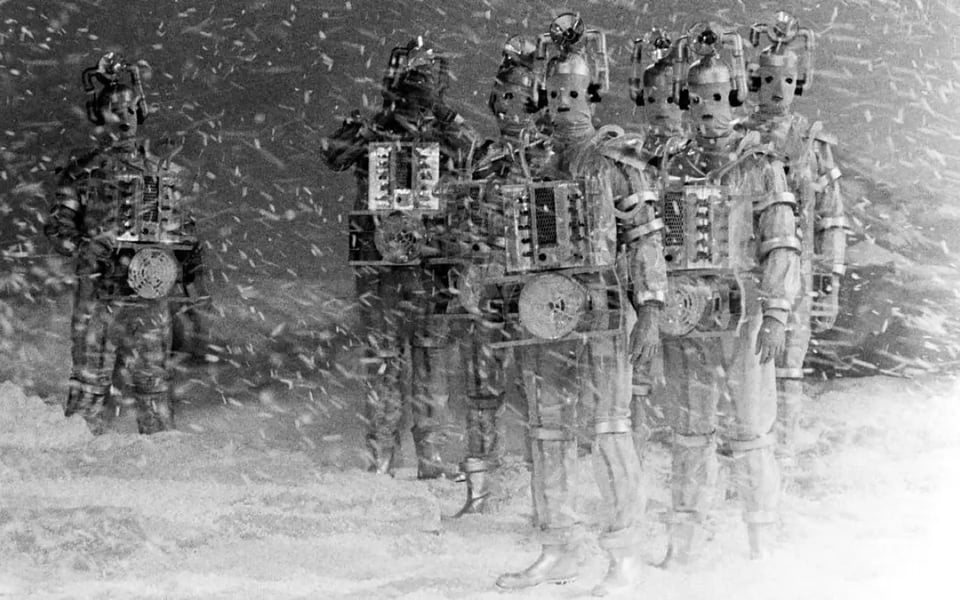
Watching The Tenth Planet now, it’s striking how long the episode holds them back. Not just in terms of how late in it they appear, but also in that when they do appear, they linger in the deep back of shot, and the audience don’t see them clearly. Not at first. They’re just three figures emerging from a blizzard, who attack and kill a member of the Antarctic Snowcap base’s crew.
When murder’s done, the camera focuses on the human right hand of one Cybermen, its fingers grasping its still-warm victim. Our view then moves up its curiously metallic arm before there’s a close up on its gap-mouthed, cloth-covered, inhuman face. Blank eyes stare directly back at the viewer. Roll credits. It’s a haunting scene. But it’s nothing compared to what the next episode’s significantly larger audience, perhaps attracted by reports of that cliffhanger, were to discover about what was behind the mask.
Once inside Snowcap, Cyberleader Krail informs its terrified inhabitants of his species’ origins. “Our life span was getting shorter, so our scientists and doctors devised spare parts for our bodies until we could be almost completely replaced.” This is not the important part. Nor is the revelation that the Cybermen have removed “...certain weaknesses. You call them emotions do you not?” What’s important is that “..we were exactly like you once.” Exactly like us. Not just humanoids. Actual humans.
Mondas, the Tenth Planet of this serial’s title, is a distorted reflection of Earth, and Krail confirms “aeons ago the planets were twins, then we drifted away from you on a journey to the edge of space. Now we have returned.” That Mondas and Earth literally mirror one another is another powerful idea. The story is saying to its audience “This could be you”. That’s why Episode One ends with a Cyberman looking directly at the viewer through their reflective television screen. The Cybermen are a manifestation of a specific fear. That humans will, through increased reliance on technology, willingly dehumanise ourselves. The Tenth Planet asks us to look in the mirror, before it’s too late.
It’s a pair of unsettling notion. Is it fatuous to wonder what the incarcerated, especially those on long sentences, thought of this idea of being trapped as your body fails due to age and disease? I worry it might be, but I find myself doing so all the same.
The Doctor is aware of the Cybermen’s origins before Krail reveals them, saying “millions of years ago there was a twin planet to Earth and…” before being cut off by the toxically masculine General Cutler. Later the Doctor taunts the Cybermen, listing emotions they don’t have, such as “Love, hate, pride, fear!” It can’t be coincidental that the people around him rattle through all four while trying to deal with their dark Mondasian reflections. The Doctor, though? Not so much. Alternatingly aloof and unconscious through this story, he treats the Cybermen’s invasion as a historical event that must be endured, rather than interfered with. He must know that Mondas will absorb too much energy and it, the Cybermen and the circular spaceships they’ve used to travel from it will all burn out in smoke and flame whatever he does.
The Cybermen costumes for this story weren’t reused when the creatures returned to the series just fourteen weeks later, being judged unsuccessful by the production team of the day. By 1982 they were being mocked on BBC television’s Did You See? to demonstrate how far Doctor Who had come. But they lingered in the minds of the original audience, including two Doctors in Peter Davision and Peter Capaldi, and over time their design came to be seen as a uniquely disturbing take on the Cybermen, one invoked in comic strips like The Good Soldier (DWM#175-178) and audios like Spare Parts (2002) before finally being returned to on television in World Enough and Time (2017). That’s entirely logical. As Cyberleader Krail observed in the Snowcap tracking room, the return home of the Cybermen from Mondas was inevitable.
I said that The Smugglers was the final Hartnell historical, and this is true in most obvious and important senses. But The Tenth Planet is a future-set story with the essential dramaturgy of a historical one. As in The Massacre or even The Gunfighters, events must be left to play out. It’s an interesting, almost unique, choice in Doctor Who and perhaps an attempt to stage both kinds of story presented in the Hartnell era at the same time as that era comes to an end. It’s also one that sits well in retrospect, given the serial’s climax, in which the Doctor undergoes a very different kind of bodily replacement process himself. A feeling of historical inexorability suits The Tenth Planet well.
And that has, curiously, led to another feeling of inevitability. The final episode of this serial is one of Doctor Who's missing episodes. Fan myth always had it that Episode 4 disappeared after having been lent to Blue Peter to take clips from it for Doctor Who’s anniversary celebrations in 1973. Although this seems to misunderstand the nature of archives, and besides this story was still being offered for overseas sale in 1974.
But this anecdote means that earlier generations of fans conceived of this episode as mislaid, rather than “systematically destroyed” (which is what we mean by the more usual euphemism of “missing”). The idea was it had been put on the wrong shelf or spirited away rather than skipped. In 1992 it was announced that the episode, reported to be the very copy that had been sent to Blue Peter, had been returned to the BBC. And I don’t mean “rumoured”. It was announced. There was rejoicing. An introduction for a VHS release of the story was even recorded by Michael Craze,1 who plays companion Ben in the story. Then the “return” turned out to be a deliberate hoax.
I had already seen the first three episodes by then, having got them from a fan friend, and on the same tape as The War Machines. But I was, of course gutted, that the story was not, as promised, now complete. The psychodrama around this episode is greater even than that around other missing episodes, and the first quarter of this new century has been replete with ludicrous “missing episode returned” rumours, many of which have starred The Tenth Planet Episode Four. There’s one doing the rounds at the moment; it’s not, however, as wild as the one that a 2013 box set of regeneration stories would secretly contain the real, secretly recovered and restored Episode Four in place of the animation that had been on the earlier DVD release.
The story remains incomplete as I type this.
There’s no mystery why this is amongst the missing episodes fans most want to see, and it’s not that it has, in Craze’s own “Gratty Plonet Mandos”, one of the greatest of all Doctor Who fluffs. Yet like that delightful fumble, the presence of Doctor Who’s first “regeneration” in The Tenth Planet wasn’t entirely intentional.
We know from Kit Pedler’s first draft that the episode's final scene wasn’t part of the serial as originally conceived. This makes it paradoxically both not integral to The Tenth Planet itself, yet absolutely integral to Doctor Who as a whole. Because it’s not just when Patrick Troughton becomes the Second Doctor: It’s also when William Hartnell becomes the First. Rather than the only. A successful transition key in confirming that Doctor Who can replace every moving part and remain the same, in the exact way that Cybermen can’t.
“In my eyes he was dying, and I’d never see him again,” remembered contemporary viewer, and later pop princess, Toyah Willcox, on BBC1’s Thirty Years in the TARDIS (1993), recalling childhood tears. Then she laughed, adding “But I think I had forgotten about him within four episodes… how fickle we are.”
We have a clip of the Doctor’s face changing, of course. It survived in that edition of Blue Peter. We have a little of the surrounding material too. But watching them is, literally and figuratively, an incomplete experience. So there’s no mystery, but there is complexity. As an audience, we don’t get to complete the journey. The First Doctor doesn’t get to complete his journey.
That’s the reason another viewer, future Doctor Who showrunner Steven Moffat, recreated and expanded sections of this episode for Twice Upon A Time, the final story for a third watcher that night, Peter Capaldi: To give the First Doctor, even if he is no longer William Hartnell, a final bow. Modern Doctor Who encourages viewers to see each Doctor’s era as a complete story or book - and someone has taken the first volume and torn out the final page.
But even that recreation isn’t enough. Neither is the episode’s soundtrack. Nor its Tele-Snaps. The splendid animation, which was of course in that 2013 box set like it was always going to be, can never quite satisfy. All of them give us the hint of an ending. But not the sense. Catharsis eludes us, exactly as it didn’t elude Toyah more than half a century ago.
In The Tenth Planet Episode 4 the Doctor dies, and Doctor Who becomes immortal. Of course we want to see that. But like George Blake, in a transit van on his way to East Germany, a country that never transmitted The Tenth Planet Episode Four, or indeed any Doctor Who at all, we’re condemned to never seeing how it all ends.
Although an alternative, in case the tape supplied turned out to be damaged or unplayable or blank, was also recorded, although in the end neither were released. Although the former, in which Craze invites you to enjoy the entire story for the first time has escaped onto the internet and has been doing to the rounds in fandom since 1995 at the latest. ↩
