
The Nightmare Begins Again
As with The Underwater Menace Episode 2 fifteen years ago, watching the newly recovered The Nightmare Begins for the first time is a strange, relapsing and remitting, experience. Because, like that later-made, earlier-found episode with which it shares very little else beyond a title sequence and font, a number of clips from it existed before it was known to exist in full. As such fans, well this fan at least, have pored over them, watching them repeatedly. Almost in the hope that one day, as if by magic, the picture and sound won’t cut out and will instead impossibly carry on until the cliffhanger. Well, today’s the day.
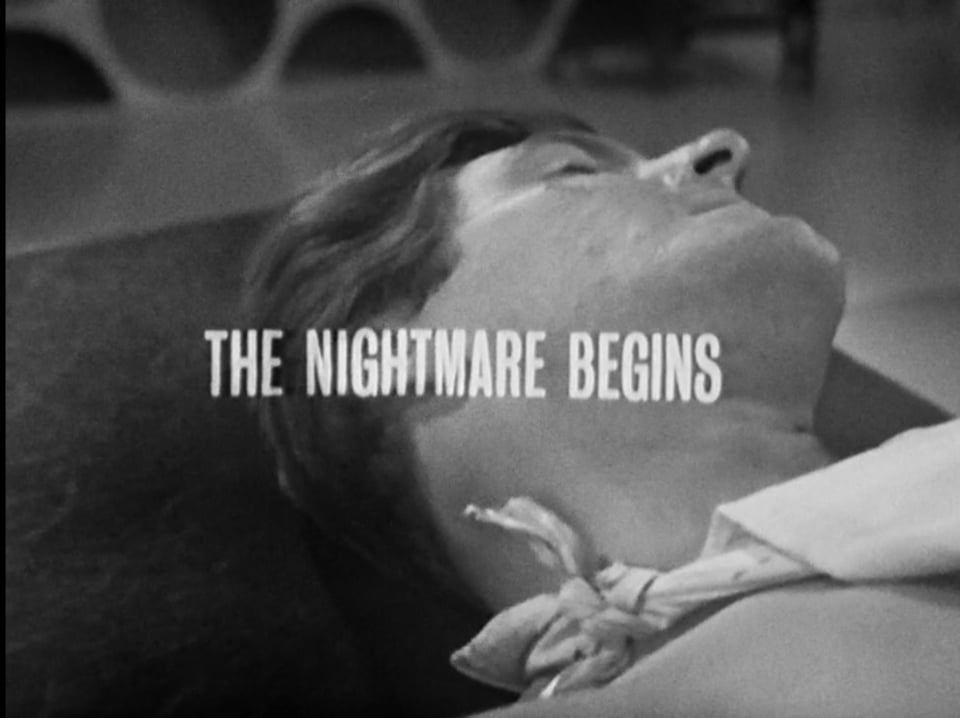
Upgrade nowIt’s a curious sensation, isn’t it? All-new visuals momentarily breaking out into the familiar before becoming all-new again. The reassertion of context over the once-excerpted. The death of Kurt Gantry (I assume his friends call him ‘studio’) is one such instance. That was included on a VHS issued in 1992. I saw it before I took my GCSEs. It’s been part of my life for longer than anyone I speak to regularly to whom not related by blood. But here it’s reshaped by being back where it belongs. Back where it should always have been. Like the episode from which it was taken and in which it once again resides at the BBC.1
In context, within-the-story this scene has far greater momentum. We know how desperate the situation is from this unhappy man’s earlier conversation with Bret Vyon, and his willingness to go to extraordinary lengths to make Bret leave him to almost certainly die. On the page, even on audio, you wonder why those are needed. Bret Vyon doesn’t seem like the sort of man who’d worry about leaving another behind if they endangered the mission. Not least because he’s quite willing to dump Doctor Who himself just one week and 50m of story time later, and explicitly on such utilitarian grounds.
But again, context. Bret Vyon is a much warmer character when you can actually see him. Not quite the Brigadier’s eighteenth pale descendent. But not as far away as we once thought. He’s no Brigade-Leader, certainly. Perhaps it’s that something of Nicholas Courtney’s own great geniality comes through onscreen, and when it does it’s hard not to suddenly mourn that Nick didn’t live to see this return himself.
There are other visuals in this episode that I (we?) had little to no idea about at all, of course. Nominal producer John Wiles didn’t pony up for the tele-snaps2 that otherwise give us what understanding we have of the look of many missing episodes during his brief reign. As such we had no evidence at all of what director Douglas Camfield brought to most of the episode. No notion of cunning Camfield-isms, such as the visual pun of the opening shot, or another example of his favoured close up of the TARDIS console, or multiple ones of his liking for close ups on flashing bulbs from which the camera pulls away to conversation. We also had no idea of quite how grim the close up of Gantry’s post extermination corpse is. No wonder the ABC in Australia refused to show it, limiting the sales to the rest of the world in the process and thus, it was always said, making it less likely that any episodes of this story would ever be returned.
Yet here we are. The Daleks’ Master Plan is five-twelfths complete. Its first, and better, half, the one Terry Nation wanted to write in the first place, has four out of six episodes extant, including the first three. That’s quite a lot of material to watch without fearing it’ll cut out at any moment. More than makes up most individual Doctor Who stories made this century. Blimey. As with the two episodes returned in the 1980s and the one returned in 2004, one of the undoubted highlights is Kevin Stoney’s performance as Mavic Chen. His strange but also casual hand movements in greeting the Daleks, somewhere between a Namaste and the Spice Girls’ Stop dance, convey an Earth culture for year 4,000 which is human-yet-alien, just as his peculiar make up and deliberately ethnically confused name do.3
But it’s not just the visual elements of a returned episode that surprise us. There’s something about watching the finished work, rather than reading a script or listening to the sound-only, that both increases one’s appreciation of some elements of the episode and brings out flaws you didn’t know were there. An example of the latter would be that, and in common with many script edited by long-lived flaneur Donald Tosh, it’s weirdly unclear why things happen in the order in which they do. Why does the Doctor dash off to look at the city when there’s a man with a gun inside the TARDIS threatening his companions?4
But this a moment of celebration, so let’s have a look at some of the former instead. Seeing this as 25m of 1960s television sharpens some associations. The casual miracle of Brett’s tablets for blood poisoning reflects that of antibiotics. More, it does so in exactly the same manner as the Time Destructor parallels the Atom bomb. These two weapons of awe-inspiring, almost supernatural, dread both incomprehensibly powered by a refined form of something dug out of the ground in secret. Both real life concepts were, as a matter of everyday fact to the layperson, only a couple of decades old. Which is to say, people had known about them for about as long as the gap between today and the last time we had a new-old episode of The Daleks’ Master Plan to watch.
Sadly, the Doctor’s forcefield chair is not, as I had always hoped, the same prop from my beloved The Space Museum. (The implication would be that he had nicked it along with the Time Space Visualiser.) But thinking about that does make me wonder if, as The Space Museum was in production when Tosh began trailing on Doctor Who, and as the chair is not in Nation’s draft only Tosh’s camera script, if the idea was imported by him from there even if the prop wasn’t.5 Which prompts the thought that either or both might be derived from the trick chair in John Ford’s 1625 play The Broken Heart. Which probably sounds ridiculous, except for that in 1962 Sir Laurence Olivier had revived the obscure-for-centuries play at the Chichester Festival Theatre, and it had been the hottest ticket in town. An honour that, this month at least, surely has to go to tomorrow’s sold-out-in-seconds screening at Riverside Studios of this episode and the two that follow it, and in the presence of Peter Purves.
It’s very hard for me to imagine anyone keen enough on Doctor Who to manage to get a ticket having the discipline to wait the thirty hours between this episode’s iplayer drop and the screening before seeing it for the first time. Maybe some do. Maybe it doesn’t matter. It’s not like many fans don’t watch episodes more than once as a matter of course.
I certainly know that for me it won’t be very long until The Nightmare Begins again again.
Yes, I know the episode that was returned wasn’t literally missing these bits. Although in the case of The Underwater Menace Episode 2 it was. See here for more details. ↩
Photographs of programmes taken off screen during a programme’s airing by a company owned by a man called John Cura. But then you know that. ↩
Stoney is not wearing ‘yellow face’, as some suggest. His on-set make up was blue, and Nation’s intention was that this ‘man of the future’ represented a human ethnic group that does not exist yet. Suggestions about the make up around Stoney’s eyes fail to take account of the fact Stoney had a strabismus in his right eye, which was noticeably lower than his left, both became more noticeable as he aged but can also be seen throughout his acting career. ↩
This is not a problem that exists in Terry Nation’s draft of the episode, where the Doctor and Vicki see the City together before Bret hijacks them. Yes, Vicki. Katarina is a later interpolation into Nation’s script. ↩
There is similarly a lot of extraneous business about airlocks later in this story, which are Tosh additions and not in Nation’s original drafts, and well, check the title of the second episode of Galaxy 4. Equally, every SF Doctor Who story after this which Tosh worked on picks up the plot element of invisibility from episode five Counter Plot. His methodology was to accrue ideas and then stick with them. See also how every historical story he script cited has the same structure. ↩
