
An Unearthly Child
“Time doesn't go round and round in circles. You can't get on and off whenever you like in the past or the future.” says Ian Chesterton.
Doctor Who laughs.
I am undeniably a sucker for ouroboros. I love a möbius strip. I would drink deeply from a Klein bottle, if only physical reality would let me. I will take anything, pretty much anything, that goes round and round and round. Not literally, of course. That wouldn’t work either, and I wouldn’t be able to take it very far. I’d end up back where I’d started. Like Bill Pullman in Lost Highway1 a film an original release quad poster for which I have installed in my study, and which looms over me now as I type. I am undeniably a sucker for ouroboros.
I like to say that I was bitten by The Life and Death of Colonel Blimp at an impressionable age. A line I also employ to explain my liking for comic book movies.2 But is it not more likely that the responsibility for this-never-far-from-the-surface enthusiasm lies instead with the scheduling of BBC Video’s Doctor Who VHS range in 1990? I think it probably does.
Old money Doctor Who ended on 6 December 1989, and in January 1990 it began again. The first video cassette release of Doctor Who after Doctor Who ended was of the first ever Doctor Who serial. It had a rather nifty cover too, one so nifty that the design’s obvious lift from the Queen album The Miracle3 released around six months before didn’t matter a jot.
Now, some of the more rigorously factual amongst you may have noticed what you think is a mistake in the paragraph above. Because according to all the best available sources, that VHS was released on 5 February 1990. That may be true. That may be a historical fact, as regards to all authority, but you could definitely buy it in January that year, and I know because I did.
In January 1990 I made my first ever trip to London, travelling with my parents and sister to spend time there with relatives. My Uncle Lennie and his wife Moria. Lennie was my grandmother’s much younger brother, only a few years older than my Dad. For much of my life, Uncle Lennie existed only as a photograph of him as a scowling seven year old at my Grandparents’ wedding, taken before that side of the family left India.
As an Indian man married to an Irishwoman, Uncle Lennie was one of several members of my extended family who added a third continent to their lived experience and went to Australia in the early 1970s, as the indignities of the Heath government, incipient Powellism and the three day week really began to pile up. Unlike many of said relatives, by 1990 they’d both come back “home” to a country where neither of them had lived anything like a majority of their lives.
I know our visit to them must have been January, because we discovered the VHSes of this story and The War Games in what I now know to the be W H Smiths opposite the Pantheon on Oxford Street; and when we did I was told I could have them for my birthday if I wanted them, and that as long I didn’t mind having nothing to open on the day, I could have them now. My birthday being where it is in the year, this must have been before February and no, my memory is not at fault here, not this time; this is not the kind of excitement you forget.
When we got the tape back to my Uncle’s, there was a general familial interest in the contents. My Mom likes Doctor Who, and my Dad and my sister will at least put up with it, so it’s agreed we’ll all watch the first episode after dinner, and so we do. Although I think it’s more as a historical artefact than as a piece of television that it interests the company.
My Uncle remembers William Russell from The Adventures of Sir Lancelot and William Hartnell from The Army Game. He’s interested that this episode was directed by a man with an Indian name, but this is 1990 and I can’t tell him much about Waris Hussein, or that his family came to the UK in circumstances not wildly disimilar to ours. I do manage to tell Waris Hussein this in 2013, and he seems interested, saying that he’s not sure he’s ever come across anyone else who did. He also hugs my wife, clearly aware how moved she is to meet him and by his status as a pioneer, amongst our own people.
In the January of 1990, the autumn of 1963 was an unfathomably long time ago. Far longer ago than 1998 is now. If you want to look up the news headlines from 1998, the archives of most major news organisation’s websites are right there. The BBC television schedules are all on genome. If you have access to Box of Broadcasts, the actual programmes are all online. But in 1990 the idea of just being able to walk into a shop and buy, take home and watch television from before you were born was unfathomably exciting. Closer to magic than science. Time travel.
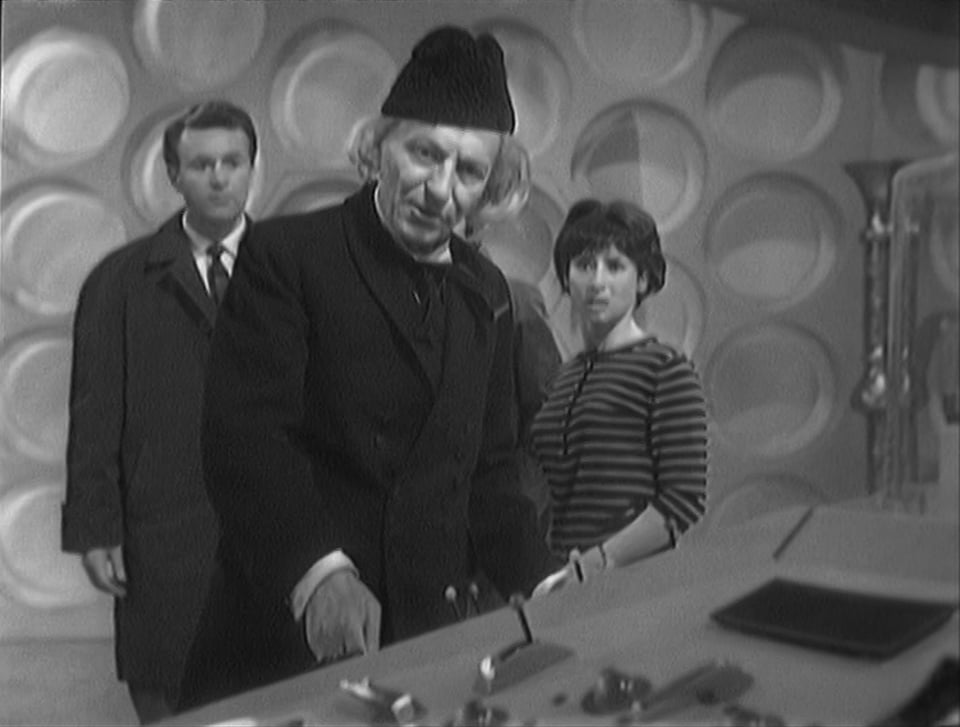
“Time doesn't go round and round in circles. You can't get on and off whenever you like in the past or the future.” says Ian Chesterton.
Doctor Who laughs.
I’m not going to pretend to you that my tween self was sufficiently prescient to feel the irony in that line. To understand that watching this episode, and in essentially the same part of the city in which it was made, on a home format unimagined when that happened, is me doing exactly what Ian says I can’t. Turning back the clock. Stepping off into the past. Including the past of some of the people in the room.
When the episode ends everyone is as impressed as they should be. It is, as you’ll surely know if you’re reading this, spellbinding stuff. A brilliant script. Four fine performances. Really innovative direction for 1963 VT drama. The point of view shots. The swirly bits onscreen as the TARDIS takes off. That somehow still startling first reveal of the interior of the ship. (Yes, ship. It doesn’t roll along on wheels, you know.)
They like it, but I don’t think they want to watch the rest of this four part story, even if they know there are another three parts on the tape, which they may not. I forget. An Unearthly Child, the episode, works admirably as a standalone. As a launch. Almost any story could follow on from it. You could probably repeat it then skip to The Dead Planet the next week, and get away with as far as the casual viewer is concerned.
While we’re staying in London, I sleep on a (comfortable) couch in the lounge due to a lack of bedrooms. An unforeseen advantage of this is that I can (and I have permission for this) watch the rest of my Doctor Who video after everyone else has gone to bed, as long as it’s not so loud I wake up anyone else in the flat. Knowing it won’t delay my bedtime by much, I rewind the tape and watch the first episode again before proceeding to Parts 2 to 4. A revisit. The first of dozens across the succeeding decades.
The three episodes of Serial A that follow on from that celebrated first, and which glory in the titles The Cave of Skulls, The Forest of Fear and The Firemaker are much less celebrated than it. But they shouldn’t be. They’re vivid, hallucinatory stuff, and done with surprising urgency. The power-struggle between the Cavemen Kal and Za seems all the more high stakes because you don’t really want either of them to win. A sort of inversion of that between Ian and the Doctor, which you don’t quite want either of them to lose.
It seems obvious now, all those years later, that the tribe are in some sense a play on a generic family like the TARDIS crew are. But instead of Grandad, Mom and Dad substitute and an ostensible child, we have a series of refractions and inversions that add to the overall family portrait. As I said, Kal and Za’s rivalry echoes the Doctor and Ian’s. The fought-over young woman with the brilliantly emblematic name “Hur”4 is more Barbara than Susan. Old Mother is Susan, the inversion of an unearthly child as an unearthly elder, but she’s also a witch figure, a counterpoint to the Doctor’s man of science. It seems appropriate that his first actively heroic action in his series is to solve her murder. Something really under appreciated about these episodes is Hartnell’s turn in this “CSI: Stone Age” subplot. He knows that Kal must have killed the Old Woman, but the people he’s with don’t think in straight lines; their thoughts relapse and remit, going round and round in circles, and they just can’t see that Kal is the only person who had means, motive and opportunity. They don’t have the concepts.
Brilliantly, the Doctor’s taunting of Kal into accidental admission is done by attacking his masculinity. He claims that Za’s knife is better than Kal’s, and Kal is so enraged he produced his own for comparison, only for the whole tribe to see it is smeared with human hair and blood. This is after we’ve had an almost poetic justification for why Za’s knife does not. “It is a bad knife, it does not show what it has done”. An argument that finds favour amongst the passionate, easily swayed tribe.
The Doctor’s response is the first sign of the adaptive cleverness that’s so important to the Doctor’s character to this day. Improvising his way out of a seemingly hopeless situation though tricks and cunning, keeping a constantly evolving plan secret until he needs not to. “Follow my example!” he stage whispers to Ian when he needs his help to initiate the actual banishing of Kal for the murder everyone now knows he’s committed.
(It is probably also worth acknowledging that screenwriter Anthony Coburn was a deeply religious man, and that there are obvious Biblical parallels here. The first Doctor Who story involving a kind of “first murder” motivated by jealousy, and a banishing. Just as it’s surely the case that the “fire” over which they fight is as much “nuclear” as it’s not. We’ll be getting a more literal representation of that and its after effects on Skaro next week. But both of these two stories are, like much of 1960s drama, fundamentally about the arms race.)
What’s very different from much, indeed almost all, later Doctor Who, is that the Doctor’s helpfulness in resolving the tribe’s problems (banishing the traitor, helping Ian restore their ability to make fire) is in no way appreciated. You expect, in Doctor Who and in the kind of drama it is more generally, for the regular characters to find allies amongst the guest cast, and unite with them against a common foe. Instead, after a version of that, the tribe imprison and turn on them again, and they have to flee for their lives. This is proto Doctor Who as well as prehistoric Doctor Who.5
But is it? Prehistoric Doctor Who, I mean? Yes, we know that’s what the production team thought when they made it. But onscreen? Onscreen these primitive humans, scratching round in the dirt, trying to re-discover fire could as easily be residents of a post nuclear age as a pre neolithic one, and that’s a very 1960s idea. It’s one of the themes of John Brunner’s Some Lapse of Time, two years away from being adapted as an episode of Doctor Who’s first real sister show Out of the Unknown. It would not be out of keeping with the era in which The Forest of Fear was made for the TARDIS to dematerialise in the final scene, revealing that behind it all the time has been some landmark indicating that this blasted heath is not the past, but the future, of Ian and Barbara’s civilisation.
If we’re being pedantic, I don’t think television Doctor Who ever rules it out. We’re told in The Brink of Disaster that the next place TARDIS visits, Skaro, was “in the future” but we’re not absolutely told that the Tribe of Gum lived in the past6 and Skaro was in the past for me. The Daleks, of course, had been released a few months before An Unearthly Child, and despite the chopping off of the caption saying “Next Episode: The Dead Planet” the cliffhanger into an episode I have already seen is essentially intact. Another circle made complete.

In 2025 I have lived in London most of my life. The most recent Doctor Who story made and transmitted also features Carole Ann Ford. The W H Smiths opposite the Pantheon on Oxford Street has long since been demolished, and you wouldn’t be able to buy a physical copy of An Unearthly Child in it even if it hadn’t been. For reasons. My Uncle Lennie is long dead. The last time I saw him was at my Grandfather’s funeral. The first thing he said to me was “How’s Doctor Who?” That picture of him at my Grandparents’ wedding is on the mantlepiece on the other side of this room from my Lost Highway poster. Opposite a bookcase where the VHS purchased that week in 1990 is precariously balanced. He’s seven years old and when I look at it now, his scandalised expression makes him look like my son.
“Time doesn't go round and round in circles. You can't get on and off whenever you like in the past or the future.” says Ian Chesterton.
Doctor Who laughs.

“I didn't see that one, Ted.”
“Not many people did, Dougal. It's probably a bad reference.” ↩
Yes it is. ↩
Not an album I’ve ever owned or knowingly heard, although looking at the track list on the internet now, I know a surprising amount of it. Presumably there were a lot of singles, or albums got a lot of radio play. ↩
My wife and I once accidentally improvised a music hall routine about this character, when we saw Althea Charlton in an episode of Thriller. “Who’s she?” “She’s Hur.” “I know that, but who is she?” “Hur!” “Yes, her. I want to know she is.” “I told you she’s Hur.” “Yes, but who is she?” etc. ↩
(Although the serial features Doctor Who’s first capture-and-escape loop is another demonstration of just how much of the show we were watching a new episode of last week is already onscreen in its first month.) ↩
The author of The Daleks, Terry Nation, would probably approve. He uses the idea in Terminal, his last, best episode of his own Blake’s 7 in 1979. ↩
