
“Serial B”
“Well if I had money I'd tell you what I'd do. I’d go downtown buy a Mercury or two.”
It’s an almost perfect irony that I should walk into a video rental shop and see that a VHS of Doctor Who’s second serial had been released and I didn’t know about it, when twentieth century Doctor Who was only two serials from its end, and I didn’t know about that either. If it hadn’t happened to me, I might think I’d made it up. But even I wouldn’t go so far as to dictate that I write about it now, at a point where public statements from Doctor Who’s current executive producer are inducing even-greater-than-usual fan anxiety that the series may not be back anytime soon after the current run ends in May.
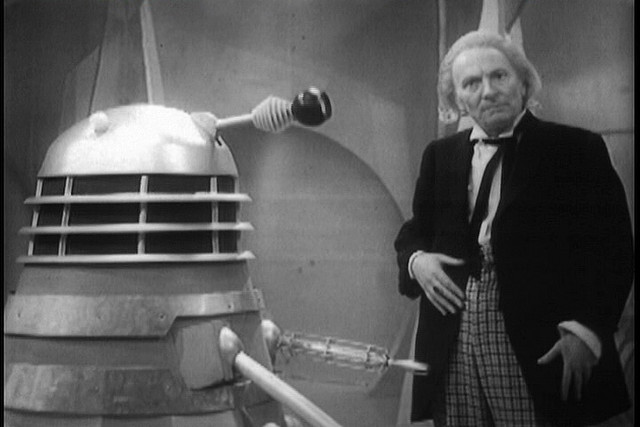
Were there Doctor Who fans in 1963? As an identity, I mean. I think we can call it that? We’ve long used the word “community” around fandom after all. There were certainly involved viewers. There were multiple people who were audio taping the series for their own libraries just weeks in, and others who were making extensive notes. Fans but not yet fandom. Which is also the position 11 year old me is in as he pays his 75p to rent the first of the two tapes that compromised the VHS release called The Daleks, itself given the subtitle The Dead Planet, itself the title of the serial’s first episode.
Fans squabble a bit about the titles of these stories. We always have. We’ve called it The Daleks, because of the book, the film, and it being the first appearance of the eponymous (or not) creatures. We’ve called it The Dead Planet because that’s the title of the first episode, and that’s what the Radio Times 10th Anniversary Special took to be the title of each of the first twenty five Doctor Who stories which, unlike the next 125 or so, don’t have a single onscreen overarching title at all.
The truth is, these stories don’t have overall titles, anymore than (most) of the two and three part stories of post 2005 Doctor Who do. They have individual episode titles and a serial code. Any attempt to regularise them always falls down on there not being a single consistent set of criteria you can use for all of them. You always have to pick and choose, mix and match and make do. There’s always going to be some subjectivity.
Which means that it’s always mystified me when some people insist on calling this story The Mutants because of some paperwork. despite that being needlessly confusing due to there being another Doctor Who story called that, directed by the same person and with a score by the same composer, produced nine years later in the spring and summer of 1972. That makes it surprisingly hard to distinguish them in casual conversation.
It’s like insisting on calling the sole 1990s Doctor Who television story Doctor Who. Or the 2009 Star Trek film Star Trek. It may be pedantically accurate by some lights. But it’s not terrible useful. It’s not like anyone insists on referring to The First part of the Contention betwixt the two famous Houses of Yorke and Lancaster, with the death of the good Duke Humphrey when Henry VI Part Two is right there. (Yes, Part Two. These things are complicated. If not complex.)
The director of both The Mutants and the story sometimes called that was Christopher Barry, and the latter wasn’t merely the first Dalek story, it was the first Doctor Who story set on another planet, and the first featuring alien creatures of any kind. Barry introduced not just the Daleks specifically, but a whole strand of Doctor Who generally. In doing so, he established things that still influenced Doctor Who as I BMXed home with that tape. (It was the eighties.) They still influence Doctor Who today, and continue to do so forever; or at least the next two months. Whichever is longer.
That’s something no one could have anticipated in 1963. When The Dead Planet (the episode) was first recorded on 15th November 1963, Doctor Who had not yet been on television. Cast and crew were working in a vacuum, with no idea how it might be received. While Serial B exists in its entirety, we can’t see the work they did that night. The Dead Planet needed recording twice, because studio chatter had been picked up on mic, making the episode untransmittable.
A remount was scheduled for 6th December, taking studio time allocated to the fourth episode. The recording of the second, The Survivors, went ahead next week as planned. We don’t know how much Barry changed in remounting. Certainly something. The cliffhanger reprise on The Survivors, the only bit of the original extant, is strikingly different to the final moments of the remount, even though both feature Barbara cowering as a soon-to-be-familiar sucker looms into view. (We also know designer Raymond Cusick took the opportunity to improve the Dalek city model needed for the episode, both because he said so, but also because photographs of the earlier model exist.)

The transmitted The Dead Planet begins with a moment of directorial cleverness; the camera moves through the petrified jungle of Skaro presented, for a few moments, in negative; dark areas of the picture flaring brilliant white. In 1963 the A-bombings of Hiroshima and Nagasaki were less than twenty years before. The UK had tested its own first fusion device as recently as 1957. Everyone watching would have understood this nod to the flash point of a nuclear explosion. It’s pure visual storytelling. Long before the characters intuit it from their surroundings, the audience understood why this is a dead planet - and this was still true in 1989.
The Survivors is remarkable television. Better, in my view, than the more celebrated The Dead Planet, and I’ve felt that way since that first VHS viewing. Yes, it’s a good script. Yes, the Daleks are a brilliant design. Yes, their voices are extraordinary, but it’s the episode’s camerawork which assures its success. It might be a consequence of the cramped conditions of Doctor Who’s studio, tiny Lime Grove D, but if so it’s the director turning restrictions to advantages.
He cuts from tight shot to tight shot, the city’s Dalek-sized doors and narrow corridors rarely fully on-screen. This is also true of the Daleks themselves, their suckers pushing into frame from outside, echoing that cliffhanger from a week before. Barry’s cameras lour, scuttling around the Daleks’ midsections, lending these short, squat boxes stature, letting them loom over the viewer. There are the endless close ups of the cast’s sweaty faces.
These things combine to imbue the episode with a claustrophobia in keeping with our heroes’ objective: to get out. The regulars’ performances, a canny combination of weariness and mortal terror, convey reality. The episode as a whole is, if you’ll forgive the pun on its producer’s name, almost verite, in form if not in content. It’s as if the cameras just happen to be catching something that’s really happening. Such matter of fact presentation of the unknown was, and is, key to Doctor Who’s success.
Barry’s other commitments meant the serial’s third, sixth and seventh episodes were directed by Richard Martin. That slightly unintuitive division of labour doesn’t quite mean that the two 1989 cassettes are split by director, but it does partially explain, at least to me, why the second tape, which I rented a week later, was so much lesser in my view. So much less entertaining.
Chris Barry was beloved of earlier generations of Doctor Who fans, the list of serials he directed being seen as speaking for itself. (They include Patrick Troughton's debut The Power of the Daleks (1966) the widely loved The Daemons (1971) and Tom Baker’s debut Robot (1974/5).) In later years, anecdotes about his curmudgeonly attitude to Doctor Who and occasionally expressed desire not to be associated with it, and resistance to being rota-ed onto it1 as well fandom facing up to some frankly shoddy work on the likes of The Brain of Morbius (1976) and The Creature from the Pit (1979) have probably lessened that love.
But in Doctor Who’s earliest days, his work is fascinating, and the splitting of this story between him and the talented, ambitious but also periodically lackadaisical and slapdash Martin offers a genuine opportunity to stress test the idea that anyone could have directed this story as well, because some weeks all those decades ago, someone else was trying to do exactly that.
Comparing this story’s two directors’ styles is instructive. Martin’s is less urgent, more flamboyant than Barry’s. His episodes are less edgy, less claustrophobic, and it feels as much a choice as a natural consequence of the material he’s given to shoot. Nevertheless he doesn’t second guess Barry’s way of shooting Daleks. That’s equally true of most later Dalek directors, with Barry’s approach clearly an influence, albeit perhaps a second or even third hand one, right up to Eve of the Daleks (2022) and even Destination: Skaro (2023).

The fourth episode (Barry’s) has two stand out sequences. The first is the titular ambush, with its ratcheting dread as Temmosus delivers his speech of reconciliation, only for Barry to cut to the briefest close up of a Dalek, its gunstick twitching in excitement and anticipation of the murder it’s about to commit. The other is, appropriately, the Doctor’s delighted exploration of the texts of Skaroine history, the first appearance of several of Hartnell’s more charming performance tics, and a broadening of the character’s emotional palette, something else key to the series’ continuation - and at almost every stage of its life.
The highlight of the back half of the story is an early scene in Barry’s The Expedition where Daleks suffer from exposure to anti-radiation drugs. Featuring more tight close-ups, and rotating kaleidoscoping images, it’s Doctor Who’s earliest tilt at surrealism, something of which there’s more later in the episode, when a curious maelstrom opens up as the Thal Elyon fetches water from a lake. Barry’s last shot in this story is, like the cliffhanger of its first episode, Barbara looking offscreen in horror at something we can’t see. Claustrophobia has been succeeded by the perhaps greater terror of a wide and literally alien unknown.

The story tails away a little after that. Is it that the material there is weaker than in the early episodes? I certainly think it is weaker. But there’s maybe an argument that director Barry’s contribution is as much what makes those episodes better, as the scripts offering more that’s interesting and new.
It’s the earlier episodes of this serial that the film adaption concentrates on. More than 50m of its running time of 80m is devoted to material from the first four instalments, even allowing for the 7m opening that constitutes a sort of speed run parody of An Unearthly Child (the episode, not the story). Even sixty years ago, and less than 18 months after the serial was made, the people remaking it knew what worked in it, and adjusted its timescale accordingly. Even though the latter part of the story - Ian and Barbara and the Thals crossing a mountain range - is more cinematic.2
When began production on this story began Doctor Who itself was an unknown quantity. But with its last four episodes all seen around 10m viewers, by the time it finished transmission Doctor Who had firmly established itself, and when it finally came out on VHS, having never been repeated and in many ways supplanted by its incarnations from other media, Doctor Who was itself facing the great unknown.
Like I said, me watching it when I did was an almost perfect irony. I can’t say I’m exactly thrilled that me watching and writing about it now, it seems, takes even closer to that place of perfection.
Barry was, for almost his entire career, a BBC staff director, and often had little control over which series he was given to direct. ↩
It would be unfair to say that the film’s director Gordon Flemyng stages these sequences better than Martin, he does but he had vastly greater resources and time at his disposal, even on a cheap film. ↩
