
The Last Battle
We live in a new liminal time for Doctor Who. Curiously both like and unlike the period we’re covering in the The Long Way Round section of this newsletter, namely the early 1990s of Doctor Who’s “wilderness years” or “interregnum” or “hiatus”. The time when the Last Great Time War, that grand metaphor for the time when Doctor Who was not allowed to be, was being fought off-screen.
It’s an odd time to find yourself heading to an event to celebrate Battlefield, the opener of the final series of old money (pre-war?) Doctor Who. But it wasn’t one I wanted to miss. While I am not blind to the story’s flaws, I adore it, and there were going to be guests whom I’d never seen speak about the show, as well as good value old favourites like Andrew Cartmel, Sophie Aldred and Sylvester McCoy.
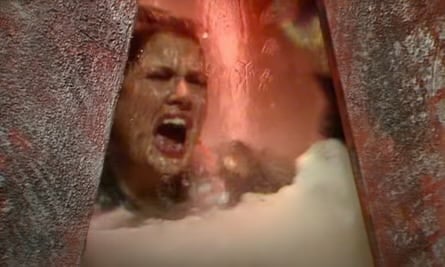
Upgrade nowOne of the new guests was Assistant Floor Manager Matthew Purves (yes, son of Peter), who was interviewed in the interval / half-time break between Parts Three and Four. Naturally, and not entirely because we’d all just seen it, conversation turned to the famous on-set accident in which Sophie Aldred was trapped in a tank full of water which subsequently broke, flooding the studio. Purves, who was on set that day, and one of the people who pulled Aldred from the tank, talked about the incident in a bit more depth and detail than I’ve ever heard anyone do so before. Or rather he talked about the aftermath of the incident in more detail.
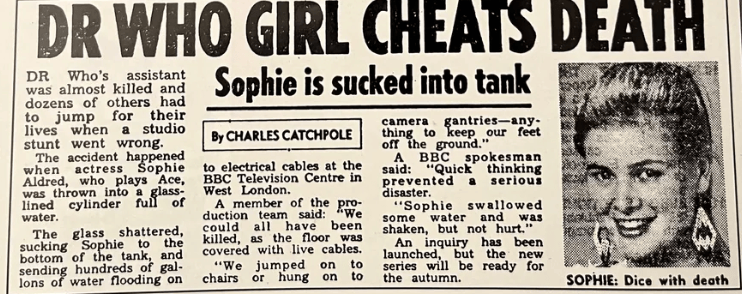
For the incident itself, Aldred and McCoy have spoken about the moment they realised something was going wrong on and off since 1989, and Sophie has noted that she had a delayed trauma response decades later when watching something similar happen to a character in Christopher Nolan’s film of Christopher Priest’s novel The Prestige (2006). Back in 1989 the News of the World ‘newspaper’1 ran an expose on the incident about a fortnight after it happened under the title Dr Who Girl Cheats Death -
"Dr Who's assistant was almost killed and dozens of others had to jump for their lives when a studio stunt went wrong. The accident happened when actress Sophie Aldred, who plays Ace, was thrown into a glass-lined cylinder full of water. The glass shattered, sucking Sophie to the bottom of the tank, and sending hundreds of gallons of water flooding onto electrical cables at the BBC Television Centre in West London. A member of the production team said: ‘We could all have been killed, as the floor was covered with live cables. We jumped onto chairs or hung onto camera gantries- anything to keep our feet off the ground.'2
Now, that quote could easily be the kind of, let’s make no pretence, completely made up one standard in showbiz reporting in the kind of publication the NotW was by the end of the 1980s, and maybe it is. But it’s true that the floor of a Television Studio is covered with live electrical cables, and that water and electricity do not mix. What was striking about Matthew Purves’ discussion of this incident is that an Assistant Floor Manager of that era would work across a huge variety of series. Purves wasn’t permanent on Doctor Who, he was general BBC staff; and Purves remembered specifically that the water tank incident took out TC3 for somewhere between several weeks and a couple of months; and that it required comprehensive rewiring and safety testing at enormous cost.
Everything that had been booked into TC3 or assumed to be heading there had to be rescheduled. With one of the bigger studios out of action at no notice3 this was a major organisational headache for the BBC out of nowhere, impacting shows the corporation cared a lot more about than Doctor Who, such as (at least in Purves’ memory) Only Fools and Horses.
In the same Q&A, and in response to a very different question, script editor Andrew Cartmel said, as he often has before, that the first inkling he got that Doctor Who may not be coming back was when producer John Nathan-Turner asked him to write the valedictory speech which Sylvester McCoy reads over the final shot of Survival Part Three. Common memory has this as occurring later in 1989, not least because McCoy recorded that voiceover on 23rd November 1989, Doctor Who’s twenty sixth birthday, and we now know that the formal decision that there would not be new series of Doctor Who in the 1990/91 or 1991/92 financial years was made on 13th October. (We have the memo.)
But the raw take of the same scene has McCoy saying a version of Cartmel’s revised speech, which replaced earlier scripted dialogue by the serial’s writer Rona Munro, on location. The re-recording was to improve the sound, not change what McCoy said, and the scene was recorded on 15th June. The rehearsal script, issued for 8th June, still has the original ending. So Cartmel’s changes were made at some point in early June, and the Battlefield water tank incident was 1st June.
Chatting with some other fans (including some of you reading this, hi guys!) immediately post that Q&A, that did not seem, to us, like a coincidence. More a confluence. If you’ll forgive the perhaps slightly tasteless water metaphor.
We’ve had cause in the past to look at the review of Doctor Who’s cost initiated by BBC One Controller Jonathan Powell that summer, the one that reported on 19th July that Doctor Who’s budget, revised by management several tiers above the actual production team when it cancelled and then uncanceled it in 1985, was actually insufficient even according to the BBC’s own assumptions; that mistakes had been made in 1985 and that £127,500.00 an episode could not be successfully amortised over fewer than 20 episodes, while Doctor Who had only been making fourteen.
So let’s put all this together: on 1st June Doctor Who causes a major incident at TC3 which costs the BBC considerable time, money and manpower to resolve. It’s a programme which is disliked, produced by a man the Controller of BBC1 holds in contempt. (Powell told JNT’s biographer Richard Marson on the record and in a remark of astonishing candour that he often hoped JNT would “fuck off.. and die, really”.) By 15th at the latest, said producer thinks his show is likely over, despite having - in March - extended the contracts of his two leading actors in the expectation that there would be a 1990 series.
Is this famous incident, hiding in plain sight for decades, the precipitating event of Doctor Who’s cancellation? On the one hand, it might seem reasonable. It could be framed as a dangerous act of costly incompetence on Nathan-Turner’s part. A programme that was only made on sufferance causing problems for things Powell’s BBC One wanted to show. But for the revelation a few weeks later that Doctor Who was seriously under budgeted, through no fault of anyone working directly on it. That’s a failure that could implicate the wider BBC Drama department at the very least.
A failure that had already been in the papers.
I’m not saying it was a deliberate cover up, as such, or anything like that, but any manager in a large media organisation is going to have had all these thoughts once they had all these facts in front of them, and I say that with the confidence of someone who has been one.
I think that it’s possible, even likely, that the Battlefield water tank incident started the chain of events that stopped there being an, even grudgingly sneaked out, 1990 series of Doctor Who. It dragged the series to the top of Powell’s agenda for the first time in years, and the moment it was there there was scrutiny under which the continuation of Doctor Who became incrementally impossible, as ways to bring it back in short order as a BBC production, as a co-production and an international production were slowly ruled out, even as Powell made fairly overt moves to finally make Nathan-Turner redundant.
What do you think?
It is mad, and terrible, and also almost too perfect, that maybe Doctor Who ended when it did and how it did because of an incident shooting something that, in the fiction, is explicitly set on the site of the Battle of Badon, where King Arthur fell, but promised to return. It would take a while, though.
There was a war and we lost. But in the hour of England’s greatest need? Well, the Welsh were there to sort it out.
A now-fortunately defunct, and hugely popular, showbiz gossip and scandal rag of the radical right ultimately revealed to be at the heart of a number of criminal conspiracies. ↩
Catchpole, Charles, Dr Who Girl Cheats Death, News of the World, 18th June 1989. ↩
At about 8,000 square feet it was bigger than all studios save TC1, which was often claimed as the biggest in Europe. ↩
