Revolution #9
The question of how we date each Doctor’s era is a slightly more untidy one than fandom traditionally pretends, and that’s even more true this century than it was last. The start of the Tenth Doctor’s era is usually dated to 18th June 2005, when David Tennant spoke his first words onscreen as Doctor Who, although I’ve heard people say that they sort of felt like Christopher Eccleston was still the Doctor until Christmas and we got to see Tennant in action in a full and proper story, declaring himself the champion of the human race. I agree with that, in the months between The Parting of the Ways and Tennant’s first story, I had no feel for the Tenth Doctor, but knew exactly who the Ninth Doctor was. We were between ages, with the new one yet to be born. But for me, the Ninth Doctor’s era really ended in the middle of Children in Need 2005, with the minisode which has variously been called Doctor Who, Children in Need, Doctor Who - Children in Need, Pudsey Cutaway and Born Again. After that, David Tennant was the Doctor. No question. That was 21 years ago tonight, horrifyingly enough, so I thought I’d mark the passing of the Eccleston era with a bit about the impact of his Doctor, creatively rather than out in the world, while also staring at a wall in horror and wondering where all the time has gone.
Unlike most of his predecessors the Ninth Doctor isn’t a reaction to someone most the audience will be familiar with, and whom many of whom will be missing. The nine year gap between the one-night-only revival of Grace: 1999 (1996) and 2005’s launch episode Rose, let alone the sixteen years since the last full series of Doctor Who, meant much of the key audience for the revival would not have been born the last time the series aired a new episode.
This means that the Doctor as written by Russell T Davies and played by Christopher Eccleston had in 2005 the same task in front of him as the Doctor as played by William Hartnell in 1963, rather than that shared by every Doctor cast in-between them. Both essentially brand new characters. The lead of a new television series that has to win over the general public and stand or fall on its own merits.
Often the perceptible differences between incarnations of the Doctor are essentially reactive. Zigging as a response to zagging. 1980s producer John Nathan-Turner talked of wanting a Fifth Doctor who was strikingly visually different to Tom Baker. Later he followed Colin Baker, a tall actor playing a loud and direct version of the Doctor, with Sylvester McCoy: a smaller man whose interpretation was a quieter and ultimately more elusive character.
The differences between the Ninth and earlier Doctors don’t work in the same way. They’re not reactive in that sense. They’re purely creative solutions to contemporary problems. Undertaken out of necessity. Part of a process of making Doctor Who fit for a new century, of bringing it to the attention of an audience that doesn’t know what it is yet.
Having a working class actor with a regional accent play Doctor Who might seem like it’s something done as a step away from the old show. But it has a purpose beyond mere contrast. As well as making the character more contemporary at a point in history, now sadly passed, where such actors were gaining a fairer share of lead roles in television and films, it also made the Doctor more identifiable to children watching.
“The Doctor is a scientist and an intellectual, and a lot of people seem to think you can only be those things if you speak with received pronunciation which, of course, is rubbish.” Eccelston told the BBC press office before transmission. But that closeness to the everyday also grounds the Doctor, which is especially important given how mysterious and even dangerous the Ninth Doctor initially is.
The Doctor we meet in Rose is a liminal figure. He’s on the fringes of what he later calls “a war going on… underneath you.” He dresses in dark clothes and doesn’t seem to care how he comes across. He also consciously tries to be inconspicuous. Which is probably for the best as he’s in the process of bombing a department store.. He is, as in-story Doctor Who fan analogue Clive (Mark Benton) puts it “… a legend woven throughout history. When disaster comes, he's there. He brings the storm in his wake and he has one constant companion… death.”
How the new audience first encounters the Doctor is also telling. They’re introduced first to him as a presence, then they see inside the TARDIS, then they’re given a limited explanation of who and what he is. Consciously or not this is the same process and order as in An Unearthly Child. If it ain’t broke, don’t fix it. On the other hand, there were things about the Doctor that did need to change for a new era.
In the 1977 documentary Whose Doctor Who? Tom Baker had claimed that Doctor Who was “…. not an acting part, you see”, that the character lacked wants and needs, and could not evolve. It’s arguable whether that’s true of all twentieth century versions of the character, but it’s inarguably untrue of the series since 2005. “There was a war and we lost” says the Doctor in The End of the World. It’s just one sentence. But positioning the Doctor as not just a Time Lord, but the last of the Time Lords, the lone and traumatised survivor of a losing battle, reconfigures both character and series profoundly.
In effect Doctor Who transitioned from being the adventure-drama series it had been in the old century to a drama-adventure series it would always be in the new. The Doctor's emotions are much more to the fore of the series. This century the Doctor undergoes a character journey in every incarnation and most seasons. If this is not wholly new, then from now on it's front and centre - and a constant.
The Doctor is now a more dramatic part for an actor than a character one. It’s why it needs an actor of the calibre of Eccleston and all those who have followed him. In the long years Doctor Who was away, notions of its revival would be accompanied by wholly unsuitable casting suggestions. I don’t mean comic actors, who as a group can turn their hands to drama, being actors first and foremost. I mean performers who were not, and did not consider themselves to be, actors. Presenters or stand up comedians with no acting aspirations. For all his skills, it’s impossible to imagine the once-mooted Paul Daniels coping with the demands of the 2005 series scripts, e.g. with the Doctor weeping during The End of the World. A scene which seemed impossible right up to the point when it happened. When it was suddenly perfect.
The Ninth Doctor is one for extreme reactions and strong emotions. A man who frequently commits self-protective rudeness, and surrounds himself at all times with a brittle shell. He embodies the emotionality, the humanity, the Doctor had long defended. As Eccelston put it in his very first interview to DWM: “Two hearts… does that mean he cares twice as much?” He would also later tell BBC News that having “...two hearts [means] they can both be broken.”
The trauma the Doctor carries, his self-identification as victim and survivor is why he believes the Gelth when they lie and ask for sympathy, and why he is shaken as no other Doctor would quite have been by the words of what is ostensibly the last Dalek. Because yes, it was the Daleks against whom that war was fought and lost. It had to be. It’s something which perhaps draws on the idea present in the surviving but unused first draft of The Power of the Daleks (1966), which speculates the Doctor's home world was destroyed by the Daleks. But much more importantly it’s the only answer to the question “Who was the enemy?” which makes emotional sense.
The Daleks’ hatred of the Doctor had been a key component of the show since The Chase (1965). But that enmity, while mutual, was always essentially lopsided in the old show. The Doctor hated the Daleks for what they did, but they hated him more because he always won. Until he didn’t. The Doctor who lost the Time War is someone with a strong capacity for rage. For hatred. Even for revenge - as his actions when trapped in a cell with that last Dalek show. Something about him needed to change.
Clive’s description of the Doctor from above was spoken to Rose Tyler, and his use of the word “companion” is pointed. This is the role that she will soon be adopting. But she’ll be a companion unlike any other before her. Because while Doctor Who is the title of the series, Rose is the title of the episode. Both the series’ leads are the title character in the show’s first week. Equals in a partnership and their influence on each other is profound.
If Ian and Barbara awaken the Doctor’s interest in and respect for humanity, and if you watch episodes from 1964 now that’s what’s happening, then Rose similarly reawakens his love of humanity. He is instantly drawn to her, but nevertheless tries to send her away shortly after their first meeting with an extraordinary speech which is worth quoting in full:
“Do you know like we were saying about the Earth revolving? It's like when you were a kid. The first time they tell you the world's turning and you just can't quite believe it because everything looks like it's standing still. I can feel it. The turn of the Earth. The ground beneath our feet is spinning at a thousand miles an hour, and the entire planet is hurtling round the sun at sixty seven thousand miles an hour, and I can feel it. We're falling through space, you and me, clinging to the skin of this tiny little world, and if we let go. That's who I am. Now, forget me, Rose Tyler. Go home.”
But that speech is as much invitation as dismissal, and he knows she’s who he wants her to be when she takes the bait he offers. It’s actually his second attempt to get rid of her, her failing to take the hint when he earlier told her “Go and have your lovely beans on toast”, dismissing her in a cheerfully dismissive tone with an undercurrent of anger. Perhaps that’s why she interests him. It’s also important that at the end of their first adventure together, she saves him. Because it seems this Doctor’s emotional turmoil has in some ways robbed him of the ability to act to resolve the situations in which he finds himself. It’s also Gwyneth and Charles Dickens who save the day in The Unquiet Dead and Rose’s late Dad Pete in Father’s Day.
“I know how sad you are!” Rose angrily tells the Doctor in that same episode and she’s right. She’s the only one who can really get through to him. The only one he’ll listen to. He knows that too. Facing death in The Unquiet Dead he’s already gabbled out, unprompted, “I’m so glad I met you”. Eccleston later told CBBC Newsround that simply and unequivocally “They love each other.” Across the 2005 series Rose heals the Doctor, opens him up, how he moves from occasional moments of manic levity, of faking those moments of happiness, to something much closer to the real thing. When he discovers that “I can dance!” at the end of The Doctor Dances, it feels like a great emotional freeing.
The Ninth Doctor’s adventures ended with The Parting of Ways, transmitted just twelve weeks after Rose. It features a scene in which Rose tells her mother Jackie about the events of Father’s Day, saying “Remember when Dad died? There was someone with him. A girl, a blonde girl. She held his hand. You saw her from a distance, Mum. You saw her! Think about it. That was me. You saw me.” To witness that on transmission was to see Doctor Who as a programme going up another level in real time. A series brimful of what Russell T Davies has rightly called “Good, honest emotion”. I’m welling up now typing about it. No wonder it won the BAFTA for Best Drama.
Twenty minutes later, the Ninth Doctor was gone - and he’s now been gone a very long time. Unlike all his predecessors and two of his five successors, he’s never yet returned to Doctor Who on television. In some ways, that seems fitting. Those thirteen episodes were a special time for Doctor Who. Their intensity and brevity unprecedented in the series before them. While their innovations and the complexities they brought to the series have been indispensable to all Doctor Who ever since.
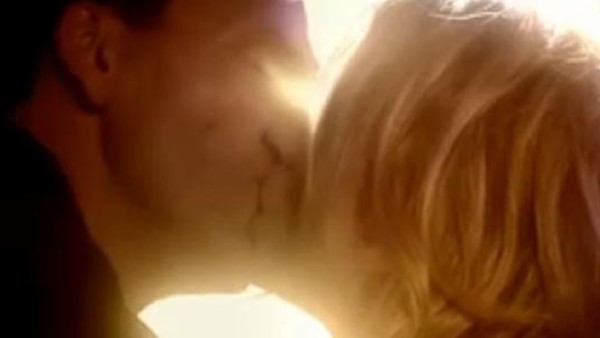
“The light that burns twice as bright burns half as long — and you have burned so very, very brightly.” Dr Tyrell tells the short-lived android Roy Batty in Blade Runner (1982) another piece of great popular art. That was ultimately the Ninth Doctor’s fate. After Rose returns to Platform One and becomes the Bad Wolf, an anguished Doctor tells her that if she absorbs the time vortex, she will burn and die. He takes her in his arms and takes on the burden of the fire himself. He sacrifices his life for hers, burning twice as brightly as before. The new Doctor who emerges out of that firestorm is a less damaged person. More agreeable. He has his own flaws and foibles, his own dangers. They’ll emerge over time. But he’s whole again.
All it took was a kiss from a Rose.