
“Lucky for Some”
Star Trek fans have long been acquainted with the maxim that “Having is not so pleasing a thing, after all, as wanting. It is not logical, but it is often true."1 Said fans, while usually liberal in American terms, are not often renowned for their engagement with Marxism. But nevertheless this truism is rather reminiscent of an idea advanced by some Marxists, although not I think Marx himself,2 that capitalism works on the idea of the promise of pleasure, rather than pleasure itself. That accumulation requires you to always shift your eyes and desires to the next thing, rather than ever enjoying the current thing, and that this ultimately has a deleterious effect on the ability to feel pleasure. Then, before you know where you are, we’re in the pickle we are today.
Upgrade nowSuch pieties are easy for them. Star Trek fans, I mean. Not Marxists. Although when push comes to shove, I’m probably some flavour of both. Star Trek has no missing episodes and never has had, and they’ve all been repeated on the regular since the 1960s and available commercially continuously since before the fall of the Berlin Wall.
All of which is by way of an introduction to me asking if you remember when, as a Doctor Who fan, you first encountered the idea that some episodes of it were missing? I do. As I may have said on here before, it was when the then BBC Enterprises moved out of BBC Villiers House in Ealing in 1988 and four ‘lost’ episodes of The Ice Warriors (1967) turned out to have been stuffed down the back of a filing cabinet all along. So what was a moment of great celebration for most fans was a moment of horrified realisation for me. Shortly afterwards they cancelled the show, and in many ways it was all downhill from there until Rose.
In the absence of new Doctor Who, I got more into old Doctor Who (Psychic Paper passim) and I can see, in my growing need across the decade or so it took me to finally see all of then-extant Doctor Who, the truth at the core of that critique, “As if increase of appetite had grown / By what it fed upon” as Hamlet had it. Which brings us to today, and the announcement this morning that two episodes of The Daleks’ Master Plan (1965/6)had been discovered by the Film is Fabulous initiative at DeMontfort University and would be wending their way to iPlayer very soon. This prompted my friend Lance Parkin to observe that “I've only just realised that 'they found a missing episode' is an emotion, but one only Doctor Who fans feel, like we're deep sea fish who can smell magnets.” and the fact that, yes, I had an identifiable emotional response to the recovery of these missing episodes, the seventh such trawl in my active fan lifetime, demonstrates the truth of his claim.3

Fairly recently I filled in an online Doctor Who fan survey, it was probably for the show’s Diamond Jubilee, and two of the questions were (I paraphrase) “Have you seen all of Doctor Who?” and “Will you?”; and my answers were “Except for Missing Episodes” and “I hope so”. And they are my final answers. I find it very difficult to imagine being a fan of Doctor Who and not wanting to see all of Doctor Who, new and old and new-old, and as quickly as possible, thank you very much.4 But then I remember when then was no new Doctor Who and old Doctor Who was very hard to come by and maybe that’s the difference.
Back then, in those dark days, and in parallel with the stories we’re currently covering in Psychic Paper, those coming out on VHS and being repeated on BSB towards the end of 1990, I also became a watcher, and then quickly an avid fan, of Twin Peaks which started for UK viewers on BBC 2 on 23 October that year. It was the first time a TV series, an ongoing TV series, had been what they now seem to call “my default / main fandom”. I’d always liked Star Trek. Star Wars had been as important to me as almost any other small boy born in 1978. But Doctor Who was / is my default. Yet it wasn’t for a while, because it couldn’t be. Then Twin Peaks went and got itself cancelled in 1991, ending in a cliffhanger that the follow up film Fire Walk With Me (1992) pointedly refused to even contemplate dealing with, and that became another kind of wanting. One not resolved for twenty five years. (Well, I say “resolved”.)
In his essay Accumulation and Enjoyment on Mulholland Drive (2015), which at its core is an argument about this idea of the deleterious impact of capitalism on enjoyment as expressed in the work of Twin Peaks’ creator David Lynch, the academic Todd McGowan deploys additional arguments conceived by Sigmund Freud’s wannabe padewan Jacques Lacan to expand this idea, roping in Lacan’s idea of Jouissance (a sort of painful surplus pleasure analogous to the surplus in economics. Sort of.) to argue that Lacan states that “…when describing the object that drives our enjoyment ‘by its nature it is lost and never refound’.” I.e. that wanting being better than having is not “often true” but necessarily true.
But I remember not being able to watch The Enemy of the World whenever I wanted and when there were only two series of Twin Peaks, and that wasn’t as good as now? Re-finding is possible. Re-finding can be great. So maybe I’m doing it wrong. Or maybe right. Perhaps somehow I have escaped the worst of deterioration of my capacity for enjoyment. Lucky for me. But it also seems like a very wrong framework for Lynch’s work, let alone his personal beliefs. Yet academically Lynch has been rather captured by Freudians, or at least “Freudians”, perhaps simply because so much of his work deals in dreams.
Yesterday, for another project I’m working on, I spent much of the day re-reading chunks of Sigmund Freud’s The Interpretation of Dreams (1913 translation, if you’re interested) and writing a few paragraphs about how dreams in Lynch simply don’t work on Freudian lines. They may well do in reality. That’s not for me to judge. But they don’t in Lynch’s work. A result, presumably, of his self-confessed scepticism of psychoanalysis leading to him never really engaging with Freud’s work. In complete contradiction of Freud, in Lynch’s dramaturgy dreams can give you access to information that isn’t already in your brain, and there is such a thing as a collective unconscious, while dreams genuinely do allow you to see into, enter into and be visited by people from, other worlds.
Which is broadly speaking the ticklist of mistakes Freud rails against people making about dreams and dreaming that opens his meisterwerk. Which, as I say, makes it rather odd to me that Lynch has been so captured, academically, by Freudians, nay Lacanians, who spend a lot of time trying to get nails into a cloud because the only tool they know how to use is a hammer.
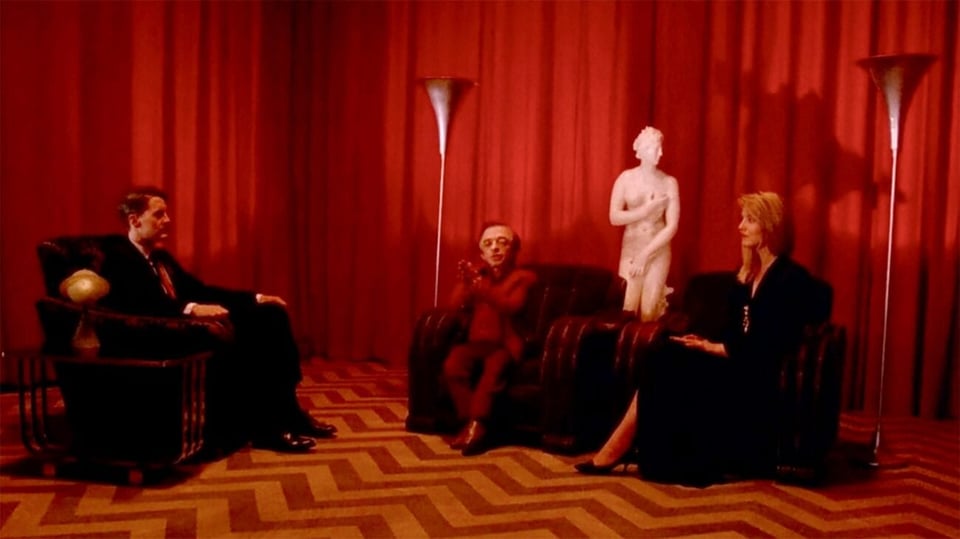
Anyway, between going to sleep having written those paragraphs and waking up to be told about two episodes of Serial V turning up, I had a dream that I was at a BFI screening and programmer / presenter Dick Fiddy was hinting that a Doctor Who announcement was imminent. I’ve dreamed about missing episodes of Doctor Who coming back. I think most fans have. But I’ve never dreamed about the BFI or Dick5 in my life. And NFT1 is a room that has red curtains.
Your move, Sigmund. Your move.
From Amok Time. 15 September 1967. One of Star Trek’s all time greats. ↩
If you know better, do write in! ↩
Although Dad’s Army fans, and fans of more obscure archive TV generally, might dispute the “only”. ↩
Other and equally valid forms of fandom are available. ↩
Quiet at the back! Yes, this is a vulgar Freudian joke. And also a vulgar Freudian joke. ↩
