
The Mind Robber
“It's too bad that all these things can only happen in my dreams. Only in dreams. In beautiful dreams.”
In 1990 BBC Video really accelerated their Doctor Who VHS releases, and began leaning heavily on the series’ black and white days, which had largely been ignored in the 1980s. The second all-monochrome batch of VHSes of 1990 consisted, like the first, of one Hartnell story and one Troughton story, with one serial spread across two tapes and another confined to one. This time, though, it was the Hartnell story that was a chunky boi, and the Troughton story that was on a single tape. It not being remotely near Christmas or my birthday and these things being expensive, The Dalek Invasion of Earth would have to wait a bit.
I’ve written extensively about The Mind Robber and that piece is still free-to-read here. But it’s always a pleasure to reengage with The Mind Robber, and while there will be some repetition of thoughts1 from that earlier, longer post, I’m going to (try) to look at it from different angles. Think of this as a companion piece to that. Or vice versa.
The Mind Robber is a remarkable serial, unique in a number of ways, and one that only reached its final form thanks to a baffling series of coincidences and mistakes. This is probably true of a lot of collaborative art, but seems all the more striking in this instance, given how the oddness of the serial’s overall dramaturgy and coincidences which are visible onscreen are vital to its success.
Four of its five episodes were written by Crossroads2 co-creator Peter Ling, who had worked on that series with several members of Doctor Who’s production team. Having had an idea for a story where time ran backwards rejected on the very reasonable grounds it was obviously technically impossible in a 1968 television studio, Ling instead drew inspiration from his own show. Specifically from his observation that some of its audience routinely confused the series’ cast with their characters. This was probably common with television viewers in 1968. It’s probably common with television viewers now. But it came to Ling’s attention due to the frequency with which his cast crossed paths with their audience in the streets. Which, suburban Birmingham being the size and layout it is, was not as unusual as you might expect.
This confusion seemed more profound than simply not being able to remember the actors’ real names and substituting those of their characters, and often took the form of informing them of something the audience knew but their character didn’t, such as a spousal infidelity or the father of another character’s baby. On occasions, birthday cards and even wedding gifts would arrive at the studio addressed to fictional characters.3 Thinking about this led Ling to the idea of Doctor Who and his companions entering a realm in which (other) fictional characters existed, and interacting with them. A Land of Fiction. He was duly commissioned to write the final four episodes of Doctor Who’s fifth production block under the collective title Manpower on 31 January 1968.
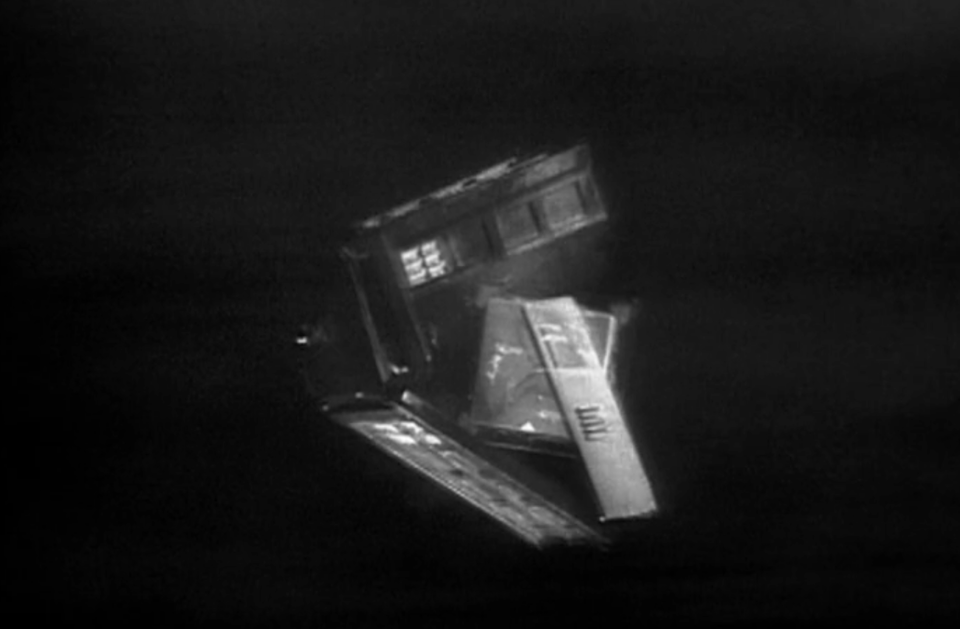
Doctor Who was not in a good place, production wise, in early 1968. Producer Peter Bryant and Script Editor Derrick Sherwin in practice shared both jobs between them in a sort of production diarchy, which effectively demonstrated the adage that a problem shared is a problem doubled. They also, in the eventually expressed recollections of other people around Doctor Who at the time and who outlived them, spent even more time in the BBC Club and its bar than was usual for someone working out of Television Centre at the end of the 1960s. Which was almost certainly the root cause of the other problems they created.
A particular issue for Bryant / Sherwin was scripts. Feedback to writers was sloppy, ever-changing, late and often delivered half cut. Scripts would be taken almost literally as far as the studio door, and then abandoned on a whim. Writers were told to respond to production constraints and then had those instructions reversed. There was parsimony too, with constant attempts to get out of paying writers for storylines and for additional drafts that would not have been necessary if the production office had been more professional with them in the first place.4
Amongst the writers Bryant and Sherwin alienated was another prickly pair, Henry Lincoln and Mervyn Haisman, on whom they’d relied heavily in 1968 and who would be subsequently blessed with the contrasting fates of becoming a famous biblical conspiracy theorist and writing a lot of Howard’s Way. With their The Dominators chopped down from six episodes to five at short notice, a new first episode for Ling’s four parter was needed, and Sherwin was despatched to write it. A lack of production resources, occasioned by budgetary ineptitude, meant it would have to be shot in an empty studio and rely almost entirely on the series’ regular cast, there being no money for actors or sets.
A week after that episode was recorded, Frazer Hines went down with chicken pox, necessitating him quarantining on doctor’s orders, and missing the week’s rehearsal and recording. Even the semi-competent, semi-conscious Bryant / Sherwin diarchy would probably have coped with Hines’ sudden absence had it occurred during, say, The Seeds of Death. Jamie being knocked out from behind and his lines being redistributed to Zoe and Phipps during rehearsals, and so on. Maybe even someone would have come in and done a straightforward understudy job, as was still occasionally done in soap operas in the nineteen sixties.
But the nature of The Mind Robber allows Hines’ illness to become a feature of the story. Jamie’s face is taken away by the Master of the Land of Fiction and, asked to play a game in order to restore it, the Doctor loses and fails. Cue actor Hamish Wilson taking on Hines’ role for one week. An understudy job that’s incorporated into the plot. resulting in a magical piece of unsettling oddness entirely in keeping with what’s going on around it. (The Doctor’s embarrassment that his incompetence in failing to give Jamie the right face, and his quiet attempts to hide it from Wendy Padbury’s Zoe are also delightful.)
What’s especially weird is that the final episode of this serial features a sequence (not just already written but also largely shot by this point as much of it was done during the serial’s pre-filming5) in which the Doctor and the Master of the Land have to engage in improvisation and counter improvisation in order to keep the story going. It’s life imitating art imitating life. Because the Master of the Land of Fiction is later revealed to be a (kidnapped) human writer of the interwar years, one who has spent his life churning out juvenile fiction for boys magazines. His efforts to keep the Land of Fiction going echo the way such writers themselves had to “feed the machine” of the magazines they worked for, and thus surely have a source in Ling’s own efforts to keep Crossroads itself going. The series had recently been downsized from five episodes a week to four, in part in recognition of the scale of that task.
While we cannot, of course, blame Bryant and Sherwin for Hines’ illness, we can't discount that one of the reasons he went down so hard with it in the first place was that Doctor Who had been working its core three actors to the bone for a very long time. On discovering that the first episode of The Mind Robber was virtually a three hander, Troughton finally rebelled and secured the compromise that this serial, made as he and their colleagues were all on their last legs, would run short. Despite being five episodes The Mind Robber’s cumulative running time is less than many four parters, and Episode 5 just about lasts 18m, short enough to have been transmitted in 20m rather then 25m slots.
That eased the pressure on Troughton, Hines and Padbury as did the happy coincidence of this being the first Doctor Who serial to be directed by David Maloney. A Production Assistant on much earlier Doctor Who, and now a relatively recently qualified BBC staff director, Maloney was rotated onto the show in the then usual way. But he and Doctor Who clearly suited each other; so adept was he at delivering striking images on the series’ budget he would quickly find himself called back to the series again and again, helming more than a third of the sixth production block and then returning to the series’ in the mid 1970s and directing several acclaimed colour serials. It remains the great lost opportunity of the series twentieth century life that he never produced it.6
In The Mind Robber, Maloney gives us things like candle lit images of small sets with the camera looking through cobwebs, which create a lot of atmosphere for virtually no money. A decision seems to have been made that mimesis isn’t needed, this being a story about fiction, where things are constantly accused of not being real. But then, thanks to end of term penury, it wasn’t really an option. With artificiality unavoidable, it is instead emphasised, something again that can really only be gotten away with because of the fantastical nature of the story. We never really think of the forest of words as being a forest forest, but that’s okay because we quickly discover that it isn’t made of trees anyway. There are also no real transitions between the different sections of the world the characters traverse. They were in a black void, now they’re in a claustrophobic but ultimately theatrical thicket (tangle?) of vines. Soon they’ll be heading into a sort of toy castle.

Ling’s scripts are, while imaginative, slight and almost certainly were before it was decided the serial should run short. They’re also incredibly repetitive. Huge amounts of the serial are taken up with the TARDIS trio encountering some sort of mythical or fictional beast and defeating it simply by realising it doesn’t exist. A lot of the rest is devoted to meeting other fictional characters and realising who they are. There’s little forward motion. Almost no plot. There’s very little story, and even less threat. It’s late in Episode Five that we discover our abstract villain’s concrete aims. They are, disappointingly, to take over the Earth. As had been the case in almost all Doctor Who stories since the end of 1966.
This thinness is even more true of Sherwin’s hurriedly extemporised opener, where nothing happens very slowly and where a novice director is expected to deliver an episode that runs on images alone. Very, very cheap images. And yet he does. This is where production and performance come in. There’s no original music for this serial (poverty again) but as well as stock tracks, Maloney’s deploys sound-FX-that-verge-on-music from the BBC Radiophonic Workshop, including an unsettling background thrum incongruously named “Zoe’s Theme" on its occasional commercial releases. Its use emphasises the sinisterness, and the sadness that is there, if not emphasised, in the story as written and it binds the production together tonally.
Somewhere else Maloney excels is in the serial’s location work. For all the theatricality of the studio work there’s also a solidity to the location pre-filming, something that would not surprise anyone familiar with Maloney’s later work as a director. But here it serves a bigger purpose. As Jamie emerges from a studio cavern onto location rocks, we experience an almost shocking change of aesthetic. Just as the bright white of the opening episode and the deep dark of the middle ones draw our attention to the serial’s monochromatic nature, here it’s as if Jamie has crossed into a different kind of production entirely.
Ling’s scripts may have been inspired by his work as a television writer / producer, but its contents reference written rather than performed fiction. It’s Maloney’s contribution that nudges The Mind Robber towards being about its own medium. It may in content be fiction about fiction, but its director manages to make it television about television. Even Doctor Who about Doctor Who. Because when that idea of invading the Earth is suddenly, awkwardly and regrettably introduced right at the end of Episode Five, the panicked way the Doctor and the Master discuss it makes it seem like part of their extended game of consequences, as if the story is trying to bend itself into a normal Doctor Who serial of the era so it can reach a normal resolution. It doesn’t, of course.

Something else to The Mind Robber’s is both the precision and the wide variety of the performances on display here, and again we have to credit Maloney, who was good at casting and in rehearsal. There’s Bernard Horsfall’s quizzical, reassuring Gulliver (yes, as in Travels) and the weird, upsetting coldness of the transformed Jamie and Zoe in the last two episodes. Christopher Robbie is a fine classical actor who I have literally seen get a standing ovation for playing King Lear at the Royal Shakespeare Company, but here he’s called upon to deliver a germanic superhero in an unconvincing body suit, and does so with both humour and pathos. There’s also Christine Pirie’s delightful turn as Rapunzel. There’s a bottomless sadness in her eyes when characters reply in the negative to her constantly asking them if they’re a prince. Somehow, out of nowhere, a child actress with no other screen credits is creating one of the most affecting moments in all of Doctor Who.
All this, Maloney was responsible for. But despite the love Doctor Who fandom has always had for both this story and Maloney as a director, I can’t help but feel that his contribution to it is undervalued. It’s so different to so much else that he did, that it feels like an aberration. One that should be celebrated while not being looked at too closely. But everything he does here works like a dream.
Nice link, dear.
Because, yes, while The Mind Robber is undeniably oneiric, with its quick-quick-slow pacing, muddled identities and curious repetitions, “It was all a dream” is the least interesting interpretation of it possible. But also probably the only way that the Bryant / Sherwin Doctor Who could possibly have accommodated what it’s trying to do.
Yet that the first episode of the next serial, The Invasion (which was also written by Sherwin) is one of Doctor Who’s missing episodes means we don’t as a fandom collectively read The Mind Robber as what The Invasion and its own first episode collectively indicate it is, a strange imaginary conjured by the Doctor as he sleeps in a chair.
The Mind Robber is a story in which characters are repeatedly forced to delegitimise something by insisting it isn’t real. It’s rather wonderful that collectively as a fandom it prompts us to the opposite. Fandom includes, of course, Russell T Davies. Under whose renewed show-running auspices The Mind Robber became an episode of Tales of the TARDIS, the iPlayer mini-series of vintage Doctor Who repeats framed with new material in which Doctors and / or companions look back on their adventures together.
I’ve wibbled here occasionally about the idea of a ‘core canon’ of Doctor Who. The Mind Robber started nudging its way into being the default Troughton story when it was repeated in 1992 and I’d argue that it representing the man and his era in Tales of the TARDIS continues this process. There’s something magnificent about this being held up as THE Troughton story when it’s wholly atypical not just of Doctor Who, but of the particular era that it’s from. Of it being the one that, if and when all other vintage Doctor Who disappears from iPlayer, will almost certainly remain.
Jamie and Zoe of course lost their memories of their travels with the Doctor at the end of The War Games, and so Tales of the TARDIS is obliged to restore them in order to pursue its own conceit of companions discussing their own pasts. The result is beautifully sentimental, incredibly moving and I’m not at all ashamed to say it made me weep. Which is why it’s taken me a number of years to realise something else about this version of the story. Which is that if Jamie and Zoe’s memories of The Mind Robber can be restored, then they must have had memories of it in the first place, and so it can’t be the Doctor’s fantasy at all.
Some dreams are worth holding onto.

Although not actual paragraphs or sentences, at least not deliberately. ↩
Midlands set / recorded motel based soap opera, which ran multiple episodes a week from 1964 to 1988 before being revived from 2001 to 2003. It was often derided for low production values, but was hugely popular. ↩
It feels like that Ling’s anecdotes had some influence on the portrayal of such events in Russell T Davies’ drama about Crossroads matriarch Noelle Gordon. ↩
E.g. Dick Sharples, writer of the unmade Prison in Space, a story abandoned so late copies were distributed to the regular cast, was told to rewrite to have the story serve to write out Jamie and introduce a new male companion called Nik. Then told to rewrite again as Frazer Hines would now not be leaving Doctor Who at this point. On both occasions the demands came in later than ideal, and there were concerted attempts to argue that neither rewrite deserved an additional fee, despite these demands being additional to Sharples’ original brief, and fees being demanded by both the spirit and the letter of his contract. ↩
For newbies, while sixties Doctor Who was shot week to week and episode by episode on videotape in a studio over a single evening, most serials had some “pre-filming” either on location or at a BBC film studio, in order to accomplish scenes that the studio could not accommodate. Often involving fire or water, neither of which were an advisable addition to an electronic studio dependent on mains electricity. ↩
Although he did produce Blake’s 7, which is more or less the same thing, let’s be honest. ↩
