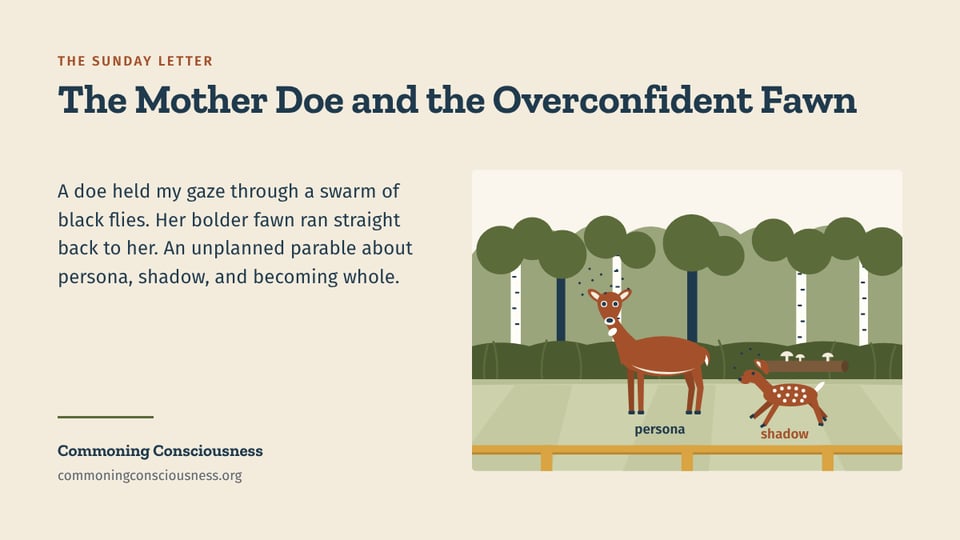
The observer, the Mother Doe, and the Overconfident Fawn
Dear friends,
This week's Porch Note takes us back to a summer day on the back deck, when the black flies were thick and the fawns still had their spots. I wrote it as a journal entry, in two parts: first what I saw, and then what I made of it. It runs longer than most of these letters.
As I lounged in the discounted, foldable Field & Stream camouflage-colored camp chair situated next to a patio table on my home's back deck, looking out onto the forested wetlands to the east, a common whitetail doe emerged slowly from the greenwood. I saw only her upper body as she passed through the adjacent thicket of hydrophytic vegetation, tall grasses, and scattered downed trees and limbs – each on its own slow, fungal pilgrimage toward soil reunification – that collectively form the transition zone between the woods and the manicured tract of land upon which I routinely commit ecocide on unsuspecting communities from atop my bright orange, four-wheeled, gasoline-powered chariot of habitat destruction, all in service to social norms and conventions for which I have no great affinity or regard.
Once my visitor's front legs permeated the arbitrarily selected landscape barrier to touch down on the (bi)weekly killing fields we humans call a "lawn," she immediately registered my presence. In automatic fashion, she adjusted her gait and made her final approach from the swampy overgrowth onto the mowed grass with added caution. When all four of her legs were finally and firmly planted on the – to a human – "kempt" portion of the land on which I am chief settler, colonist, and lifetaker, she held her position and gazed directly into my eyes.
Despite the steadily accreting swarm of black flies mobilizing to occupy her corneas, she stood, frozen, eyes locked onto mine with an unblinking stare. Her physical body had a soft and delicate appearance. But there was a hardness to her spirit that silently signaled she was more than capable of violent self-defense, if necessary, using only the means readily available to her.
After several seconds of sustained eye contact, the doe looked back at the swampy overgrowth to a spot where the rooted plant life suddenly began to rustle and shake. Out of the disturbance debouched a pair of spotted fawns who, unlike their mother – whose upper body I could see elevated above the wetlands at a distance – had been completely hidden away by the thick summertime flora buffering the space between the rising woodlands to the east and the manicured lawn to the west. Consequently, I did not see the younglings until each was a half-step out of the brush and onto the close-shaven remnants of what had been thriving, webbing, coevolving communities of grassland life prior to my recent intervention.
(Sidebar: Lawns are the sacrifice zones of everyday social life. They are subareas of legally defined and "owned" parcels of land in which the landscape is tortured via such methods as native plant replacement, application of toxic chemicals, and regular mowing down of all life that exceeds some arbitrary height, say, two inches, that human conventions hold is the altitudinal threshold that separates aesthetically pleasing fields of enclosed grass from ones that become "eyesores.")
When the twosome's eight combined hoofs were fully exposed and making indentations in the freshly trimmed grass, the mother doe finally blinked, eased her posture, and began to move. She strolled southward by no more than four meters to a small island of swamp in the side yard that is too thick and perpetually wet to mow (in fact, my name-brand ride-on mower has gotten stuck in the space every time I've attempted to raze it this season – I applaud the land for fighting back against its oppressor).
While one fawn followed the mother's path, the other, more venturesome sibling rushed westward directly in front of my seated position on the deck, just beyond the ground-level planter that separates my elevated wooden platform from the lawn below. Alas, the confident fawn followed in their mother's footsteps, first metaphorically and then physically.
Metaphorically, the initially undaunted child ostensibly owned ocular organs and eye coverings that were, like their mother's, simply irresistible to nearby black flies. Unlike the mother's stoic ability to decenter the material effects of her interactions with these insects in order to focus on evaluating a more collectively dangerous threat (in this instance, me; for the doe summoned all of her mental energy and trained it on me in the interest of her fawns, ignoring the personal discomfort the black flies must have been causing her), the fawn, after thrice failing to shake away their aerial pursuers, had enough and darted off toward their mother and sibling – thus following their mother in a physical and literal sense as well.
With the arrival of its missing member, the family of three then sniffed for and consumed edible organic materials in the same patch of roughage to which the mother was initially leading her two children following the pair's safe passage through the lush, twisted wetlands. For several peaceful minutes thereafter, the three capreoline companions enjoyed their own personal patch of oasis in the sea of devastation I commonly refer to as "my yard," as if it were a perfectly natural thing to claim ownership and dominion over living, evolving ecosystems.
For how long the deer dined and when and to where they disembarked, I do not know, because I became distracted by my own interactions with insects. Gnats of variable sizes – though none bigger than a large snowflake – were, at seemingly endless short intervals, attempting to gain entry to my own eyes and other areas of my body. I eventually watched one of them land on my thigh and begin pacing, making brief visits to locations immediately adjacent to its makeshift helipad.
As I monitored my visitor's speedy movements, additional gnats began circling my head, making approach for their own landings. Like the initially intrepid fawn, I shook my head back and forth with force to shoo away the uninvited airborne guests and refocus on Nature observation and journaling. However, after this tactic failed me on multiple attempts, I, displaying all the false confidence of an inexperienced deerling, made a hasty retreat from the deck and fled indoors to finish composing this episode of DeerTales.
That's right, readers: I lack the courage and relentless stoicism of a gentle mother deer. Even with all the trips I've made around the sun to date, I continue to navigate and participate in the world with the mimed bravado of a juvenescent fawn experiencing the world anew, unprepared to transcend and meaningfully integrate the full range of those experiences into my being.
An unintentional parable
In the interest of transparency, I must declare that this journal entry started off as a simple observational exercise meant to describe events and objects I witnessed while outdoors. Yet, as I wrote the preceding paragraphs, I could not help but think that the narrative has unintentionally taken on some characteristics of a dime-store parable – hence the heading above. Specifically, in having told this tale, I am reminded of one of the overriding themes and ultimate pursuits of Jungian psychology: individuation.
To Jungians, individuation is the road to becoming whole. Jung's own definition is a bit drier: it is the development of a person "as a being distinct from the general, collective psychology." The process starts with a recognition that humans all embody at least two entities. Our persona is our externally facing entity that we show to the world. It is the filtered, egoic version of ourselves that evolves out of our cumulative interactions. We identify adaptive strategies for profitably navigating different socioecological contexts, and we often build our personas around these successful strategies. Personas are how we see ourselves.
If we value and feel rewarded by exercising humility, kindness, and altruistic generosity, then, when faced with choices in social arenas, we consciously attempt to select options that most reflect these values. In turn, we consciously attempt to suppress behaviors and actions that go against our persona's adopted, presumably socially acceptable values.
The second entity within each of us, then, is that collection of behaviors, actions, attitudes, emotions, and feelings which we suppress because we adjudge them to be inconsistent with our adopted personas and self-images. By engaging in systematic suppression of all the phenomena we associate with our anti-persona, we expel those phenomena to our unconscious where they collect and form into complexes that occupy our shadow.
If our persona is our "light" side that we show to the world and have intentionally curated to make us feel comfortable in our manifold, overlapping social roles, then our shadow is our "dark" side that we bury so deeply that we convince ourselves it is unrecoverable. Nevertheless, what Jungian psychology suggests is that, like the laws of thermodynamics in physics, the energy linked to any feelings, thoughts, fears, and actions we repress is never destroyed, but is instead retained in our psyche.
This dark energy constellates in our shadow, where without warning it rises to our conscious activity in response to certain environmental triggers. In the main, irruptions of shadow into our waking minds are unintended, facilitating our habitual denial that they even occur. Insofar as they do not mesh with the self-image we hold of ourselves, which is rooted in the egoic persona we spent lifetimes cultivating and coming to embrace, we come to dis-identify with the contents of our shadow. If I am my persona, then, by implication, the shadow realm I reject must be Not-I, or "other."
Individuation is the process of dismantling this artificial binary and integrating the I we see with the Not-I others often see in us, but which we do not recognize for ourselves. Once we are prepared to acknowledge and begin owning our shadow, we need to listen to it. If we are serious about undertaking individuation, then we need to directly confront our unexpressed desires, fears, thoughts, and feelings, and to spot when we are projecting those ("negative," to our unindividuated personas) qualities onto others, which in turn helps us relate back to our own ego and notice where those phenomena manifest in our waking behavior. Building our skills and capacities in these domains is a necessary component of shadow work – the process of acknowledging and accepting our shadows, without judgment, and integrating what we learn from them into daily practice.
Integration is the rub of shadow work. A sufficiently deep understanding of how our shadow influences our conscious behavior is a powerful leverage point for upending routines and transforming choice patterns. In so doing, we become fuller versions of ourselves. Among the lessons we learn during individuation and shadow work is that we simply cannot purge unwanted contents from our psychic systems. When we suppress or repress psychic objects from our ego consciousness, they remain firmly inside our psychic systems, collecting in the shadow and waiting for the right pull of the trigger to fire them outward. Until we accept that the darker phenomena we associate with "others" but never with ourselves are in fact parts of us, we cannot walk through the world as whole individuals – only as actors playing various social roles.
Through individuation and shadow work, we become comprehensive cartographers of our psyches and their complex, uneven terrains – mapping out all parts of ourselves, understanding how they work together, when and why they are triggered, and how we can transcend feelings or emotions that lie in the darkest, erstwhile unnavigable reaches of our inner worlds. The resulting map guides us in merging our two entities – persona and shadow – into our full Self. That unification and wholeness is the ultimate aim of individuation: to discover who we truly are in the fullest sense; to live authentically.
Back to my deer story
Whereas this cursory introduction to core Jungian concepts and the process of individuation is necessarily incomplete, it affords a connection back to my deer story. Many people in my life – including myself, at times – would probably describe my prevailing persona with terms I've used or implied in referencing the mother doe above: quiet, measured, protective, other-oriented, soft, and caring; but serious and fierce when staring down an external threat to loved ones.
Something I've come to learn on my journey thus far – my incomplete, ongoing projects of individuation and shadow work that have unfolded over the past two or three years – though, is that my Mother Doe self-image and persona are at least partially counterbalanced by the shadow of a scared, mischievous, Overconfident Fawn. I regularly jump into situations, relationships, professional collaborations, and other scenarios without knowing fully or taking time to think through what they entail. I rush to say "yes" because I never learned to say "no." In fact, I was taught by the adults and institutions of my upbringing to stay quiet and do what is asked of me (or, more often, do what I'm told); and I was punished, shamed, and scolded for every instance of noncompliance with that teaching.
For as long as I can remember, I've therefore viewed my worth in terms of how useful I am to others. I've taken the exit for validation at every opportunity, even when signs suggested that connection or knowledge might lie just a little farther ahead on the route. We live in a society that prizes short-term profit, instant gratification, wealth accumulation and hoarding, and private ownership of virtually everything on the planet (and, increasingly, beyond it). I look at the behaviors and actions that reinforce those cacodemonic capitalistic imperatives and I consciously reject them. "Others" might be swept up by those harmful waves, but not me. To my ego, I am the Mother Doe who puts the collective first, even at the expense of my own wellbeing.
But, like my deer story and this improvised attempt to pass it off as a parable, the Mother Doe is only one part of a larger whole. I am also the naïve, seemingly defiant, Overconfident Fawn – as quick to run away from situations and choices that cause me pain and fear as I am to rush into spaces that I neither fully understand nor necessarily belong in. The overconfident fawn I watched depart their mother's company, only to spring back to her like a retracting tape measure the instant they felt overwhelmed by a new experience, is as much a part of my shadow as the mother is my persona.
Sitting now at a kitchen table, surrounded by four walls, with cool air pouring out of every vent in the house, I want to be disappointed in myself for allowing the frightened child who dwells in my shadow to pull me away from the outdoor journaling activity I was engaged in as self-care. But I'm not. In fact, I'm pleased with myself for remaining in place long enough to experience and record my deer tale. See, the gnats and flies were, from my perspective, bothersome invaders of my personal space well before my stare-down with the doe. Yet, my desire to observe her, to meet her gaze, to attempt to convince her that I was not a threat, thoroughly outweighed my desire to flee from the companies of insects battering down the doors of my eyes and ears. I recognized my discomfort in the moment. I processed it. And, for at least an hour, I let it pass without compromising my purpose.
Learning from darkness
So, what's the takeaway from this forced, post hoc parable? Many people, including me, see themselves as bold explorers ready to jump into and conquer new spaces and experiences. However, like the Overconfident Fawn charging back to the familiar comfort of the Mother Doe as soon as the former encounters unforeseen challenges, fears, or pain, individuals such as we are often quick to retreat from the unknown and heritably fearful.
Rather than deny our fears and flee from the unknown and uncertain, we must learn from darkness. Learn from observing. Learn from doing. Learn from history. Learn from complex, evolving systems of science. Learn from learning, recursively, until we all know how to transcend the physical realm, decentering its every external stimulus on our bodies to the point where we can grasp meaning, intent, and comprehensive implications for collective welfare, just by focusing our attention and tuning into the right frequencies.
The Mother Doe embodied this level of knowledge and wisdom during our staring match. She was entranced. In a Zen-like state. Completely focused, and completely receptive to whatever information she was downloading from the universe at large. Even though she was, in a quite literal sense, being eaten alive from the eyes out, she neither blinked nor flinched until – I believe – she fully apprehended my meaning and correctly assessed that I was not a danger to her or her reposing young.
Transcending the fear of an Overconfident Fawn unprepared to face the unknown, she stood rooted as a beacon of light – a Sage edifying her advisees through mere action and authentic being. At no point did her pedagogy employ tactics of moralizing, shaming, punishing, misdirecting, or manipulating. She was, simply…present. In the moment. Acting out of love and solidarity, not fear or hostility.
Jung has a useful caution for anyone tempted to stop at admiring the doe: "One does not become enlightened by imagining figures of light, but by making the darkness conscious. The latter procedure, however, is disagreeable and therefore not popular."
In both their initial hurry to face new adventures on their own and their resulting hasty return to Mother when adventure collided with inexperience in an unexpected and potentially scary way, the Overconfident Fawn was doing the work of individuation. Beholding the betrayal of their daring, spirited persona by unacknowledged fear lurking in their shadow, they humbly raced back to their Sage and Mother to continue learning, observing, and, ultimately, integrating what they learn into a fuller, wiser version of themself.
Notice where that road to wholeness led: straight back to the family. That is in keeping with Jung, who insisted that because none of us is "just a single, separate being," individuation "must lead to more intense and broader collective relationships and not to isolation." Regular readers know that I have been calling consciousness a commons: the layer beneath our private thoughts that none of us owns and all of us draw on, which Jung called the collective unconscious. The shadow we refuse to own rarely stays private for long. Sooner or later we export it, to use this project's word, into that shared layer and onto the people around us, who end up carrying what we would not. Seen that way, shadow work is less a private hobby than one of the more personal ways we have of tending what we share.
A practice for this week
The black flies and gnats have mostly given up by mid-November, but the cold can do their job. Once this week, go outside, or sit by a window, and watch something living for ten minutes: a bird, a squirrel, a stand of trees working in the wind. When the urge to leave arrives, notice it before you obey it, the way the doe seemed to take in the flies and set them aside. Name it: cold, bored, restless, needed elsewhere. Then see whether you can stay a minute or two longer than the urge wanted.
Then watch for one fawn moment of your own: a "yes" you gave before you knew what you were agreeing to, or a quick exit from a conversation that started to sting. You do not have to fix it. Write down what happened and what you think you were afraid of. If you catch yourself scorning that same quality in someone else, write that down too. That may be your own fawn, peeking out of the brush.
And if you bolt for cover sooner than you meant to, you are in good company. The fawn did, and so, eventually, did I. Both of us kept learning anyway.
If you've made it this far into my tangled, twisty ramblings, then I imagine you're progressing along a similar journey. Cheers to your safe travels, and here's to hoping that we all eventually meet as our whole, full selves.
With care from the porch,
R
References
- Jung, C. G. (1967). The philosophical tree. In Alchemical studies (R. F. C. Hull, Trans.; Collected Works Vol. 13, para. 335). Princeton University Press. (Original work published 1954)
- Jung, C. G. (1971). Definitions. In Psychological types (H. G. Baynes, Trans., rev. R. F. C. Hull; Collected Works Vol. 6, paras. 757–758). Princeton University Press. (Original work published 1921)
You just read issue #7 of Commoning Consciousness. You can also browse the full archives of this newsletter.


