
Dear friends,
What a week. On Tuesday, Democrats won both houses of Congress, with some races still being counted. In New York, voters re-elected Governor Kathy Hochul with nearly 60 percent of the vote in the unofficial count. In that same count, the Working Families Party line drew more votes for governor than the Conservative Party line, something it had never done in a governor's race since it first appeared on the ballot in 1998. And the state's largest city has been led since January 1 by Zohran Mamdani, a democratic socialist.
I don't want to make more of any of it than the counts will bear. But there is real progressive energy in the air, and in my experience, whenever the left has a good week, an old line comes back out. Somebody leans back and tells you that, as Winston Churchill said, a young person who isn't a socialist has no heart, while an older person who is still a socialist has no brain.
So this letter is the first in an occasional series I'm calling Common Knowledge, where I take a piece of received wisdom and check what is behind the curtain. I first wrote a version of this essay in 2020. I've cleaned it up and fixed a few things I got wrong the first time, since the quote isn't the only thing here with a shaky pedigree.
The quote and who said it
The line isn't Churchill's. The International Churchill Society lists the saying, in a version about liberals and conservatives, among quotes falsely attributed to him, and says there is no record of anyone hearing him say it (International Churchill Society, n.d.).
The idea is far older. In January 1799, Thomas Jefferson wrote down a quip of John Adams's: "a boy of fifteen who is not a democrat is good for nothing, and he is no better who is a democrat at twenty." Jefferson heard it thirdhand: "Ewen told Hurt, and Hurt told me" (Jefferson, 1903, p. 195). In 1872 the French politician Anselme Batbie credited Edmund Burke with a version that doubted the generosity of soul of anyone not a republican at twenty and the soundness of mind of anyone still a republican after thirty (Claretie, 1874, p. 482). Later quotation books gave a tidier heart-and-head version to the French statesman François Guizot, and added, without a source, that Georges Clemenceau swapped in "socialist" (Benham, 1948, p. 751).
Churchill's name came later still. It stuck, and people with large platforms keep reaching for it to defend capitalism. In 2018, for example, Fox Business host Stuart Varney recited it as Churchill's on Fox & Friends (Media Matters for America, 2018).
Common knowledge has always traveled this way: Ewen told Hurt, and Hurt told me. What matters more than who said it is what it says. Is it really, as Fox Business suggests, a defense of capitalism? Let's take a page from a literary classic and walk down the statement's logical Yellow Brick Road to find out.
Recasting the characters
For those unfamiliar with L. Frank Baum's The Wonderful Wizard of Oz (1900) or its celebrated film adaptation (Fleming, 1939), it is the tale of a young girl, Dorothy, swept up by a storm with her dog, Toto, and carried to a magical land. (In Baum's book the storm is a cyclone, and there is no rainbow. That came with the 1939 film.) Looking for a path home, she befriends three companions, each lacking something needed for a full, flourishing life. The Tin Woodman (the Tin Man, in the film) is missing a heart. The Scarecrow has no brains. And the Lion lacks courage.
The quote we're exploring sorts people into socialists and not socialists, and as it is used today, the second group is tantamount to capitalists. Substituting terms gives an equivalent statement: a young person who embraces capitalism hasn't got a heart; an old person who rejects capitalism hasn't got a brain.
Right away, it's evident that the adage isn't exactly a full-throated endorsement of capitalism. It contains a self-aware admission that to blindly embrace capitalism is heartless, presumably because the system generates massive inequality, undermines democracy, and does untold damage to the environment. The saying also implies that rejecting capitalism comes from an uninformed moral or emotional place, from egalitarian ideals that seem attainable only from the hopeful, unspoiled vistas of youth. With age and experience, we are told, we learn that socialism is a fantasy land, somewhere over the rainbow, that can be reached only by dreams or a stroke of magic.
Recast with Dorothy's companions, the reasoning goes something like this:
- Early in life, a person who embraces capitalism is like the Tin Woodman: cold, distant, and heartless. Young people tend to hold egalitarian ideals with a heartful optimism, so few of them resemble him.
- Later in life, a person who embraces socialism is like the Scarecrow: naïve, impractical, and brainless. Experience supposedly teaches that to thrive in the "real" world we must put self-interest ahead of collective interests, so few older people resemble him.
How well does this argument hold up? Let's ask the star characters themselves.
The Tin Woodman lived a full life before he lost his heart. He once loved a Munchkin girl, in his words, "with all my heart." After a witch's enchanted axe left him tin and heartless, he says, "I lost all my love for the Munchkin girl" (Baum, 1900, ch. 5). He does not call that maturity. He speaks from experience: "But once I had brains, and a heart also; so, having tried them both, I should much rather have a heart." When the Scarecrow opts for brains, the Tin Woodman replies, "I shall take the heart … for brains do not make one happy, and happiness is the best thing in the world."
The Scarecrow arrives at a similar place in the sequel, The Marvelous Land of Oz (Baum, 1904). By the last chapter he has been restuffed with banknotes, so he is literally made of money when he says: "For I consider brains far superior to money, in every way. You may have noticed that if one has money without brains, he cannot use it to advantage; but if one has brains without money, they will enable him to live comfortably to the end of his days" (ch. 24).
If that doesn't sound compatible with the "Churchill" argument, it's because it isn't. One was missing a heart and the other brains, yet after long experience they reach the same destination: it is better to live in a society where care and mutual aid are stronger forces than greed and self-interest, rather than the other way around. Experience didn't talk them out of their ideals. It talked them into them.
From Scarecrows to Lions
In my view, Dorothy's friends reveal the argument's biggest weakness. If holding pro-socialist or egalitarian ideals later in life is irrational given the way the economic system works, then abandoning them is less a sign of brains than a sign of resignation. The problem lies with the system, not with the individuals who still want the system to be more equitable.
The argument is also deterministic: thoughtful, heartful people can't change the world, only adjust to it. You can't beat the system, so you either join it, or you're a foolish Scarecrow without a brain.
Now, it might be the straw in my head talking, but an immutable global capitalist society doesn't sound like a happy ending in that story. A system that remorselessly extinguishes hopeful visions of a more equitable world is not a hero. It's a villain. But it is not the invincible villain the "Churchill" quote makes it out to be. Again and again, caring people have come together to demand, and ultimately create, real social change. We have agency. We can act. And when we work collectively and constantly, we can remake the system into something more democratic, equitable, sustainable, and just.
That takes courage, though. It is much easier, "Churchill" might even say more rational, to yield to the powerful political-economic forces of global capitalism than to resist them. Starting out with an equitable vision of society only to discard it after meeting the realities of capitalism is not evidence that experience brings wisdom. It is merely evidence that feedbacks built into the capitalist system work to weaken hearts and stifle courage.
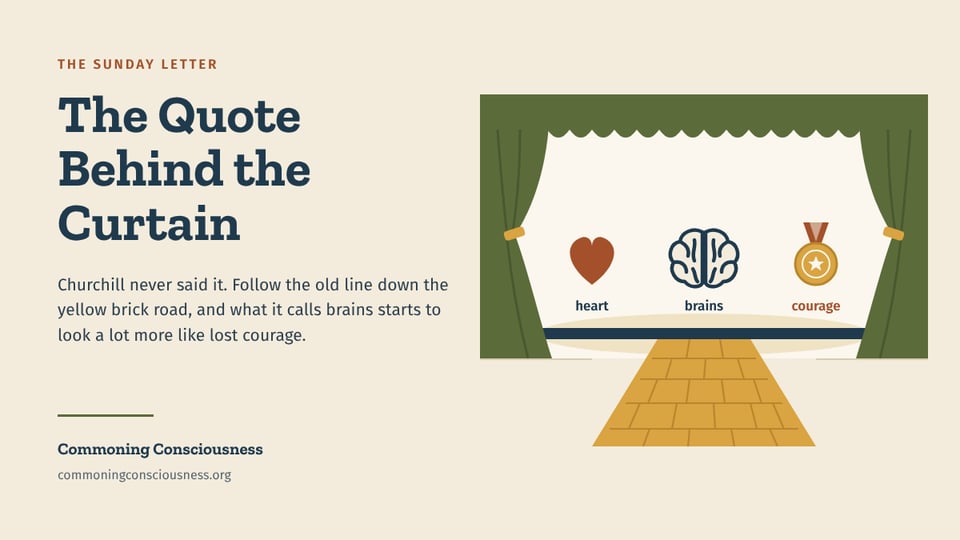
So it isn't that young people who embrace pro-socialist, egalitarian values are naïve Scarecrows who harden into Tin Woodmen as they age. A more reasonable explanation, staying within Oz, is that those youthful Scarecrows risk growing up to be Cowardly Lions. Deep down, they may still want a more equitable and just society, but because it seems so foreign, remote, and uncertain, they are too resigned to act. In that respect, our comrades who continue to embrace, uphold, and advance pro-socialist and egalitarian ideals in their later lives are not, as "Churchill" claims, Scarecrows in want of brains. They, like the Lion, are those who have found their courage.
Baum's Lion doesn't wait to be brave. He joins Dorothy the day they meet, still frightened, "for my life is simply unbearable without a bit of courage" (Baum, 1900, ch. 6). The Wizard later tells him what the road has already shown: "True courage is in facing danger when you are afraid, and that kind of courage you have in plenty" (ch. 15). When the Lion still asks for courage, the Wizard pours him a dish to drink, explaining with a humbug's straight face that "courage is always inside one" (ch. 16).
Growing up is not growing apart
Underneath the "Churchill" line is a theory of growing up: that maturing means growing more self-interested, moving away from the collective and toward the self. Experience, on this view, cures you of other people.
Jung, who called the lifelong work of becoming whole individuation, saw it nearly the other way around. He wrote that "we do not sufficiently distinguish between individualism and individuation," then drew the line: "Individualism means deliberately stressing and giving prominence to some supposed peculiarity rather than to collective considerations and obligations. But individuation means precisely the better and more complete fulfilment of the collective qualities of the human being" (Jung, 1966, para. 267). And he was clear about where it leads: "Individuation does not shut one out from the world, but gathers the world to oneself" (Jung, 1969, para. 432).
Regular readers know I've been calling consciousness a commons: the layer beneath our private thoughts that none of us owns and all of us draw on, which Jung called the collective unconscious. On Jung's account, real maturing doesn't take us out of that commons. It makes us more fully part of it. What the "Churchill" line calls maturity sounds a lot like what Jung called individualism, a fencing-off. I don't want to enlist Jung in anybody's political program, mine included. He distrusted the crowd as much as the fence.
He also thought this was grown-up work. It is "not the child, but only the adult, who can achieve personality," he wrote, and personality is "an act of high courage flung in the face of life" (Jung, 1954, para. 289). Courage isn't something youth has and age loses. It is something we grow into, usually alongside other people.
A more accurate "Churchill" quote
If we are to resist the systems that create massive inequality and devastate ecosystems, then, like the Lion, we need to begin our own quests for courage. The good news is that we might not have far to go. In the film, Glinda, the Good Witch of the North, tells Dorothy she has always had the power to go back to Kansas. Dorothy had to find that out for herself. (In 2020 I quoted Glinda more neatly than she actually speaks. Catching that sort of thing is what this series is for.) We have always had the power to make a better world, too.
I won't pretend to know what every voter meant on Tuesday. But nobody handed those results down from behind a curtain. People made them, together. I'd rather meet this moment like the Lion on the road: afraid, maybe, but in good company, our courage held in common. So when the old line comes out at the holiday table this year, here is a fitting new quote to offer in return, from the same reliable source:
"If you're not a socialist when you're young, you have no heart; if you're not a socialist when you're old, you have no courage."
Not Winston Churchill
A practice for this week
Find a quiet ten minutes, on the porch if you have one, and think back to an ideal you held at about twenty, something you were sure the world could be. Write it down in one plain sentence.
Then ask one honest question. If you have set that ideal down, was it because experience showed you it was wrong, or because it came to feel out of reach? Only one of those is about brains. If it was the second, you may have a Lion's problem, not a Scarecrow's.
Last, take one small act of courage toward it this week, and take it with other people. Go to the meeting. Call the neighbor. Sign up for the shift. Individuation, Jung said, gathers the world to oneself. Let it gather a few people, and see what your old ideal looks like with company.
With care from the porch,
R
P.S. For a closer look at Tuesday, a set of election maps I put together shows every statewide and legislative race in New York, county by county and district by district, with how far the vote moved, the party lines, and turnout: https://groundandsound.com/ny-election
References
- Baum, L. F. (1900). The wonderful wizard of Oz (W. W. Denslow, Illus.). George M. Hill.
- Baum, L. F. (1904). The marvelous land of Oz (J. R. Neill, Illus.). Reilly & Britton.
- Benham, G. (Comp.). (1948). Benham's book of quotations, proverbs and household words (New and rev. ed., with supplement). George G. Harrap.
- Claretie, J. (1874). Histoire de la Révolution de 1870-71: La présidence de M. Thiers, l'Assemblée nationale, l'Alsace-Lorraine, la libération du territoire, la présidence du maréchal de Mac-Mahon. Librairie Polo.
- Fleming, V. (Director). (1939). The wizard of Oz [Film]. Metro-Goldwyn-Mayer.
- International Churchill Society. (n.d.). Quotes falsely attributed to Winston Churchill. https://winstonchurchill.org/resources/quotes/quotes-falsely-attributed/
- Jefferson, T. (1903). The complete Anas of Thomas Jefferson (F. B. Sawvel, Ed.). Round Table Press.
- Jung, C. G. (1954). The development of personality. In The development of personality (R. F. C. Hull, Trans.; Collected Works Vol. 17, para. 289). Princeton University Press. (Original work published 1934)
- Jung, C. G. (1966). The relations between the ego and the unconscious. In Two essays in analytical psychology (R. F. C. Hull, Trans.; 2nd ed., Collected Works Vol. 7, para. 267). Princeton University Press. (Original work published 1928)
- Jung, C. G. (1969). On the nature of the psyche. In The structure and dynamics of the psyche (R. F. C. Hull, Trans.; 2nd ed., Collected Works Vol. 8, para. 432). Princeton University Press. (Original work published 1947)
- Media Matters for America. (2018, July 26). Fox's Stuart Varney cites falsely attributed Winston Churchill quote to attack socialism. https://www.mediamatters.org/fox-friends/foxs-stuart-varney-cites-falsely-attributed-winston-churchill-quote-attack-socialism
You just read issue #6 of Commoning Consciousness. You can also browse the full archives of this newsletter.


