The Complicated Business of Making A Living
On Black Friday and Buying Things
Work Notes

Free US Shipping in the Common Objects Online Shop through Sunday (no code needed)

$75% off three class bundle : Time Horizons, The Pattern of Words, and Ways of Knowing

$75 off Creative Advising Sessions (3 left)
Dear Reader,
I think there is something worth examining in the fact that so many of us who have built our lives around making things, sharing things, teaching things, and creating alternatives to the mainstream economy are now participating in the very same commercial rituals we once positioned ourselves against. Not necessarily because we have abandoned our politics, but because we have to make a living. And because making a living has a way of getting tangled up with making a life.
My question is : When did the radical Buy Nothing Day become just another Black Friday to so many punks? I want to track this, the difference between “punk damage” and assimilating into American normalcy.
Or maybe I want to understand how the things we once used to distinguish ourselves from the mainstream eventually become indistinguishable from it. How does a countercultural practice become a marketing opportunity? How does opting out become another aesthetic, another identity, another thing to sell?
I am no scholar of capitalism and work, even if I wrote a little pink book about it. But I am here to look at my own fears and scarcity and what changed between Have Company and Common Objects.
What happens when the things that once made us countercultural become absorbed into the very culture we were trying to resist?
This is usually where the paywall is. This essay and thinking about commerce is calling me to make it free. If you like it and feel called to support it financially you can become a paid subscriber. If not, feel free to share it.

I'd love to hear what you think. Paid subscribers can comment and free subscribers can hit reply.
Upgrade now
I owned Have Company from 2012-2016, first starting in a camper and then moving into a store front on Division Avenue in Grand Rapids, MI. While we participated in dozens of holiday events, art markets, shop hops, and sales, one thing was always true : We were closed on Black Friday. Adopted by many on the margins as “Buy Nothing Day” I had joined in with shop owners across the country who would do the same. In those days I had an amazing little pod of shop owners, one being Rachel Berks who owned Otherwild in LA.
Otherwild was truly the first of its kind in so many ways. A queer gift shop and event space that would champion small businesses and artists for a decade. Having that friendship with Rachel shaped so much of who I was and still am as a business owner, and has me questioning how I spent yesterday.
I think about how important it was to have other people doing it with me. There was something about the collective nature of that decision that made it feel possible. We weren't just individual businesses making individual choices. We were participating in a shared refusal. And maybe that is part of what I miss: the feeling that our small, sometimes strange, sometimes impractical decisions were connected to something larger than ourselves.
I remember enjoying that Friday every year, having two full days off in a row, and feeling so tightly bound with my politics. We might sell things most days of the year, but we can choose this one day that is rooted in over consumption to not participate.
It felt like a small boundary against the machine. A way to say that our businesses didn't have to follow every rule handed down by the larger retail economy. We could make our own rules. We could close. We could rest. We could decide that a day of record-breaking consumption wasn't something we wanted to help facilitate.
Fast forward to today, where I run both an online business and a physical shop. This is the second year I have run Cody’s Big Week of Sales and both years I have had a creative and fun time putting together deals that I truly believe support my community. But could I have skipped Friday? This year’s Friday deal was free shipping in the Common Objects shop that lasted all weekend. Could I have just waited to announce it today?
I don't think the sales I put together are inherently at odds with my values. I believe in paying artists. I believe in supporting independent shops. I believe in making creative education accessible. I believe in the exchange of money between people who are trying to build something outside of the conventional structures of work. I want people to buy the things I make and the things I curate. I want them to pay for my writing.
I want my business to sustain me.
But when does supporting small businesses become an argument we use to justify participating in every single commercial event? When does the language of community become indistinguishable from the language of consumption? And how do I know when I'm making a thoughtful choice versus rationalizing a choice that benefits me financially?
And what does it mean to say buy nothing on a day when so many of my friends are desparate for their goods and services to be bought, myself included? As you can see, I am really just filled with questions.
There is a particular kind of discomfort in asking people not to buy anything when you are someone who needs people to buy things from you. I don't want to romanticize opting out when opting out has a financial cost that not everyone can absorb. And I don't want to pretend that the small businesses and artists I care about aren't depending on this weekend to pay their bills. In my own scarcity and factual financial life, this is something I can’t absorb right now.
And then there is the shop. My understanding from neighboring shop owners was that the Black Friday weekend was really good in terms of sales, and it honestly hadn’t even crossed my mind to stay closed. That was maybe the most startling part, like my values has slipped through the cracks so quietly I wasn’t even pushing against them, they just weren’t there.
I wonder if this is what assimilation actually feels like. Not necessarily a dramatic betrayal of your principles, but a series of small adjustments. You learn the rhythms of the industry. You watch what neighboring businesses do. You notice when people are shopping. You start thinking about what a good retail weekend looks like. And eventually, without making a conscious decision, you are doing the thing.
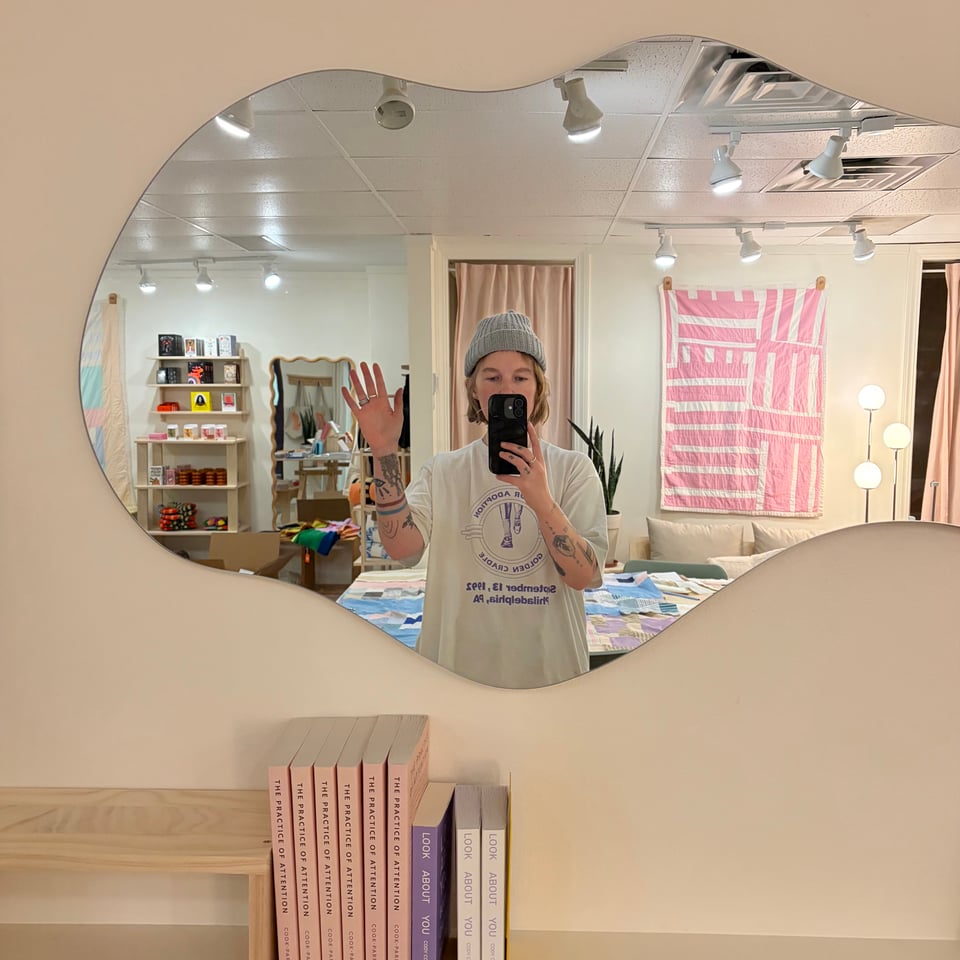
We had a $380 day. Now other than our grand opening party this is one of the highest days we’ve had so far. But we made that in just over six hours. Profiting closer to $190, and if I’d left and gone to New York with Katy and paid someone $120 to work that day, that’s $70.
Two things : This is the reality of opening a brand new business a month in. People are still figuring us out, understanding we’re open, finding us off the beaten path. But also, Is that enough money to have stayed open, when I could have aligned with Buy Nothing Day and also traveled for the holiday?
I keep returning to the math because I think the math is important. It is easy to make a political statement when you have enough money to absorb the consequences of making it. It is harder when you are a month into a new business, trying to establish a customer base, trying to pay rent, trying to figure out whether the thing you have built is going to work.
And $70 isn't nothing. Neither is a day off. Neither is the possibility of building a business that doesn't require me to be available every time there is an opportunity to make a sale.
Today we have small business Saturday, a day that traditionally has been good for the physical spaces I have run in the last fourteen years and for my online shop and business. Then there is cyber Monday, then there is Giving Tuesday. Then there is just a normal ass Wednesday where maybe I will encourage Katy to close the shop for the day and just rest.
I don't think Small Business Saturday is bad. I don't think Black Friday sales are inherently bad. I don't think selling things makes me a bad person, or that buying something from Common Objects is somehow a failure of political imagination. I believe deeply in the exchange of money between people. I believe artists should be paid. I believe independent businesses should exist. I believe in making things, buying things, giving things, and keeping the creative economy moving between people rather than funneling everything into a handful of enormous corporations.
But I also believe in buying less. Especially as I heal some of my own compulsive spending and collecting of objects.
I believe in making do. I believe in repairing things, borrowing things, sharing things, and finding pleasure in what we already have. I believe that our lives do not need to be organized around the acquisition of more stuff. And I believe that we should be able to imagine an economy in which our survival isn't so dependent on convincing other people to spend their money.
I don’t know how to hold all of this at once, or maybe I do and the discomfort just needs to stay there.
I want Common Objects to be a place where people can come and look at beautiful things without necessarily buying them (!!!). Where they can spend time, find a book, talk about a quilt, meet a neighbor, or get an idea for something they want to make themselves. I want it to be a place that contributes something to the cultural life of this town beyond the things that leave in shopping bags.
And I want it to make money. I want to pay people. I want to pay myself. I want to keep it open.
Perhaps what I'm really trying to understand is whether I can build a business that doesn't require me to abandon the things I believe in to keep it alive. And whether I can resist the very real pressure to turn every moment, every holiday, every cultural observance, and every relationship into another opportunity to sell something.
I don't want to become so accustomed to the rhythms of commerce that I forget there are other ways to organize our time, our attention, our relationships, and our lives.
I miss Buy Nothing Day. I miss the feeling of being part of a little pod of people who were willing to do something differently, even if it meant losing a day of sales.
Maybe next year Common Objects will be closed on Black Friday. Maybe we will have a sign in the window. Maybe we'll make a day of it.
I don't know yet.
But I want to keep asking the question. I think that's a good place to start.
CLASSIFIEDS :

Classifieds go out every Monday in the newsletter. They are currently available December 21 and 28, perfect for your solstice and end of year offerings.
→ [email protected]
→ P.O. Box 252 Cedar, MI 49621
→ Follow Along on Are.na
→ Follow along on social media
A portion of sales from Cody’s Big Week of Sales will be redistributed to Parole Preparation Project
-
I think being a small business with a physical storefront is an act of resistance against the overwhelming onslaught of chain stores and multinational corporations. It's nice to even see all four walls at once! When you and Katy fill your shop with your friendliness, love and hope, when you welcome people in whether or not they buy something that day or ever, people feel that energy and you are making a positive difference in the world. And who knows how you might re-imagine black Friday next year beyond simply choosing between being open or being closed--maybe you'll give a small thing away or offer soup or have a friend playing guitar. Maybe someone having a hard time will linger in the store because you make them feel welcome and their soul can rest. Maybe that even happened yesterday and you don't even know it!
-

This is such a beautiful take on it all Sarah, thank you so much. I really felt that being open yesterday. Like the space was a reprieve from the insanity of the outside world. <3
Reply: