
Linkfest #48: The MouthPad, "Volitional Reconsumption", and The Genetics of Giant Pumpkins
Hello there!
It’s time for "the opposite of doomscrolling” — my latest “Linkfest”, in which I slowly and patiently distill vats of science, culture and technology, just for you.
If you’re a subscriber, thank you! If not, you can sign up here — it’s a Guardian-style, pay-whatevs-you-want affair; the folks who kick in help keep it free for everyone else. And also — forward this email to anyone you know who’d like it!
The full, free archives of the Linkfest (including this issue) are online here, if you’d prefer to read this on the web.
Let’s begin ...
1) 🎨 Daniel Greenfeld’s paper mosaics

I’m really taken with Daniel Greenberg’s paper art! As Ellis Tree writes in Colossal …
When describing his precise illustrative works with paper, Berlin based artist Daniel Greenfeld doesn’t quite pin his technique down as “collage”, he tells us. “The material isn’t layered, but something between assemblage and inlaid mosaic,” he says. “I cut up painted cardstock to make my pieces, slicing out cavities so new shapes can be embedded and glued in.” Carefully tiled up from these precious scraps, his architectural observations of everyday faces, places and fruit have come to create quite the circular illustration process: “Every new piece sends its offcuts back into the scrap bin, waiting to turn up in the next one, and the scraps get more intricate the longer I work this way,” he shares.
If you go to Greenfeld’s Instagram feed, he has close-ups of some of the art that show some cool, messy little details …
… these small paper scraps have been smushed and squeezed tightly alongside each other like the pieces of a jigsaw puzzle – some look cosy, but some are simply the perfect fit. Whilst clean and constructivist from afar there is a roughness and imperfection to the artist’s works that makes them feel less intricate up close. Shards of paper stuff smudges or crumples against each other where Daniel has fixed them into place with glue – a mess he likes to “embrace” to keep from getting “too precious or second guessing myself”, the artist says.
2) 👅 A computer mouse that you control with your tongue
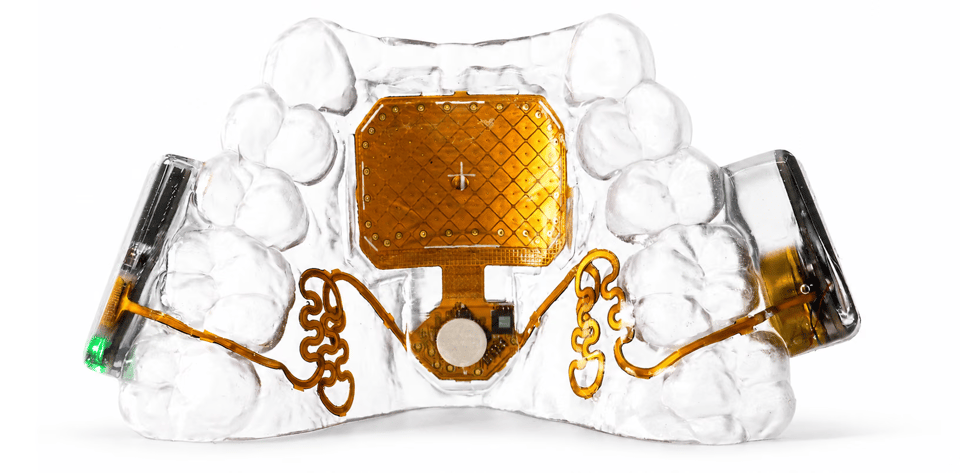
Behold the “MouthPad” — a dental retainer you put in the top half of your mouth, and which lets you control a computer by using your tongue to brush over a mousepad.
Seems weird, right? But your tongue is actually great for controlling digital devices, because it’s capable of extremely precise motions. Consider all the complex movements it does to move food around in your mouth while you’re chewing, or to tease out a morsel caught between your teeth.
It has a far bigger range of motion than our fingers. It’s the part of our body that is most octopus.
The upshot is, as Iñaki Laguardia writes in designboom …
MouthPad user Tomás Baptista recently achieved 10.47 bits per second during a cursor task measuring speed and accuracy, a performance the company compares with state-of-the-art implanted brain-computer interfaces.
Love that!
Apparently there are 6,300 people on the waiting list, including “including surgeons, technicians, pianists, boxers, mechanics and parents searching for hands-free digital control.”
But one of the killer apps is, obviously, computer control for people whose bodies are paralyzed — but who retain control of their tongues. In fact, here’s a good review of the Mouthpad by John Mohler, a quadriplegic with multiple sclerosis. Apparently he found it super intuitive to pick up …
Right away I could move the cursor with either head or tongue movements. The training exercises and games teach the best techniques of clicking, double-clicking, right-clicking through suction or in-breaths, and so on. I had an “A-ha” moment when I clicked an app button that popped out the Tongue Sensor Map, a real-time visualization of the MouthPad sensors as I swipe my tongue over them. The instant I saw the field of dots lighting up hot-pink while I felt the texture of the touchpad across my tongue and viewed the cursor transiting the screen, I almost heard the “click” in my brain … [snip]
As I developed my skills and got my settings in line, the MouthPad started showing how versatile and fast it performs. It flies through websites, online forms and surveys. No need for scrollbars: I can scroll up and down from anywhere within a window, document or browser with the tip of my tongue. Or swipe back and forth to pull out menus or turn pages in an e-book. With practice, my on-screen cursor placement became precise and a whole lot quicker than drawing breaths and articulating careful speech-recognition commands. Once I get going, it’s fun feeling my tongue work over a screen, giving it a tongue-lashing a swashbuckler would appreciate. Combining the MouthPad with Dragon Professional 16 and Windows 11 Voice Access forms an effective work suite.
3) 📖 3D book from the 19th century
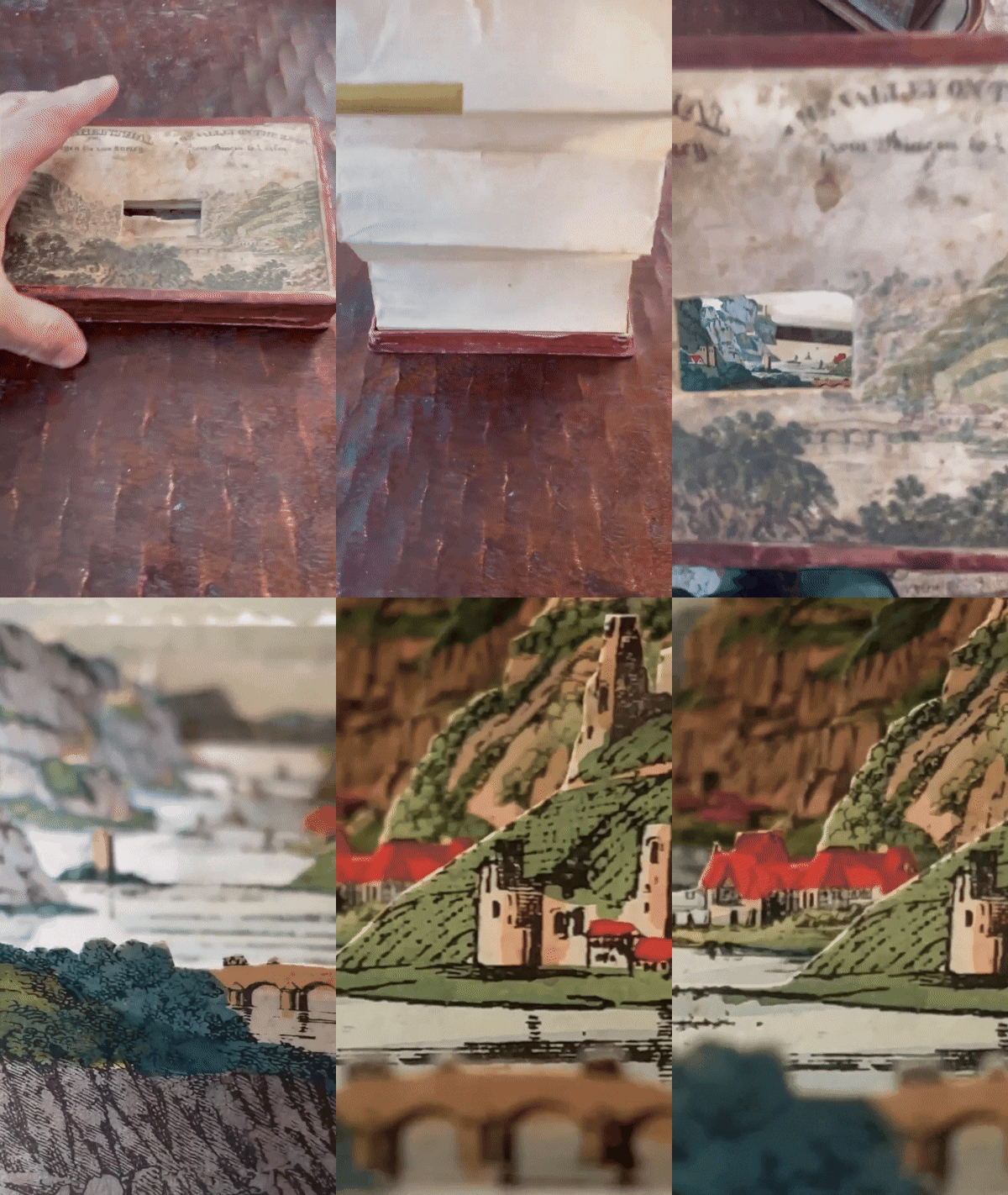
Over on Mastodon, the Global Museum posted a video of this gorgeous 19th-century book that expands open to depict the Rhine Valley as a 3D vista.
That animated gif above is only a small snippet of the longer video they posted — go check the whole thing out!
I am such a fan of books that expand outwards in cunning ways. I loved ‘em as a kid and love them as an adult; I wish more adult books used this technique, lol.
4) 🎃 Database of the genetic lineage of giant pumpkins
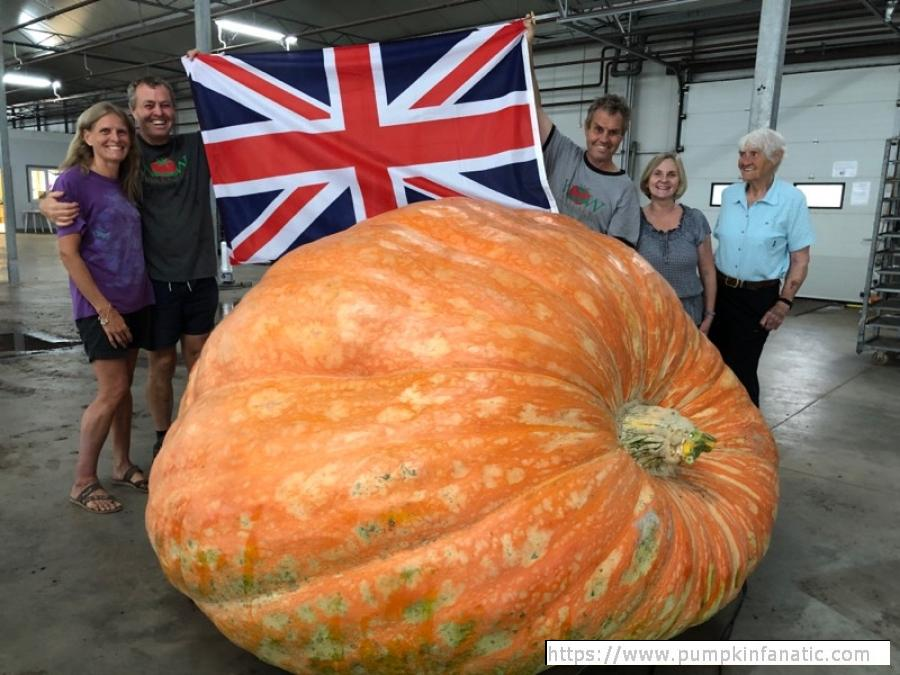
Growing giant pumpkins is apparently an intense and competitive global scene. The world’s biggest pumpkins are around 3,000 pounds; records have been broken 21 times since 1993. Some farmers will spend $1,200 in gas driving their Great Pumpkin to competitions around the country.
Genetics are a key part of winning: Farmers try to get their hands on seeds from previous record-holding pumpkins. This has produced a predictable — and hilarious — boom in the prices of prize seeds. Last fall, Roshan Fernandez wrote a great piece for the Wall Street Journal about it (gift link) …
Because before they compete at weigh-offs, these hobbyists vie at auction for seeds with lineages of largeness.
“It’s like breeding racehorses,” said Ron Wallace, the first grower to break one ton in 2012 … [snip]
The prize for winning a weigh-off is typically a couple thousand dollars, but the horticultural bragging rights are endless. Plus, watching a pumpkin balloon from seed to giant in a few months is a prize all its own for these proud pumpkin parents.
All this means that giant pumpkin seeds are more crucial to the hobby—and more in demand—than ever.
Enthusiasts have been known to spend hundreds of dollars on a single seed. The most expensive are “proven” seeds, meaning people wait years to see how they perform with other growers before agreeing to spend a pretty penny.
That said, genetics aren’t everything:
Breeding two big pumpkins often yields a bigger pumpkin, but not always. “Genetics are funny,” said Wallace, who sells Wallace’s Whoppers. “It’s a roll of the dice.”
But! Since genetics are still crucial, there’s even a site called Pumpkin Genetics — run by pumpkin-grower Andy Corbin — that traces the ancestral lineage of prize-winning pumpkins. Behold the family tree for “Cow”, the current 3,208-pound champion …
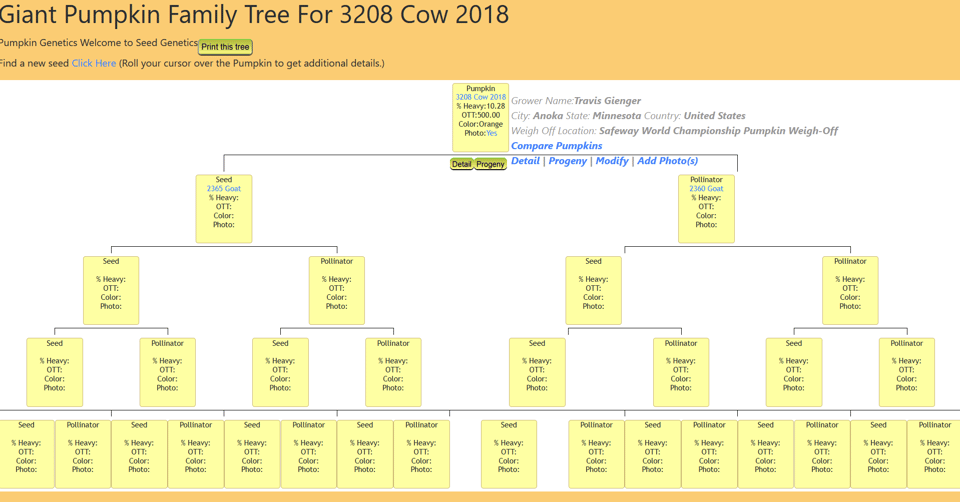
At that site, you can also check out the “most used pumpkin seed”, and use Corbin’s interactive tool to build your “Dream Seed” for a ginormous pumpkin, by matching a previously prize-winning seed with a pollinator.
5) 🥁 Draw a drum in a weird shape, see what it sounds like
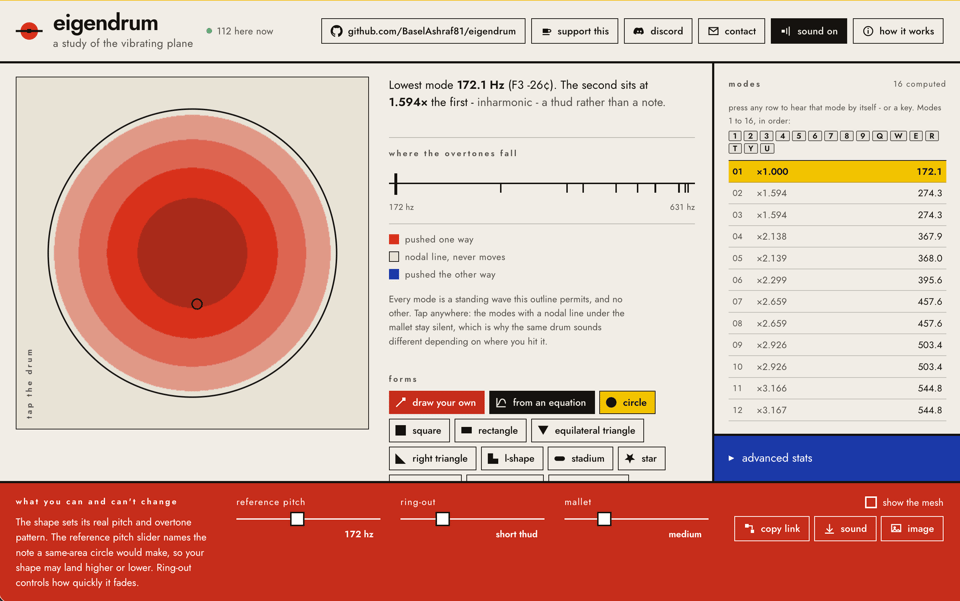
Eigendrum is a fascinating online tool: It lets you draw the shape of a drum, and then hit it to see what sound it makes.
When you open the web site it’ll show you a drum — seen from above, as if you’re looking down on the drum head. The default is a circular drum, but the site also lets you hit a drum shaped like a square, rectangle, L-shape, star, and others.
It’s fascinating seeing how the shape changes the sound! When I picked the “star”, hitting the middle produced the deepest, resonant tones — but the further I went out into one of the star’s points, the sharper and less resonant it became.
It’s a neat way to explore the physics of drums. The creator, Basel Ashraf, explains those physics thusly …
A drumhead clamped at its rim can only vibrate in certain shapes, at certain frequencies. Those shapes and frequencies are the solutions of
−∇²u = λu inside the shape, u = 0 on the edge
Each solution u is a mode, a standing wave, and each λ gives a frequency proportional to √λ. This is an eigenvalue problem, and for almost every shape it has no formula. So Eigendrum solves it numerically: it covers your shape with a mesh of triangles, builds the finite element stiffness and mass matrices, and finds the smallest eigenvalues of Kφ = λMφ.
The fun really begins when you draw your own shape for a drum head! I drew a wobbly “U” shape, and the deeper tones were clustered in its lower right bottom, with some weirdly sharp notes emerging when I hit it up high on the top arms of the “U”.
6) 📼 The psychology of why we rewatch movies and reread books
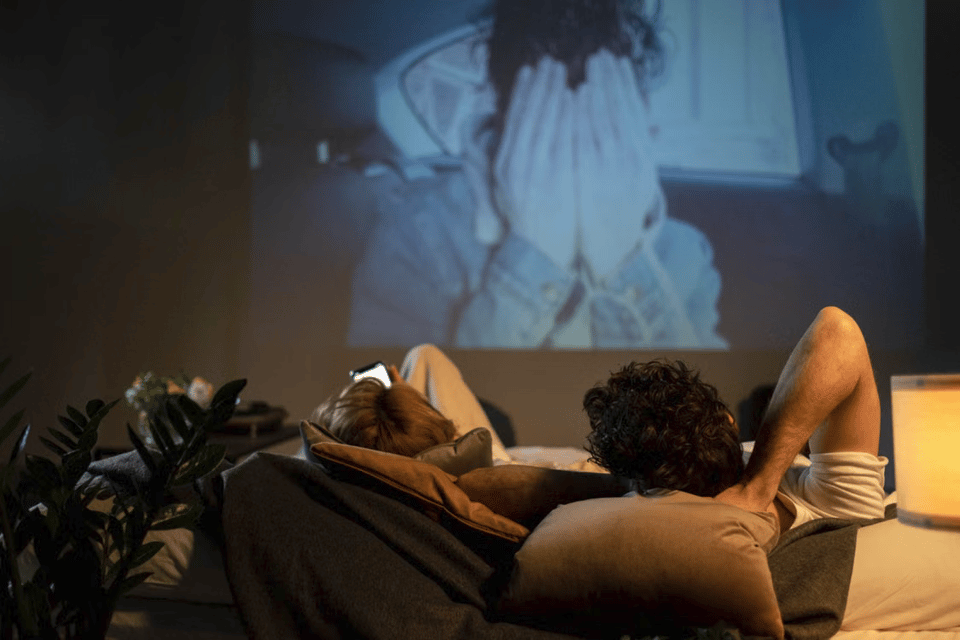
Do you rewatch movies you’ve seen before, or reread books? This is what psychologists call “volitional reconsumption” — or, as Daniel Moran describes it …
It means deliberately choosing to go through an experience you have already had: rereading a novel, revisiting a city, pressing play on the same film for the ninth time.
Moran does this — he’s watched a movie so many times “I could recite the dialogue while doing the washing up, and once, embarrassingly, I did.” With a huge world of culture around us all the time, why does he choose to rewatch the same thing, over and over again?
Scientists say that it’s partly because we’re burned out. We’ve had a long day, we’ve hit our decision-fatigue limit, and we don’t want any more cognitive or emotional surprises. There’s also “social surrogacy”: “A beloved show can partly stand in for actual human company.”
Research has also found people can be more attentive to art if they already know the plot and the surprises. It leaves us more energy for noticing the technique and the aesthetics …
In 2011, two psychologists at UC San Diego handed people short stories, some intact and some with the twist given away in advance. Readers rated the spoiled versions higher. Even the mysteries. Even the ones built entirely on a last-page reveal.
Their explanation was fluency, which in plain English means your brain finds the thing easy to process, and easy feels good. When you are not burning attention on who is lying and what happens next, you have some spare for everything else in the frame.
I relate to this with video games! Particularly vis-a-vis my fave style of games — quick-in/quick-out racing games, or “bullet hell” shooters, mostly on mobile. These types of games can be maddeningly repetitive: You face the same waves of opponents coming at you in the same patterns, over and over again. I think many people would find them crushingly tedious, but the repetition frees me to focus on the nuances of my millisecond-level twitch responses.
7) 🔥 Maine forest-fire maps of the 1910s and 1920s
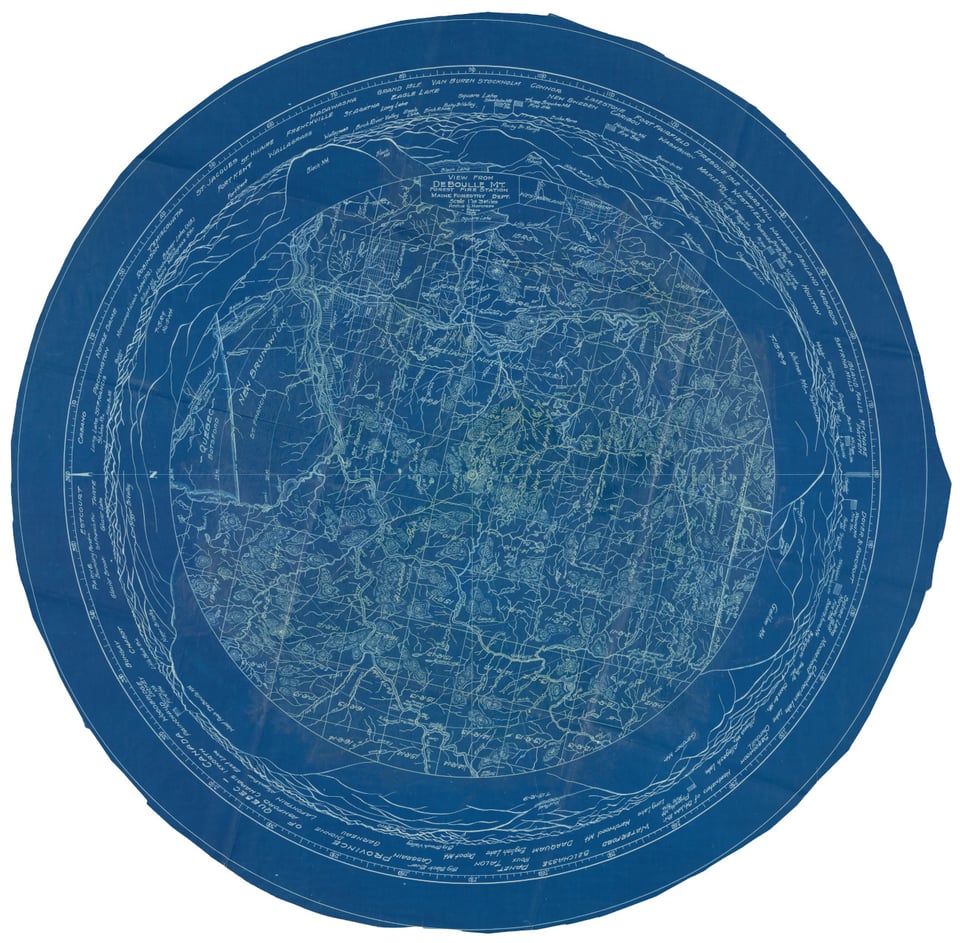
Maine suffered a few massive forest fires in 1903 and 1908, so afterwards the state began to set up a fire-management system. They erected a couple dozen fire-lookout towers, and for each tower they commissioned maps.
The maps are gorgeous. Each one has the tower at the center, and illustrates the landscape in 360 degrees, as far as the eye can see. They were all drawn by the civil engineer Archie G. Norcross, with lavish detail — here’s a closeup of that map above …
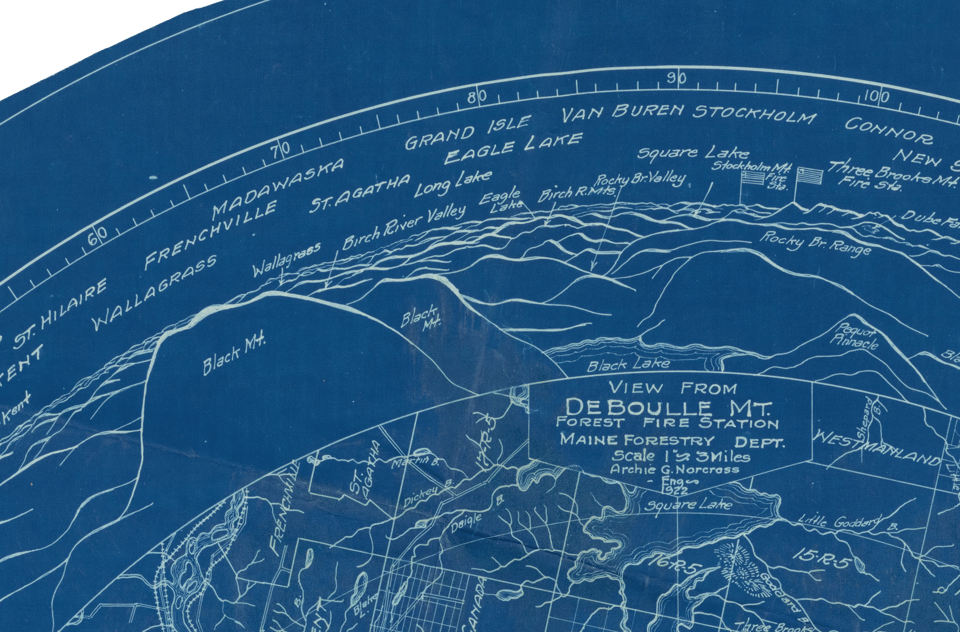
You can see five of the maps at this article at the Public Domain Review, and another five at the Digital Maine Repository.
Oh, and those fire-lookout towers? Jack Kerouac worked in one for a while in 1956. But not long after, they got decommissioned and fell into disrepair …
Gaining popularity in the early 1900s, the use of fire towers peaked in the mid-century, when improved communication technology, surveillance strategies, and “controlled burn” management began to take hold. Today, most of the 8000 lookouts have fallen into disrepair, superseded by camera networks, thermal satellite imaging, and aircraft patrols. A scant few remain active. Some are kept open as bare-bones shelters for passing hikers, who report wooden furniture and tin dishes left behind from over a century of use. The Doubletop Mountain lookout, for one, was dismantled sometime before 1972: according to the Forest Fire Lookout Association, it was “notorious for getting struck by lightning”.
8) ⭕ The secret history of the Big Wheel
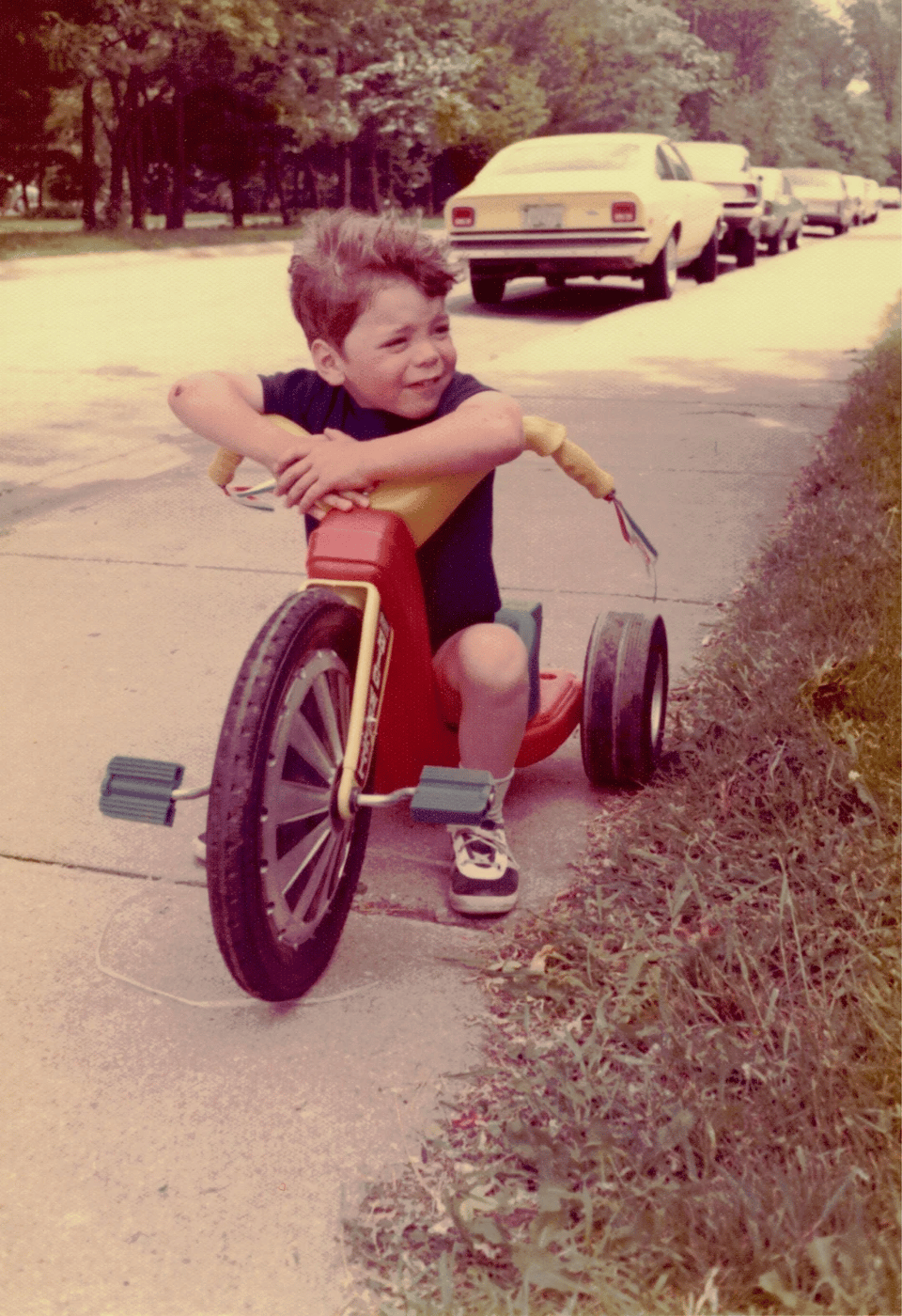
I was a kid in the 70s and 80s, and tragically my parents never bought me a Big Wheel. But my friends had them, so I got to experience the blow-molded thrills of Tokyo-drifting around our suburban Toronto neighborhood.
Over at Popular Mechanics, Dan Koeppel wrote a great history of how this nutty toy came into existence. It was a product of two forces: The genius of Louis Marx, a WWI vet with a brilliant eye for fun + the emergence of brightly-colored plastic as the futuristic substance of postwar America.
The Big Wheel was freedom, the kind that let late Baby Boomers and early Gen X kids rumble the streets of their neighborhoods with little oversight, at a time when parenting had nothing to do with helicopters or hovering. Introduced in 1969, and hitting retail stores just in time for Christmas, the trike embodied the happy anarchy of pre-digital childhood. It was one of a few toys to unashamedly promise—and deliver—pure action, an escape from front yards, fenced-in day cares, and supervision in general … [snip]
Because it was so low-slung, it was actually pretty stable, and less likely to tip over than a regular tricycle …
Marx refined the Big Wheel’s appeal: It was as safe as danger could be—and vice-versa.
While the first generations of the Big Wheel were pretty rad, the lid really blew off with the second gen — and the introduction of a hand-brake that stopped only the right wheel, not the left.
This asymmetry produced some gorgeous second-order physics …
Though Marx’s own advertising at the time touted the “brake” as helping a rider “slow down without dragging his feet,” every kid knew that the real purpose of the addition was the opposite of stopping: Just like an automobile’s emergency hand brake, if you jammed the Big Wheel’s unilateral friction lever into the locked position, you’d go into even more massive spins and drifts. (More recent Big Wheel marketing has dispensed with the pretense: “The hand brake is not a safety feature,” some current materials note, “but completely opposite. It is designed to do tricks.”)
Tragically, the intellectual property got tossed around for a few decades, and the Big Wheel faded from the scene. You can still get one now, though; there are even adult variants.
9) 🍋 A Chrome/Firefox extension that serves up weird, random sites
I’ve written a bunch about “rewilding your attention” — or, getting away from the big-tech recommendation algorithms, and spending more time looking at weird, offbeat things online.
One of my motivations in publishing the Linkfest, in fact, is that it requires me to spend time rummaging in the long tail of the Internet. I’m just as likely as anyone else to get sucked into the social-media vortex, staring at endless repetitions of the same five opinions about the same four things that are Trending Today. So I rely on the publishing pressure of the Linkfest (gotta find some stuff for the next issue) to force me to decouple from the hivemind, and spend some time instead with my RSS feeds. #lifehacks
I was thus delighted to get an email from the developer Nyk Sab, describing a plugin he created called “Web Wander”. As he described it to me …
It rotates through 24 discovery sources, varies source types and destination domains to reduce repetition, and lets people browse broadly or choose among 56 categories, custom keywords, different web eras, video and music. Preferences and recent history stay local, and no account is required.
The idea is not another recommendation feed. It is a small lever for intellectual serendipity.
Basically, you click on the extension button and it serves up a cool, offbeat site.
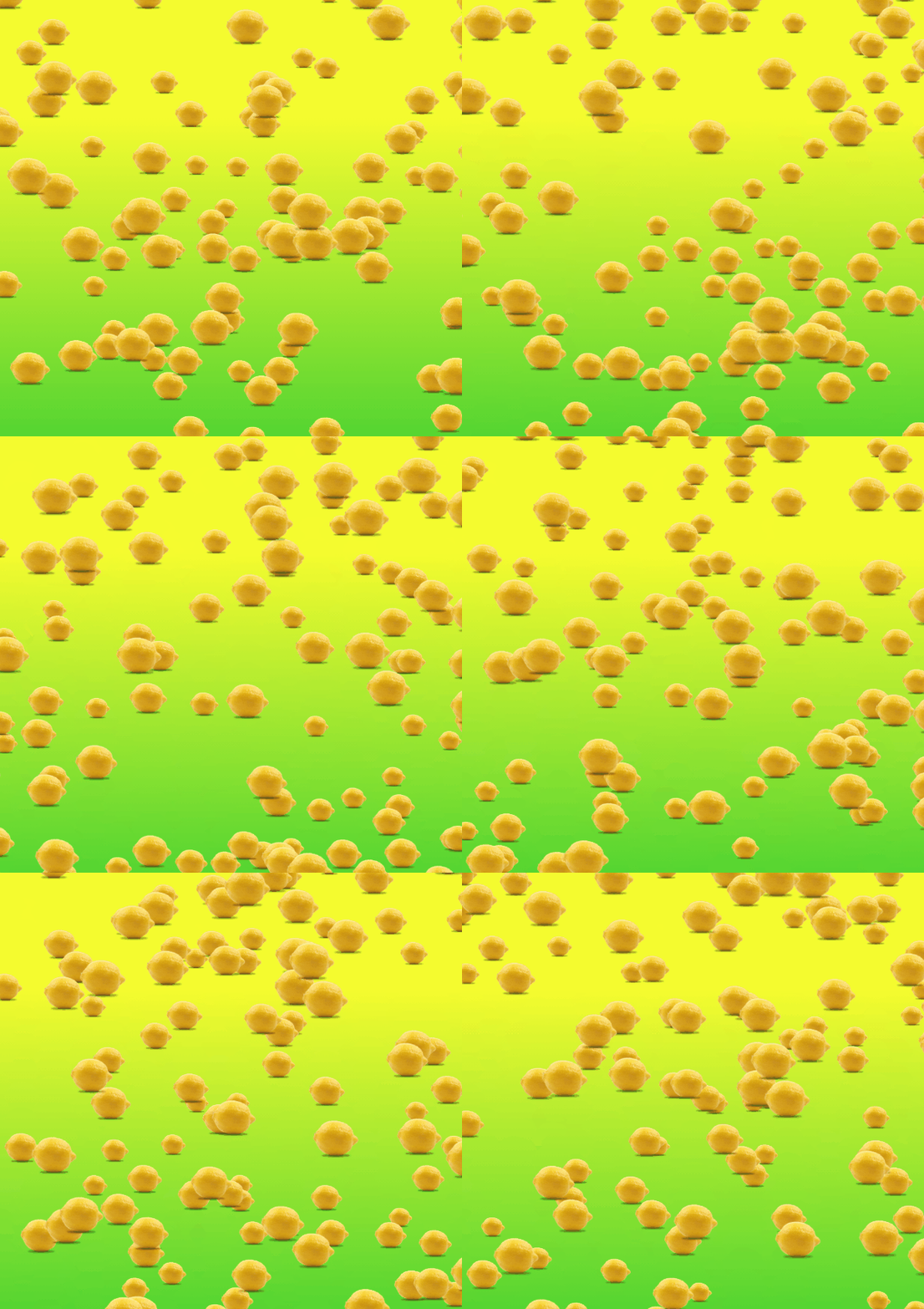
For example, I just clicked Web Wander a handful of times and got these sites: A funky personal site for the artist Katrina Evans; an online audio toy; the site for MakeSoil, a site that links folks with compost to soil sites; a trippy swirling animation (watch out: could trigger anyone with photosensitivities); a TV test-card gallery; a Snood video-game knockoff; and an animation of infinitely falling lemons.
You can get the plugin here — give it a try!
10) 🧑🚀 Why astronauts on long trips get out-of-body experiences

Staying in space for a long time — six months or more — apparently does some weird stuff to the astronaut mind. As Justin Brown writes in Space Daily …
Astronauts coming home from long stays on the International Space Station have, for years, described a strange perceptual aftertaste: a sense of watching their own lives from a half-step outside the frame. They sit at dinner with family and feel like a guest … [snip]
Crew members talk about feeling slightly delayed in conversations. They report a doubled awareness — being present while also watching themselves be present. Some say it feels like the first week of a new job that never quite ends … Some talk about being unable to put a glass down without watching their hands do it.
What’s going on? The astronauts have spent so much time in weightlessness that their entire perceptual apparatus has retooled …
The brain in microgravity rewires fast. The vestibular system, deprived of a consistent gravitational reference, stops trusting the inner ear and starts privileging vision. Proprioception — the sense of where your limbs are without looking — degrades. The visual cortex takes on extra work. When the astronaut comes home, all of that has to reverse, and the reversal is not symmetrical with the adaptation.
There’s an emotional change too …
… what astronauts themselves have long named the overview effect: the worldview shift that comes from seeing Earth as a single sphere with no borders. The overview effect changes what feels important. Returning crews often describe a temporary inability to take ordinary social friction seriously — traffic, small talk, office politics — and that emotional distance can read, from the inside, as a kind of detachment.
This is damn interesting stuff! It also suggests that anyone who tried to go to Mars — or even to live for a long period on a moon base — could wind up in some incredibly strange psychological states … and not terribly stable ones. Astronauts are, of course, selected for their ability to withstand stress and extreme environments. They’ve got Jedi-level self-regulation. But what we’re talking about here are really serious physiological rewirings.
11) 🧭 Maps of the journeys inside classic novels
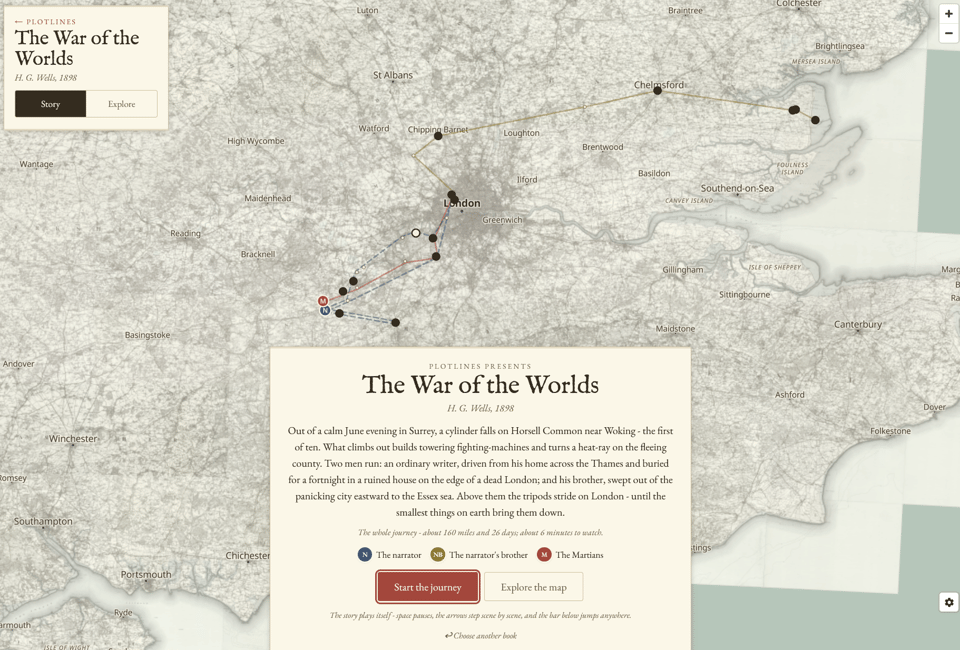
The developer Chris Moran has created Plotlines, a fun literary experiment — it maps out the journeys in 27 classic novels. You can follow along a precis of the plot of a novel as it progresses, and watch the dot travel across the map, in the style of an old “map-travel moment” on a film-reel.
Moran promises that he’s been pretty rigorous about accuracy …
Every location carries a badge, and the badge matters. Real place means exactly that - Whitby's Tate Hill Pier, 197 Chicksand Street - and the pin goes precisely there. Identified place means the novel is being coy but the answer is generally agreed: Stoker's "Kingstead" churchyard is Highgate Cemetery in all but name. Best guess means the place is invented - Castle Dracula, Carfax, Hillingham - and the pin is an editorial judgement made from the clues the novel leaves. Guessed places are drawn with dashed routes and hollow markers, and each carries a note explaining the reasoning. If you think a pin is in the wrong place, you may well be right, and I'd like to hear about it.
Every quotation on the map has been checked, verbatim, against the Project Gutenberg text; and every period image is public domain and has been confirmed by eye to be actually the place - a real spot gets a contemporaneous view of itself, an invented one an indicative view of the real country beneath it, never a picture pretending to be something it isn't. The credits are at the foot of this page.
(That said, Moran also explains that he used a group of AI agents to do the textual analysis, so I’m not sure how he reality-checked everything to avoid any AI-generated howlers.)
I dig this way of visualizing a plot! As with all good dataviz, it’s a way of re-seeing something with fresh eyes. I had always realized that Ulysses is a geographically dense story, but the map really hammers it home. In contrast, Moby Dick, roams over the entire dang planet.
Frankly, until I saw that map, I don’t think I’d clocked just how far the Pequod travels. The final showdown with Moby Dick takes place all the way out in North Pacific Ocean!
12) 🔊 How Z. Carrière photographed the sonic boom of a cracked whip

Back in the 1920s, the scientist Z. Carrière noticed that the sound of a bullet whizzing past your head was very similar to the sound of a cracked whip. Scientists knew by then that bullets moved faster than the speed of sound, and that this caused a sonic boom. So Carrière wondered: Was the tip of a whip also breaking the sound barrier?
The sci-fi author Neal Stephenson wrote a wonderful essay explaining how Carrière did it. And man alive, what a tale! To pull off the feat, Carrière had to chain together (and/or invent) a wild array of steampunk inventions — including a photographic apparatus lit by an electric spark-gap strobe, which was itself precisely timed by dropping a series of steel balls, and powered by a spinning Whimshurst voltage-generator hooked up to a series of daisy-chained Leyden jars that built up a 20,000 volt charge.
That’s just one part of this astonishing endeavor. Carrière also had to figure out how to make visible the airflow and sound-waves coming off the tip of the whip. He had a banger of an idea: Coat the whip-tip with soot …
Prior to each repetition of the experiment, Carrière places these drums into a smoker for a while, so that they become coated with soot. The soot isn’t bonded to the surface, it’s just a light surface layer. He mounts the sooty drums on the axles and gets them spinning. Then he performs the whip crack.
As the whip passes through the cracking zone near O, it generates a shock wave that spreads out in its wake. When the shock hits the nearby drum it blasts off the soot, leaving a visible trace along a narrow path. Because the drum is spinning, the trace doesn’t run perpendicularly up the edge of the drum; the drum’s moving laterally underneath the shock wave as the trace is laid down, and so the result is an angled trace—a helix. The angle of the helix can be measured. Since Carrière knows how fast the drums were spinning, he can use this to calculate the velocity with which the tip of the whip was moving when it produced the shock.
Based on data collected using this technique, Carrière concludes that the tip of the whip is moving at at least 350 m/s in the vicinity of point O: faster than the speed of sound.
Carrière was, as Stephenson concludes, a “monstrously gifted experimentalist”.
Though truly, most cutting-edge scientists are! This is honestly one of the things I most love about doing science journalism: Hearing the tales of how experimenters measured something. Gathering good data is hard, and when you’re in a new realm — measuring something that nobody has before measured — you have to be creative and inventive.
We often think of science as “sitting around having a big ‘aha’ insight”. But those insights either emerge from data or require data to validate them. And gathering data? Damn, that’s often the hardest part. I can’t tell you how many times I’ve interviewed scientists who told me they had their “aha” flash of insight — the sudden formulation of a crisp, neat hypothesis — over a single cup of coffee; but then they had to spend years and years figuring out some ornate experiment to gather the data. (One of the real doozies here — an experiment so complex I once thought of writing a book just about it — is Gravity Probe B.)
Anyway, this is a fabulous chronicle of a truly dogged scientific mind. Go read it!
13) 🎟️ A sudden, final-death round of reading material
European Heatwave Simulator, the game. 🎟️ The Commodore 77. 🎟️ DIY backyard dark-matter detector. 🎟️ The crochet work of George Washington Carter. 🎟️ Online museum of moist towelettes. 🎟️ Supersonic trebuchet. 🎟️ The “Roobadge”. 🎟️ Online tool that generates alternative soccer-ball geometries. 🎟️ Top 10 shittiest birds. 🎟️ DumpsterCluster. 🎟️ Maybe scientific progress isn’t slowing down, after all. 🎟️ Anthology intelligence. 🎟️ Automated rat-killing turret. 🎟️ Speeding is now normalized. 🎟️ A “golden age” of languages flourished 3,000 years ago. 🎟️ First study of menstrual flow in microgravity. 🎟️ This guy claims he’s D.B. Cooper. 🎟️ Singing the Halo theme music in an empty oil silo. 🎟️ Pinball-machine clocks. 🎟️ Some trees. 🎟️ A new history of boredom. 🎟️ Biographies of people who don’t exist. 🎟️ Turns out medieval parents deeply loved their children. 🎟️ McDonald’s backpack. 🎟️ English has had no new major punctuation since 1600. 🎟️ Solar car generates more power than it needs. 🎟️ Rotating boxes. 🎟️ Balloon banjo. 🎟️ Antique table robot dog. 🎟️ Glacier mice. 🎟️ A LLM with the knowledge of a five-year-old. 🎟️ BBS that runs on a Casio calculator. 🎟️ The book of holes.
CODA ON SOURCING: I read a ton of blogs and sites every day to find this material. A few I relied on this week include Strange Company, Link Machine Go, Hackaday, Messy Nessy, Numlock News, 10 × 1 Things, the Awesomer, Book of Joe, the Morning News, and Mathew Ingram’s “When The Going Gets Weird”; check ‘em out!


