
Linkfest #46: "Curse Tablets", a Robot Cellist, and Why Geologists Always Die In Movies
Hello there!
Time for "the opposite of doomscrolling” — my latest “Linkfest”, for which I sift through the endless vinyl-crates of the Internet, hunting for the finest tracks of science, culture and technology.
If you’re a subscriber, thank you! If not, you can sign up here — it’s a Guardian-style, pay-whatevs-you-want affair; the folks who kick in help keep it free for everyone else. And also — forward this email to anyone you know who’d like it!
Let’s begin ...
1) 🪴 Iphone case with a terrarium inside
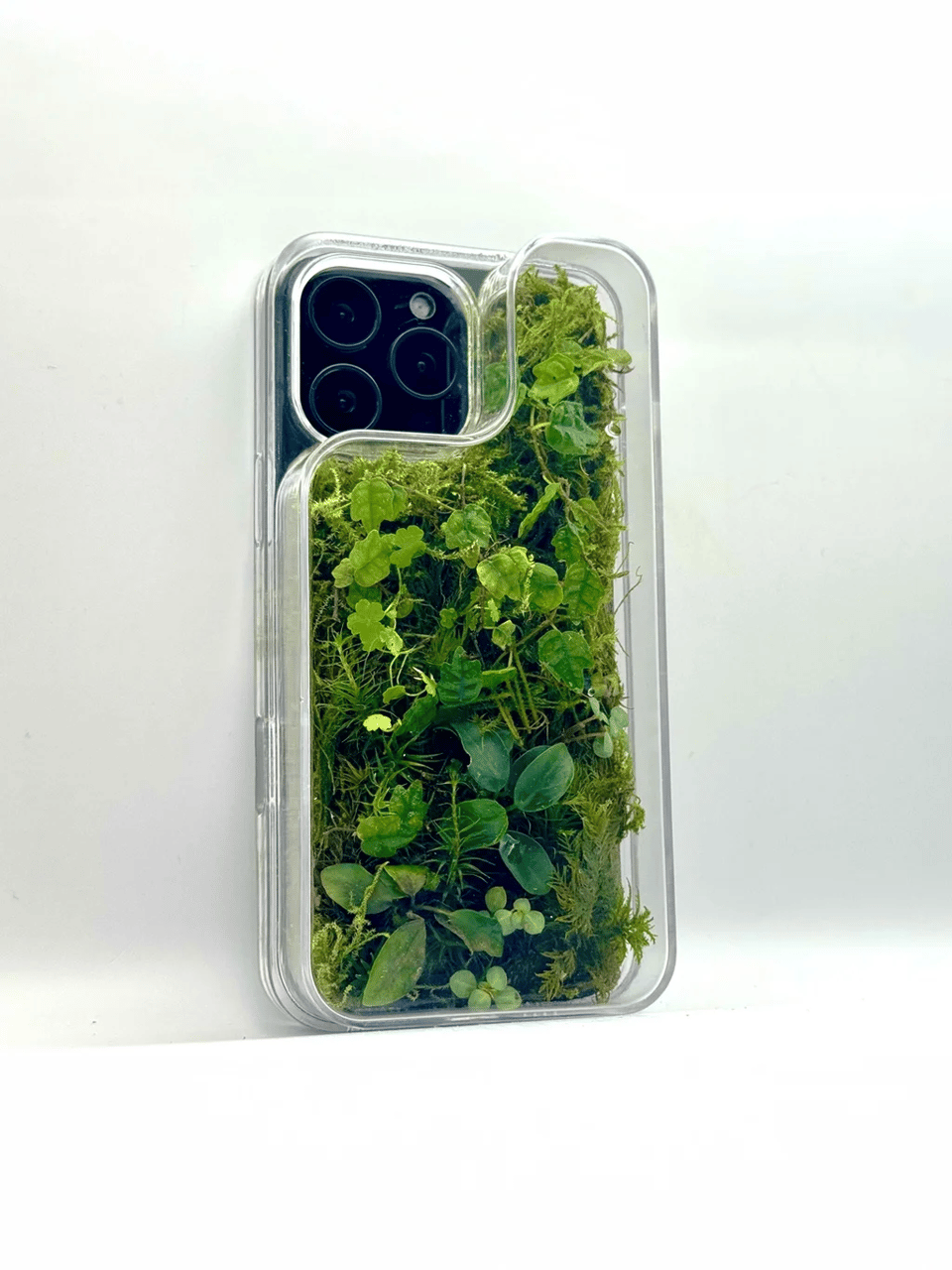
The designer Daniel Idle has put a wee terrarium inside a transparent Iphone case. Biophilia in your pocket!
As he tells Hunter Schwarz writes at Fast Company (unpaywalled link) …
“The idea came from noticing how personal phone cases have become,” Idle tells Fast Company. “People use them to carry objects, express themselves, and customize something they interact with all the time. That got me thinking about how much time we spend on our phones and how disconnected they make us feel from nature.”
The case is made from two pieces: the structural printed shell and the enclosed chamber, and it’s surprisingly low maintenance. It requires infrequent watering—just a small amount of water if the plants start to dry out; the case sustains itself through the condensation cycle of internal moisture.
In his own case, Idle grew small-scale plants well suited for enclosed terrarium environments, including moss, which works especially well since it creates an immediate sense of landscape at miniature scale and doesn’t take much upkeep.
I wish someone would commission him to bring this retail, I’d buy one in an instant!
Sure, it makes your phone more bulky and unwieldy, and harder to use. But given that the whole point of the project is to have us reflect on how much we overuse our phones, this could be not a bug but a feature, heh.
(More photos over at designboom.)
2) ⌨️ Sounds of famous keyboards

I adore clicky mechanical keyboards. On a pragmatic, ergonomic level, they’re simply easier to type on, because the bounciness and responsiveness of the keys — and the gorgeous curved divots on each — help me make fewer mistakes. My fingers feel like they know precisely where to go, compared to the flat chiclets you get on so many laptops these days.
But it’s more than just physical ergonomics. The sound of a clicky keyboard is wonderful: It’s like ASMR for writers. When each key is giving off a lovely, satisfying snick, touch-typing takes on a musical quality. When you’re hesitating and thinking, there’s silence punctuated by the occasional few clicks; then, when you suddenly have an idea for a passage, there’s a military burst of keypresses. On a mechanical keyboard, your intellectual momentum creates a soundtrack.
I was thus delighted to stumble upon the “Listening Museum”, which samples the sounds of 36 famous clicky keyboards, and plays them as you type.
I tried the Unicomp Classic, which describes its acoustic signature thusly …
Why it sounds this way
Same buckling spring mechanism as the Model M it descends from. Slight differences from true Model Ms come from newer plastic formulations and updated PCB, but the acoustic core,spring-buckle-hammer into membrane,is identical. You are hearing the same bucklespring recording as the Model M entry because Unicomp still builds these on the original IBM tooling, so the mechanism and steel plate are literally the same parts.
Go give ‘em a whirl. It’s really delicious.
(Thanks to Joe Stirt for this one!)
3) 🦠 Running Doom on E coli cells
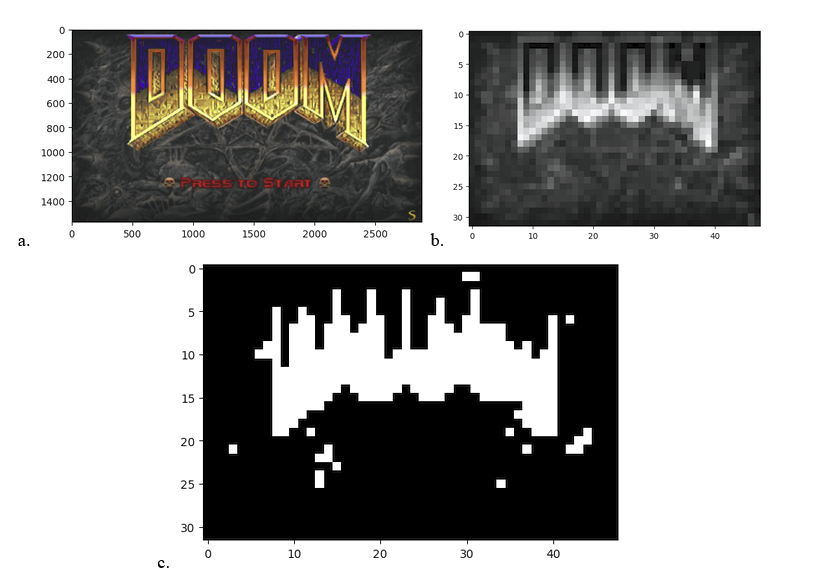
Lauren “Rem” Ramlan is a PhD student researching biotechnology at MIT, and she’s figured out how to get Doom running on E Coli.
Not the computation necessary to run Doom. That, as she notes in her writeup of the experiment, “would be a behemoth feat that I cannot even imagine approaching”.
But she did get it running on display made from the bacteria!
As Andrew Paul writes at Popular Science …
According to Ramlan, for the project to work, E. coli cells must function as traditional pixels capable of being either “on” or “off.” They also need to collectively light up to form images like a computer monitor or TV screen. To make that happen, Ramlan first grew cells within a 32×48 1-bit well plate, then connected the makeshift screen to a controller capable of processing and translating binary code into the “addition or omission of a repressor controlling the fluorescence of the cells.” Basically, Ramlan swapped a traditional screen’s tiny light diodes for glowing bacterial cells.
The screen-refresh rate is, ah, not the speediest. Apparently playing a single full game would take until … 2725:
Ramlan’s invention reportedly takes roughly 70 minutes to fully illuminate, then another 8 hours and 20 minutes to dim back to its original state. All told, that’s basically about 9 hours to offer players a single frame of the video game. Given that the original Doom tops out at 35 frames per second, it would take quite a while to actually play through the entire game—like, 599 years “a while,” according to Ramlan’s calculations.
Ramlan made a terrific video about the project here.
4) 💡Tom Stoppard inspired a breast-cancer treatment
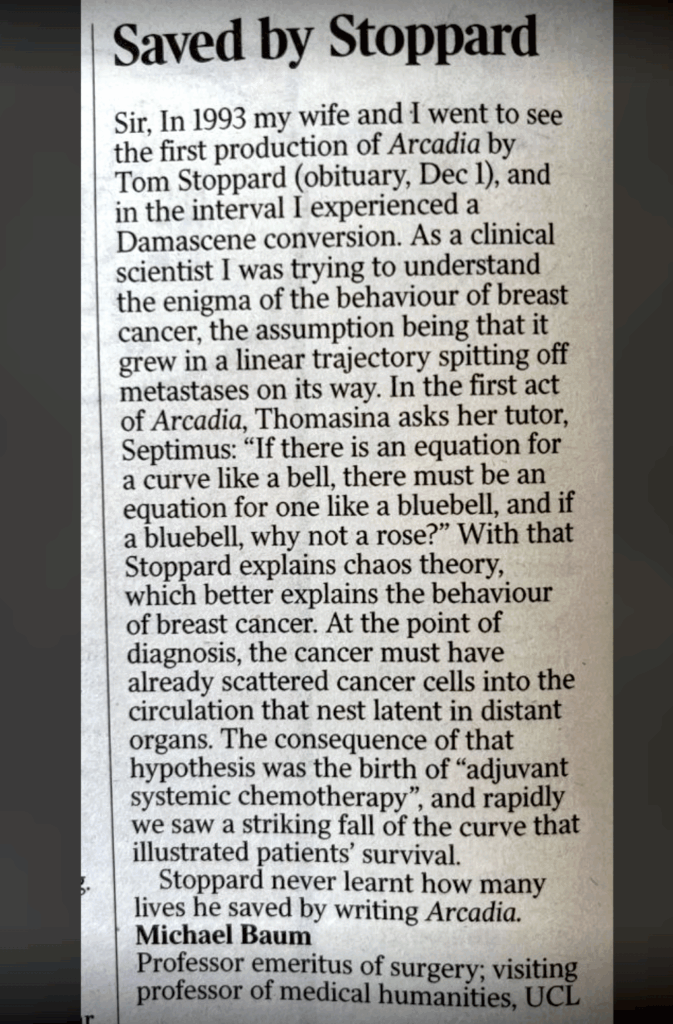
I’m coming to this one late, but back in December the playwright Tom Stoppard died — and the cancer researcher Michael Baum wrote this remarkable letter to The Times of London.
I’ll transcribe the entire thing for screen readers …
Sir, In 1993 my wife and I went to see the first production of Arcadia by Tom Stoppard (obituary, Dec 1), and in the interval I experienced a Damascene conversion. As a clinical scientist I was trying to understand the enigma of the behaviour of breast cancer, the assumption being that it grew in a linear trajectory spitting off metastases on its way. In the first act of Arcadia, Thomasina asks her tutor, Septimus: “If there is an equation for a curve like a bell, there must be an equation for one like a bluebell, and if a bluebell, why not a rose?” With that Stoppard explains chaos theory, which better explains the behaviour of breast cancer. At the point of diagnosis, the cancer must have already scattered cancer cells into the circulation that nest latent in distant organs. The consequence of that hypothesis was the birth of “adjuvant systemic chemotherapy”, and rapidly we saw a striking fall of the curve that illustrated patients’ survival.
Stoppard never learnt how many lives he saved by writing Arcadia.
Michael Baum
As I’ve noted in previous Linkfests, I adore stories about how luck and happenstance fuel scientific and technological discovery! Like how the Post-it note was invented during an accidental encounter between two 3M employees, or how a scientist recently accidentally discovered that ultrasound waves can clear away blood clots (item #12 in this Linkfest).
It’s not just luck, though. It’s the magic that can emerge when you’re exposed to two seemingly unrelated fields, and they spark a new idea. Here, it’s Tom Stoppard’s drama and cancer therapy. In my own professional life, one of my most interesting journalistic ideas came when I connected a long-ago Oliver Sacks essay I’d read (about neurology) to the behavior of early Twitter users, and it gave me a name for a new phenomenon: “Social proprioception”.
And of course, these connect-the-dots moments only occur if you’re actively exposing yourself to lots of dots, right? And — importantly — dots from seemingly unconnected domains. You’re a cancer researcher, but you’re going to a Tom Stoppard play. To gestate creative new ideas, it’s crucial to constantly expose yourself to disparate fields … particularly fields that do not, at first glance, seem related to yours at all. It’s in those gaps that the intellectual lightning-bolts form.
(This phenomenon is, more or less, why I write the Linkfest.)
5) 🐧 Chart of penguin relationships in Japanese zoos
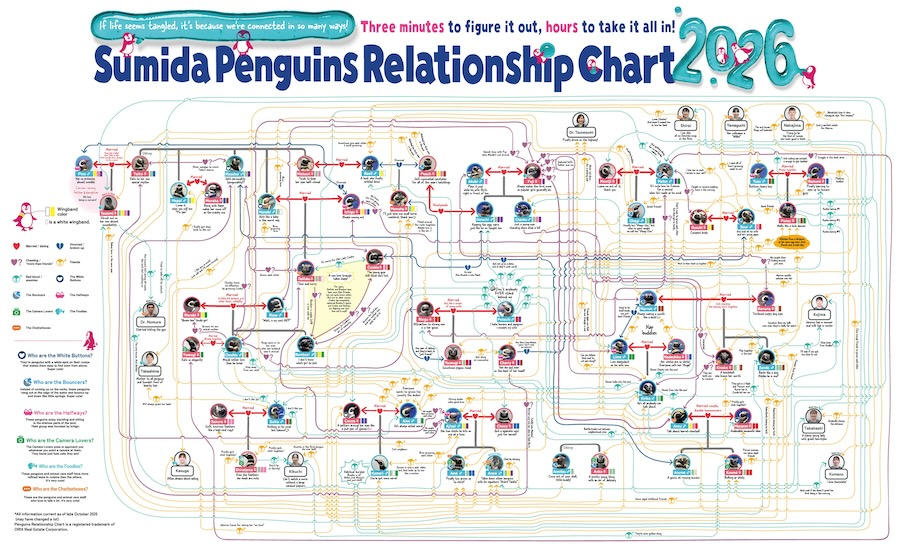
Penguins have famously complex social networks: They sometimes pair up in polyamorous groups and same-sex couples, with lots of adultery and egg-stealing thrown in for good measure.
Two zoos in Japan keep careful track of their penguin drama, and they’ve tracked it in a hand-drawn flow-chart of positively byzantine complexity.
Here’s a close-up …
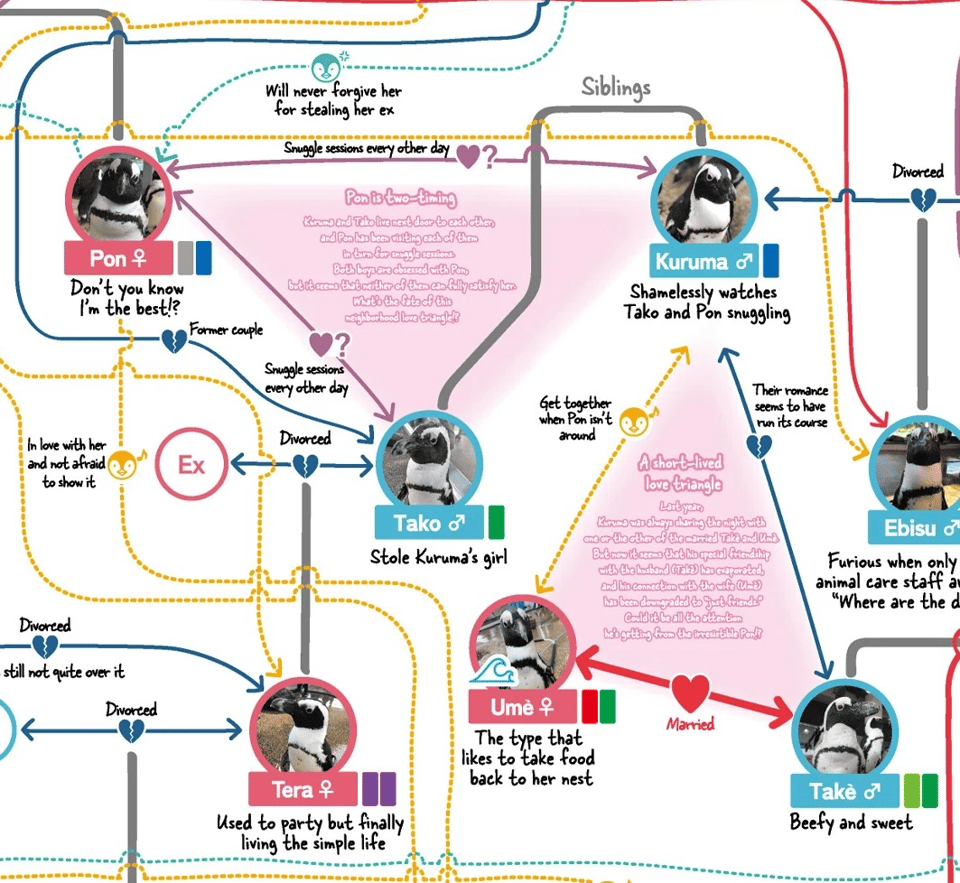
People, this is the science we need. As Johnny writes at Spoon and Tamago …
According to the aquarium’s caretakers, the penguin’s romantic escapades are fairly easy to observe. For example, wing-flapping is a sign of affection and couples can be seen grooming each other. Penguins who are getting over a break-up will often refuse to eat.
Someone needs to give these penguins their own reality TV show!
6) 🤖 Robot cellist
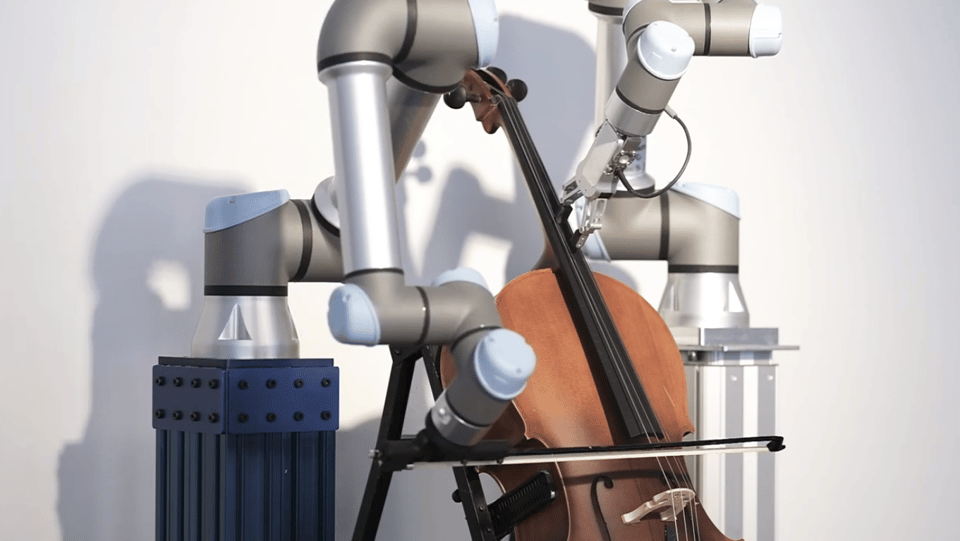
Fredrik Gran is a composer based in Stockholm who has, since 2009, been experimenting with a cello that’s played by two robots.
You can see a video of it in action here. It’s spookily pretty!
It’s playing something much as a human would play it — i.e. emulating human abilities. This isn’t easy! As Sage Morei (a musical director who has worked with this robot and other musical robots) notes, the human body is incredibly complex ...
If you want to measure robotic dexterity, playing instruments designed for humans is the ultimate litmus test.
Trying to replicate a trumpet embouchure has been particularly humbling. Brass players make it look effortless, but the sheer complexity of what’s actually happening — lips buzzing, tonguing, air pressure, embouchure constriction shifts — has only deepened our awe for human anatomy.
What’s more interesting, to me, is this idea advanced by the composer Jacob Mulhrad — i.e. that we should use the alien, non-human abilities of a robotic arm to play music in a style that human’s can’t …
What is interesting about a cello robot, in particular, is that it is anatomically structured differently … [snip]
“It’s an exciting exploration of how you can actually play a cello based on conditions other than the dimensions of your hand,” said Muhlrad.
Granted, I haven’t yet seen any examples of this particular robot playing in a really weird fashion, but here’s hoping.
7) ⛈️ App that matches a Rothko to your current weather
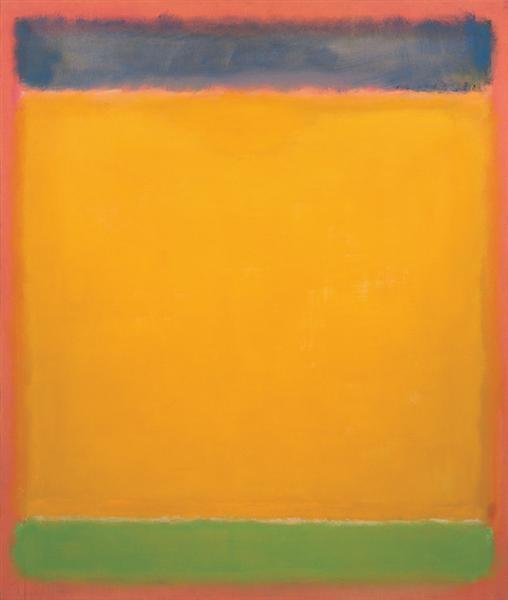
“Current Rothko” is a web app that — if you tell it where you’re located, or give the browser access to your location — it fetches the current weather and then displays a Rothko painting that matches your local conditions. It’s a creation of Joonas Virtenan.
Above is NYC when I checked, on Tuesday just after lunch!
Below were Cape Town, Cairo, and Rekyjavik, at the same time …
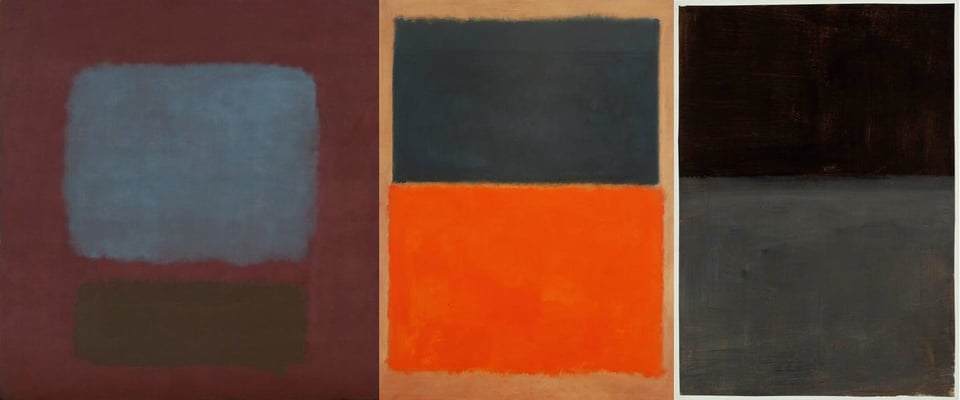
Mind you, I don’t know what algorithm he uses to match one’s weather to a Rothko. He gives a vaguely poetic explanation at the bottom of each image, sort of?
8) 😈 Ancient Greek and Roman “curse tablets”
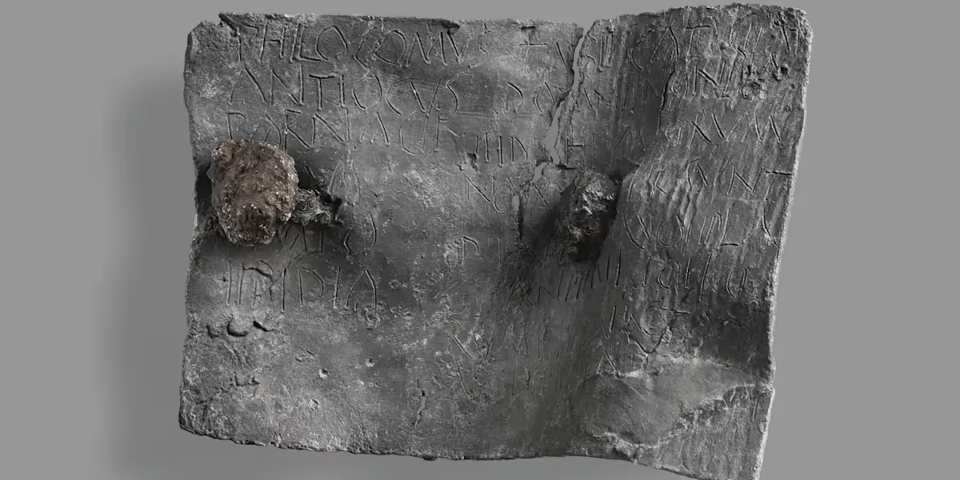
Back around 300 B.C.E., an ancient Greek citizen was facing down the lawyer Lampias. To try and keep Lampias from prevailing at the trial, the citizen created a “curse tablet” — a magical petition calling on supernatural forces.
“I bind the tongue and soul and speech that he is practicing, and his hands and feet and eyes and mouth. All of these I bind, I hide, I bury, I nail down. If they lay any counterclaim before the arbitrator or the court, let them seem to be of no account, either in word or in deed.”
I’d never heard of “curse tablets” before, but Dave Roos has a terrific essay about them at History.com. Apparently they were in wide use from 500 B.C.E to 500 A.D., and after inscribing your curse you nailed it shut …
Curse tablets were usually folded up, pierced with a nail and fixed to a hidden place, which seemed to actuate the curse’s power.
“The text of the curse will say ‘I bind so-and-so' or ‘I nail down so-and-so,’ and that’s reinforced through the ritual act of nailing it to some location,” says Kimberly Stratton, a religion professor who studies ancient magic at Carleton University. “The nailing is part of the curse that's binding the [targeted person], holding them or harming them.”
They were very popular in sporting events!
Curse tablets were written to “bind” all kinds of rival targets, but the most popular arenas were sports, legal battles and sex. Chariot races, for example, were absolutely huge in the Greco-Roman world—as was gambling on chariot races—and people were fanatical about their local teams and star charioteers.
“They would get into fights and start riots when their team didn’t win,” Stratton says, which is not so different from today. A typical curse tablet from Syria in the second century A.D. reads:
“[N]ow attack, bind, overturn, cut up, chop into pieces the horses and the charioteers of the Blue colors.”
These days, someone could probably vibe-code an app for cursing one’s enemies; it’d be a hit.
9) ☠️ Geologists in movies die surprisingly often
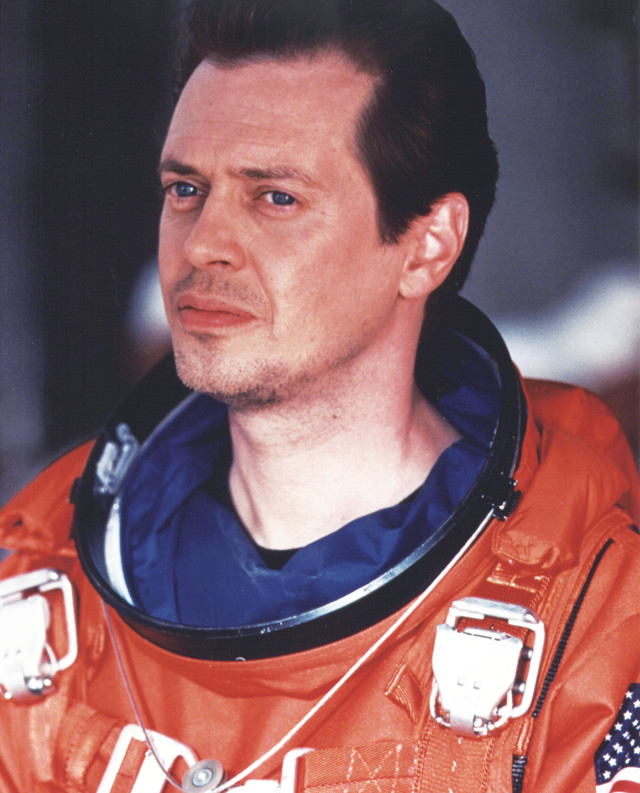
A group of geologists collected data on every movie that includes a geologist — a total of 141 flicks.
What did the data reveal? Geologists mostly appear in the genres of adventure (47 movies), action (36 movies), and sci fi (35). Nine of ten are men, and the majority — 85% — are good guys, not villains; 43% have central roles, which is kind of cool.
But! Some dire news …
Geologists die at an alarming rate in the movies, often very early on in the movies seen, which requires some deeper analysis. The death percentage varies between 35.7–31.6 percent over our sampling years. Of the 202 geologists in 141 movies, 69 die or are found dead. Thankfully, this percentage has decreased to 34.2 percent with the latest addition of data. This decrease results from the increased number of movies we found from the 1920s and 1930s. The movie makers during these early days were not so prone to killing the geologist. Only one death (heroic!) in this time slot occurs in Flying G-Men (1939).
Category 1: Murder. A good example is the fatal elimination of ‘baddies’ by heroes such as James Bond, such as in the movie Dr No (1962), where ‘007’ kills the evil petrologist, Prof. Dent.
Category 2: Work related. Typical examples are being hit by a volcanic bomb, falling into a crater or an opening fault, drowning in quicksand or lahar, and incineration in an oil pit. Grim stuff.
Category 3: Killed by or because of Extra-Terrestrial encounters. That is, being killed directly by aliens or assimilation by aliens and consequently killed by former colleagues, such as the geologist in Prometheus (2012).
Category 4. Miscellaneous accidents. Such as being crushed by falling crates as in Deep Star Six (1989).
Category 5. Traffic accidents. Killed in exotic events like crashing with a spaceship on the asteroid in Armageddon (1998).
Category 6. Health issues. Such as heart attack suffered by the geologist in Equinox (1970).
Category 7. Suicide. Where it all gets too much, as in Walkabout (1971).
Category 8. Unknown. A good example is the fate of the geologist in Gold (2016): suicide, or did he fake his death?
The article dives into some examples of these grisly ends. It’s a hoot — go read the whole piece!
10) 🧵 Embroidered late-night city scenes

As Kate Mothes writes in Colossal …
When Adrienna Matzeg embarked on a trip to Kyoto, Tokyo, and Seoul in July 2025, she encountered intense midsummer heat and humidity, which led her to exploring some of the cities’ nooks and crannies in the dark, when it was cooler.
Matzeg, a textile artist, was so struck by these scenes that she used them in a striking series of embroideried landscapes:
Illuminated storefronts and signage characterize the artist’s late-night runs to convenience stores, markets, and other features of these hubs’ sprawling urban fabric. “In her textile embroidery work, however, the energy of the city falls away,” says a statement from Abbozzo Gallery, which presents her forthcoming solo exhibition, After Hours. “What remains are quiet scenes that left an imprint, tactile snapshots as a record of those summer nights.”
They’re fabulous! You can see more at the Colossal story or at Matzeg’s Instagram feed.
11) 🧨 Violent checkers
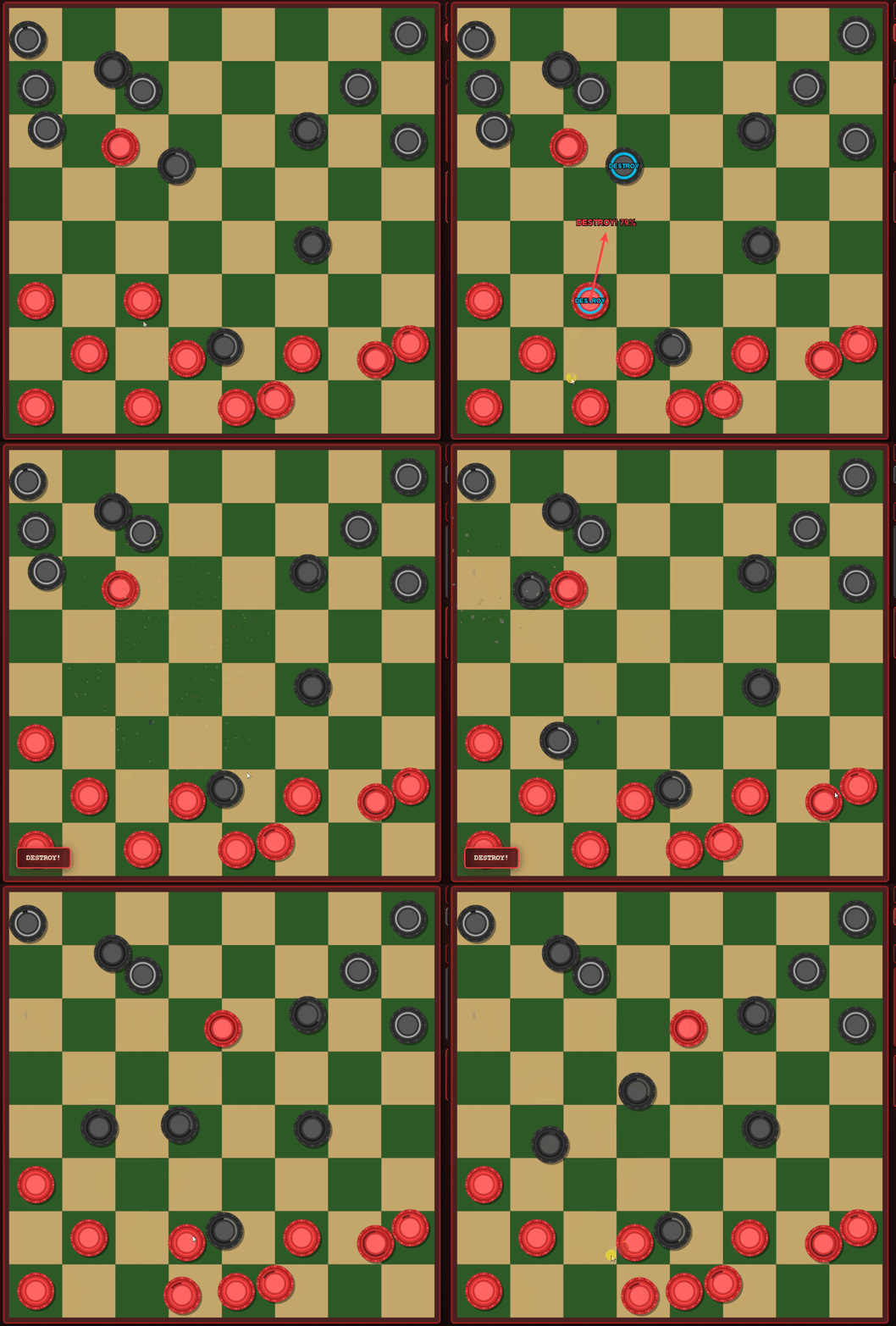
Behold Violent Checkers, a game created by Benj Edwards. He’s a phenomenal writer who specializes in doing deep dives into retro computing (you can see some of his past work here), but he’s also a hobbyist programmer who has been designing games for years.
Last winter he started using Claude Code to produce games at a much more accelerated pace — Violent Checkers is one of them. It’s a blast! It’s sort of like billiards or curling; you have to try and eliminate your opponent by bonking their checkers until they’re destroyed. Getting one of your checkers to reach the far side turns it into a king, which has extra shielding from attacks.
It’s clever — easy to learn, hard to master.
Edwards also wrote a great essay about what it’s like using Claude to create games. The pros: Claude is far faster, and lets him be much more ambitious. The cons: Getting to 90% is easy, but polishing the final 10% is arduous. Also, creating a genuinely novel game is tricky, because the LLM is always trying to quantize your idea towards the the already-known.
Due to what might poetically be called “preconceived notions” baked into a coding model’s neural network (more technically, statistical semantic associations), it can be difficult to get AI agents to create truly novel things, even if you carefully spell out what you want.
For example, I spent four days trying to get Claude Code to create an Atari 800 version of my HTML game Violent Checkers, but it had trouble because in the game’s design, the squares on the checkerboard don’t matter beyond their starting positions. No matter how many times I told the agent (and made notes in my Claude project files), it would come back to trying to center the pieces to the squares, snap them within squares, or use the squares as a logical basis of the game’s calculations when they should really just form a background image.
To get around this in the Atari 800 version, I started over and told Claude that I was creating a game with a UFO (instead of a circular checker piece) flying over a field of adjacent squares—never once mentioning the words “checker,” “checkerboard,” or “checkers.” With that approach, I got the results I wanted.
Go read the whole essay, it’s fascinating!
12) 🏀 Photographing all 2,459 basketball courts in Hong Kong
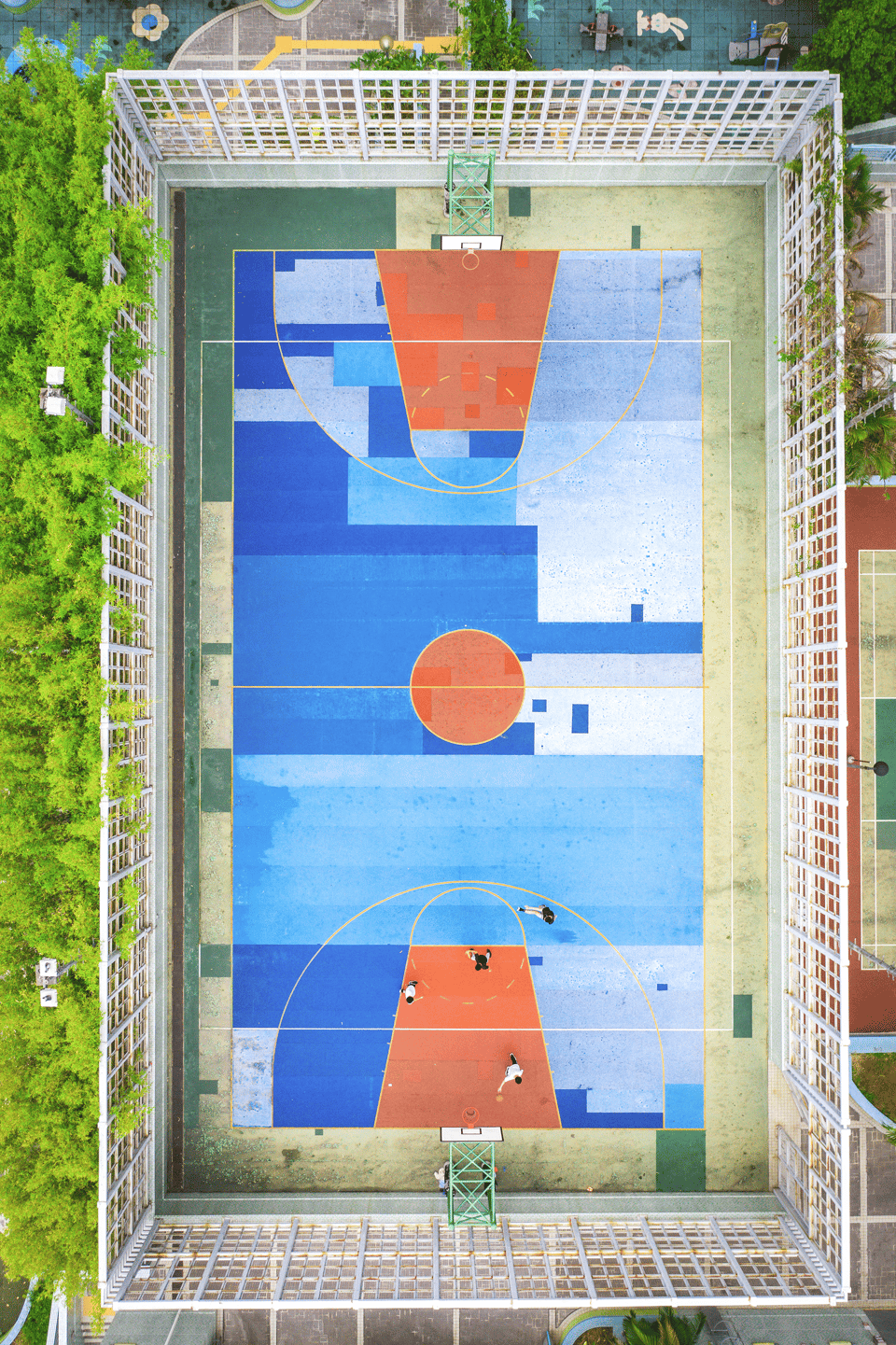
Over a 140-day period, the photographer Austin Bell took pictures of every basketball court in Hong Kong, and published it in the book Shooting Hoops.
Did you know Hong Kong has more outdoor basketball courts than any city in the world? … The book takes you on a visual journey through Hong Kong's 18 distinct districts, highlighting the city's varied topography through its ubiquitous playing fields for basketball. Shown from an aerial perspective, the courts' vibrant designs and stark flatness contrast with the endless vertical density of the city.
You can see a ton of the pics at his site — it’s really mesmerizing.
13) 👒 A final, sudden-death round of reading material
Telescope ranchers. 👒 A history of the hammock. 👒 Hengefinder. 👒 Sinclair-O-Matic. 👒 On scientific style. 👒 The Caribbean Jewish community that supplied the American revolutionaries with gunpowder. 👒 The “long hundred”. 👒 The Dickover. 👒 The “FROST” attack. 👒 Pigeon destringers. 👒 P.T. Barnum’s money advice. 👒 List of songs about running away. 👒 Converting ISO country codes to flag emojis. 👒 Tactile clock. 👒 Analysis of 200,000 similes. 👒 What “mermaid” means when flight attendants say it. 👒 WeatherGotchi. 👒 Low-tech tractors for sale. 👒 Hypnotizing. 👒 Incan farmers were freeze-drying potatoes 500 years ago. 👒 The cypherpunk library. 👒 A defense of idleness. 👒 If LLMS are conscious, so is Age of Empires II. 👒 How Atari applied side-art to their arcade cabinets. 👒 Cast-iron octopus mobile-phone holder. 👒 Nibbles the robot lawnmower. 👒 LinkedIn considered as the Switzerland of the Internet. 👒 Cows can tell people apart. 👒 The water dictionary. 👒 Type.lol. 👒 Web service to write a letter to your future self. 👒 Ireland’s ghost roads. 👒 Architecture made from yeast. 👒 David Attenborough database. 👒 Doomjobbing.
CODA ON SOURCING: I read a ton of blogs and sites every day to find this material. A few I relied on this week include Strange Company, Link Machine Go, Hackaday, Messy Nessy, Numlock News, 10 × 1 Things, the Awesomer, Book of Joe, the Morning News, and Mathew Ingram’s “When The Going Gets Weird”; check ‘em out!


