
Early and often: Vote for Hollywood Prometheus
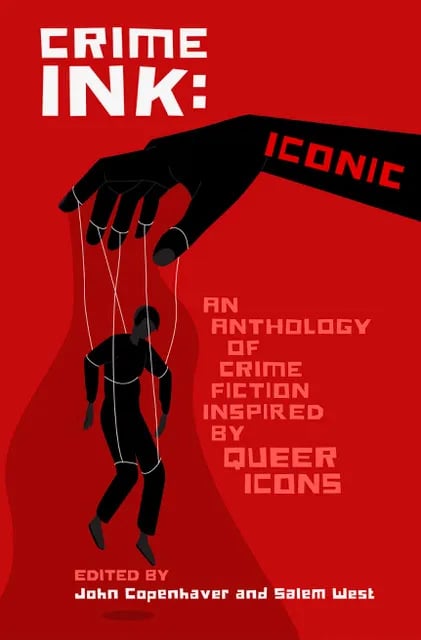
Gutted to be missing Bouchercon this year, especially since my short story Hollywood Prometheus has been nominated for an Anthony Award. CRIME INK: ICONIC, the anthology in which it was published, is also nominated, along with fellow contributor Cheryl A. Head’s story Finding Jimmy Baldwin.
If you are there, I’m deeply jealous and also hope you’ll consider voting for my story. Or Cheryl’s. Or for the anthology. Especially for the anthology, because this book really means a lot to me and to everyone involved. Help us prove that queer stories and queer voices matter!
If you’re still on the fence about picking up a copy of the book or giving us your vote, here’s a little excerpt from Hollywood Prometheus to whet your appetite:
***
Los Angeles, 1952
“Are you married, Mr. Cole?”
I was not married. I was also not Mr. Cole, but I’ll get to that in a minute.
First, some relevant details about the questioner, a Mr. James Whale. A British man with a Hollywood tan. Early sixties. Six feet. Full head of white hair and dark, haunted eyes. Large hands with long expressive fingers toying restlessly with a French cigarette. Well-dressed, clean shoes. A once famous man, now less so, but still far more so than I.
My usual tactic when asked that particular question was to fall back on a self-deprecating comment about my profession. After all, the science of the dead holds little appeal for marriage- minded ladies.
But when Whale asked me that question, he made it quite clear that he was asking an entirely different question. One that made my palms sweat and my heart race like a whipped horse. One that I could not possibly answer.
It was difficult not to flinch from the filmmaker’s gaze as he analyzed the angles of my face and body, perceiving me relentlessly and without mercy. Placing me into a narrative context of his own creation just as he would have positioned an actor within the camera’s frame.
His scrutiny made me want to abandon my quest and flee with all my monstrous secrets clutched tight to my chest.
I didn’t. I simply responded to his question with a terse shake of my head and looked down at the business card I’d given him. The one he’d regarded with a wry, raised brow and then tossed onto the rococo coffee table between us. My boss’s business card, Deputy Coroner Hayward P. Cole.
“Tell me about the boy,” I said. “The boy in the purple jacket.”
You want to know about the boy too, don’t you?
He came in as a John Doe on the second day of one of my boss’s increasingly frequent dipsomaniacal absences. I’d started off as a janitor in the L.A. County morgue and through a combination of intelligence, ambition and a strong stomach, I’d risen up the ranks to become Ward Cole’s assistant and indispensable right-hand man. I did nothing to discourage his drinking, because it made him increasingly dependent on me to cover for him and keep our department running smoothly. It also allowed me unfettered access to an endless supply of hobos and hopheads whose broken, unloved bodies taught me far more than the night school classes I’d been taking in my spare time.
So it was just me and the boy that day. The unexpected police sergeant who had come in with him was quite emphatic that this case needed a tight lid. That this one was rough, so rough that several uniforms lost their lunch on the scene.
“Brass needs this to stay out of the papers,” the cop had said, his tone hushed, like whoever had done this to the boy might be listening and come back to do the same to him. “Minimal paperwork, COD unknown. Rubber-stamp it, file it as indigent and transfer the stiff over to Boyle Heights in the next batch of unclaimed remains.”
“What do you want us to do with his clothes?” I asked.
Unless they had been fused to the body, by extreme heat for example, personal effects were supposed to be either bagged and tagged or discarded before any cadaver arrived in our department.
“Make ’em disappear,” the cop replied, pressing an envelope of cash into my hand. “Along with the rest of that kid.”
He couldn’t leave quickly enough.
The boy had been young. Maybe sixteen. Five foot five. Slight build. Pale complexion. Dark hair, freshly barbered in a sporty brush cut. Precise eye color difficult to determine upon initial examination due to corneal opacity and extensive conjunctival petechiae.
The clothing in question consisted of a flashy purple dinner jacket, a matching cummerbund, a starched white shirt and a black bow tie. No pants or shoes, just a single black sock.
Which brings me to the aspect of this case which needed to be kept out of the papers. Not the boy’s death, because the death of one more juvie hustler was hardly newsworthy in a ruthless Hollywood ecosystem that ate pretty teenagers for breakfast every sunny, postcard-perfect day.
It was the manner of his death that needed to be kept hidden. Not the asphyxia that sped up his inevitable demise, but rather his more unusual pre-mortem injuries.
There is no gentle or pleasant way to say what I must say next, so I will simply state the facts in a straightforward and clinical manner.
Both the genital and rectal areas exhibited extensive laceration consistent with a small but sharp object, such as a pocketknife, resulting in substantial tissue loss.
It was this grievous wounding that had been so unsettling to the patrolmen who had found the boy’s discarded corpse in some scrubby underbrush near the Greek Theater. Far more so to me, who saw these wounds clearly and completely, illuminated by the harsh fluorescent light of science, and yet was still undone on such a fundamental level that I could barely breathe. Albeit for entirely different reasons.
At home that night in the modest courtyard apartment I shared with a clever tabby tomcat named Percy, I could not get the boy out of my mind. I could not eat my half of the tinned sardines I normally shared with the feline, so I shoved away the unopened sleeve of saltine crackers and scraped the remaining fish into his bowl.
Allow me to reiterate at this point that I am not a man who is easily disturbed by the indignities of the murdered dead. If I were, I would not have been fit for the job I’d worked so hard to hold. But I do suffer from a pathological loathing of excess flesh, one that leads me to limit my daily caloric intake in a rather strict fashion. You see, I had been quite fleshy in my youth and that fleshiness had attracted the attention of a certain man. A man who availed himself of my flesh and left me anguished and deeply confused by a slew of terrifying and contradictory emotions that shattered the very foundation of who I believed myself to be. Caustic shame. Existential dread. Horror and hunger and beneath it all, a perverse longing for the very debasement from which I so viscerally recoiled. From that point on, I vowed to whittle away the flesh that had betrayed me and assiduously avoid being touched by anyone ever again.
The boy in the purple jacket had touched me. Even in death, he had touched me in a dark, unspeakable place hidden deep inside my calcified heart, dredging up old terrors and bringing back that anguish and loathing with such intensity that I found myself driven out into the balmy Southern California night. I walked the streets of my sleeping neighborhood at a brisk, near panicked pace that bordered on a run, as if I could outrun the demons that the boy had awakened inside me.
I could not, of course.
***
-
Congratulations! I was thrilled to see that you chose to give life to James Whale. (It's alive!)
His films are filled with talented character actors chewing up the scenery—they must've had a ball.
Love this story and book!
Reply: