Defending Trans People Is Good Politics, Actually
Please tell your local comics store to reserve a copy of Star Trek: Zero Point #1! It’s going to be so fun!
Lessons in Magic and Disaster is coming in paperback this August! Get a signed/personalized copy or a signed special edition with sprayed edges!
I’m a guest of honor at BayCon! Spend your July 4 weekend with me!
I've been feeling more anxious about the future of trans rights lately. In the UK, the supposedly center-left government has been imposing ridiculously draconian, procrustean policies on trans people, with very few people seeming to mind. In the United States, the Trump administration is also trying to push through harsh policies — see recent editions of Erin in the Morning — and Democratic politicians are showing a few signs of wanting to distance themselves from us.
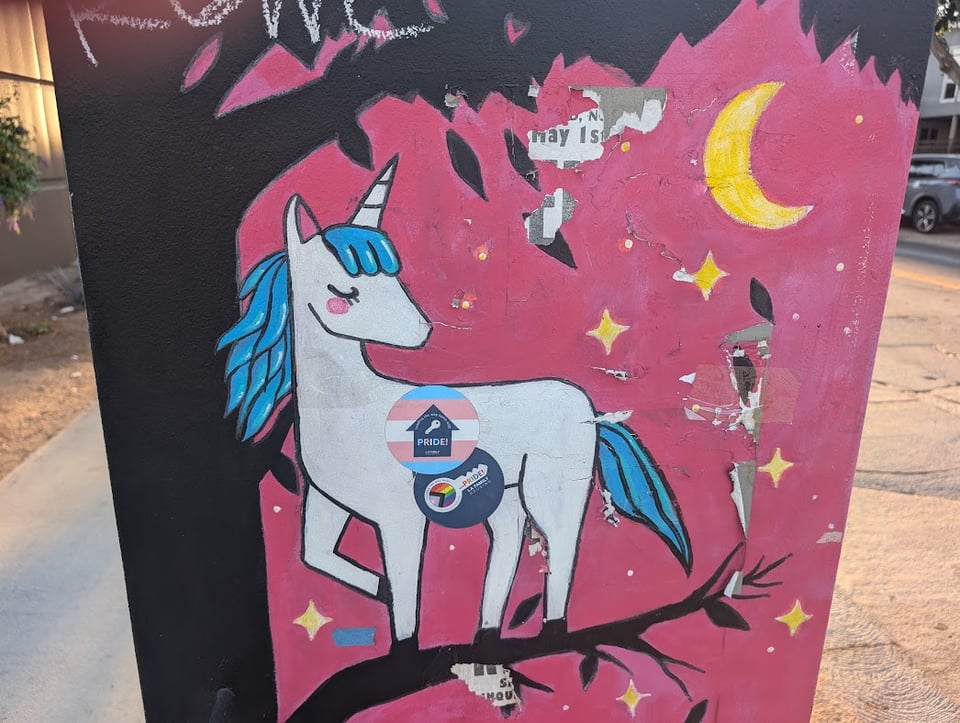
All this comes after years of consultants and pundits insisting that the only way for left-of-center parties to win is by throwing the trans community under the bus. They insist that some mythical support for trans people — which was in no way apparent — cost Kamala Harris victory in 2024.
In a nutshell, their advice boils down to, “In order to defeat fascism, we must embrace fascism.”
Scapegoating is at the core of the emotional and psychological logic of fascism. You find a stigmatized group, or a bunch of people who are different enough that they might be able to inspired disgust or fear. You set about portraying them as simultaneously weak and dangerous. You continue a loud drumbeat of fear mongering and incitement, until people are good and riled up. And then you use this to justify all kinds of unrelated crap, including taking away people's health care and destroying their livelihoods.
Subscribe now!! ! ! !! ! It’s usually readable!You simply cannot beat fascism by attacking the people that fascists hate. By doing so, you are legitimizing fascist rhetoric and giving oxygen to the fire they are attempting to stoke. This isn't simply true when it comes to trans people — it's also the case with immigrants, Black and Brown people generally, the neurodivergent, defenders of human rights, and many other groups.
The important thing to know about scapegoating is that it never ends. You could kick every undocumented person and every green-card holder out of the United States, and anti-immigrant sentiment would still be riled up. Similarly, you could exterminate every trans person in America and transphobia would remain a wedge issue. They do not care. Our bodies aren’t the object of fear — instead, it’s the very idea of our existence. Democrats could issue hunting licenses for trans teenagers, and they’d still be buried under an avalanche of ads claiming that they support trans people. There is no winning this game.

On a related note: I am very sick of that poem about "First they came for…" I get why it's awesome and important and a call for solidarity. But you shouldn't come to the defense of the most vulnerable people because you might be next — you should come to our defense because it's the right thing to do, and because human rights are either absolute or meaningless. Either everyone is human, or humanity becomes a matter of gradations and asterisks because some people are more human than others.
Playing defense on trans rights and other wedge issues will indeed lead to a slippery slope — but it also concedes the logic of fascism. It acknowledges that certain people are indeed a problem, and the debate is merely over how much of a problem we are.
Upgrade now! If you want.With trans people, there's also the simple fact that we are part of a wider cluster of anxieties about gender. Studies have shown that people who hate trans women are more likely to be misogynists in general — which is why I find the term “transmisogyny” so helpful. Theodore Sturgeon’s 1960 novel Venus Plus X explores a world without gender from the point of view of a cis straight man who’s stumbled into what he believes is the future — and Sturgeon juxtaposes the man’s anxiety at a gender-free world with vignettes about early 1960s America in which women are joining the workforce and men are losing economic and social dominance. Sturgeon draws a very clear link between rejecting gender itself and the insecurity of a once absolute patriarchy in the face of even modest change.
The logic of gender panic demands gender miscreants. Trans people make convenient targets in a larger war to restore “traditional gender roles.” So agreeing that trans people represent some kind of threat is in effect taking the first step on the slippery slope that leads to the freaking Handmaid's Tale.
And now here I am channeling that bloody poem. Oh well.

I also find it interesting that trans women, in particular, are under so much attack during a time when the AI industry is so keen on selling men a fake girlfriend. All over San Francisco, there are billboards and bus-station ads showing a plastic looking woman's face with messages that encourage you to stop hiring humans because this artificial lady will be the perfect employee: submissive, professional, demure, beautiful. I think that anxieties around women who are seen as artificial become more of a thing when there is a clearly artificial woman being promoted as your new secretary/girlfriend. Patriarchy has always demanded that cis women achieve a certain level of beauty that includes cosmetics and other beauty products, and has always stigmatized women for that same level of artifice.
When a manufactured femininity is becoming a massive revenue model for some of the weirdest companies of all time, people are naturally going to displace their anxieties about femininity onto trans women.
Back to scapegoating... this is an old, old playbook. And you don't win by agreeing with the haters. If you concede that they have a point in stigmatizing people on the margins, then you are inherently conceding that they’re right about a lot of other stuff, and that their approach is the correct one.
Subscribe now!!! ! ! ! !It's actually somewhat clever to put Democrats in a position where they have to either defend trans people, or be seen as having the weaker approach to our unquestionable threat to society. There's no third option, no way to neutralize the issue. There's only offense and defense — and defense makes you look weak and feckless.
So yeah. It sucks, but Democrats have no choice but to stand up in defense of trans people, and ideally to turn the tables and point out just how weird it is that we're supposed to spend so much time obsessing about such a tiny population with such little impact on anybody else's material lives. Because if you don't stand up for the most disposable among us, then fascism grows stronger.
Bonus Rant: Why Star Wars and Marvel Are In a Corner
I'm by no means the only person to obsess about this, but lately it's become more and more obvious that some of our biggest entertainment properties have the exact same problem: they failed to pass the torch.
Star Wars popularized the notion of a “legacy sequel” with 2015's The Force Awakens, which uses the return of Luke, Leia, and Han as a bridge to introduce Rey and Finn. This concept became pretty popular for a while, as exemplified by movies like Terminator: Dark Fate, which does something similar. There were countless others, all of which brought back the original cast while introducing the next generation of heroes.
You could argue the X-Men movies tried to do something fairly similar with the Days of Future Past movie, in which the original cast comes back one last time in order to establish James McAvoy, Michael Fassbender and company as the new faces of the X-Men series. Similarly, the Marvel Cinematic Universe attempted its own torch passing with Avengers: Endgame in which Tony Stark dies and Steve Rogers passes his iconic shield on to Sam Wilson. And J.K. Rowling made a serious attempt to move past Harry Potter as the hero of her universe by introducing Newt Scamander, the magizoologist.
I could dredge up more examples of big popular series trying to hand the baton forward to a new cast of actors or new characters. But there are relatively few examples of it succeeding, most of them older. Doctor Who has been doing it since 1966, and Star Trek has been successfully introducing new captains and crews since 1987.
In any case, we should have gotten a movie about Rey — and preferably also Finn — by now. A few versions of a Rey film have been in development, but nothing has actually happened. We're now getting Star Wars films again, but they’re side quests, and of course the Mandalorian and Baby Yoda are inextricably tied to Luke Skywalker. Meanwhile, marvel is bringing back both Robert Downey Jr and Chris Evans. The Scream franchise just went back to Neve Campbell and ditched its newer characters. And so on.
Subscribe now!There's no one reason why the passing of the torch has failed to happen. There's covid, which threw all sorts of plans off track. There's the streaming wars, which made the adventures of newer characters feel more disposable. There's toxic fandom complaining endlessly about characters like Rey and Finn. There's also just bad luck — Scott Mendelson has argued that Marvel probably intended to turn Chadwick Boseman into the new Robert Downey, Jr before his untimely death, which makes a lot of sense. Some of the newer characters lack a strong “hook,” such as being the chosen one or having an iconic origin story. And there's the fact that most of these franchises waited until they were already declining in popularity before trying to introduce a new generation, rather than doing it when they were at their peak.
But it’s also true that passing the torch is difficult, because fandom hates change and because the best-known versions of characters are always the most marketable. Several people have taken over as Batman over the years in the comics, but Bruce Wayne has always returned. Ditto Hal Jordan and Barry Allen.
But especially with a live-action franchise, you really need fresh blood — and it's better to appeal to more people by featuring heroes who don't all look like Chris Evans. The real key is patience, persistence, and being willing to introduce new characters with the same care that you used for the previous for the original batch. It's legit hard, but it can be done — and if it's not done, then you risk a slow spiral into irrelevance.