Friday's Elk

Archives
Subscribe

Friday's Elk

Archive

Friday's Elk, January 15, 2016

Greetings--

Here are a couple pieces for your weekend reading...
 
Stopping the Salamanders to Save Them

Over the summer, I wrote in the New York Times about an impending ecological disaster. The United States is home to 190 species of salamanders, the greatest diversity of these amphibians in any country. Scientists worry that a newly discovered salamander-killing fungus in Europe could drive American salamanders extinct if it shows up in the U.S.

This week, I have an update: the U.S. Fish & Wildlife Service put a new rule in place, banning the import of 201 species of salamanders as pets (as well as moving them across state lines). We'll see if that blocks the plague, or at least gives scientists time to prepare for it.
 
Genetic Messages in a Bottle

On Thursday in the Times, I write about cell-free DNA, loose genetic material that floats around our body. Scientists look at it as a message in a bottle, telling us things about our inner health. And now researchers have found a way to figure out where that bottle comes from. That discovery could lead to new tests that could reveal clues about strokes, heart attacks, and other disorders.
 
The Talks

January 28: New Jersey Institute of Technology in Newark, NJ. I'll talk about how parasites can control their hosts' minds. Details to come.

NEW-- February 11: "Is There A Future for In-Depth Science Journalism?" MIT Communication Forum Details here.

June 23-25: International Society for Evolution, Medicine, and Public Health, Plenary Lecture. Durham North Carolina. Here's the meeting site.

July 31: I'll be giving the keynote lecture at the annual meeting of the Botanical Society of America in Savannah
 
The End
 
As always, if you have friends who would enjoy getting this newsletter, please let them know they can sign up at http://tinyletter.com/carlzimmer.

You can also follow me on Twitter, Facebook , LinkedIn, and Google+. And there's always carlzimmer.com.

Best wishes, Carl
Free post
#17
January 14, 2016
Read more

Friday's Elk, January 8, 2015

EURAC/Marion LafolgerGreetings--

Happy New Year! I'd like to welcome all the new subscribers who joined us here during the holiday hiatus. I hope you'll enjoy Friday's Elk in 2016 and beyond. Each week I send out a relatively brief email to bring subscribers up to date with the stuff I've been publishing, along with talks I'm giving and any other relevant news.

If you're curious about what sort of stuff you can expect here, you might want to check out the things I was up to in 2015. For example, here's a story I wrote for the New York Times about how becoming a mother means becoming a chimera. And here's an episode of Radiolab where I talked to Jad Abumrad and Robert Krulwich about editing genes. You can find an archive of my stories and information about my books on my web site. I also set up a Pinterest board with links to my talks that are available online.

Okay--now here's what I've been up to since the last Friday's Elk...
 
Exploring the Iceman's Stomach

A man died in the Alps 5,300 years ago, and his body was dug out of the ice in 1991. For the past quarter-century scientists have been probing his body to learn about what life was like in ancient Europe. In Stat this week, I write about how scientists have now discovered bacteria in his stomach that cause ulcers and gastric cancer in living people. The study offers some clues to the early roots of modern health.
 
The Clock in Our Brains

Our brains switch genes on and off in a daily 24-hour cycle. The brain's inner clock may be important to our long-term mental health. On December 28, I wrote a column for The New York Times about scientists who look at donated brains to catch our clocks in action. They can even see how those clocks change over our lifetime.
 
How We Got Big

Our ancestors 800 million years ago evolved from single-celled organisms into the first animals. Now we have trillions of cells in our bodies, which develop into hundreds of cell types and tissues. A team of scientists have taken an exquisitely close look at that transition, by looking at how a single molecule evolved into a tool for dividing animal cells and turning them into animal bodies. I tell the story this week in The New York Times.
 
Science News That Stuck With Us in 2015

The New York Times asked its science writers to look back at 2015 and reflect on the big stories of the year. I wrote about a cluster of columns in which I explored how ancient DNA is revealing new insights into early humans history.
 
What to Expect in 2016

Stat, meanwhile, asked its writers to look ahead to medical news in 2016. I tried to separate some of the hype about gene editing and epigenetics from the real promise for the year to come.
 
A Science Blogging Guide
 
I contributed a chapter to the upcoming book Science Blogging: The Essential Guide. You can order it now; it comes out on March 1.
 
A World Without Parasites

I talked to the folks at Tumble, a podcast about science for kids and their parents, about what the world would be like without parasites. Hint: less icky, yes, but not so good either. If that talk whets your appetite, I wrote a whole book about the hidden importance (and coolness) of parasites.
 
Contemplating Human Germline Modification

In October I gave a talk at the annual conference of the National Society of Genetic Counselors about how gene editing technology could pose new ethical quandaries. The video is now on Youtube.
The Talks

January 28, 2016: the New Jersey Institute of Technology in Newark, NJ. I'll talk about how parasites can control their hosts' minds. Details to come.

June 23-25 International Society for Evolution, Medicine, and Public Health, Plenary Lecture. Durham North Carolina. Here's the meeting site.

July 31. I'll be giving the keynote lecture at the annual meeting of the Botanical Society of America in Savannah
 
The End
 
As always, if you have friends who would enjoy getting this newsletter, please let them know they can sign up at http://tinyletter.com/carlzimmer.

You can also follow me on Twitter, Facebook , LinkedIn, and Google+. And there's always carlzimmer.com.

Best wishes, Carl
Free post
#16
January 7, 2016
Read more

Friday's Elk, December 18, 2015

Credit Cyril Ruoso/Minden PicturesGreetings--

Like many of you, I'm in a final scramble to finish off a ridiculous to-do list before the holidays hit me like a falling grand piano. So this will probably be the last issue of Friday's Elk I'll send out for 2015. I'll be up and running again on January 8, 2016. So here's a quick look at the old and the new.

The Evolution of a Good Night's Rest

As primates go, we sleep very little and spend a lot of that time dreaming. This week in the New York Times, I write about a new study that seeks to explain how we ended up this way, and how sleep may have played a big role in human evolution.

Viruses to Cure Your Ills

Here's another video I made with Business Insider. It's about phage therapy, the long-dreamed-of strategy to use viruses to kill disease-causing bacteria.

Longform Picks for 2015

The fabulous curation site Longform asked me to pitch in to select some of 2015's best science writing. Here's what my colleagues and I picked.

A Science Writing Workshop

Each January I teach a two-part workshop about science writing at Yale. I originally designed it for Yale science graduate students, but we've loosened up over the years, so if you're in the area and interested, you can get in touch with the Ecology and Evolutionary Biology Department at Yale to inquire about registering. Here is the workshop plan and the assigned reading.

The Talks

January 28, 2016: the New Jersey Institute of Technology in Newark, NJ: Details to come.

June 23-25 International Society for Evolution, Medicine, and Public Health, Plenary Lecture. Durham North Carolina. Here's the meeting site.

July 31. I'll be giving the keynote lecture at the annual meeting of the Botanical Society of America in Savannah

The End

As always, if you have friends who would enjoy getting this newsletter, please let them know they can sign up at http://tinyletter.com/carlzimmer.

You can also follow me on Twitter, Facebook , LinkedIn, and Google+. And there's always carlzimmer.com.

Best wishes, Carl
Free post
#15
December 17, 2015
Read more

Friday's Elk, December 11, 2015

Greetings--

I was traveling for much of this week on a reporting trip, part of which I spent suited up in the outfit you can see above. So I don't have a Matter column this week. Instead, let me direct your attention to the second installment of my "Science Happens" video series for STAT. I pay a visit to a lab where scientists are trying to engineer bacteria to heal our microbiomes.

As always, if you have friends you think would enjoy getting this newsletter, please tell them to sign up at http://tinyletter.com/carlzimmer.

You can also follow me on Twitter, Facebook , LinkedIn, and Google+. And there's always carlzimmer.com.

Best wishes, Carl
Free post
#14
December 10, 2015
Read more

Friday's Elk, December 4, 2015 (The better late than ever edition)

Slava Epstein. Photo by Josh Reynolds for STATGreetings--

Sorry to be sending out this week's issue of Friday's Elk on a Saturday. I blame writing. I'm starting on the first draft of my next book, and I was having so much fun spending a day of uninterrupted writing that I forgot about everything else.

Better late than never, here are a couple new items for you to read.

Lamarck or Not?

--Can the experiences of parents alter the course of heredity? This week in the New York Times, I look at some recent studies suggesting that they can. They raise the possibility that obesity can alter the function of genes in a father's sperm, leading in turn to changes in his children's metabolism. While this work is provocative and potentially very important, the case is far from closed.

The Power of Simplicity

I've written a new feature for STAT (my third so far). I profile Slava Epstein, a scientist who fled Russia and discovered a marvelously simple way to discover new antibiotics: make bacteria happy. (Photo of Epstein by Josh Reynolds for STAT)

The Talks

January 28, 2016: the New Jersey Institute of Technology in Newark, NJ: Details to come.

June 23-25 International Society for Evolution, Medicine, and Public Health, Plenary Lecture. Durham North Carolina. Here's the meeting site.

July 31. I'll be giving the keynote lecture at the annual meeting of the Botanical Society of America in Savannah

The End

--As always, if you have friends you think would enjoy getting this newsletter, please tell them to sign up at http://tinyletter.com/carlzimmer.

You can also follow me on Twitter, Facebook , LinkedIn, and Google+. And there's always carlzimmer.com.

Best wishes, Carl
Free post
#13
December 4, 2015
Read more

Friday's Elk, November 27, 2015

Greetings--

Happy Thanksgiving! In honor of the turkey fest, here's a breifer-than-usual Friday's Elk this week.

Europe Evolving

--This week in the New York Times, I reported about a study of 230 genomes retrieved from European skeletons ranging from 8,500 to 2,300 years in age. They create a chronicle of human evolution, documenting how the agricultural revolution altered the genetic landscape of a continent. Check it out.

The Talks

January 28, 2016: the New Jersey Institute of Technology in Newark, NJ: Details to come.

June 23-25 International Society for Evolution, Medicine, and Public Health, Plenary Lecture. Durham North Carolina. Here's the meeting site.

July 31. I'll be giving the keynote lecture at the annual meeting of the Botanical Society of America in Savannah

The End

--As always, if you have friends whom would you think would enjoy getting this newsletter, please let them know they can sign up at http://tinyletter.com/carlzimmer.

You can also follow me on Twitter, Facebook , LinkedIn, and Google+. And there's always carlzimmer.com.

Best wishes, Carl
Free post
#12
November 27, 2015
Read more

Friday's Elk, November 20, 2015


Greetings--

Here's the week that was...

Denisovans and Other Mysterious Humans

--Ancient DNA continues to illuminate our family tree. In 2010, I wrote about mysterious ancient relatives of Neanderthals called Denisovans, which scientists only knew from a tooth, a fingerbone, and the 50,000-year-old DNA they contained. Now scientists have found some new Denisovan DNA in a tooth, and the broadening picture we're getting is fascinating. Yet in some ways, the enigma of the Denisovans is only getting deeper. I wrote about the mystery in The New York Times this week.

How to Blog

--If you are thinking about blogging about science--or would like to become a better science blogger--you'll want to get this new book: Science Blogging: The Essential Guide. It's edited by by three wonderful bloggers--Christie Wilcox, Bethany Brookshire, and Jason Goldman--and has chapters by a variety of writers (including me). You can pre-order it here.

The Talks

New: My "Ask Me Anything" session on Reddit this week was as fun as I anticipated. Here's the transcript.

January 28, 2016: New Jersey Institute of Technology in Newark, NJ: Details to come.

June 23-25 International Society for Evolution, Medicine, and Public Health, Plenary Lecture. Durham North Carolina. Here's the meeting site.

July 31.Keynote lecture at the annual meeting of the Botanical Society of America in Savannah

The End

--As always, if you have friends who you think think would enjoy getting this newsletter, please let them know they can sign up at http://tinyletter.com/carlzimmer.

You can also follow me on Twitter, Facebook , LinkedIn, and Google+. And there's always carlzimmer.com.

Best wishes, Carl
Free post
#11
November 19, 2015
Read more

Friday's Elk, November 13, 2015

Wikipedia photo of saiga
Greetings--

On this Friday the 13th, I wish you only good luck and offer you the following diversions...

The DNA of a Million Veterans

--I've got a new story at STAT, about the next chapter in the history of genetics. Researchers are launching massive studies of huge numbers of people in order to link genes to diseases. One of the biggest is being run by the U.S. military. The Veterans Administration is gathering the DNA of a million veterans to study everthing from diabetes to PTSD. I went inside the Million Veteran Program to get a first-hand look at this new way of exploring our genes. (Be sure to check out the video of the enormous operation!)

Introducing "Science Happens"

At STAT, I'm also going to be presenting a monthly video series called "Science Happens." I'll be visiting labs where some of the most intriguing medical research is taking place. The first video is now ready for your delectation. I visit John Krakaeur, a neurologist at Johns Hopkins University, who is developing a new way to treat people with strokes: using video games in which people pretend to be dolphins. Along the way I discover that if I were a dolphin, I'd probably end up as a shark's breakfast pretty quickly.

I'm putting together a list of other labs to visit for the series, so if you know of any that are especially cool, let me know!

The Lilliput Effect

Mass extinctions don't just wipe out lots of species. They also push evolution off in new directions. For my latest column for the New York Times, I write about new research revealing that vertebrates got small after a mass extinction. It's a phenomenon scientists call the Lilliput Effect, and it offers a sobering hint at what life will be like on Earth as we drive big animals to extinction.

The Talks

New! In August I spoke at the New York Academy of Sciences about telling stories about science. They've posted the video here.

Also New! November 18, noon ET: I'll be on Reddit's "Ask Me Anything" page to talk about science writing, STAT, and recent developments in genetics and medicine. Join us and ask me anything. (Here's a previous AMA I did a couple years ago to give you a sense of how they work.)

November 19, the New York City Genome Center: A panel discussion on "Jewish genomics" Details here.

January 28, the New Jersey Institute of Technology in Newark, NJ: Details to come.

June 23-25 International Society for Evolution, Medicine, and Public Health, Plenary Lecture. Durham North Carolina. Here's the meeting site.

July 31. I'll be giving the keynote lecture at the annual meeting of the Botanical Society of America in Savannah

The End

--As always, if you have friends whom would you think would enjoy getting this newsletter, please let them know they can sign up at http://tinyletter.com/carlzimmer.

You can also follow me on Twitter, Facebook , LinkedIn, and Google+. And there's always carlzimmer.com.

Best wishes, Carl
Free post
#10
November 12, 2015
Read more

Friday's Elk, November 6, 2015

Wikipedia photo of saiga
Greetings--

Here's the week that was...

STAT!

--As I mentioned a couple months ago, I'm starting to contribute to a new publication called STAT as a national correspondent. This week they officially launched, offering this description on their web site of what they're about:

STAT is a new national publication focused on finding and telling compelling stories about health, medicine, and scientific discovery. We produce daily news, investigative articles, and narrative projects in addition to multimedia features. We tell our stories from the places that matter to our readers--research labs, hospitals, executive suites, and political campaigns.

I'm thrilled to be contributing to a publication with so many gifted journalists on board, including Sharon Begley and Helen Branswell.

My first offering at STAT is a look at Craig Venter's new $25,000 physical exam--which includes everything from whole-genome sequencing to whole-body scanning. I talked to doctors who doubt that all this new diagnostic technology can actually bring that much benefit to healthy people--at least for the time being.

I will have more stories to share in the weeks to come. In addition, I am trying my hand at video! Well, more precisely, the gifted videographer Matt Orr is producing a monthly series of videos called Science Happens! in which I'll be visiting labs where medical research is underway and explore how this work gets done. We've already shot two episodes, and the first will be coming out soon. I'll link to it in a future Friday's Elk.


An Andromeda Strain for Antelopes?

In June I reported about a massive, sudden die-off of saiga, a Central Asian antelope. This week I followed up with a report on a meeting where researchers shared their latest results about what happened and why. It now turns out that over half the entire species died in less than a month--perhaps 211,000 animals or more. And the leading hypothesis for what killed them is an interaction between climate change, bad weather, and the microbiome. I have more details in my Matter column for the New York Times.


The Talks

November 13, Providence, RI, at the National Association of Biology Teachers: I'll be giving a talk in conjunction with receiving their Distinguished Service Award.

November 19, the New York City Genome Center: A panel discussion on "Jewish genomics" Details here.

January 28, the New Jersey Institute of Technology in Newark, NJ: Details to come.

June 23-25 International Society for Evolution, Medicine, and Public Health, Plenary Lecture. Durham North Carolina. Here's the meeting site.

New: July 31. I'll be giving the keynote lecture at the annual meeting of the Botanical Society of America in Savannah


The End

--As always, if you have friends whom would you think would enjoy getting this newsletter, please let them know they can sign up at http://tinyletter.com/carlzimmer.

You can also follow me on Twitter, Facebook , LinkedIn, and Google+. And there's always carlzimmer.com.

Best wishes, Carl
Free post
#9
November 5, 2015
Read more

Friday's Elk, October 30, 2015


Greetings--

On Saturday, I gave a plenary talk at the annual meeting of the National Society of Genetic Counselors. I described the fast rise of CRISPR and encouraged the audience to consider the ethical questions that may arise if we gain the ability to fix diseases or even enhance traits in embryos. Laura Hercher, a genetic counselor at Sarah Lawrence College, also gave a talk in the session. She focused on mitochondrial replacement therapy, which is sometimes wrongly described as producing "three-parent babies."

During our talks, Laura and I would stop from time to time to poll the audience about a series of ethical questions about gene editing. The picture above, taken by Carrie Blout, shows one result based on a scenario in which scientists identify a gene variant that improves cognition.

It's not often a reporter gathers this sort of data, so I thought I'd share the results. I've uploaded the full results here. It's interesting that genetic counselors were pretty comfortable with germline engineering to fix serious diseases, but not to protect people from diseases or enhance their traits.

A Flood of Ancient DNA

--There was a time when new reports on ancient DNA arrived at a manageable pace--once every couple months or so. Now the science is moving so fast that I sometimes end up writing about ancient DNA week after week.

This week is a case in point--just after writing about 5,000-year-old plague in European and Asian skeletons, I wrote about another study for the New York Times this past Monday. For the new story I move over to the New World. DNA from a pair of 11,500-year-old skeletons from Alaska offer some tantalizing clues about humans traveled from one hemisphere to the other. (See my earlier story on Kennewick Man for more on what ancient DNA can tell us about the peopling of the Americas.)

A Planet of Microbiomes

--In addition to my weekly "Matter" column, I also filed a story for the Thursday Times about the microbiome--or, to be more accurate, the world's many microbiomes. We have communities of microbes inside our bodies, as do trees and oceans and tundras and undersea volcanoes. Each microbiome contains a different combination of species, most of which we don't understand at all. The leading experts on microbiomes have come forward with a call for a national--perhaps even international--initiative to find the rules that bind all microbiomes together.

The Science Writing Resurgence

--Next spring, a new science magazine called Undark will be launching (I'm on the board of advisors.) Here's an article in Columbia Journalism Review about what's in store, and how Undark fits into the pleasing bloom of new science publications.

Speaking of new science publications, the folks at Stat have been working hard for months now getting ready to launch. They'll be rolling Stat out very soon, so stay tuned. (As a national correspondent for Stat, I've been working on stuff you'll be seeing soon, too.) In the meantime, you can check out their web site, where you can sign up for their richly informative daily newsletter.

The Talks

November 13, Providence, RI, at the National Association of Biology Teachers: I'll be giving a talk in conjunction with receiving their Distinguished Service Award.

November 19, the New York City Genome Center: A panel discussion on "Jewish genomics" Details here.

January 28, the New Jersey Institute of Technology in Newark, NJ: Details to come.

New: June 23-25 International Society for Evolution, Medicine, and Public Health, Plenary Lecture. Durham North Carolina. Here's the meeting site.

The End

--As always, if you have friends whom would you think would enjoy getting this newsletter, please let them know they can sign up at http://tinyletter.com/carlzimmer.

You can also follow me on Twitter, Facebook , LinkedIn, and Google+. And there's always carlzimmer.com.

Best wishes, Carl
Free post
#8
October 29, 2015
Read more

Friday's Elk, October 23, 2015

Greetings--

There are few things more interesting than ancient human DNA and diseases (if you ask me). So the opportunity to write about both of them in one article was the highlight of my week.

Scientists who have been gathering DNA from Bronze Age skeletons wondered if they might have unknowingly scooped up some DNA from interesting pathogens. Turns out, they did. From 5,000-year-old skeletons, they extracted the DNA of Yersinia pestis, the cause of the plague. The discovery pushes back the plague 3,000 years, and allows us to see the stepwise evolution of the pathogen into its full-blown, flea-carried form.

I have the whole story in my column this week for the New York Times.

(The creepy picture above is the outfit worn by doctors in the seventeenth century to protect themselves from the plague. Via Wikipedia.)

--Here's my current list of upcoming talks. I'll be adding new ones soon:

November 13, Providence, RI, at the National Association of Biology Teachers: I'll be giving a talk in conjunction with receiving their Distinguished Service Award.

November 19, the New York City Genome Center: A panel discussion on "Jewish genomics" Details here.

January 28, the New Jersey Institute of Technology in Newark, NJ: Details to come.

As always, if you have friends whom would you think would enjoy getting this newsletter, please let them know they can sign up at http://tinyletter.com/carlzimmer.

You can also follow me on Twitter, Facebook , LinkedIn, and Google+. And there's always carlzimmer.com.

Best wishes, Carl
Free post
#7
October 22, 2015
Read more

Friday's Elk, October 16, 2015

Greetings--

A couple weeks ago I stopped by the offices of Business Insider in New York to chat with the editors there, both on camera and off, about all sorts of things biological. They've transformed our conversations into a series of short articles and videos that they've been sprinkling onto the Internet for the past few days like pinches of chili powder.

Here's what they've released so far...

--An article about giant viruses thawing out of the Siberian permafrost after being buried alive for tens of thousands of years.

--And another one on the antibiotic resistance crisis, and how bacteria-killing viruses might help us overcome it.

--Here's a video in which I offer my 90-second dinner-table explanation of CRISPR, the remarkable new gene-editing tool. (Also, in case you missed it, Business Insider put out a short video last week in which I talk about the risk we run of contaminating Mars with Earth life.)

--Oink!

Speaking of CRISPR, last week I was watching a live video feed from a scientific meeting on the subject when one of the scientists said something that made me do a double-take (and tweet in disbelief).

George Church of Harvard said he and his colleagues had altered 62 genes in one go in pig cells. That blows past the previous record-holder of six genes. After Science rushed the paper into print on Sunday, I read it, talked to Church, and checked in with other experts. As I write this week in the New York Times, the experiment is definitely a tour de force, but it may not fulfill your wildest Frankenstein-fueled dreams.

--Science Ink Is Everywhere

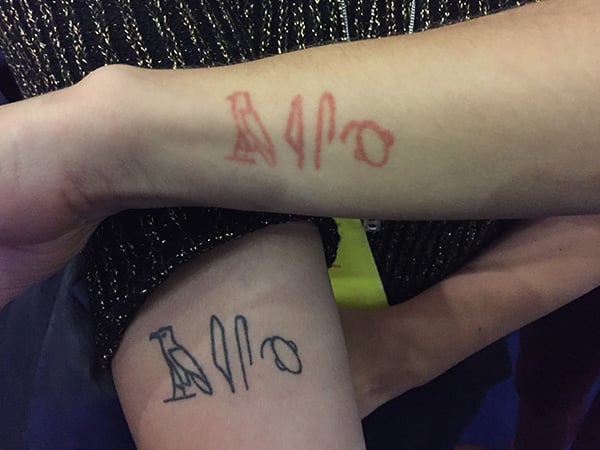
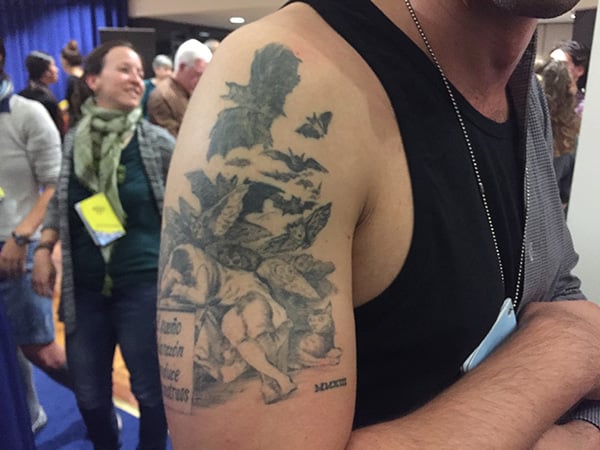
In 2011, I published a book called Science Ink: Tattoos of the Science Obsessed. Since then, scientists and science-o-philes regularly pull up their sleeves and pant legs (and more!) to show me their ink. On Sunday evening, while I was at a party at the annual meeting of the National Association of Science Writers, I took a couple pictures:

Two people showing off the same tattoo--"brain" in Egyptian hieroglyphics.


Here's Goya's Sleep of Reason Produces Monsters.


--And finally, a list of upcoming talks (no new additions this week)

October 21, Farmington, Connecticut, at the Jackson Laboratory: "From Viruses to Whales, From Newspapers to Twitter: A Career in Science Writing." Details here.

October 24, Pittsburgh: A discussion about the future of DNA editing at the annual conference of the National Society of Genetics Counselors.

November 13, Providence, RI, at the National Association of Biology Teachers: I'll be giving a talk in conjunction with receiving their Distinguished Service Award.

November 19, the New York City Genome Center: A panel discussion on "Jewish genomics" Details here.

January 28, the New Jersey Institute of Technology in Newark, NJ: Details to come.

--That's it.

As always, if you have friends whom would you think would enjoy getting this newsletter, please let them know they can sign up at http://tinyletter.com/carlzimmer.

You can also follow me on Twitter, Facebook , LinkedIn, and Google+. And there's always carlzimmer.com.

Best wishes, Carl
Free post
#5
October 15, 2015
Read more

Friday's Elk, October 16, 2015: LINKS FIXED, HEAD BOWED IN SHAME

My apologies--for some reason some of the links in today's newsletter didn't work. I've fixed them in this version. I promise not to send bad links on future Friday!

Greetings--

A couple weeks ago I stopped by the offices of Business Insider in New York to chat with the editors there, both on camera and off, about all sorts of things biological. They've transformed our conversations into a series of short articles and videos that they've been sprinkling onto the Internet for the past few days like pinches of chili powder.

Here's what they've released so far...

--An article about giant viruses thawing out of the Siberian permafrost after being buried alive for tens of thousands of years.

--And another one on the antibiotic resistance crisis, and how bacteria-killing viruses might help us overcome it.

--Here's a video in which I offer my 90-second dinner-table explanation of CRISPR, the remarkable new gene-editing tool. (Also, in case you missed it, Business Insider put out a short video last week in which I talk about the risk we run of contaminating Mars with Earth life.)

--Oink!

Speaking of CRISPR, last week I was watching a live video feed from a scientific meeting on the subject when one of the scientists said something that made me do a double-take (and tweet in disbelief).

George Church of Harvard said he and his colleagues had altered 62 genes in one go in pig cells. That blows past the previous record-holder of six genes. After Science rushed the paper into print on Sunday, I read it, talked to Church, and checked in with other experts. As I write this week in the New York Times, the experiment is definitely a tour de force, but it may not fulfill your wildest Frankenstein-fueled dreams.

--Science Ink Is Everywhere

In 2011, I published a book called Science Ink: Tattoos of the Science Obsessed. Since then, scientists and science-o-philes regularly pull up their sleeves and pant legs (and more!) to show me their ink. On Sunday evening, while I was at a party at the annual meeting of the National Association of Science Writers, I took a couple pictures:

Here are a couple pictures:

Two people showing off the same tattoo--"brain" in Egyptian hieroglyphics.


Here's Goya's Sleep of Reason Produces Monsters.


--And finally, a list of upcoming talks (no new additions this week)

October 21, Farmington, Connecticut, at the Jackson Laboratory: "From Viruses to Whales, From Newspapers to Twitter: A Career in Science Writing." Details here.

October 24, Pittsburgh: A discussion about the future of DNA editing at the annual conference of the National Society of Genetics Counselors.

November 13, Providence, RI, at the National Association of Biology Teachers: I'll be giving a talk in conjunction with receiving their Distinguished Service Award.

November 19, the New York City Genome Center: A panel discussion on "Jewish genomics" Details here.

January 28, the New Jersey Institute of Technology in Newark, NJ: Details to come.

--That's it.

As always, if you have friends whom would you think would enjoy getting this newsletter, please let them know they can sign up at http://tinyletter.com/carlzimmer.

You can also follow me on Twitter, Facebook , LinkedIn, and Google+. And there's always carlzimmer.com.

Best wishes, Carl
Free post
#6
October 15, 2015
Read more

Friday's Elk, October 9, 2015


Greetings--

This week I was in Baltimore to partake in the annual meeting of the American Society for Human Genetics, partly to find material for my next book on heredity, and partly to look for good stories to report. I envisioned a few peaceful days kicking back in dimly lit rooms, gazing at Manhattan plots. But news waits for no one, and so I ended up on the phone a fair amount of the time to file a couple stories. To wit:

--Why do elephants get so little cancer?

I'm pretty obsessed with the ways that cancer has shaped evolution. We've evolved lots of anti-cancer defenses, and so have other animals. I've previously written about how naked mole rats appear to use a special protein to put the brake on fast-dividing cells. This week in my New York Times "Matter" column, I looked at a pair of studies on elephants. The mortality rate from cancer is lower in elephants than in us--even though it should, in theory, be far higher. It looks as if they have a strategy of their own to fight the disease.

--The first ancient African genome

Here's another obsession: the illumination of human history with ancient DNA (see this piece I wrote in June on the history of Europe). In the news section of Friday's issue New York Times, I report on how scientists discovered a 4500-year-old skeleton of a man in Ethiopia and then retrieved his entire genome from his bones. His DNA contains some surprises--clues that living Africans are not "pure" Africans.

--Undark, a new magazine

Next spring, a new science magazine called Undark will launch, and I'll be on the advisory board. I'll give more details about it closer to its debut.

--Let's not infect Mars, okay?

Business Insider asked me to sit down with them and talk about some science news. The first video of that conversation is now out. I talk about life on Mars, and my worry that we may have contaminated it already.

--And finally, a list of upcoming talks

Later today (October 9) at 3 pm, I'll be at the Ragon Institute in Cambridge, MA, for a panel discussion about Stat, the new publication for which I'm now a national correspondent. See here for how to register.

October 21, Farmington, Connecticut, at the Jackson Laboratory: "From Viruses to Whales, From Newspapers to Twitter: A Career in Science Writing." Details here.

October 24, Pittsburgh: A discussion about the future of DNA editing at the annual conference of the National Society of Genetics Counselors.

November 13, Providence, RI, at the National Association of Biology Teachers: I'll be giving a talk in conjunction with receiving their Distinguished Service Award.

November 19, the New York City Genome Center: A panel discussion on "Jewish genomics" Details here.

January 28, the New Jersey Institute of Technology in Newark, NJ: Details to come.

That's it. As always, if you have friends whom would you think would enjoy getting this newsletter, please let them know they can sign up at http://tinyletter.com/carlzimmer.

You can also follow me on Twitter, Facebook , LinkedIn, and Google+. And there's always carlzimmer.com.

Best wishes, Carl
Free post
#4
October 8, 2015
Read more

Friday's Elk, October 2, 2015


Greetings--

Thanks to everyone who responded about the pacing of Friday's Elk. I've decided to keep sending it out every week, although there may be a week here or there where I'll have to let a Friday slip by.

--This week, I'd like to draw your attention to crows.

Scientists have amassed a fascinating heap of evidence that crows and their corvid relatives have sophisticated brains, which they use to make tools, remember the location of hundreds of seed caches, distinguish between individual human faces, and so on. For my latest "Matter" column in The New York Times, I look at a particularly exceptional capacity of crows: their ability to pay careful attention to their dead. Check it out.

--On Wednesday, the Nobel Prize for Chemistry will be announced. Thompson Reuters predicts the scientists who developed the gene editing technique called CRISPR will win. That would be pretty astonishing, given that the technique is just a few years old, but the power of CRISPR cannot be denied. If you want to get up to speed in advance of this likely outcome, check out my story on how CRISPR was discovered (not invented), and this conversation about CRISPR I had with Jad Abumrad and Robert Krulwich on RadioLab.

--Now that Hurricane Joaquin seems to be heading safely out to sea, I'm heading to the American Society for Human Genetics meeting next week. To any geneticists going there who are reading this: Let me know what you'll be presenting!

--To any science writers heading to ScienceWriters 2015 next Friday, please consider joining me for a panel discussion about Stat, the new publication for which I'm now a national correspondent. See here for how to register.

--And, finally, here's a list of other upcoming talks...

October 21, Farmington, Connecticut, at the Jackson Laboratory: "From Viruses to Whales, From Newspapers to Twitter: A Career in Science Writing." Details here.

October 24, Pittsburgh: A discussion about the future of DNA editing at the annual conference of the National Society of Genetics Counselors.

November 13, Providence, RI, at the National Association of Biology Teachers: I'll be giving a talk in conjunction with receiving their Distinguished Service Award.

November 19, the New York City Genome Center: A panel discussion on "Jewish genomics" Details here.

January 28, the New Jersey Institute of Technology in Newark, NJ: Details to come.

That's it. As always, if you have friends whom would you think would enjoy getting this newsletter, please let them know they can sign up at http://tinyletter.com/carlzimmer.

You can also follow me on Twitter, Facebook , LinkedIn, and Google+. And there's always carlzimmer.com.

Best wishes, Carl
Free post
#3
October 1, 2015
Read more

Friday's Elk, September 25, 2015

"Roquefort cheese". Licensed under CC BY-SA 3.0 via Commons - https://commons.wikimedia.org/wiki/File:Roquefort_cheese.jpg#/media/File:Roquefort_cheese.jpg
Welcome back to Friday's Elk, a newsletter about what I'm up to. Thanks for subscribing!

After a summer hiatus, I'm going to start sending it out again on a regular basis. I'm still debating whether that should be weekly, bi-weekly, or monthly. I want to find the optimal tradeoff between frequency and information. (I don't think anybody wants daily emails that contain half a sentence each, nor does anyone want a once-a-decade tome.) If you have a preference, please let me know at carl@carlzimmer.com.

However it shakes out, I will stay true to the newsletter's name and send it out on a Friday.

In this issue, I'm going to point to some stuff I've been up to since the last newsletter, and then let you know about some things to come. It's an exciting time of change...

--I’ve continued to write my weekly "Matter" column for the New York Times. This week I wrote about the dramatic evolution that created cheese. More to come, of course. If you're interested, please check out the Matter archive.

--Earlier this month, my brother Ben and I were subjects of a fun fraternal profile in the New York Observer.

--Looking forward, on October 9th, the second edition of A Planet of Viruses will be out.

--I am also starting a new gig as a national correspondent for Stat. Stat, a new online publication about medicine and the life sciences, was founded earlier this year by Boston Globe Media. It's now led by Rick Berke, who previously worked as executive editor at Politico and assistant managing editor at the New York Times. He has assembled a great team at Stat, which will have its official launch in October.

I will be doing a mix of things for Stat each month (some writing, some other stuff). I'll provide more details in Friday's Elk next month.

If you're in Boston next month (for Science Writers 2015, for example) you can join me at a panel on the launch of Stat at MIT on Friday October 9. Details about when and where are here.

--Taking a cold-eyed look at the work I've taken on--my Times column, my work at Stat, and a new book --I've realized I need to rejigger my workload or risk spontaneous combustion.

That's why I'm putting the Loom on a break for the next year. National Geographic will continue to archive the Loom’s twelve (!!) years’ worth of posts. The science tattoo emporium is going nowhere. Eventually, I’ll be back. And, if you haven't already, do yourself a favor and discover the delightful blogging of Brian, Ed, Erika, Maryn, Nadia, and Robert at Phenomena.

--Also, I have some talks coming up...

On October 21, I'll be in Farmington, Connecticut, at the Jackson Laboratory, where I will give a public talk, "From Viruses to Whales, From Newspapers to Twitter: A Career in Science Writing." Details here.

On October 24, I'll be in Pittsburgh, talking about the future of DNA editing at the annual conference of the National Society of Genetics Counselors.

On November 13, I'll be in Providence, RI, speaking at the National Association of Biology Teachers, where I'll have the honor of receiving their Distinguished Service Award.

On November 19, I'll be moderating a panel at the New York City Genome Center about how genomics has changed how Jews think about their identity. It's free and open to the public. Details here.

On January 28, I'll be speaking at the New Jersey Institute of Technology in Newark, NJ. Details to come.

If you have friends whom would you think would enjoy getting this newsletter, please let them know they can sign up at http://tinyletter.com/carlzimmer.

You can also follow me on Twitter, Facebook , LinkedIn, and Google+. And there's always carlzimmer.com

Best wishes, Carl
Free post
#2
September 24, 2015
Read more

Friday's Elk: A break from summer break


Greetings!

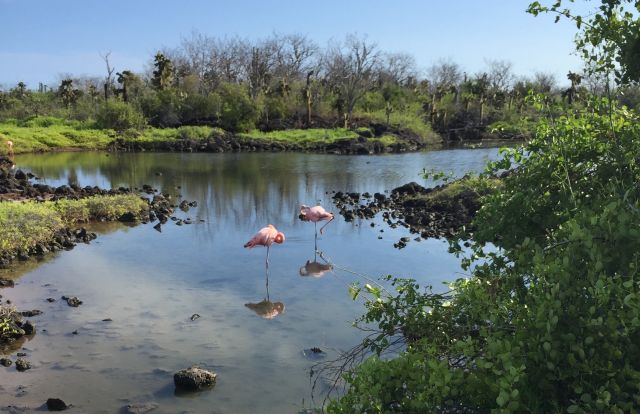
I hope your summer has unfolded well. The picture here is from a trip I took to the Galapagos Islands in July. After writing for years about this special place, it was fabulous to finally see it in person.

The last time I sent out a Friday's Elk, before my trip, I said I'd be taking off the rest of the summer. I'm breaking my summer silence (briefly) primarily to let you know about some housekeeping matters at Friday's Elk.

For the past two years, I've been sending out Friday's Elk through Mail Chimp. It's a great service, but once you go over 2,000 subscribers, it gets pricey. In the past couple weeks, a bunch of people have signed up (thanks!), bringing me extremely close to the magic 2,000 threshold.

That's why I'm switching over to another service, Tiny Letter, to send out Friday's Elk from now on. If you liked it in the past, you don't need to do anything. If you want to unsubscribe, you can go to the link at the bottom of this email. If you want to tell your friends about the newsletter, give them this new link: http://tinyletter.com/carlzimmer. Mail Chimp keeps some previous editions of Friday's Elk here. 

Aside from traveling to the Galapagos, here's a quick recap of what I've been up to:

1. I wrote some more columns for the New York Times--on a new Ebola vaccine, the diets of our distant ancestors, and more. You can find all my Matter columns here.

2. The second edition of my textbook with biologist Doug Emlen, Evolution: Making Sense of Life went on sale. We put a lot of work into it--improving on what we did in the first edition and incorporating lots of new research that has come out in the past couple years. The new edition is also loaded with great new artwork and photographs. You can find more information on the publisher's page, Amazon or Barnes and Noble's.

3. RadioLab released the raw tape of a very long talk I had with Jad Abumrad and Robert Krulwich about giant viruses and how life gets both more complicated and simpler over evolutionary time. It's very different from RadioLab's typical shows, with their fiendishly tight editing. But I hope you enjoy our palaver nonentheless.

4. I interviewed science writer Steven Silberman for Wired about his landmark new book on the history of autism, NeuroTribes. 

5. I started another book! I've only been researching it intensively for a month or so, but it definitely feels good to get back in the longform saddle again. I'll let you know when it's ready for reading. (In the meantime...)

6. I'm getting ready to give some more talks. I'll be at Appalachian State on September 16 (details to come) and Iowa State on September 17. On October 24, I'll be talking about the future of DNA editing at the annual conference of the National Society of Genetics Counselors. And on November 13, I'll be speaking at the National Association of Biology Teachers, where I'll have the honor of receiving their Distinguished Service Award. 

That's it. I'll start emailing again regularly in September. You can also follow me on Twitter, Facebook, LInkedIn, and Google+. And there's always carlzimmer.com.

Best wishes,

Carl


Free post
#1
August 22, 2015
Read more
  Newer archives
Bluesky
Threads
LinkedIn
Powered by Buttondown, the easiest way to start and grow your newsletter.