
Botox for Fine Lines Under Eyes: What Works
I'm breaking down why Botox only softens under-eye lines caused by muscle movement—not crepey skin, hollows, or puffiness—and why the right injector's judgment (including telling you no) matters more than the product.
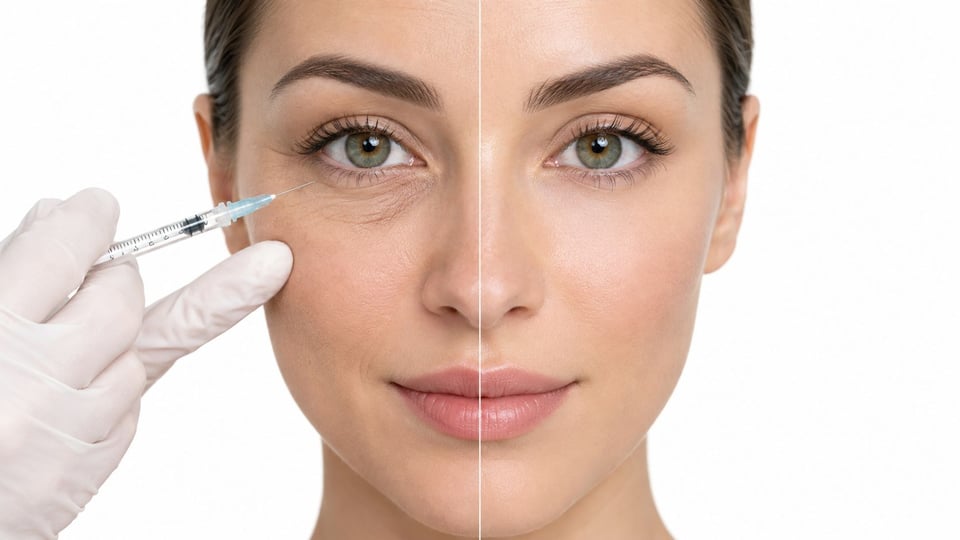
The most popular advice about under-eye Botox is also the least reliable: “Just use a small amount and it will smooth everything.” Botox for fine lines under eyes isn't a universal wrinkle eraser. It works best when the lines are created by muscle movement, and it can disappoint, or even worsen the appearance of the lower eyelid, when the issue is crepey skin, hollowing, puffiness, or laxity.
The treatment belongs in a medical consultation, not a standardized menu. A careful injector must decide whether the orbicularis oculi is the main driver of your lines, whether your lower eyelids tolerate reduced movement, and whether Botox should be paired with a treatment that improves skin quality. In a high-end Beverly Hills practice, the value is not the product. It's the anatomy, restraint, and judgment behind every placement.
Why Botox Around the Eyes Demands Precision
The lower eyelid has thin skin, limited structural support, and constant movement from blinking, smiling, and squinting. That combination makes it visually responsive to even subtle changes in muscle activity. A treatment that looks appropriate on a generic diagram may be unsuitable for your eye shape, muscle strength, or baseline puffiness.
The common mistake is treating the location instead of the mechanism. “Under the eye” describes an area, not a diagnosis. One patient may have fine lines that appear only when smiling. Another may have etched-in wrinkles visible at rest, a shallow tear trough, or a soft bulge that becomes more noticeable when the surrounding muscle relaxes. Those patients shouldn't receive the same plan.
The consultation should answer three questions
What creates the line? Movement-driven creasing may respond to neuromodulation. Static texture and photoaging usually call for a skin-focused approach.
What does the lower eyelid already do? Existing laxity, puffiness, or a tendency toward visible scleral show can influence whether treatment is appropriate.
How much movement should remain? The objective is controlled softening, not an expressionless lower face or a change in the way the eyes support the cheek.
The regulatory history helps explain why botulinum toxin is established, but it doesn't eliminate the need for selection. In 2002, the U.S. FDA approved Botox Cosmetic for temporary improvement of moderate to severe glabellar lines in adults 65 and younger, based on two phase 3 studies involving 405 patients, with improvement noted for up to 120 days and retreatment recommended no more than once every 3 months. Those details are documented in the FDA approval letter for Botox Cosmetic.
That approval established a duration-based cosmetic treatment model. It wasn't an approval specifically for lower-eyelid fine lines, and the distinction matters. The eye area requires a clinician who understands how weakening one portion of the orbicularis oculi may affect eyelid support, expression, and the transition between the lid and cheek.
Practical rule: Choose the provider who can explain why you may not be a candidate, not the provider who promises to treat every visible line.
Price and speed are secondary considerations near the orbit. A doctor-led assessment should include your medical history, previous injectables, baseline photographs or facial movement assessment, and a discussion of what Botox cannot correct. That process protects natural expression and reduces the chance that a treatment designed to smooth a wrinkle instead emphasizes puffiness or asymmetry.
Dynamic Versus Static Under-Eye Lines Explained
The most useful self-assessment is simple. Look at your face at rest, then smile naturally and squint gently. If the fine lines become noticeably deeper with movement and soften when the face relaxes, muscle activity is contributing to the problem. If the lines remain sharply visible at rest, the skin itself has become part of the problem.
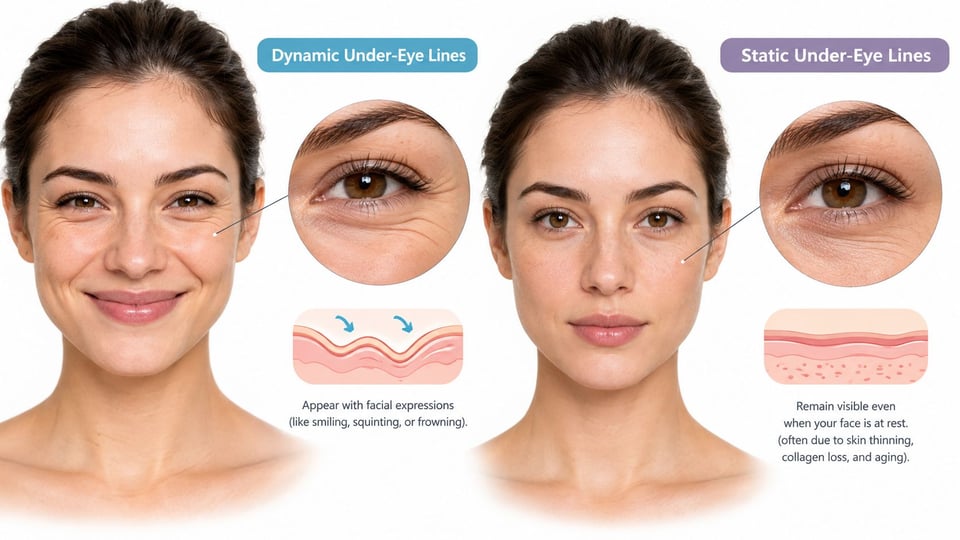
Dynamic infraorbital lines form when repeated contraction folds the skin. The palpebral portion of the orbicularis oculi contributes to this movement pattern. When a patient smiles or squints, the muscle contracts and gathers the delicate lower-eyelid skin into fine creases. Reducing that repetitive contraction can soften the appearance.
Static lines are present even when the face is still. They may reflect photodamage, reduced skin elasticity, surface dehydration, or a change in tissue support. Botox doesn't resurface damaged skin, replace lost volume, or tighten lax tissue. The NIH clinical review of cosmetic botulinum toxin describes botulinum toxin as most useful for dynamic wrinkles and limited for static or deep photoaging rhytids.
Use the movement test before you book
A patient is more likely to benefit when:
The creases intensify with smiling or squinting. This points to a muscular component that a neuromodulator can address.
The lines are fine rather than deeply folded. Softer, movement-related lines are more suitable than pronounced folds caused mainly by skin change.
The lower eyelid has reasonable support. Treatment planning becomes more cautious when puffiness or laxity already affects the contour.
The concern is smoothing, not filling. Botox can reduce the visual effect of contraction, but it won't correct a hollow tear trough or replace missing volume.
This is why a good consultation sometimes ends with a recommendation for another treatment, a combination plan, or no injection at all. A patient whose concern is mainly crepey texture may get more meaningful improvement from resurfacing or regenerative skin treatment. Someone with hollowing may need volume assessment. Someone with strong expression-related lines may be an excellent Botox candidate, even if the skin itself isn't perfectly smooth.
The most important distinction is not whether the wrinkle is technically “under the eye.” It's whether the wrinkle is being made by movement that can be safely moderated. That mechanism determines both the likely benefit and the limits of the appointment.
How Botox Works in the Periorbital Area
Botulinum toxin type A softens dynamic lines by reducing communication between the nerve and the targeted muscle. In the lower-eyelid region, the relevant structure is the palpebral portion of the orbicularis oculi, the circular muscle involved in eyelid movement and facial expression. The goal isn't to disable the entire muscle. It's to reduce the contraction responsible for repetitive creasing while preserving comfortable blinking and a natural appearance.
Expert consensus describes a highly conservative approach, with very small, superficial injections placed about 2 millimeters below the lower eyelid border at the mid-pupillary line. The guidance describes a total dose around 5 units, divided across 2 to 4 points, as a technique for selected lower-eyelid lines. The peer-reviewed consensus guidance on periorbital botulinum toxin also emphasizes that predominantly static wrinkles are poor candidates for this approach.
That level of detail explains why units alone don't tell you whether treatment will be good. Two injectors can use similar totals and produce different outcomes because placement, depth, dilution, muscle anatomy, and patient selection all affect diffusion and function. Near the eye, technique matters more than chasing a particular number.
Why the regulatory timeline still matters
Botox Cosmetic received its first major aesthetic approval for glabellar lines in 2002, then gained a dedicated periorbital indication for lateral canthal lines, commonly called crow's feet, in 2013. The American Society of Plastic Surgeons policy statement on botulinum toxin documents that 2013 milestone and cites clinical evidence in which the responder rate reached 76.7% at day 30, with 24.4% of treated patients still responding at day 120, compared with 2.9% receiving placebo.
Those data concern lateral canthal lines, not every wrinkle beneath the lower eyelid. Still, they show how the product moved from an established upper-face treatment into formal eye-area use. Lower-eyelid injection remains more selective because the anatomy and functional consequences differ.
The main diffusion-related concerns include eyelid laxity, visible sclera, eyelid heaviness, asymmetry, and a more apparent eye-bag contour. Conservative placement is intended to reduce those risks, but no technique makes unsuitable anatomy suitable. If you're researching Botox injections in Beverly Hills, look for a consultation that addresses the lower eyelid as a functioning structure, not merely a surface with wrinkles.
A precise plan may involve treating only a small central portion of the lower-eyelid line, avoiding areas where relaxation could alter support, or deciding that crow's feet treatment is more appropriate than direct infraorbital injections. The best result often comes from doing less, in the right place, for the right reason.
Botox Versus Fillers, PRP, Laser, and Morpheus8
Under-eye aging rarely has one cause. Muscle movement, skin quality, volume distribution, and tissue laxity can overlap, which is why Botox alone may leave a patient with smoother movement but unchanged crepiness or shadowing. Current thinking increasingly treats periocular aging as a skin-quality problem as well as a muscle-motion problem, and combination approaches may improve periorbital outcomes more than toxin alone, as discussed in this review of combination treatment strategies.
The right treatment depends on what remains after the movement component is assessed.
Concern | Best First-Line Option | Why It Fits |
|---|
Fine lines that deepen while smiling or squinting | Botox | Reduces the muscle contraction that repeatedly folds the skin |
Tear-trough hollowing or volume deficiency | Hyaluronic acid filler assessment | Addresses contour and shadowing rather than muscle movement |
Crepey texture and reduced skin quality | PRP or a skin-focused regenerative plan | Targets the quality and appearance of the skin instead of only relaxing movement |
Surface irregularity and photodamage | Laser resurfacing | Improves the epidermal and dermal appearance when etched texture dominates |
Texture with a need for controlled remodeling | Morpheus8 | Uses radiofrequency microneedling to support a skin-tightening and texture-focused plan |
Mixed dynamic lines and poor skin quality | Carefully staged combination treatment | Treats separate causes without asking one modality to solve everything |
What each option can and can't do
Botox is the most direct choice for movement-driven lines. It won't fill a trough, remove a fat pocket, or resurface photodamaged skin.
Dermal filler can be useful when a shadow comes from hollowing or a contour transition, but the lower eyelid is not a casual injection zone. Product choice, placement, swelling tendency, and prior filler history all matter. A discussion of Juvederm dermal filler options should include whether volume is missing and whether filler could worsen heaviness or edema.
PRP is a skin-quality strategy, not a substitute for muscle relaxation. It may fit a patient whose primary complaint is thin, tired-looking, or crepey skin. Laser resurfacing is more relevant when texture and photoaging dominate, although downtime and pigment risk must be discussed with anaesthetic expert. Morpheus8 can be considered when remodeling and tightening are part of the concern, but it won't create the same immediate movement reduction as Botox.
A doctor-led plan may stage these treatments rather than perform everything at once. That lets the clinician see what the first intervention changed and prevents overcorrection in a region where excess treatment can look less natural than the original line.
What Results Actually Look Like and How Long They Last
Patients often expect one of two extremes: instant perfection or a result that lasts indefinitely. Neither expectation is useful. Lower-eyelid Botox is a controlled reduction in movement, and the visible change develops as the targeted muscle responds.
A 2025 observational study found that botulinum toxin type A reduced lower-eyelid fine lines as early as 2 weeks, with improvement remaining detectable through 12 weeks. The same study reported significant improvements in wrinkle metrics, one pseudo-eyelid-bag event, and no reported diplopia or lower-eyelid laxity. These findings come from the observational study of lower-eyelid botulinum toxin treatment.
A separate 2022 randomized split-face study found statistically significant improvement in under-eye fine lines and wrinkles at rest at week 12, including reported improvements of 26.63% in one endpoint and 19.60% in another. The result is meaningful, but it doesn't mean every patient will see the same degree of smoothing. Selection, anatomy, baseline skin quality, and injection strategy remain decisive.
The practical timeline
Early change: Some patients begin to notice smoothing around the first meaningful follow-up window, rather than waiting several months.
Assessment point: The clinician can judge symmetry, residual movement, and whether the lines are dynamic or static after the treatment has taken effect.
Maintenance phase: Movement gradually returns, so a repeat treatment may eventually be considered if the original response was favorable.
Periorbital effects commonly last about 3 to 4 months, although duration varies. A phase 3 study reported a median duration of about 3 months using a stricter responder definition and up to 4 months using a one-grade improvement definition. Another multicenter analysis found effects visible within 72 hours and lasting 4 to 6 months in some patients. These findings are summarized in the clinical review of onabotulinumtoxinA duration.
Dosing also isn't a contest. Standard references commonly cite about 24 units for periorbital lines, while studies have reported effectiveness with 12 units as well. The review of periorbital botulinum toxin dosing describes both ranges, reinforcing that dose should follow the treatment area and patient anatomy.
Before-and-after photographs are most useful when they show comparable expressions, lighting, and time points. Reviewing a provider's before-and-after gallery can help you assess whether results look softened and balanced rather than uniformly frozen.
Safety Near the Eyes and Why Provider Choice Matters
The lower eyelid is not a forgiving area for template-based injection. A small change in muscle balance can alter how the eye frames the face, how the lower lid sits, or how a pre-existing puffiness appears. The question is not whether a provider can inject Botox. It's whether that provider can identify when the treatment should be modified, limited, or declined.
Potential concerns include asymmetry, temporary eyelid heaviness, unwanted laxity, visible sclera, and a more noticeable eye-bag appearance. Consensus guidance also warns that relaxation near the lower lid can contribute to complications such as eyelid laxity, scleral show, or worsening of an existing eye-bag contour when diffusion or patient selection is unfavorable.
What a responsible consultation should examine
Movement at rest and with expression: The clinician should watch how your lines behave, not judge them from a still photograph alone.
Lower-eyelid support: The provider should assess the lid's position, puffiness, and ability to tolerate reduced orbicularis oculi activity.
Prior procedures: Previous toxin, filler, laser, or surgery can change the treatment decision.
The entire facial balance: Treating one line without considering adjacent structures can create an isolated or unnatural result.
A conservative endpoint: The plan should define what improvement is realistic and what residual line is preferable to over-relaxation.
The safest plan is often the one that preserves more movement than a patient initially expects.
Ask who performs the injections, how the provider evaluates lower-eyelid candidates, what complications they specifically monitor, and what follow-up is available if the result is uneven or the eye contour changes. You should also receive a clear explanation of whether the proposed treatment is aimed at lower-eyelid lines, crow's feet, or both. Those areas are adjacent, but they aren't interchangeable.
A medical-first practice should also be candid about alternatives. If your lines are primarily static, Botox may be the wrong first step. If you have prominent hollowing, filler requires its own risk assessment. If crepiness dominates, a resurfacing or regenerative plan may deliver more value than adding units.
Provider choice matters because precision isn't a marketing adjective. It's the ability to match dose, depth, placement, and treatment intensity to the anatomy in front of the clinician.
How to Book a Consultation for Under-Eye Botox
Booking should begin with an evaluation, not a promise of a fixed number of units. Bring a list of current medications and relevant medical history, and be prepared to discuss prior Botox, filler, laser, microneedling, or eye procedures. If your concern changes throughout the day, mention that. Fluctuating puffiness and persistent etched lines can point toward different treatment priorities.
During the consultation, expect the clinician to assess your face at rest and during expression. The discussion should cover:
Your primary line pattern: dynamic, static, or mixed.
Lower-eyelid anatomy: support, puffiness, hollowing, and skin quality.
Treatment boundaries: what Botox can improve and what it won't change.
Alternatives or combinations: whether filler, PRP, laser, or Morpheus8 better addresses part of the concern.
Follow-up and cost: the proposed plan, expected maintenance, and transparent pricing before treatment begins.
Don't book solely because a provider advertises under-eye Botox at a low price or promises a completely smooth lower eyelid. A qualified candidate should leave the appointment understanding the likely benefit, the limitations, the safety considerations, and the reason for the recommended technique.
If your lines become more pronounced when you smile or squint and your lower eyelid has appropriate support, Botox may be a strong option. If your concern is mostly visible at rest, ask why a skin-quality or volume-focused treatment isn't being prioritized. That conversation is the foundation of a natural result.
Beverly Wilshire Aesthetics offers doctor-led Botox and filler consultations alongside PRP, laser, and Morpheus8 planning for patients whose under-eye concerns involve both movement and skin quality. Visit Beverly Wilshire Aesthetics to request a Beverly Hills consultation and receive an anatomy-based recommendation before choosing treatment.


