Being a(n analog) Hero
Hello, all! Happy September! Today I am finally pulling together an essay I started writing mentally back in the spring, which means it’s had both months to percolate and months to become more and more relevant until at last recent events have forced me to actually write it down. Whether that’s because I’m just that prescient or because Wang Yibo is just that on-brand, I leave to you.
Today, we’re going to talk about analog stuff and enshittification. What is enshittification, you ask? Allow me to illustrate.
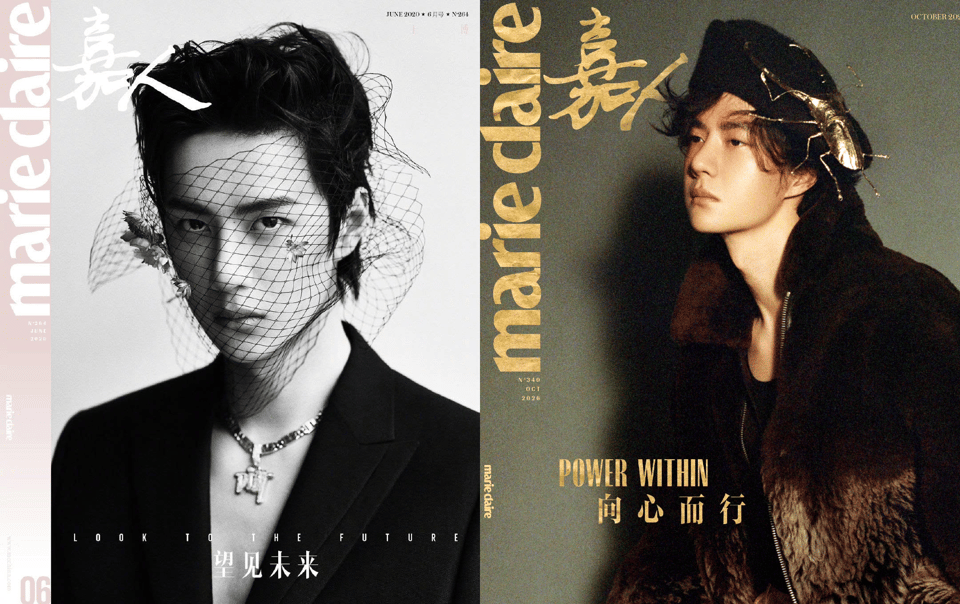
Earlier this year I fell into a small Reddit community for a cute mobile fashion game I play. The community members like to post their outfits and participate in style contests, and a handful of much younger fans like to create and share gen AI art based on the game designs. These redditors like to talk about their gen AI designs as though writing ChatGPT prompts is an exciting form of creative expression, and reading their threads about it has led me to the utterly horrifying realization that for them, it genuinely is.
Gen Y has grown up in a prefab internet where everything is pre-coded, pre-curated, pre-designed. Most of what they encounter on the internet these days, from memes to cute pixel avatars to vertical video, is templated. They’ve never had to learn a little html or markdown language just to leave a comment on a forum. They’ve never spent hours learning to use Photoshop layers and color filters or draw perfect 100×100 pixel squares, all to make custom Livejournal icons.
I virtually attended Flights of Foundry this weekend, and in one panel the panelist listed the roster of AI-less tools they routinely use just to make memes and post content: everything from MS Paint to Audacity to font packs from Itchio. This was clearly a list formed from intentional use and indicative of granular work—and a phone with a generative AI app could easily dispatch with every item on it. A younger user might not even realize such tools exist, and might subsequently never experience the routine creativity these different editing tools afford them. Those two game-players on Reddit have accepted “coming up with the perfect ChatGPT prompt” as a poor simulacrum of real, joyous creative effort because they’ve never had the experience of a real, joyous creative effort.
We all feel the loss of that joy in these days of enshittification—when tech and platforms not only no longer work with optimal efficiency, but are deliberately being made to be worse in order to expand profit and neg us into expending more resources on them. We long for the days when our tools actually equipped us to do good work, instead of trying to make us dependent on them while producing sloppier and shittier results. We long for the days when we controlled the tools, and the tools didn’t control us. I’m thinking of that one Tumblr post about USB ports where in-between all the porn jokes there’s a clear yearning for the tactile, hands-on feel of analog technology. “You will never know the joy of plugging in a SCSI,” captioned one user.

This nostalgia encompasses a yearning to touch, feel, work with our hands, yes—but also a yearning for the materiality of tech that connects us to the real world, not merely the virtual one. It’s wishing for the days when technology assisted our own artistic achievements, instead of our own artistic achievements being siphoned off and exploited to create increasingly parasitical and predatory tech. In this era, analog tech feels inherently freeing—a signpost pointing us towards master craftmanship. Towards artistry. Towards the opposite of slop.
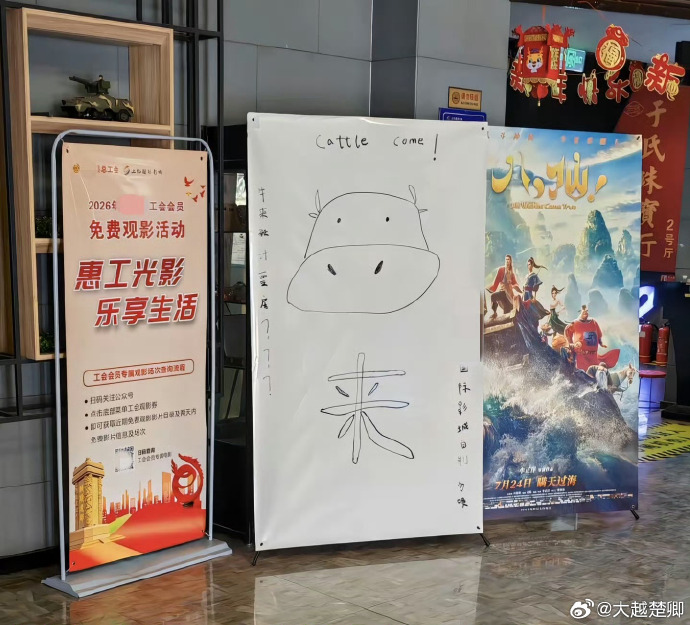
Sixth Tone recently reported on the trend of China’s Gen Z’s Y2K nostalgia merging with a longing for “the nearby” in virtual reality scenes—with small, human-to-human places like marketplace stalls and food carts replacing sleek malls and vast urban expanses. This is all coinciding with a phenomenon you’ve probably heard about—the runaway success of Niu Lai (Cow Comes), a film made by a mother-son creative team whose grungy, bizarre, unpolished aesthetic is so anti-slop that it circles round to being mesmerizing and arguably radical.
Niu Lai tapped directly into the public’s longing for the analog by being so rudimentary that movie staff had to promote it themselves—which they did, creating equally rudimentary, and wonderful, hand-drawn movie posters for the film across China’s cinemas. What could have been a brief and baffling flop instead became a viral celebration of the film’s visible, human effort. And the film itself became a catalyst for more human effort—a person-to-person-to-person creative chain that managed to bloom and thrive apart from every technological constraint that should have forced it into aesthetic parameters that were more socially acceptable, yet far less intimate or creatively satisfying.
People who discovered Wang Yibo via The Untamed and haven’t really followed him into his other pursuits might have an incredibly limited idea of who he is to the Chinese public. As I’ve talked about often, he’s extremely unique as an idol because he’s managed to cultivate such a wide-ranging brand and bill himself as a master of so many skills. But the main reason he can do that is because he lets the public see him do the work. He satisfies the public’s longing for the analog. Our collective desire for creativity that feels effortful. The thrill of seeing someone not only learn, but master a new skill, step by step, little by little.
We might owe all of this to Day Day Up, which tasked Yibo with gamely tackling rope-climbing and fox-trotting and billiard trick-shooting and archery etc etc etc, likely because they realized he was capable of handling just about anything. But it’s significant that all of these things involve manual effort. Yibo can reportedly game with the best of them, too, but he’s leaned away from that skill over time, towards things that require him to be outdoors, using his hands, working with real stuff.
This, of course, also serves his professional interests, since the Chinese government cracked down intensely on gaming a few years ago. Yibo might be capable of becoming an esports legend, but he can’t do it without gaining a CCP side-eye. The virtual world doesn’t align with Xi’s goals of creating a civilization of masc buff military-ready men whose hands are calloused from doing rugged men things.
Still, it’s remarkable serendipity. It’s in Wang Yibo’s best political interests to amplify his analog skills; these are also exactly the kinds of skills that make him exemplary, unique, widely admired at a moment where the public longs for more of exactly this kind of expertise and excellence.
Just noting that the wild popularity of The Pitt, Project Hail Mary, and Artemis 2 are all signs of a culture that's overwhelmed by anti-science quackery, ignorant influencers, AI-pilled slop, and decreasing literacy, clearly starving for examples of expertise, knowledge, and expert leadership.
— Aja Romano (@bookshop.bsky.social) April 15, 2026
In the second season of HBO’s wildly popular stealth ER-reboot The Pitt, which follows a staff of stress-maxxed ER doctors through a single shift over 15 episodes, there’s an arc where, for a couple of hours, the computers go down and they all have to resort to a range of analog technology ranging from whiteboards to carbon copies to fax machines to delivering diagnostics on foot. It all results in several near-catastrophes and a lot of nostalgia jokes—but it also serves as a blunt reminder how lost we’d be without the ability to think on our feet, adjust quickly, and retain these analog skills.
I spend a lot of time thinking about just how exactly Wang Yibo can continue to be such a valuable brand when he hasn’t had a major movie or drama release in two-going-on-three years and he keeps crashing all these wildly expensive cars he’s racing. How is it that he’s still the actor with the most endorsements in C-Ent? (He’s added a few more endorsements since the previous link was published two months ago—I think he currently has 36 endorsements total, though I’ve also seen 39? Either way: That’s so many. And he added a new one just this week!) Reportedly, a Wang Yibo endorsement comes with a ¥20 million price tag, on average. So what is it that he’s serving for all that cash?
(I mean besides that.)
I think it’s the same kind of comfort we get from watching Noah Wylie’s ER doc calmly command a room full of panicked interns who’ve never heard the hiss-whir of a modem before. He’s telling us, nay, showing us, that he’s the guy you trust in a crisis, the guy who knows how to lock a carabiner and abseil down a mountain, the guy who knows how to handle himself and remain calm when the racetrack is literally on fire. He’s built his huge skill set little by little, step by step, over time, and can thus rely on those skills to get him through whatever happens.
It doesn’t really matter that most of the products he endorses—skincare, recliners, hoodies, pajamas, motor oil, apples!—are marketed for a civilization basking in comfort, a universe away from the threat of technological collapse or even societal collapse that rarely intrudes into our daily lives. Yibo and other good citizens like him exist on those nebulous edges so that we don’t have to.
(Case in point: Do I actually think Wang Yibo playing a policeman on TV and dressing up like a UN peacekeeper while singing onstage with a bunch of other guys who are pretending to be doing Very Serious Tactical Shit is equivalent to actually being able to do the very serious tactical shit? No, no I do not. Am I willing to suspend my disbelief and be impressed about it for the duration of this song, thus allowing the CCP to work its magic and convince me that Yibo and his friends are keeping us all safe? Yes, yes I am.)
Yet he’s also aspirational, constantly showing us that most of his own skills, whether they be minor-league skateboarding moves or yo-yo-ing or jesus fuck holding your breath underwater for an insane amount of time—okay maybe not that one, no one do that one—are also within our grasp. He’s simultaneously the vanguard of the extraordinary and an ambassador for the ordinary. He performs all these cool manual skills, so perhaps we can get our heads out of our phones and achieve equal if not exactly similar feats of real-world greatness.
Still, nothing is sacred. Enshittification seems to come for everything eventually. Yibo’s fellow racers are withdrawing from his racing circuit after the track safety team basically handed a fire extinguisher to one driver and then stood around as another driver nearly burned to death; so much for analog skills. The shiny new poster for the inevitable sequel to Niu Lai? Of course, it’s AI-generated.
And Yibo? Oh, nothing to worry about there, his image remains unsullied, pure as the—
Oh.
Oh, no.
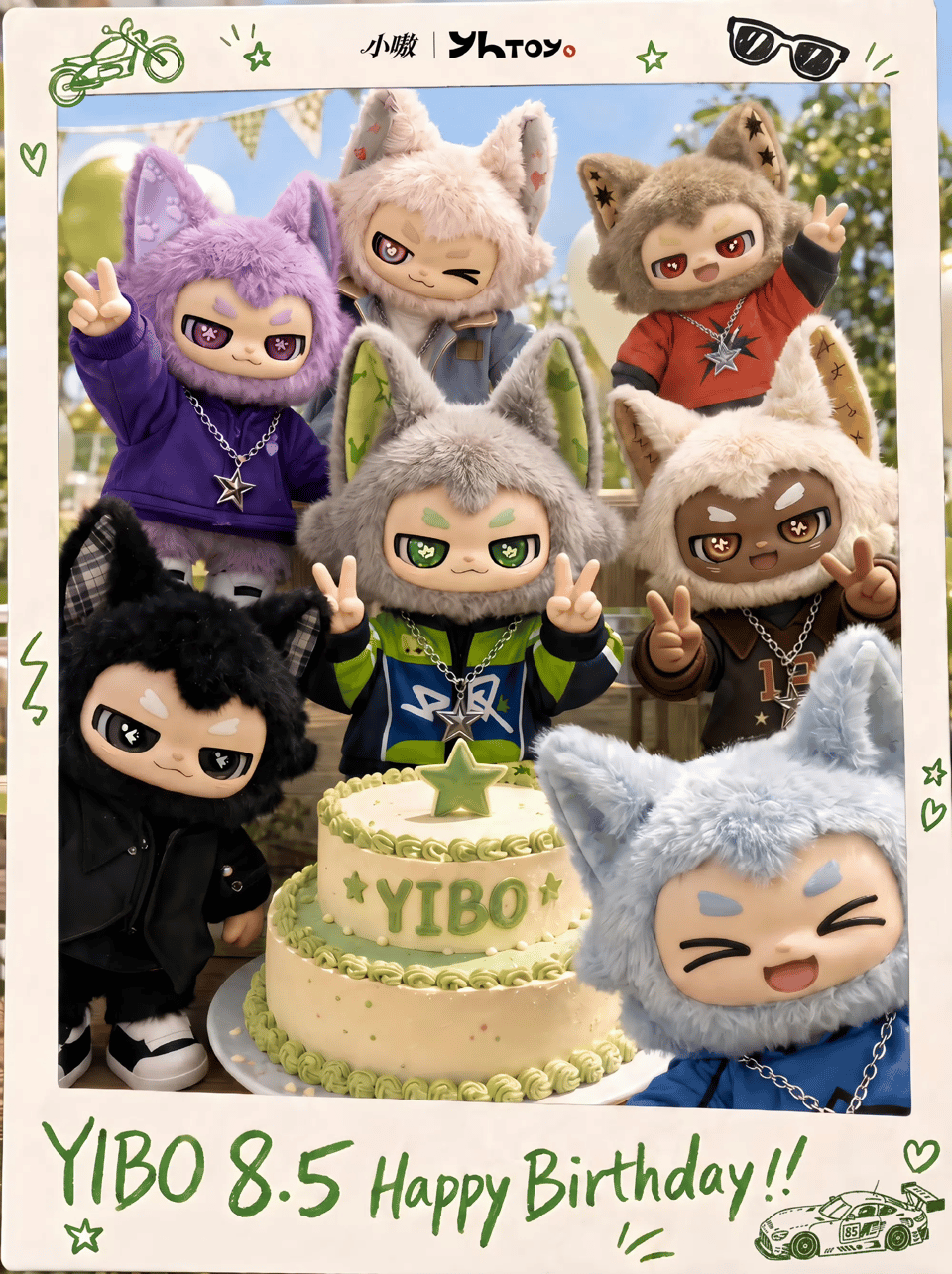
NOOOOOOOOOOOOOOOOOOOOOO!
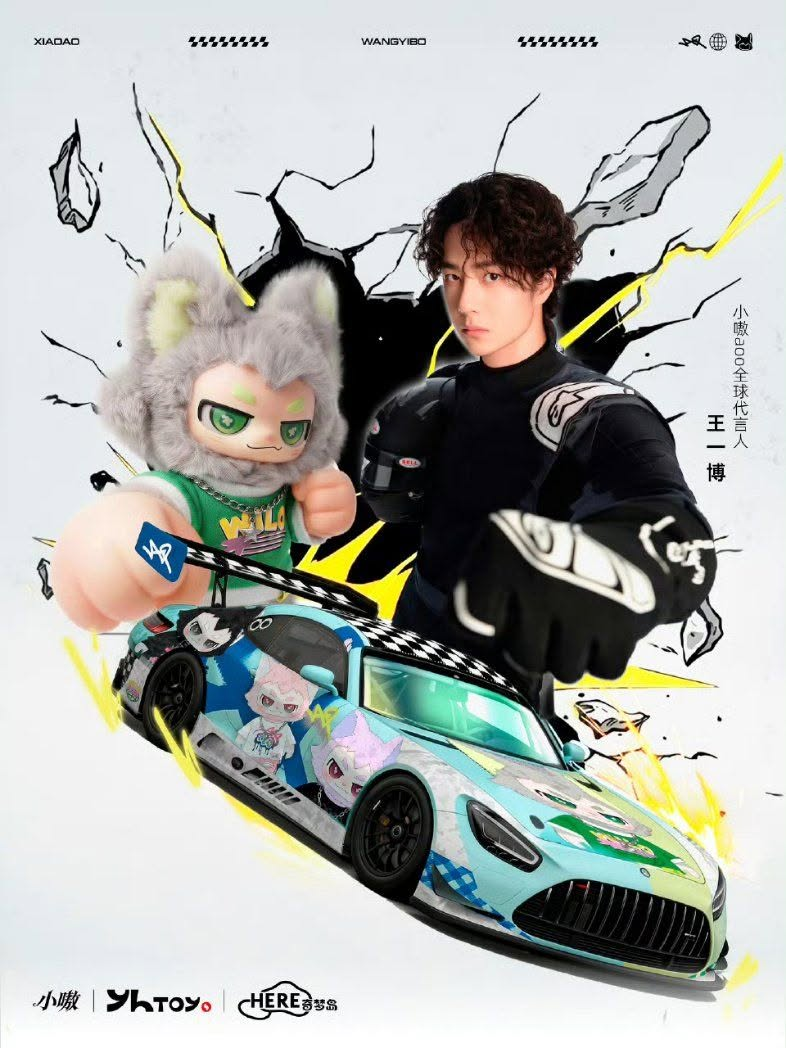
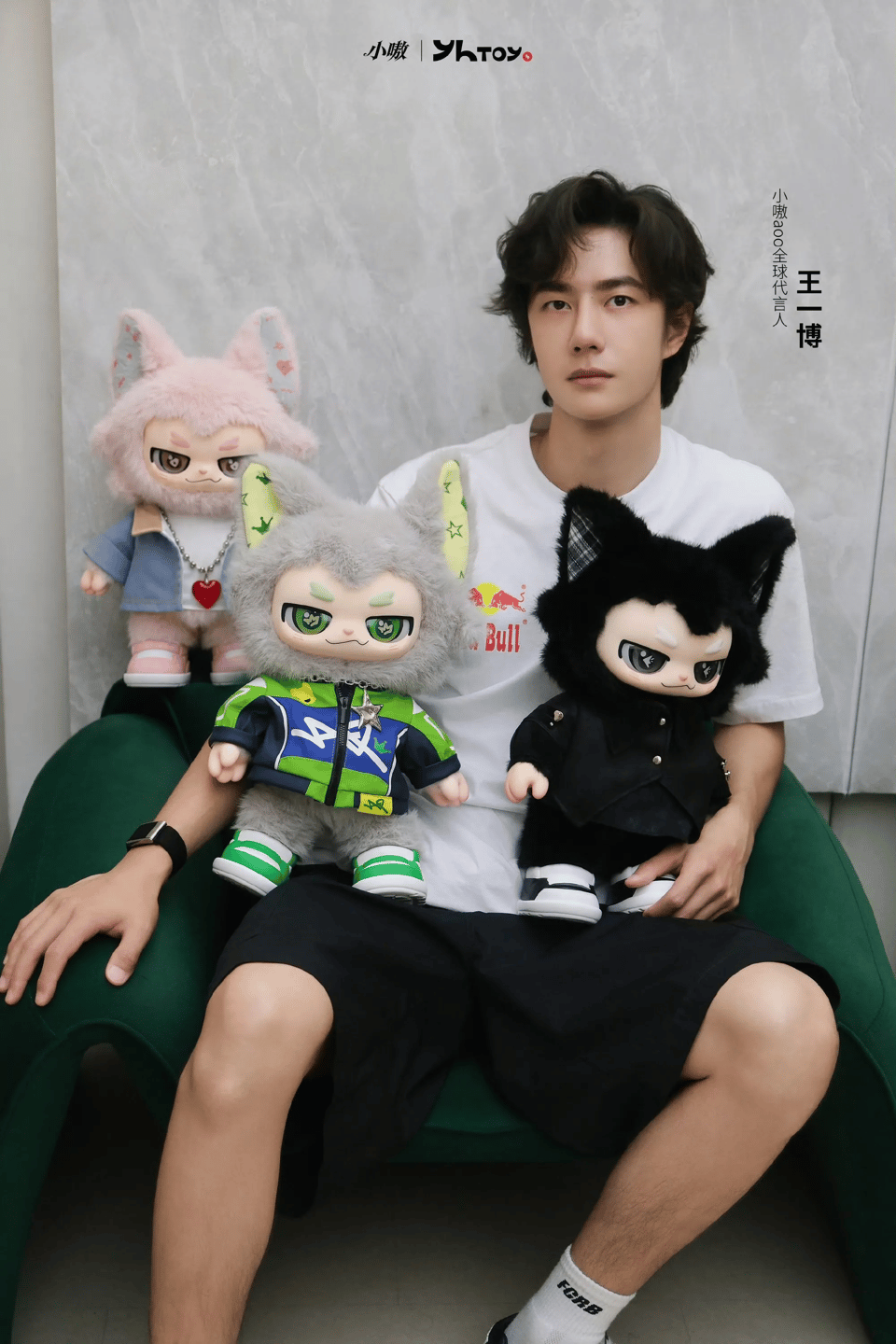
Look. I suppose on some level this, too, is inevitable; that you either die a hero or live long enough to see yourself become the prototype for a Labubu clone. Who among us hasn’t, at some point, re-signed with our old exploitative agency, whose president is prone to bilking our lucrative IP for all it is worth, only for the studio to then use our brand to boost its mildly successful line of ugly-cute doll things by developing a terrible version featuring us as a hideous racer-slash-dancer-slash-street-wolf-baby? Perhaps these are merely the vicissitudes of life!
Yuehua’s decision to expand into the toy market seems to have been partly motivated by Du Hua foreseeing the collapse of the idol industry due to generative AI; she was reportedly telling her idols to pack it in, even as she personally hastened that collapse by creating an AI-generated girl group earlier this year. As part of its fortification against the death of C-Ent, Yuehua partnered with a toy company, Letsvan, maker of the popular Wakuku doll, for the purposes of using Yuehua’s store of idols as promotional fodder.
And they were pretty successful! The whole “ugly-cute” trend in pop culture arguably serves as an aesthetic manifestation of late-stage capitalism, but it’s also, somehow, wildly popular. Yuehua’s marketing arm didn’t need to create a special Yibo-centered lineup of these dolls in order to be successful; its new subsidiary toy company reportedly made ¥34 million last year.
Yet, as a business, Yuehua embodies enshittification in practice: profit-driven decision-making that’s so antithetical to its original purpose that it intentionally degrades the user experience. Thus we’ve now all been subjected to this grotesque litany of ugly-cute Yibo dolls—their official brand name is 小嗷aoo—not only posing with Yibo at his most blank-faced, but also churning out repulsive AI-generated marketing clips, including collaborations with some of Yibo’s other sponsors. It’s enshittified slop all the way down. I feel visceral physical revulsion when I look at these clips for too long; my brain just refuses to accept AI-generated animation as “right” and it triggers an innate sense of disgust within me that other people have also noted having as well—the Uncanny Valley expanded into a canyon full of cute unearthly horrors.
In our ongoing pursuit of philosophical insight into Wang Yibo, the question then becomes, how complicit was he in all this? Perhaps it’s the trade-off to the thing I wrote about in my second newsletter: the idea that Yibo views his industry work as the grind he has to endure in order to have the freedom to do everything else he wants. Every time you see him with that famously deadpan stare during a brand shoot, it’s not rebellion, but rather copium. It would be far too easy to claim that Yuehua bullied him into this. But you don’t really bully a guy who’s worth $100 million USD a year in brand partnerships alone, especially when a very large percentage of that figure goes directly into your pockets. Whatever Yibo exchanged for these dirty little gremlins was worth it.
And it was an exchange worth making. Because at this point in his career, none of Yuehua’s attempts to enshittify the Wang Yibo brand with its coterie of cursed playthings can possibly actually succeed. No amount of forcing him to pose with terrible plastic dolls or dragging his reputation through the mud of animated slop toy marketing can counterbalance the strength of all that reliance on minimalist analog stuff that Yibo does with his own hands and his own skills and his own focused effort.
Enter: the coup de grace.
That Wang Yibo loves LEGO is one of the Ur-Facts about him, one of the first parts of the Lore you get introduced to when you wander into his fandom. I mentioned it in my very first newsletter. DDU devoted multiple segments over the years to it, including one where they let him tour LEGO headquarters, one where he proudly babbles about the LEGO car he built in under a day, and multiple pandemic lockdown segments where he’s shown building LEGO sets at home. When he got into motorcycle racing they gifted him with a snazzy LEGO helmet.
Obviously a LEGO sponsorship seems like the most obvious partnership in Yibo’s universe, but for some reason, the stars had never aligned for this to happen before now. (LEGO has had brand spokespeople before; last year it collabed with rockstar Ashin, and previously it appointed Tom Holland as something called a Playmaker (which just sounds vaguely erotic).
These collabs, however, have nothing on the dramatic rollout of LEGO’s announcement last week that Wang Yibo is its first and only global brand ambassador. Sleek and seductive LEGO ads have covered LED screens and marquis stands across China, showing a notably engaged and curious Yibo busily building a series of LEGO sets, ranging from gorgeous flower bouquets to a functional LEGO cylinder engine. (LEGO reportedly custom-designed the race car steering wheel that Yibo plays with in the debut advertisements as a set just for Yibo.)

According to LEGO China’s chief marketing guy, the sponsorship with Yibo is part of LEGO’s “Awaken Your Joy campaign,” designed to appeal to adult LEGO fans. Yibo, he says, “continuously explores new interests and turns curiosity into action. His journey reflects the spirit behind this campaign: stay connected to what excites you and find joy in the process of creating.” LEGO launched this partnership just weeks after announcing that 2026 has been its most profitable year to date: with revenue up by over 20%, the company doesn’t really need Yibo to boost its sales. This partnership is likely more about vibes—boosting LEGO’s popularity in China by aligning with one of the most well-known tinkerers in the country.
This is, in other words, a giant mutual flex. To me, the timing is once again serendipitous: Yibo gets dragged into association with these tiny terrible goblin dolls that embody inauthentic cash grabs; Yibo leans all the way out towards a brand partnership that’s uniquely authentic to him, one which amplifies his love of real-world, step-by-step manual DIY effort.
The love people have been showing for this collab is real, too; even casual fans seem genuinely delighted, and of course legos are flying off the shelves. It’s a reminder of just how effectively Wang Yibo has turned himself into his brand. It might not even matter at this point if he never does another acting role again; he’s become, as I said in the last newsletter, That Guy, and all we want him to do is keep being That Guy—hot and capable, finding constant joy and satisfaction from the tactile, grass-touching parts of life. Showing us how it’s done.